The Squeamishness of Scholarship: Cameron Bailey’s Critique of Sam van Schaik’s book on Buddhist Magic


Sam van Schaik’s Buddhist Magic: Divination, Healing, and Enchantment through the Ages (2020) attends to the often-overlooked domain of spells, incantations, divination, healing rituals, and what one might call “magic” in Buddhist traditions. The book offers, among other things, a translation of a Tibetan spell-book from the Dunhuang corpus and situates it in a broad historical trajectory of Buddhist ritual technologies. Yet in his 2021 review for H-Net, Cameron Bailey argues that the book suffers from significant omissions, conceptual limitations, and a subtle apologetic tone toward the more aggressive, violent, and transgressive forms of magic found in tantric Buddhism.¹ Bailey suggests that this tone is not simply stylistic but stems from deeper disciplinary biases about what “real” Buddhism is and what kinds of ritual power are acceptable to the scholarly gaze.

For readers of Tantric Deception, which is concerned with hidden ritual power, subversive techniques, and coercive practices in the “shadow” side of tantra, Bailey’s critique is especially pertinent. The benign, therapeutic, protective aspects of magic are only half the story; the aggressive, destructive, boundary-breaking elements are equally constitutive. Here the critique unfolds on three levels: (1) Bailey’s reading of Chapter 3 of van Schaik’s book (on the Ba ri be’u ’bum); (2) his broader objections to how van Schaik defines “magic” and frames the field; and (3) implications for the study of tantric magic and deception.

Bailey’s Critique of Chapter 3: “A Tibetan Book of Spells”

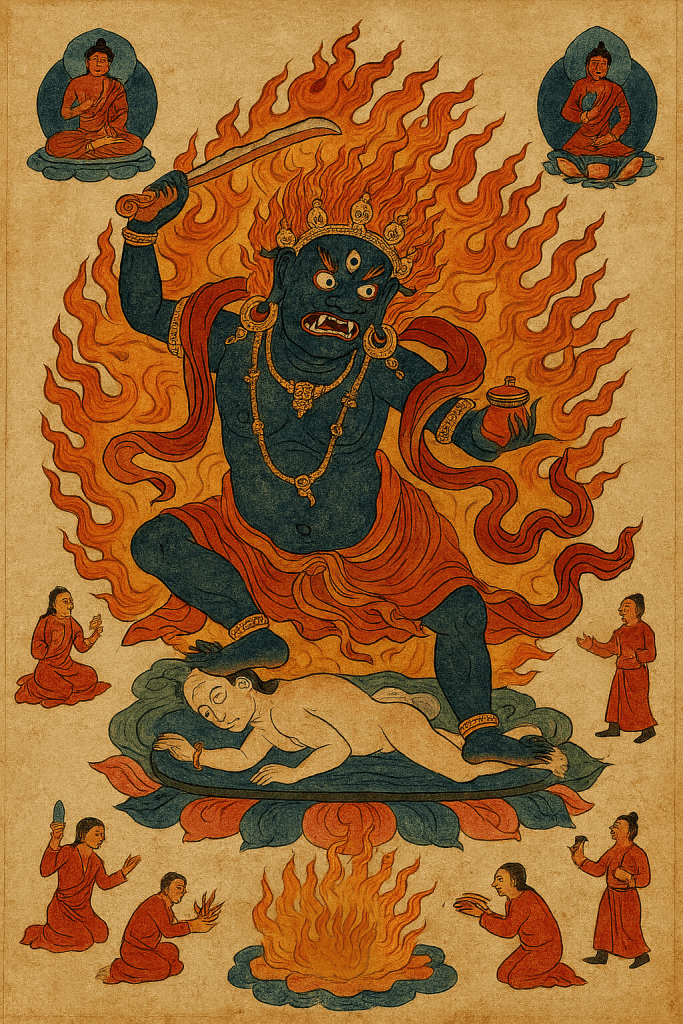
Bailey looks at Chapter 3, which discusses the Tibetan spell-book known as the Ba ri be’u ’bum, compiled by Ba ri Lotsāwa in the eleventh century.² Van Schaik concludes the chapter by pointing to the presence of violent magical ritual, what might be called “black magic,” in Buddhist spell-books and tantric scriptures such as the Vajrabhairava Tantra

Bailey’s critique is threefold:

  1. Understatement of prevalence. Van Schaik, he argues, seriously understates how widespread aggressive or destructive ritual practices are in tantric sources: “He could also have discussed the army-repelling magic in the Hevajra Tantra, the legendary violent magical exploits of the great tantric sorcerer Rwa Lotsāwa, or Nyingma Mahayoga scriptures, which are often positively brimming with black magic.”⁴
  2. Authorial discomfort. Bailey detects an obvious unease with “aggressive” magic and with rituals that use human remains as ingredients, suggesting van Schaik takes an apologetic tone when discussing them.⁵
  3. Scholarly bias. He links this tone to the longstanding tendency of Buddhist studies to privilege an idealized, pacifist Buddhism: “This kind of squeamishness … unconsciously replicates the biases of past generations of Buddhist scholars …. It is ultimately an artifact of Western observers thinking they know more about what should constitute normative Buddhism than their sources do …”⁶

For Bailey, this is not simply an omission but a rhetorical framing that soft-pedals the destructive dimensions of tantric magic.

Defining “Magic”: Bailey’s Broader Critique

Bailey extends his criticism to van Schaik’s opening chapters, where the author defines his working category of “Buddhist magic.” Van Schaik adopts a “family-resemblance” approach, noting that no direct equivalent of the Western word magic exists in Sanskrit or Tibetan.⁷ He describes magical practices as “focused on worldly ends, including healing, protection, divination, manipulation of emotions, and sometimes killing. The effects of these techniques are either immediate or come into effect in a defined, short-term period. The techniques themselves are usually brief, with clear instructions that do not need much interpretation, and are gathered together in books of spells.”⁸

Bailey objects that this framing:

  • Over-narrows the field by confining magic to short-term, worldly ends, thereby excluding tantric practices that are long, soteriological, and embedded in complex ritual technologies.⁹
  • Privileges text and literacy, focusing on manuals and specialists while sidelining oral, embodied, and popular forms of practice.¹⁰
  • Sanitizes the topic by foregrounding healing and protection while downplaying cursing, corpse-magic, and enemy destruction.¹¹

He concludes: “The way he defines and explains ‘magic,’ and describes how magical practices have traditionally been used by Buddhists across Asia, ends up inadvertently reinforcing many of the historical scholarly prejudices against magic that he ostensibly is trying to correct.”¹²

Van Schaik’s framework thus risks reproducing the very boundaries it seeks to challenge.

A Wider Blind Spot: Aggressive Magic and the Tantric World

Bailey argues that van Schaik should have engaged more fully with texts such as the Hevajra Tantra (with its army-repelling spells), the violent exploits of Rwa Lotsāwa, and the Nyingma Mahayoga scriptures filled with wrathful deities, corpse-magic, and enemy-destruction rites.¹³ By not doing so, or by treating such material as peripheral, van Schaik, he claims, sanitizes Tibetan Buddhism. “Van Schaik displays an obvious discomfort with the presence of ‘aggressive’ magic … and takes an apologetic tone when discussing them.”¹⁴

For scholars of tantra, this omission matters because tantric systems operate through extremes such as creation and annihilation, compassion and wrath, life-force and death. To highlight only healing and protection produces a partial picture of ritual power, one aligned with modern therapeutic Buddhism but detached from the coercive, political, and martial realities of historical tantric practice.

Bailey notes that while van Schaik does acknowledge violent spells (for example, in the Dunhuang materials), he does not trace how these recur and become canonical in later tantric systems.¹⁵ The result is a book that opens the field but keeps its most provocative elements at the margins.

Implications for the Study of Tantric Magic and Deception

Bailey’s critique has clear implications for the study of tantric ritual power:

  • Broaden the definition of magic. Magic in Buddhist contexts is not confined to short spells. It includes deity-yoga, state-sponsored rituals, corpse-assemblage, body technologies, and institutions of ritual power.
  • Recognize multiple aims. Magic serves soteriological as well as worldly purposes such awakening, subjugation, and mediation between spirits and humans.
  • Acknowledge popular practice. Lay and non-monastic forms of magic interpenetrate elite traditions. Focusing solely on literate specialists truncates the field.¹⁶

Examining the Aggressive and Transgressive

To understand tantric magic fully, scholarship must confront its aggressive, destructive, and taboo aspects such as spells to kill or incapacitate, invocations of wrathful deities, rituals using human remains, and forms of mystical violence justified through tantric cosmology. When these are treated as aberrations, the study of tantric sovereignty, ethics, and power becomes impoverished.

Deception, Hidden Power, and Normativity

Bailey’s review also raises a methodological issue: the scholar’s discomfort can itself become a form of concealment. Reluctance to confront violent or transgressive material filters what is studied and what remains hidden. Bailey argues that van Schaik’s apologetic tone mirrors earlier generations of scholarship that preferred a morally “respectable” Buddhism.¹⁷

For research into deception, secrecy, and power in tantra, this is crucial. Reflexivity is required: how much of what we present as Buddhism is sanitized by our own unease with its violent, ambiguous realities?

Conclusion

Cameron Bailey’s critique of Buddhist Magic is more than a review. It is a reminder that scholarly framing shapes what becomes visible and what remains unseen in the study of ritual power. Van Schaik’s work makes an important contribution by bringing spells and enchantments to the center of Buddhist studies. Yet, as Bailey insists, by downplaying the aggressive and coercive sides of tantric magic, it perpetuates a pacified image of [Tibetan] Buddhism.

For those exploring tantra, deception, and hidden power, the shadow side of magic demands attention. Spells of domination and annihilation, corpse-magic, and state-sorcery are part of the story. Scholarly discomfort cannot determine what counts as legitimate tantric Buddhism. True understanding must include the violent and transgressive alongside the healing and protective.

Van Schaik opened the door; Bailey challenges us to step through. In tantra, concealment is not accidental, it is a method and a weapon. So too must scholarship have the courage to unmask it.


Notes

  1. Cameron Bailey, “Review of Sam van Schaik, Buddhist Magic: Divination, Healing, and Enchantment through the Ages,” H-Buddhism (H-Net Reviews), July 2021. https://www.h-net.org/reviews/showrev.php?id=56639.
  2. Ibid.
  3. Ibid.
  4. Ibid., p. 3.
  5. Ibid.
  6. Ibid., p. 4.
  7. Van Schaik, Buddhist Magic: Divination, Healing, and Enchantment through the Ages (Boulder: Shambhala Publications, 2020), pp. 6–8; Bailey, review.
  8. Quoted in “Think Again Before You Dismiss Magic,” Lions Roar, April 2020.
  9. Bailey, review, p. 3.
  10. Ibid.
  11. Ibid.
  12. Ibid., p. 2.
  13. Ibid., p. 3.
  14. Ibid.
  15. Ibid.
  16. Ibid.
  17. Ibid., p. 4.

References

Bailey, Cameron. “Review of Sam van Schaik, Buddhist Magic: Divination, Healing, and Enchantment through the Ages.” H-Buddhism (H-Net Reviews), 2021. https://www.h-net.org/reviews/showrev.php?id=56639.
Van Schaik, Sam. Buddhist Magic: Divination, Healing, and Enchantment through the Ages. Boulder: Shambhala Publications, 2020.
“Think Again Before You Dismiss Magic.” Lions Roar, April 2020.

Occult Parallels Between Freemasonry and Tibetan Tantric Buddhism


When most people hear the term Freemasonry, they think of an old-world fraternity, moral instruction through symbolism, and discreet handshakes. When they hear Tibetan tantric Buddhism, they imagine serene monks, compassion, and meditation. The public image of both is carefully cultivated, and in both cases, that image obscures a deeper, more esoteric reality.

Layers of Secrecy

Freemasonry is famously structured in degrees. Early initiates learn benign moral allegories; the deeper teachings are said to be revealed only at the highest levels, with rumors persisting about a Luciferian current unveiled around the 33rd degree. Likewise, Tibetan tantric Buddhism presents an accessible outer face, with philosophical teachings and an emphasis on compassionate practices, while reserving its most potent techniques for advanced initiates. These require formal empowerment ceremonies (wangkur) and vows (samaya) that bind the disciple not only to the guru but also to the unseen entities invoked in the practice.

Initiations and Oaths

In both systems, entry into the deeper mysteries requires swearing oaths. In Masonry, the vows historically invoked dire consequences for betrayal, couched in symbolic language. In tantric Buddhism, the initiatory vows carry the threat of karmic ruin, disease, or worse for breaking them. From a critical perspective, these oaths are more than quaint tradition. They function as binding contracts with what practitioners believe are spiritual forces. Those who view the occult with suspicion might identify these forces not as enlightened beings or symbols, but as demonic entities.

Hidden Entities and Magical Practice

Strip away the Buddhist philosophical overlay and Tibetan tantra reveals a highly ritualized form of magic. Complex visualizations, mantras, and mudras serve not merely as meditation aids, but as precise methods of summoning and merging with non-human intelligences. This is not unlike the ceremonial magic that underpins parts of Masonic symbolism, particularly in its higher degrees, where the initiate engages with archetypes, symbols, and names drawn from older mystery traditions. Both traditions cloak these operations in the language of self-improvement and enlightenment, but the mechanics of calling upon unseen forces, entering altered states, and channeling power remain strikingly similar to ancient magical rites.

Shared Roots in Ancient Occultism

Freemasonry draws openly from the Hermetic and Kabbalistic streams of Western esotericism, both of which trace their roots back to the mystery schools of the ancient world. Tibetan tantric Buddhism, though filtered through the Buddhist canon, absorbed elements from pre-Buddhist Bön shamanism, Indian Tantra, and Himalayan spirit-worship. From this angle, both may be considered descendants of the same primordial magical worldview: that reality can be manipulated through ritual, symbol, and alliance with non-physical beings.

The Public Face vs. the Hidden Core

The genius of both systems is their dual-layered structure. The public face draws in seekers with ideals of morality, compassion, and personal growth. The hidden core, accessible only through successive initiations, operates in a world of occult allegory, ritual precision, and spirit interaction. Whether one calls those spirits Buddhas, angels, demons, or archetypes depends largely on one’s interpretive lens. From a Christian lens, it is clear that both systems engage with fallen angels.

Freemasonry and Tibetan tantric Buddhism, at first glance, seem to occupy opposite ends of the cultural spectrum, one a Western fraternal order, the other an Eastern spiritual tradition. Yet both can be read as initiatory magical systems that mask their deeper workings behind an accessible moral or philosophical front. For the uninitiated, this outer layer is all they will ever see. For those who pass through the degrees or empowerments, the real initiation may lie in forging a relationship with the very forces their public image denies. And that is where the parallels become most disturbing.

These similarities are not vague or coincidental. They are structural, symbolic, and functional. Strip away the public image and both systems follow the same blueprint: they lure the seeker with ideals, bind them with oaths, then initiate them into rituals that channel demonic forces. Below is a side-by-side look at how the two traditions mirror each other in startling detail.

Freemasonry vs. Tibetan Tantric Buddhism: Structural & Occult Parallels

AspectFreemasonryTibetan Tantric Buddhism
Outer PresentationFraternal order promoting moral improvement, philanthropy, brotherhoodCompassion-based philosophy, meditation, cultural preservation
Initiatory Structure3 public degrees (Entered Apprentice → Master Mason) followed by higher Scottish Rite or York Rite degrees culminating in the 33rd degreeThree turnings of the wheel of Dharma leading to tantric initiation (Vajrayana), then advanced empowerments and yogas
Vows/OathsOaths of secrecy and loyalty; historical versions included symbolic penaltiesSamaya vows taken during empowerments, with karmic penalties for violation (illness, misfortune, spiritual ruin)
Hidden CurriculumEsoteric symbolism, Kabbalistic and Hermetic philosophy, rituals involving archetypal forcesAdvanced deity yoga, mantra recitation, visualization, and energy-body work aimed at merging with yidams (tutelary deities)
Entities InvokedAllegorical architect figure, angels, and names from older magical traditions; higher degrees hint at Lucifer as light-bearerDeities, protectors, and Buddhas invoked in ritual, often fierce or wrathful forms with clear pre-Buddhist shamanic traits
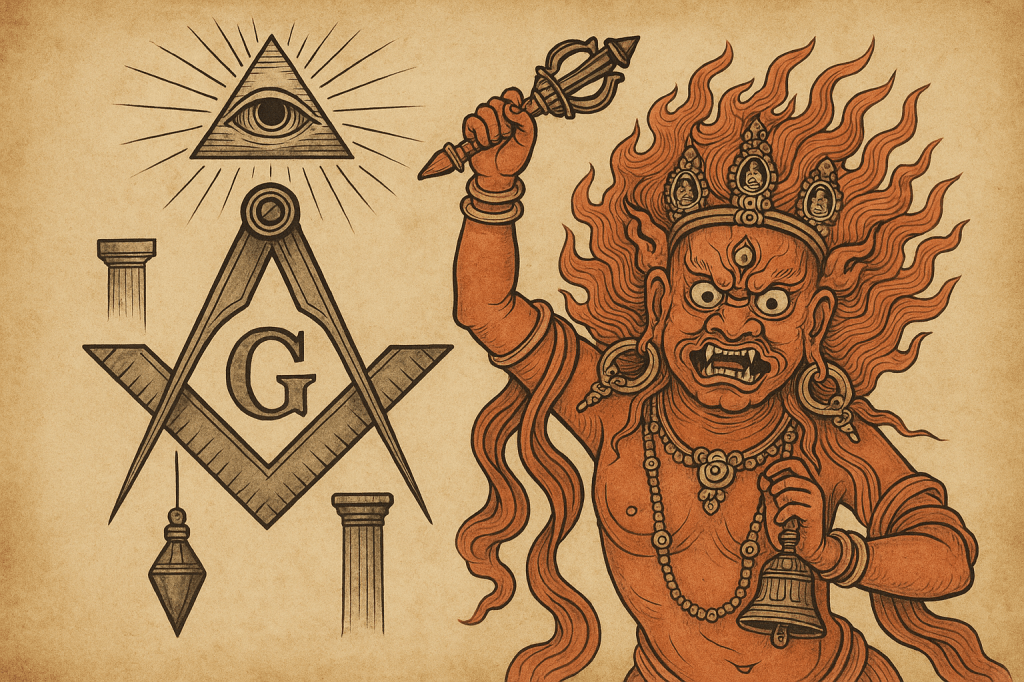
Magical ToolsCompass, square, tracing boards, symbolic implements; ritual words and gesturesVajra (dorje), bell, mandalas, mudras, mantras, tormas (substitutes for sacrificial offerings), visualized palaces
Source TraditionsHermeticism, Kabbalah, Rosicrucianism, medieval guild ritualBön shamanism, Indian Tantra, Himalayan spirit practices overlaid with Buddhist philosophy
Outer vs. Inner TeachingsPublicly moral, privately esoteric; higher levels teach occult philosophyPublicly compassionate, privately tantric; higher levels teach deity invocation and magical union
Binding MechanismOaths tie member to lodge and brotherhood, reinforced through ritual dramaSamaya ties disciple to guru and the deities invoked, reinforced through ritual visualization and mantra
Potential Root ParallelsMystery schools of antiquity, ritual magic, symbolic initiationsMystery schools of antiquity, ritual magic, symbolic initiations (via Eastern streams)

When we see these parallels laid bare, the comforting illusion of ancient wisdom starts to crumble. The robes and rituals, whether in a Masonic lodge or a Himalayan temple, are not neutral cultural artifacts. They are technology for binding humans to hidden powers, likely demons. Those who hold the keys to these systems know exactly what they are doing. The question is not whether the forces behind them exist, but whether the seeker truly understands who or what is answering when the call is made.

Perfect Possession: The Hidden Endgame of the Tantric Path?


Catholic exorcists consistently emphasize that full demonic possession is rare. Far more common are lesser forms of demonic influence, what the Church calls degrees of demonic attack. According to experts like Fr. Gabriele Amorth and Fr. Chad Ripperger, these stages are typically identified as:

  • Temptation (ordinary spiritual warfare)
  • Infestation (demonic presence in a place or object)
  • Oppression (external hardships caused by a demon)
  • Obsession (mental or emotional torment)
  • Possession (a demon controls the body, but not the soul)
  • Perfect Possession (the soul itself has given full consent to the demonic)

What Is Perfect Possession?

Fr. Malachi Martin, Jesuit priest, Vatican insider, and exorcist, famously warned of the phenomenon he called perfect possession. This occurs not when a demon forces its way into a person, but when a human being voluntarily invites and cooperates with a demonic entity over time until the human will is no longer in conflict with the demon’s presence. In such cases, the individual may appear calm, successful, and even spiritual, but has wholly aligned his or her soul with darkness.

Martin described this as the most terrifying form of possession because there is no resistance and often, no exorcism possible. The person has handed over consent of the will, and the demon resides not only in the body but in the soul.

This is not the ugly, contorted possession made famous by Hollywood. This is a quieter form of coexistence.

Possession Among the Occult Elite

Catholic exorcists often connect perfect possession to satanic priests, high-level occultists, or individuals who have undergone ritual consecration to Lucifer. It is the end point of a spiritual trajectory, not a single moment of sin. It involves years of voluntary cooperation with evil using ritual invocation, blood pacts, and blasphemous imitation of the sacraments.

But there is more discrete path that leads to the same end. It is cloaked in lotus flower imagery, Sanskrit mantras, and spiritual “blessings,” and is propagated by tantric adepts, yogis, and mahasiddhas who have spent years practicing yoga and ritual invocation of beings they consider to be deities.

Is Perfect Possession the Hidden Goal of Tantra?

In the Tibetan Vajrayana tradition, called “the quick path to enlightenment,” tantric practitioners visualize themselves as the deity. They merge consciousness with the god, goddess, or guru, often through esoteric or sexual ritual, in pursuit of realization.

But what if these “deities” are not who they claim to be?

What if they are counterfeit spirits or demonic intelligences disguised as beneficent beings of light?

In that case, the tantric adept is inviting an entity to live within him, again and again, through ritual, offerings, and mental surrender. Over time, the boundary between the self and the invoked being dissolves.

This is a form of spiritual possession.

And if the person no longer resists, if they call this possession “enlightenment,” then it seems to meet the classical definition of perfect possession or possession of the soul.

Signs of Perfect Possession in the Tantric World

Unlike Hollywood portrayals, the perfectly possessed do not foam at the mouth or speak in guttural Latin. Instead, they:

  • Radiate serenity, even as they worship gods of wrath and destruction
  • Exhibit supernatural knowledge or powers (siddhis), which are praised, not feared
  • Express total identification with the spirit/s they invoke
  • Are untouchable by traditional exorcism, because they do not want to be freed

In Catholic understanding, this is the most dangerous state of all because it involves no inner conflict, and therefore no pathway to repentance. The soul lives in union with a demon, often under the delusion that it is serving the good.

Satan Appears as an Angel of Light

Scripture warns us:
“And no wonder, for even Satan disguises himself as an angel of light.” – 2 Corinthians 11:14

What better disguise than that of a esoteric deity offering long life, healing, spiritual bliss, and enlightenment?

Exorcists like Fr. Amorth and Fr. Martin remind us that total possession doesn’t happen by accident. Satan must be invited in. And perfect possession is the result of spiritual consent, repeated and ritualized over time.

Tantric practitioners may never use the language of possession. They may call it “liberation,” “non-duality,” or “union with the deity.”

But from the standpoint of Christian spiritual warfare, it is not liberation but captivity, sanctified and made beautiful. It is a demonic entity, ethereally robed and seated on lotus thrones, perfectly at home in the human soul. And it leaves the adept deeply indebted to demons.

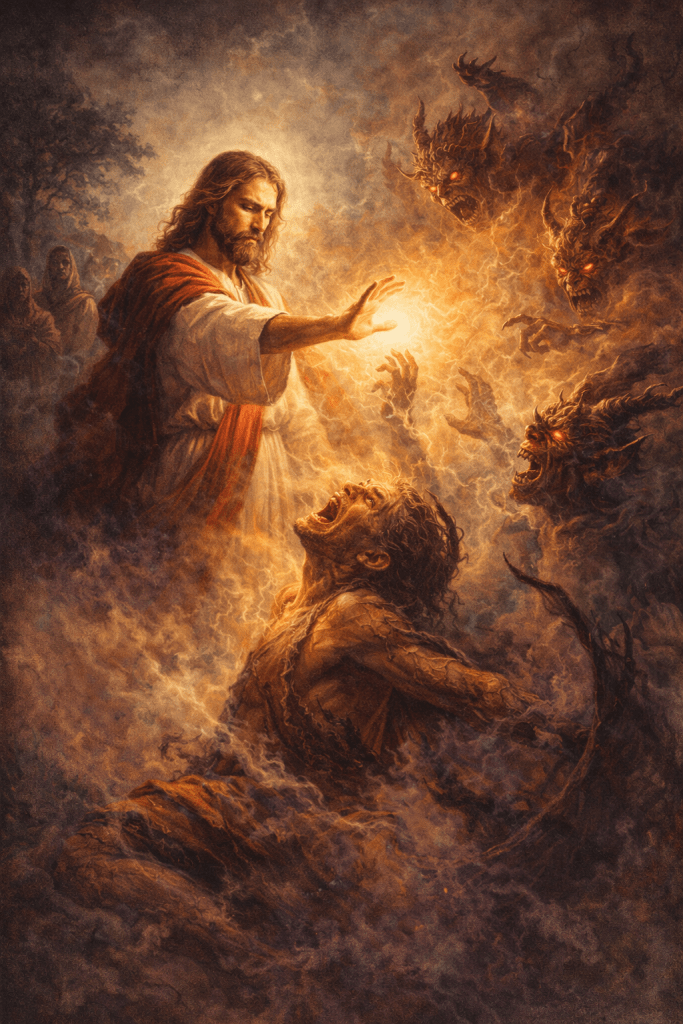
When Demons Leave the Way They Came: Breath, Tantra, and the Kalachakra Deception


Lately, I’ve been praying for God to continue revealing the truth about what I was involved in during my years of deep immersion in Tibetan Tantra. I’ve asked Him to uncover every layer of deception and to expose every way in which these practices are demonic. And He is answering.

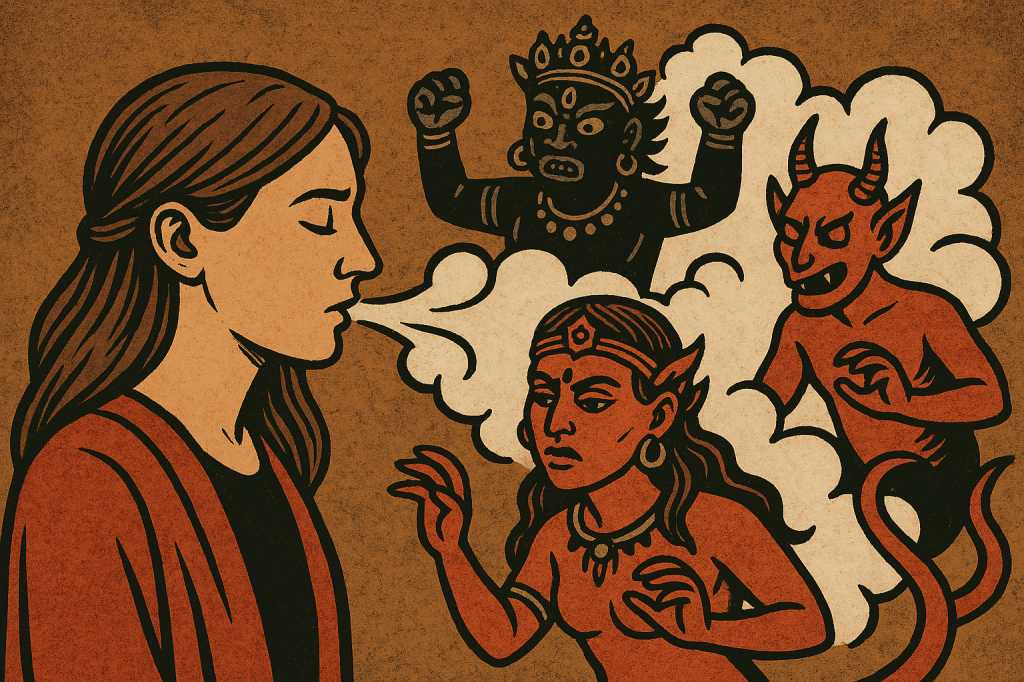
This past week, something profound happened: I experienced mass deliverance through my breath. As I exhaled, demons left me. Over and over again. It was undeniable. And then it hit me: of course they left on the breath. They came in on the breath.

This is not metaphorical. This is how tantra works. The breath is a key mechanism through which demonic entities enter one’s being. Yogic and tantric practices revolve around breath control: deep manipulation and intentional retention of the breath to open oneself to possession by what are euphemistically called “deities” but are, according to Christianity, demons.

In my three-year retreat, the main entities I invoked and merged with were Vajrayogini, the Red Dakini, and her consort. These were not simple meditations or visualizations. These were acts of surrender and identity dissolution. In essence, the goal was full-blown possession, even though it wasn’t couched in those terms and I didn’t realize that is what was happening.

Vajrayogini doesn’t come alone. Her retinue includes approximately 120 assistants, each with its own functions and qualities. That number is staggering, and that’s just one system of practice. In addition to her, I practiced the sadhana of a wrathful black deity with a massive host of demonic attendants. I should stress that these are not benign energies. They are demanding, and potentially violent and spiritually lethal.

But even beyond retreat, I continued to receive more initiations, or so-called empowerments. One that stands out is the Kalachakra initiation in 2011 from the Dalai Lama in Washington, D.C. It was a 10-day, all-day affair. I was zealous, determined to catch every detail of the ritual. I arrived early each morning to watch the Dalai Lama prepare himself by “self-generating” as the deity Kalachakra. It was amazing to watch; he was ritually becoming the deity.

Kalachakra, which means “Wheel of Time,” is a tantric deity surrounded by a staggering retinue of 722 deities. But these aren’t heavenly hosts. According to Christianity, they are demons. Every one of them. The entire system is a carefully constructed spiritual snare designed to bind souls to counterfeit light.

Thousands, maybe millions, have received these same initiations. The Dalai Lama has made it his mission to offer the Kalachakra globally. People believe they are receiving a blessing. But in reality, they are being spiritually colonized. Demonic systems are being seeded into the nations. These rituals are not neutral cultural events. They are portals for dark power.

If you want a glimpse into what may really happening during these ceremonies, I encourage you to read this article that lays it out plainly:
Dalai Lama and the Kalachakra

As for me, I’m continuing to pray and seek God’s help in cleansing every layer of my being. What I’m realizing is horrifying but I am confident that God is showing me the truth and setting me free.