
Sacrifice, Favor, Repeat


Before the modern age romanticized pagan religions into New Age panaceas, ancient worship was known to be raw and brutally pragmatic. In our modern spiritual-industrial complex, it is often sugarcoated into some kind of warm, earth-loving ceremony filled with personal empowerment and divine intimacy. But if you’re reading this, you’re probably already suspicious of that narrative.

In fact ancient religion, pagan religion, was highly transactional. The gods didn’t love you. They didn’t weep over your suffering or aspire to protect you.

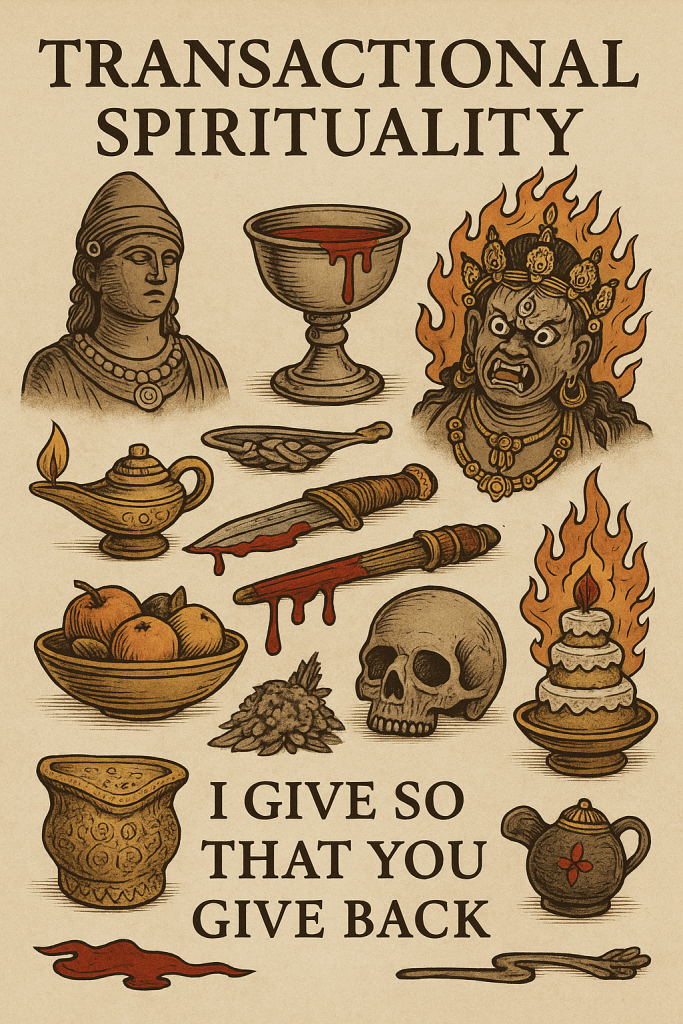
A passage from Behold the Christ: Proclaiming the Gospel of Matthew by Leroy A. Huizenga makes this brutally clear. Pagan worship, he writes, operated on the ancient principle of do ut des: “I give so that you give back.”(1) In other words, the gods and humans used each other. You offered sacrifices, incense, food, or praise not out of adoration, but because you wanted something in return: good crops, protection in war, fertility, rain, wealth, healing, vengeance, and victory. And the gods? They wanted to be fed, praised, and kept relevant. It was mutual exploitation dressed up in sacred costume.

“That is, the worshipper provides a sacrifice to a god that pleases and empowers the god, who then turns around and does the worshipper favors. Because the gods are often indifferent to humans, worshippers engage in repeated ritual to reach out and get a god’s attention.”

This paragraph says more about ancient spirituality than most modern New Age books on “manifesting” or “connecting with the divine.” The ancients weren’t confused. They understood that the gods were powerful, unpredictable, and not especially interested in human wellbeing unless there was something in it for them.

And this wasn’t limited to Rome or Greece. Versions of do ut des appear in Vedic sacrifice, Mesopotamian temple economies, and also Tantric Buddhist practice where offerings are made to wrathful deities to invoke, control, or appease.

Nowhere is this transactional logic more systematized and ritualized to the point of industrial precision than in Tibetan Buddhism. While cloaked in the language of enlightenment and compassion, the tradition is saturated with mechanisms that mirror the ancient do ut des economy: elaborate offerings, incense, butter lamps, mandalas, and tormas (sacrificial cakes that replaced blood offerings when the Buddhist principle of ahimsa “non-harming” took root). These were given not out of unconditional reverence, but to elicit specific outcomes from specific deities. Monastic liturgies are not just meditative recitations, but are negotiations with a pantheon of wrathful and peaceful beings, each with their own preferences, powers, and temperaments. Moreover, the non-harming sentiment in Tibetan Buddhism only extends so far. While Buddhist tantra forbids blood sacrifice, its subjugation rituals, aimed at both spiritual and human enemies, can involve some of the most brutal punishments found in any ritual religion.

Drupchöd ceremonies, held in large monasteries, exemplify this beautifully. These are days- or weeks-long ritual marathons involving collective chanting, visualization, music, mudras, and vast offerings, all designed to propitiate deities into bestowing protection, wisdom, and worldly benefits like health and prosperity. Whether invoking Mahakala to remove obstacles or Tara for swift blessings, the assumption is clear: the deity acts when properly fed, praised, and invoked. The gods (or enlightened beings, depending on your doctrinal parsing) are not passively watching; they’re participants in a cosmic economy, and Tibetan Buddhism, more than almost any other tradition, has mastered the bureaucratic apparatus needed to transact with them. It’s not just about personal devotion. It’s about correct performance, correct offerings, and the correct “exchange rate” of ritual. The love of the gods is not assumed. Their attention must be earned over and over again.

Modern Takeaways and a Warning

This transactional pattern isn’t limited to ancient paganism or esoteric Tibetan ritualism. You’ll find the same spiritual economy alive and well in the darker corners of contemporary occultism. Take it from someone like Riaan Swiegelaar who’s lived on the other side: former Satanists and occult practitioners routinely speak of offering sacrifices, especially blood, to demons in order to negotiate outcomes.(2)

He described it well: “A lot of people ask me, ‘Why are there so many sacrifices in Satanism? Why is there blood?’ The answer is simple: blood has currency in the spirit world. If I want to negotiate with demons, I need to bring an [animal] sacrifice because that blood holds value. It functions as spiritual capital.

“But here’s the contrast: the blood of Jesus is the highest currency in the spirit world. It covers everything. That’s the authority we stand on. And every ex-Satanist or ex-occultist who’s encountered Christ will tell you the same thing. I might be the only one talking about it openly, but this is real: we engaged in negotiations with demons, offered animal sacrifices, and got results. That’s how the system worked. Then we experienced the blood and love of Christ and there’s no comparison. It’s not even close. His blood is infinitely more powerful. In spiritual warfare, people need to grasp that reality. The blood of Christ is free, but it is not cheap, is it? It came at the highest cost. And what happened on the cross? That wasn’t a one-time transaction in history: it remains as valid, active, and potent today as it was then, and always will be.”

This is so important that it bears repeating: no spiritual currency, no ritual offering, no demonic pact compares to the raw, unmatched power of the blood of Christ. This is the rupture at the heart of Christianity: the economy of sacrifice is over, not because gods stopped demanding payment, but because one sacrifice bankrupted the system.

From blood-soaked altars in Babylon to ritual offering tormas in Himalayan monasteries, humanity has always traded devotion for power and offerings for favor. But the cross flipped the script. There is no more need for bartering, manipulation, and performance to win divine attention. What Christ offered wasn’t another payment into the cosmic vending machine but a final act that rendered the machine obsolete. And if that’s true, then every attempt to re-enter the old system, whether through pagan ritual, tantric bureaucracy, or occult negotiation, isn’t just a return to tradition. It’s a rejection of victory.

(1) Leroy A. Huizenga, Behold the Christ: Proclaiming the Gospel of Matthew (Emmaus Road Publishing, Steubenville, Ohio).

(2) Riaan Swiegelaar, former co-founder of the South African Satanic Church, in various public testimonies including interviews and livestreams (e.g., “Riaan Swiegelaar Testimony,” YouTube, 2022), has spoken openly about blood sacrifice as spiritual currency and his eventual conversion after experiencing the love of Christ.

Worldly Protectors and Demons in Tibetan Tantric Buddhism: Symbolic Forms or Tools for Harm?


Tibetan Buddhism is often portrayed as a peaceful, meditative tradition centered on compassion and enlightenment. However, this masks a complex esoteric system that includes the worship and manipulation of worldly protectors (Chökyong) and wrathful spirits. While some of these entities are invoked for protection and blessings, they can also be weaponized against perceived enemies. In this article, we explore the darker side of tantric practices involving these beings and how they can be used to harm others.

Worldly Protectors: Not Always Benevolent

Worldly protectors (Tib. Chökyong) are not enlightened beings but rather powerful spirits, often local deities or ancient demons that were subdued and bound by tantric masters into serving the Buddhist dharma. Unlike fully enlightened protectors, who “alledgedly” operate beyond mundane entanglements, worldly protectors still possess emotions, grudges, and the capacity for harm. Their allegiance to particular sects or lineages makes them especially useful for those seeking to gain favor or exert power.

Beyond protectors, Tibetan tantric Buddhism includes rituals explicitly designed to summon harmful spirits to attack enemies. These practices often involve wrathful deities and demons, coercing them into carrying out curses, sickness, or even death.

Gyalpo spirits are mischievous and vengeful entities, often former monks or rulers who became wandering ghosts. These spirits can be bound through ritual to inflict misfortune, financial ruin, or insanity on an intended victim. Their influence is particularly feared in tantric monasteries.

Mamo spirits are wild, untamed female entities that exist in liminal spaces between worlds. These spirits are associated with plagues, natural disasters, and personal calamities. Invoking them requires blood offerings and precise tantric rituals to direct their chaotic energy toward an enemy. (These days the blood offerings have probably been replaced by symbolic blood offerings like red tormas–offering cakes made of barley flour and butter and painted red). The risk, however, is that Mamos are unpredictable and can turn against the summoner if not properly controlled.

Wrathful Drupchods in Tibetan Monasteries

In Tibetan monasteries in India and Nepal, large-scale tantric rituals known as drupchods are performed to invoke wrathful deities such as Vajrakilaya and Mahakala. These elaborate ceremonies involve extensive mantra recitations, fire offerings (homa), and ritual dances aimed at subjugating negative forces. While officially framed as purification rituals, they also contain elements of esoteric warfare.

The practice of using effigies (linga) in Tibetan Buddhist rituals, particularly during drupchods invoking wrathful deities like Vajrakilaya and Mahakala, is well-documented in esoteric Buddhist literature. These effigies are crafted to represent specific enemies, both spiritual and human, and are often imbued with personal or symbolic elements to establish a metaphysical link to the intended target. The ritual destruction, burning, or expulsion of these effigies is believed to direct the wrathful energy of the deity towards those perceived as threats.​

Scholarly research highlights the significance of these practices. For instance, Haoran Hou’s study on The Ritual Use of Human Effigies in the Esoteric Buddhist Literature from Karakhoto, discusses how liṅga effigies were utilized for purposes such as inflicting harm, healing, and exorcism. These rituals, originating in India, traversed through Tibet and extended into regions like the Tangut Empire and the Yuan Dynasty. The study provides translations and annotations of ritual texts, illustrating the methods of making and using liṅga effigies for harming humans and other purposes, while exploring their transmission across Eastern Central Asia between the 11th and 14th centuries.

Additionally, contemporary practices continue to reflect these ancient traditions. At the Palpung Sherabling monastery in Baijnath, India, monks perform the cham dance on the eve of the Tibetan New Year, invoking the wrathful deity Mahakala. This ritual involves monks dressed in vibrant robes and menacing masks enacting sacred dances, accompanied by drums, cymbals, and horns. A significant aspect of this ceremony is the creation and subsequent burning of a large mask-like representation of Mahakala, made from barley flour and butter. This act symbolizes purification and the elimination of negative forces, aligning with the traditional use of effigies to target and dispel obstacles or perceived threats. ​

These sources underscore the ritualistic use of effigies in Tibetan Buddhist ceremonies, highlighting their role in both historical and contemporary contexts to symbolically address and neutralize adversarial forces.​

How These Forces Are Used in Power Struggles

While many Tibetan Buddhists are unaware of these esoteric practices, high-ranking lamas and tantric practitioners have long used them to settle disputes, intimidate rivals, punish samaya breakers, and maintain control. Whether through secret rituals, oracles, or direct curses, these entities serve as supernatural enforcers in an unseen war for power within the tradition.

Historically, factions within Tibetan Buddhism have accused each other of using protectors and demons for political advantage. Even the exile of the Dalai Lama from Tibet involved a struggle over a protector propitiation. In modern times, stories persist of lamas employing such methods against those who leave or criticize the lama or the tradition.

Breaking Free from the Grip of These Forces

For those who have problems in Tibetan Buddhism and experience its darker aspects, the lingering influence of these protectors and spirits can be overwhelming. The key to breaking free lies in renouncing, breaking ties, forgiving those who harmed you, and refusing to participate in any aspect of Tibetan Buddhism. If one needs protection it is necessary to embrace a spiritual path that does not require servitude to wrathful entities. I find solace in Christian prayer and deliverance, a system that offers freedom from demons, witchcraft, and pagan practices.

Conclusion

While Tibetan Buddhism outwardly promotes compassion and enlightenment, its esoteric layers reveal a different story, one where worldly protectors and demons can be weaponized against others. These beings, bound by oaths and rituals, operate in a liminal realm and can be used for both defense and destruction. Understanding their dual nature is crucial for anyone seeking to navigate or escape the hidden dangers of tantric practice.

References:

Hou, Haoran. The Ritual Use of Human Effigies in Esoteric Buddhist Literature from Karakhoto. BuddhistRoad Paper Series 2.3. Ruhr-Universität Bochum, 2023.

Cuevas, Bryan J. Illustrations of Human Effigies in Tibetan Ritual Texts: With Remarks on Specific Anatomical Figures and Their Possible Iconographic Source. Journal of the Royal Asiatic Society 21, no. 1 (2011): 73–97.

Dreyfus, Georges. The Shugden Affair: Origins of a Controversy. Journal of the International Association of Buddhist Studies, 1998.

Nebesky-Wojkowitz, René de. Oracles and Demons of Tibet: The Cult and Iconography of the Tibetan Protective Deities. The Hague: Mouton, 1956.

Lopez, Donald S. Prisoners of Shangri-La: Tibetan Buddhism and the West. Chicago: University of Chicago Press, 1998.

Samuel, Geoffrey. Civilized Shamans: Buddhism in Tibetan Societies. Washington, D.C.: Smithsonian Institution Press, 1993.

Kapstein, Matthew. The Tibetans. Malden, MA: Blackwell Publishing, 2006.

Goldstein, Melvyn C. A History of Modern Tibet: The Demise of the Lamaist State. Berkeley: University of California Press, 1989.