

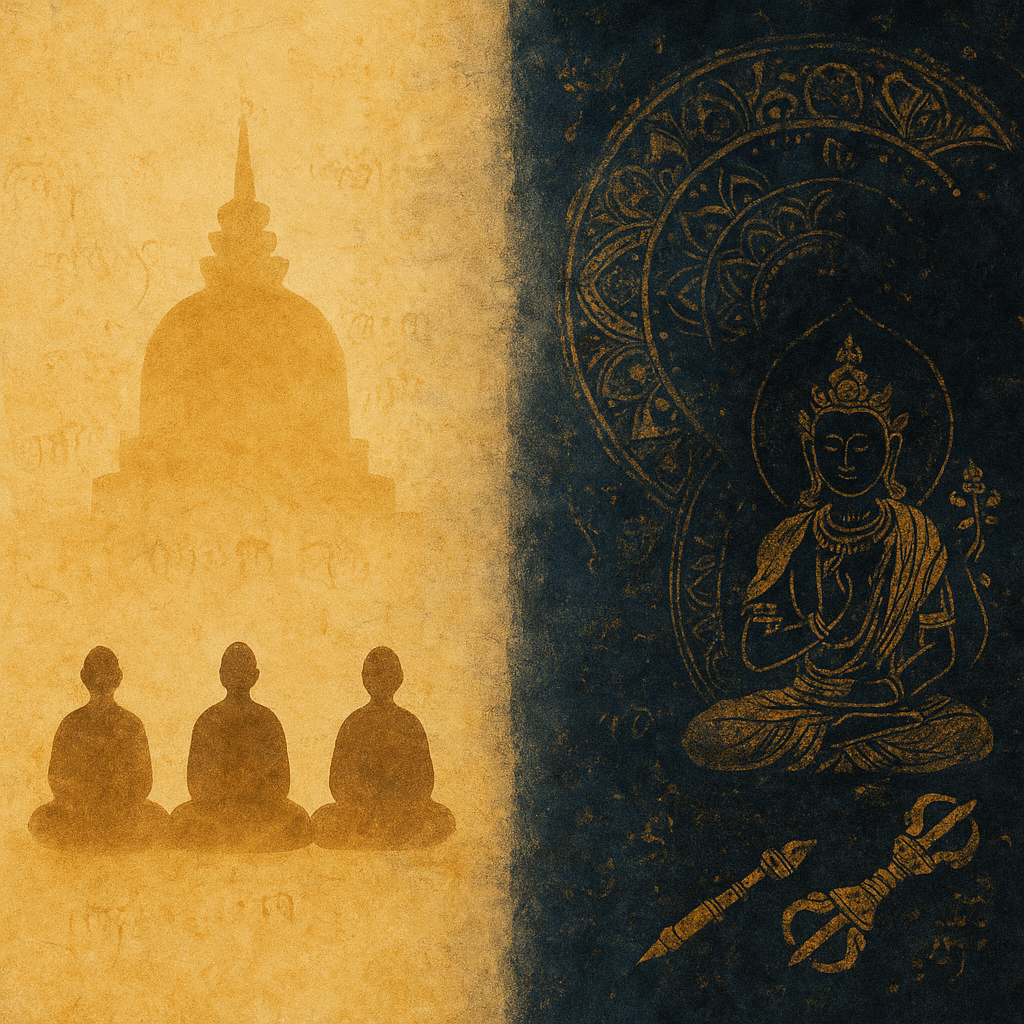
I spent years as a Tibetan tantric Buddhist practitioner. I once assumed the mantra, ritual, and mandala machinery I practiced was simply the Buddha’s own teaching passed down intact. We were taught that although the historical Buddha did not teach tantra in person, he taught it after his passing, on Mount Malaya, to gods and men. Koichi Shinohara’s work forces a different view and poses the question: Did Sakyamuni really teach the long formulaic dhāraṇīs, image worship, and mandala visualization as later practitioners used them? Or did later communities invent those ritual technologies and then cloak them in the Buddha’s authority so people would better accept them?
In Spells, Images, and Maṇḍalas: Tracing the Evolution of Esoteric Buddhist Rituals, Shinohara gives us a working hypothesis that can be pressed hard for answers.[1] The rituals in question are most plausibly later innovations that used the Buddha’s prestige to become authoritative. They were not the Buddha’s core teachings in any strictly historical sense. That does not make them illegitimate as religious forms for people who practice them today. It does mean historians and critics should stop pretending these rituals are reflections of Sakyamuni’s own instructions. The burden of proof rests on anyone who wants to show unbroken doctrinal transmission from the Buddha to the later esoteric ritual machinery.
Shinohara offers a testable, evidence-driven reconstruction. He traces a plausible sequence from simple spoken spells through image ritual to organized visualization. Crucially, he foregrounds early, datable Chinese dhāraṇī collections and ritual manuals. Those Chinese witnesses often predate the surviving Sanskrit and Tibetan corpora scholars have relied on. That chronological fact is the hinge of the whole argument. (Columbia University Press)
What Shinohara’s working hypothesis means
A working hypothesis is provisional and falsifiable. Shinohara is not issuing an ideological verdict. He is proposing a historical explanation that organizes the evidence and makes concrete predictions that could be falsified by earlier, securely dated Indian or canonical texts showing the full ritual machinery already present in the Buddha’s time. To press the hypothesis hard, scholars should look for those disconfirming witnesses. So far the datable documentary and manuscript evidence he emphasizes points toward post-Buddha innovation that relied on attribution to the Buddha for legitimacy.
The core empirical point
Early Buddhism included ritual speech. The Pali paritta corpus shows that communal protective chants and recitations were an early feature of Buddhist practice. Importantly, these early chants are directed primarily to the historical Buddha and the Triple Gem, the Buddha, the Dhamma, and the Saṅgha, rather than to the later, expanded pantheon of cosmic buddhas and bodhisattvas that appear in Mahāyāna and tantric literature. By contrast, the long, formulaic dhāraṇīs with non-lexical syllables, their ritual manuals, and the tightly scripted mandala visualizations appear in the surviving record mainly in later sources, often first in Chinese translations and compilations dated to the fourth through eighth centuries. That pattern strongly suggests the later technical dhāraṇī and mandala apparatus developed after the historical Buddha and used his name as an authority seal rather than being his literal, unbroken teaching (see Ratana Sutta and the paritta collections; Access to Insight).
Pali paritta versus three representative dhāraṇīs
Below is one short Pali paritta example and three representative dhāraṇī excerpts that have early Chinese witnesses. For each dhāraṇī there is a short literal transliteration excerpt, the earliest datable Chinese witness, and why this matters for Shinohara’s thesis.
A note about transliteration and length. Full dhāraṇī texts can be very long and use non-lexical syllables. I quote short, clearly identifiable openings or kernel sequences and give citations to the editions or translations where you can read the full texts.
A. Pali paritta exemplar (short protective chant from the Buddha’s time)
- Text (Pali, introductory formula used in paritta recitation):
Namo tassa bhagavato arahato sammāsambuddhassa.
Translation: “Homage to the Blessed One, the Worthy One, the Fully and Exactly Awakened One.”
Dating and context: part of the Ratana Sutta and the paritta repertoire attested in the earliest Pali strata and used continuously in Theravada protective ritual. These are short, lexically meaningful formulas employed in communal contexts. (Access to Insight)
This matters because paritta recitation shows early Buddhists used spoken protective formulas directed to the Buddha and the Triple Gem. That continuity leaves an opening for later mantra culture to develop, but continuity alone does not prove that the later technical dhāraṇīs were the Buddha’s teaching.
B. Uṣṇīṣavijayā dhāraṇī: short transliteration excerpt and dating
- Transliteration excerpt (IAST style, short kernel):
oṃ aḥ hūṃ uṣṇīṣa vijaya svāh. Translation: “Om. Ah. Hum. Victory to the Ushnisha. Svāhā.” Note: full versions are much longer and include complex Siddhaṃ syllables. The line above is a short recognizable kernel rather than the entire dhāraṇī. - Earliest datable witness: multiple Tang dynasty Chinese translations; primary translations appear in the late seventh century and the text circulated widely in Tang China thereafter. Several ritual manuals for this dhāraṇī were also translated into Chinese. (84000)
This is important because Uṣṇīṣavijayā is a canonical example of a dhāraṇī that crystallized as a ritual unit in China by the seventh century. Its early and repeated Chinese attestations show how the formulaic dhāraṇī corpus became standardized in East Asia, a datum that supports Shinohara’s emphasis on Chinese witnesses. (84000)
C. Nīlakaṇṭha / Great Compassion dhāraṇī: short transliteration excerpt and dating
- Transliteration excerpt (short recognizable opening):
Namo ratna trayāya … oṃ namaḥ parāya svāhā. Translation: “Homage to the Three Jewels… Om. I bow to the Supreme. Svāhā.”
Again, the dhāraṇī in practice is very long; this is a short illustrative kernel. - Earliest datable witness: Bhagavaddharma’s Chinese transliteration of the Thousand-armed Avalokiteśvara dhāraṇī is commonly dated to ca. 650–661 CE at Khotan, and Dunhuang manuscript copies are attested from the eighth century onward. The standard East Asian version is listed in Taishō as T.1060. (Wikipedia)
This matters because the Great Compassion dhāraṇī’s early Chinese and Central Asian circulation shows the mobility of formulaic spells across cultural borders and their crystallization in Chinese textual layers before the later Tibetan tantra apparatus matured. That pattern again undercuts a simple claim of unbroken oral descent from the historical Buddha.
D. The Dhāraṇī of the Six Gates: transliteration indicator and dating
- Short indicator: the sutra opens with formulaic addresses and contains six gate dhāraṇī sequences; full transliteration is available in modern critical editions. The Chinese translation by Xuanzang is dated to 645 CE (Taishō 1360). (84000)
This matters because Xuanzang’s mid-seventh century translation gives a secure terminus ante quem for certain dhāraṇī forms in East Asia. The existence of such dated translations is exactly the kind of evidence Shinohara places in the foreground when reconstructing the genealogy of ritual techniques. (84000)
Short methodological point about dates and what they prove
When a long formulaic dhāraṇī and a ritual manual appear in a secure, dated Chinese translation in the seventh century but not in any securely dated Indian source from the centuries immediately after the Buddha, the safest historical inference is that the particular ritual form crystallized later and that Chinese transmission played a major role in its textual preservation and standardization. That does not prove the practice first originated in China. It does show that the textual and ritual machinery as preserved and circulated in East Asia is early and often predates surviving Sanskrit witnesses. Shinohara uses exactly this dating logic to show how spells, images, and visualization interrelate historically. (Columbia University Press)
Did the Buddha forbid images or deification of himself?
Canonical passages caution against attachment to the person of the teacher. A well known example is the Vakkali Sutta where the Buddha tells the sick Vakkali that seeing the Dhamma is what matters, not seeing his physical body: “One who sees the Dhamma sees me; one who sees me sees the Dhamma.” That admonition has been read as discouraging hero cult and literal deification. (SuttaCentral)
The archaeological and textual record complicates the claim that the Buddha formally forbade images. However, here is a settled scholarly debate about early “aniconism” in Buddhist art. Most scholars agree that standardized, large anthropomorphic Buddha images do not appear widely until several centuries after the historical Buddha’s death. Some specialists argue that early absence of the anthropomorphic image reflects doctrinally driven aniconism. Other specialists argue the evidence is better explained by devotional practice, material culture, and local circumstances rather than by a simple canonical ban. In short, canonical caution about attachment to persons exists, but practice evolved in ways that embraced images for devotional, pedagogical, and institutional reasons. (Wikipedia)
For the former practitioner who wants a practical takeaway
If you were taught that tantric rituals are from Sakyamuni’s own instructions, the historical picture is more complicated and poses big questions to that narrative. The very technical dhāraṇī machinery, image cults, and visualization systems that define much of later tantric practice have a historical biography. They emerge, consolidate, and professionalize in the centuries after the Buddha lived, and much of the documentary evidence that preserves them comes from dated Chinese compilations and Dunhuang manuscripts. That history changes how they should be presented when someone claims they were directly taught by the Buddha himself.
History cannot prove the metaphysical provenance of a ritual. Textual and manuscript research can show whether a practice dates to Sakyamuni’s lifetime or to later cultural development, but it cannot by itself settle whether a given visionary or ritual impulse is benign or malign. If you take the language of spiritual warfare seriously, that uncertainty argues for caution. Here are four practical questions to ask before you embrace a practice: Where does its chain of transmission point? Does it coherently line up with the ethical core of the Buddha’s teaching, such as nonharm, compassion, and right conduct? What fruits does it produce in practitioners’ lives, emotionally and morally? And how transparent are its teachers about origins and effects? If a practice fails those tests, step back and favor practices that visibly cultivate ethical integrity and mental clarity. For someone who has been inside the tantric world, this is not an abstract exercise. It is a matter of spiritual survival. Let historical honesty inform your discernment, and let the lived, ethical results of practice be the final arbiter.
Sources and Bibliography
[1] Koichi Shinohara. Spells, Images, and Maṇḍalas: Tracing the Evolution of Esoteric Buddhist Rituals. New York: Columbia University Press, 2014. xxii, 324 pp. ISBN 9780231166140. See especially Chapter 1, “The Three Ritual Scenarios” (pp. 1–28), the material on the Collected Dhāraṇī Sūtras and the All-Gathering ceremony (pp. 28–89), and the chapters on the introduction of visualization practice (pp. 89–160). Recommended exact pages to quote when discussing the three scenarios and Chinese-dated evidence: consult pp. 1–4, pp. 28–64, and pp. 89–118 for Shinohara’s core arguments and manuscript citations. (Columbia University Press)
Primary dhāraṇī witnesses and editions (quick references)
- Dhāraṇīsaṃgraha, Taishō no. 901, translated by Atikūṭa in the Tang; contains collected dhāraṇī sūtras and an early mandala initiation ritual. See Taishō T.901 and catalog entry. (NTI Reader)
- Uṣṇīṣavijayā Dhāraṇī. Multiple Tang Chinese translations; widely circulated from the late seventh century. See 84000 Reading Room entries explaining translation history. (84000)
- Nīlakaṇṭha / Great Compassion Dhāraṇī. Bhagavaddharma’s Khotan transliteration dated ca. 650–661 CE; standard Taishō entry T.1060 and Dunhuang manuscripts attest its early East Asian circulation. (Wikipedia)
- Dhāraṇī of the Six Gates. Chinese translation by Xuanzang dated 645 CE (Taishō 1360). See Xuanzang colophon and modern critical editions. (84000)
Pali and early canonical material (for paritta comparison)
- Ratana Sutta, Sutta Nipāta 2.1. Standard Pali editions and translations; see SuttaCentral and Access to Insight translations for text and context. (Wikipedia)
Secondary literature and resources on dating, aniconism, and early ritual evidence
- Scholarly debate on Buddhist aniconism and the delayed appearance of anthropomorphic Buddha images. See Susan L. Huntington, “Early Buddhist Art and the Theory of Aniconism” and subsequent debates summarized in surveys of early Buddhist art. (Buddhism Library)
- Columbia University Press page for Shinohara’s book with contents and excerpt. (Columbia University Press)

 Tantric Deception