

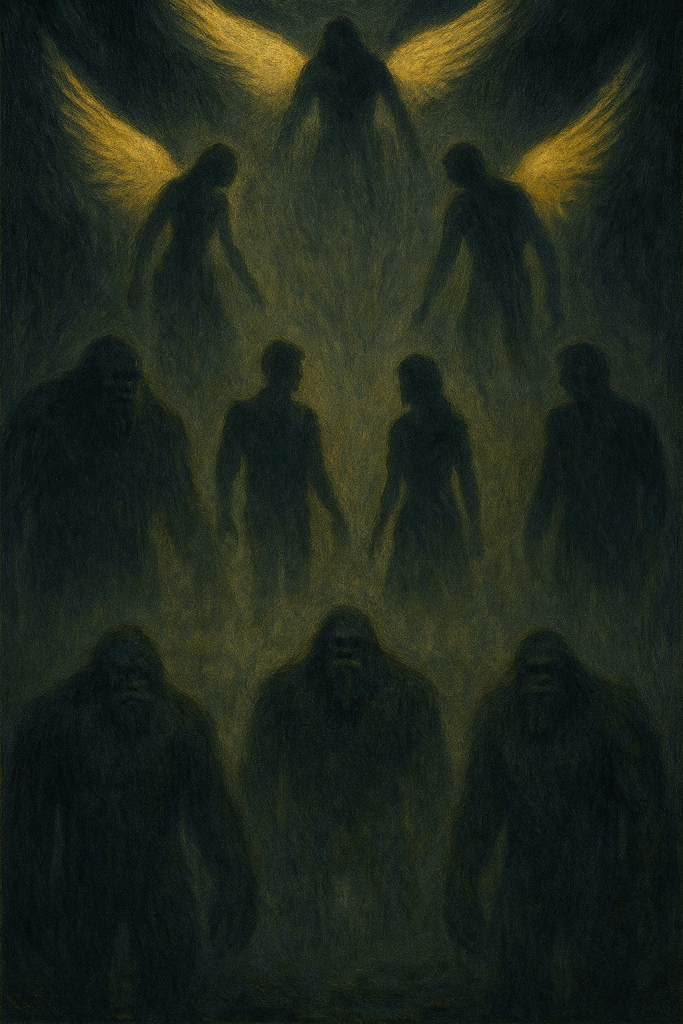
When most people hear the word Bigfoot, they picture a shaggy giant slipping through the misty forests of North America. But the legend is far older and wider than that. Across the globe, cultures tell of towering, manlike beings who walk the line between human and beast. In the Pacific Northwest, he is Bigfoot or Sasquatch, keeper of the deep woods. High in the Himalayas, mountaineers whisper of the Yeti, the Abominable Snowman. In China’s shadowed valleys roams the Yeren; in the outback of Australia, the Yowie stalks the night. The Amazon has its Mapinguari, Siberia its Almas, and medieval Europe carved the Woodwose, the wild man, into stone cathedrals as if to warn future generations.
The sheer spread of these accounts, from mountains to jungles to deserts, suggests a phenomenon far deeper than campfire stories. For the late Scott Carpenter, one of the most respected yet controversial Bigfoot researchers, the truth was darker still. His work pointed to a being not just of flesh and blood, but something supernatural: an entity at once physical and otherworldly.
In this article, based on a two-hour conversation with Carpenter’s son, we explore the evidence, the warnings, and the spiritual dimensions of Bigfoot research that most mainstream outlets won’t touch. [1]
From Survivalist to Supernatural Researcher
Scott Carpenter didn’t start out as a paranormal investigator. He was a survivalist, outdoorsman, and common sense skeptic. His interest in Bigfoot was at first just a way to spend time in the woods. But his encounters forced him into a paradigm shift:
“This isn’t just flesh and blood. This isn’t just an ape. It’s something more: flesh and blood and something supernatural.”
That realization set him apart from other researchers and drew him into a spiritual battle that would last the rest of his life.
The Survivorman Bigfoot Episode
One of Carpenter’s breakthroughs came when survival expert Les Stroud featured him in Survivorman Bigfoot (Episode 7, Smoky Mountains). Stroud not only allowed Carpenter to share his evidence but even let him discuss it in terms of Genesis 6, the infamous “Nephilim” passage.
In Genesis 6:1–4, the text describes how the “sons of God” came down to earth and took human women as wives, producing offspring known as the Nephilim. These beings are often interpreted as giants: hybrids of divine and human lineage. Some traditions see them as fallen angels mating with women, others as divine beings creating a corrupted bloodline that spread violence and chaos across the earth. This was one of the driving reasons for the Flood of Noah: to wipe out this distorted genetic legacy.
Carpenter and Stroud’s willingness to bring Genesis 6 into a Bigfoot discussion was groundbreaking. It suggested that Sasquatch might not be just another undiscovered primate, but instead tied to ancient accounts of hybrids that were part human, part “other.” For many, that biblical connection reframed Bigfoot research from zoology into theology, raising the unsettling possibility that the phenomenon could be as much spiritual as physical.
That moment shocked many viewers. Mainstream Bigfoot media usually avoids biblical or supernatural frameworks, but Stroud leaned into it. Carpenter’s evidence, including sound bites, strange photographic captures, and face reconstructions, challenged the simplistic “big ape in the woods” narrative.
DNA and the Sasquatch Genome Project
Carpenter contributed samples to the Sasquatch Genome Project, led by Dr. Melba Ketchum, a veterinarian and DNA scientist with more than 30 years of experience in genetics and forensics. Before turning her attention to Sasquatch, Ketchum had built a reputation in the professional DNA world: her laboratory, DNA Diagnostics, worked on animal forensics cases, breed verification, and even high-profile wildlife investigations. She had published in peer-reviewed journals, testified in court as an expert, and earned respect for applying human forensic standards to animal DNA.
In 2012, Ketchum announced the results of the Sasquatch Genome Project, claiming the sequencing of three complete nuclear genomes pointed to a mysterious human/primate hybrid. The team initially submitted the paper to major journals such as Nature, but Ketchum later reported it was rejected without review. Facing repeated barriers, her group launched their own journal, DeNovo Scientific Journal, to get the findings into print. That decision only fueled criticism: mainstream scientists dismissed the work as self-published and riddled with contamination, while supporters argued it was blackballed precisely because its conclusions were too disruptive.
Whatever one believes about the controversy, the scale of the project was unprecedented: it involved more than 100 samples collected across the United States that were analyzed using forensic-level protocols. Carpenter’s contributions placed him at the center of one of the most ambitious and debated attempts to prove Sasquatch through genetics. The results stunned both researchers and skeptics: the mitochondrial DNA consistently read as human, but the nuclear DNA defied classification, pointing to something nonhuman and previously unknown. If true, this would mean Sasquatch was neither myth nor mere ape, but a hybrid: a creature with human maternal lineage and a mysterious paternal source. For Carpenter and others reading through a biblical lens, this echoed the ancient warning of Genesis 6, where the “sons of God” took human women and produced hybrid offspring: the Nephilim. In that framework, the genome data was not just a curiosity but a genetic fingerprint of a story as old as Scripture.
- Mitochondrial DNA (from the mother) came back human.
- Nuclear DNA (from the father’s side) was unknown.
- GenBank, the global DNA database, couldn’t match it to any known species.
A Land Charged with Ancient Spirits
Carpenter’s main research area sat near Morganton Cemetery in East Tennessee, on a peninsula surrounded by Cherokee land now drowned under Tellico Lake. Beneath the water lie the ancient towns of Chota, Tanasi, and Citico that had been excavated in the 1970s before the flooding. Archaeologists uncovered Cherokee council houses, plazas, burials, and artifacts from both Native and earlier Mississippian cultures, including temple mounds and ritual sites. Nearby, at Icehouse Bottom, human activity stretched back nearly ten thousand years. To Carpenter, this wasn’t just history but sacred ground, a spiritually charged landscape where human and nonhuman beings had mingled for millennia. Even the state’s name, Tennessee, traces back to Tanasi.
Local lore adds a darker layer. Legends speak of the Citico giants, towering figures tied to Canaanite-like practices of sacrifice. In the 19th century, Smithsonian surveyors and local antiquarians reported unusually tall skeletons, some approaching seven feet, uncovered in Tennessee Valley burial mounds. While mainstream archaeology explains these finds as exaggerations or natural variation, oral traditions preserved them as memories of a prehistoric race of great size and power. Citico (or Sitiku), later drowned beneath Tellico Lake, became the center of these stories, with settlers claiming to find oversized remains there. To some, the submerged cities of Chota, Tanasi, and Citico are not only Cherokee towns but remnants of an older, stranger presence, one that resonates uneasily with the biblical accounts of the Nephilim.
Carpenter’s son said:
“No wonder that area is a hotspot. The veil is thin there. Whatever was done there, it still lingers.”
Portals, Oak Ridge, and UFOs
As Carpenter’s research deepened, he began recording anomalies that looked like portals or openings through which beings appeared or vanished. These were like fleeting windows into another dimension. Strangely, this idea is not without precedent in Native tradition. Accounts of the Apache leader Geronimo describe him as more than a warrior; he was said to possess mystical knowledge of the land itself. According to oral histories, Geronimo could locate “spirit doorways” in the mountains and deserts and pass through them to evade capture. Some stories claim he used chants or songs to activate these portals, stepping into hidden realms before reappearing miles away. Whether literal or symbolic, such traditions mirror the kinds of interdimensional phenomena Carpenter reported: beings that could not be tracked or cornered because they moved in ways outside ordinary space. To those who take these parallels seriously, Geronimo’s legends suggest that what Carpenter encountered may have been part of a much older, indigenous understanding of the land’s supernatural architecture.
The geography adds another layer: just upriver lies Oak Ridge, Tennessee, one of the central sites of the Manhattan Project. While Los Alamos, New Mexico, gets most of the attention as the place where the bomb was assembled, Oak Ridge was where uranium enrichment took place on an industrial scale. Locals whisper that Oak Ridge is still conducting experiments in dimensional physics.
Carpenter’s own grandfather reported seeing UFOs “like ships battling” in the skies over Norris Lake decades ago. This wasn’t just folklore but lived experience.
Bigfoot Encounters: More Than Harmless Giants
Not all encounters are benign. Reports include:
- Bigfoot revealing itself more often to women than to men.
- Instances of sexual advances toward women.
- Encounters where couples were watched or even escorted out of the woods.
These beings aren’t cartoonish “gentle giants.” They are unpredictable, intelligent, and capable of menace. As Carpenter warned:
“Killing you might be way down the options list… but it’s still on the list.”
This perspective ties directly into the Missing 411 phenomenon, the thousands of unexplained disappearances in North America’s national parks and wilderness areas. Researcher David Paulides, a former police investigator and close friend of Carpenter’s, has spent more than a decade compiling these cases. The patterns are chilling: people vanish without a trace, often leaving behind neatly arranged clothing or possessions, sometimes reappearing dead in areas that had already been thoroughly searched. Weather, terrain, and predators can’t account for the sheer number of anomalies.
Paulides mapped “cluster zones” of disappearances across the continent. Some of the most active are places steeped in both natural beauty and paranormal lore: Yosemite National Park in California, Crater Lake in Oregon, the Great Smoky Mountains along the Tennessee/North Carolina border, and Colorado’s Rocky Mountain National Park. These regions share rugged terrain, deep caves, and long histories of indigenous legends about otherworldly beings.
While Paulides has always stopped short of naming a single culprit, his research repeatedly points to something more than accidents or foul play. Among the possibilities, he has floated Bigfoot as a key player because it is an intelligent, powerful being with abilities beyond human understanding. Carpenter’s evidence of portals and supernatural qualities dovetailed with this idea, suggesting that Sasquatch might not just be an elusive primate but a creature capable of moving in and out of our reality. For those who see the overlap, Missing 411 is not only about human disappearances but also about encounters with beings that share the wilderness with us, such as the Bigfoot phenomenon that Carpenter dedicated his life to studying.
A Spiritual Battle
The deeper Carpenter went, the more convinced he became that Bigfoot was not simply a zoological mystery but a spiritual one.
“This is not a pastime. This is a spiritual being. When you open yourself to it, you open yourself to spiritual warfare.”
Carpenter never set out to be a prophet of the paranormal, but his path led him into a mystery that defied biology and crossed into the realm of the supernatural. His work left behind evidence, stories, and warnings that Bigfoot is not just an ape, but something entangled with ancient powers.
In his final years, Carpenter faced the very battles he had long warned others about. The strange phenomena he spent decades documenting seemed to turn inward, manifesting as spiritual oppression, sleepless nights, and a heavy sense of being pursued. Friends recalled how he spoke of attacks that weren’t merely physical but psychological and spiritual: the kind of warfare described in scripture as coming from “principalities and powers.” For Carpenter, the line between research and personal cost blurred; the entities he had studied were no longer distant mysteries but forces pressing against his own life.
His son believes that, in the end, God lifted the hedge of protection (a biblical phrase for divine safeguarding). Not as punishment, but as mercy, releasing Carpenter from the relentless fight and bringing him home.
His legacy remains one of courage and conviction: to look unflinchingly at the unknown and to remind others that what walks in the forests may not simply be flesh and blood, but part of a deeper, spiritual war. For his family, the lesson is clear: do not seek these beings lightly.
Carrying the Legacy
Scott Carpenter’s son never intended to follow in his footsteps. He wanted to be a survival expert, not a Bigfoot researcher. But, as he put it:
“God said, ‘Nope. You’re not going to sit on the sidelines. You’re going to talk about me, and Bigfoot is the way you’ll do it.’”
Now, through the Sasquatch Awareness Project and his survivalist channel, Tarp1616, he carries forward his father’s mission: warning others that Bigfoot is real, but not in the way they have been conditioned think about it.
The story of Scott Carpenter sits at the crossroads of science, faith, and the supernatural. His evidence, from DNA to video to eyewitness accounts, forces us to consider whether Bigfoot is a relic hominid, a hybrid, or something that slips through portals from another realm. Whatever the answer, one truth remains: to pursue Bigfoot is to enter into a world of spiritual warfare.
[1] Nephilim In Tennessee, Portals, & Abnormal Settlers w/ Travis Carpenter, Six Sensory Podcast, Aug 23, 2025

 Tantric Deception