
Tibetan Tantra: A Snake in a Bamboo Tube


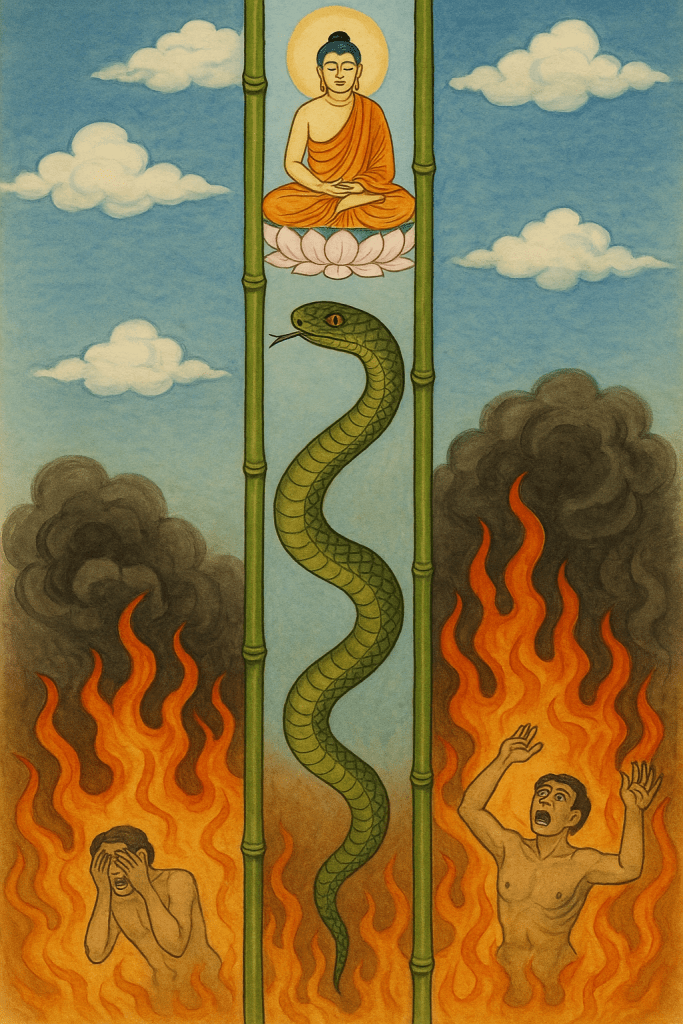
In Tibetan tantric Buddhism, the image of the snake trapped in a bamboo tube is more than a vivid proverb. It functions as a doctrinal warning: once a student enters the tantric path, there is no lateral escape. One either goes upward toward awakening or downward toward failure and “vajra hell.” Teachers have used this image to describe the uncompromising nature of samaya, the vows that bind a student to the guru, the deity, and the tantric methods themselves.¹

What is striking is how explicitly the tradition frames tantra as irreversible and high-stakes, and how rarely that stark truth is communicated to Western beginners before they agree to the vows that supposedly make the tube snap shut behind them. This mismatch between traditional warning and Western presentation is not a minor detail; it shapes the entire experience of Vajrayāna in modern contexts.

When the Warning Arrives Too Late

Many longtime practitioners have reported that the “snake in the tube” metaphor is introduced only after they have taken empowerments, established loyalty to the teacher, and accepted vows they did not fully understand. In one account, students were told after receiving advanced teachings that they were now like snakes [in a tube] with no side exit, and that questioning or leaving the guru’s authority carried dire karmic consequences.² Once framed in these terms, the student is no longer encountering tantra freely. The imagery becomes a retrospective justification for total commitment and an interpretive trap that discourages reevaluation, dissent or disengagement.

This sequencing matters. Warnings given after the student is already inside the tube are not warnings at all; they function as a mechanism of control. Sadly, it’s not just empty scaremongering to get the student to do whatever the teacher wants. The teacher can play a part in destroying the student if he wishes.

Western students, however, often enter tantra without the cultural framework that understands concepts like vajra–hell, and as a result frequently interpret them metaphorically or ignore them altogether during empowerments or teachings. As a result, the gravity of samaya is often hidden in plain sight. Students may assume that vows are symbolic or aspirational when, within the tradition, they are treated as binding conditions that determine spiritual destiny.

The asymmetry of information here is profound. Tibetan teachers know the stakes, but Western students usually do not.

Fear as a Reinforcing Mechanism

Inside the tantric system, samaya is often discussed as a bond of trust and devotion. But its shadow side is rarely addressed openly: the way threats of karmic ruin can be used to enforce silence and obedience. If leaving the guru, criticizing harmful behavior, or even doubting the teacher’s purity is framed as a breach of samaya, then fear becomes central to the student’s experience. Some Tibetan masters teach that both teacher and student can fall into vajra-hell for damaging the guru-disciple bond.³ In practice, however, this warning is most often directed at students, who are told that speaking publicly about misconduct or abuse may destroy their spiritual future.

Why the Snake Matters

The “snake in the bamboo tube” metaphor distills these concerns with unusual clarity. It shows that tantra is not designed to allow experimentation or partial commitment. It requires total participation in a closed system with its own rules, hierarchies, and cosmology. In cultures where this system has historically been embedded, those entering it do so in fuller awareness of the stakes. In the West, students often do not and they may hear such warnings in a highly suggestible state, without really grasping the implications.

One famous guru in the 1980s bluntly told students that they could be both Christian and Buddhist with no conflict whatsoever. This blatantly goes against Christian teaching. In those days Westerners were often thrust into the three-year-retreat program shortly after they signed up for teachings at Dharma centers with no knowledge of what they were really getting into. Many had little preparation to truly understand the arcane nature of samaya and its risks. Furthermore, many Tibetan teachers took advantage of their roles as authority figures to manipulate vulnerable students into sexual relationships and other sorts of commitments. Engaging in secretive sexual relationships with students while pressuring them to take highest yoga tantra vows and practices that would bind them forever often led to deep confusion and psychological unmooring.

The result is a form of spiritual engagement that looks consensual on the surface but lacks true informed consent. Students may be drawn in by promises of transformation but only later discover the rigidity of the commitments they have made. This is especially jarring given that Vajrayāna wraps together the renunciation of the Hinayāna, the boundless compassion of the Mahāyāna, and the esoteric demands of tantra. In this unwieldy fusion, the same tradition that teaches gentle observation of thoughts can also insist that a single critical thought toward one’s guru carries the weight of karmic catastrophe. The threat of vajra-hell sits uneasily beside Buddhism’s wider emphasis on compassion and non-judgment. An ethical issue looms large: a path that describes itself as having no side exit should not be offered as if it does.

To treat tantra’s danger as a secret or secondary detail is to undermine the integrity of the path itself. If practitioners are indeed snakes in a tube, they deserve to be told before they go inside.


Footnotes

¹ “Once you take samaya you become like a snake in a vertical bamboo tube: you’re either going up, or you’re going down. You can’t sneak out the side.” (Kun zang.org) (kunzang.org)
² Note: practitioner-reports and forum posts indicate the metaphor is often applied post-initiation. For example: “A Vajrayana practitioner is like a snake in a tube; … he can either go up or down, not left or right.” (dharmawheel.net)
³ “The metaphor for samaya is a snake in a bamboo tube. It has only 2 directions – up to enlightenment or down to the hells.” (TibetDharma.com) (Tibetan Buddhism)
When Tantric Union in Tibetan Buddhism is Invasive and Unwanted


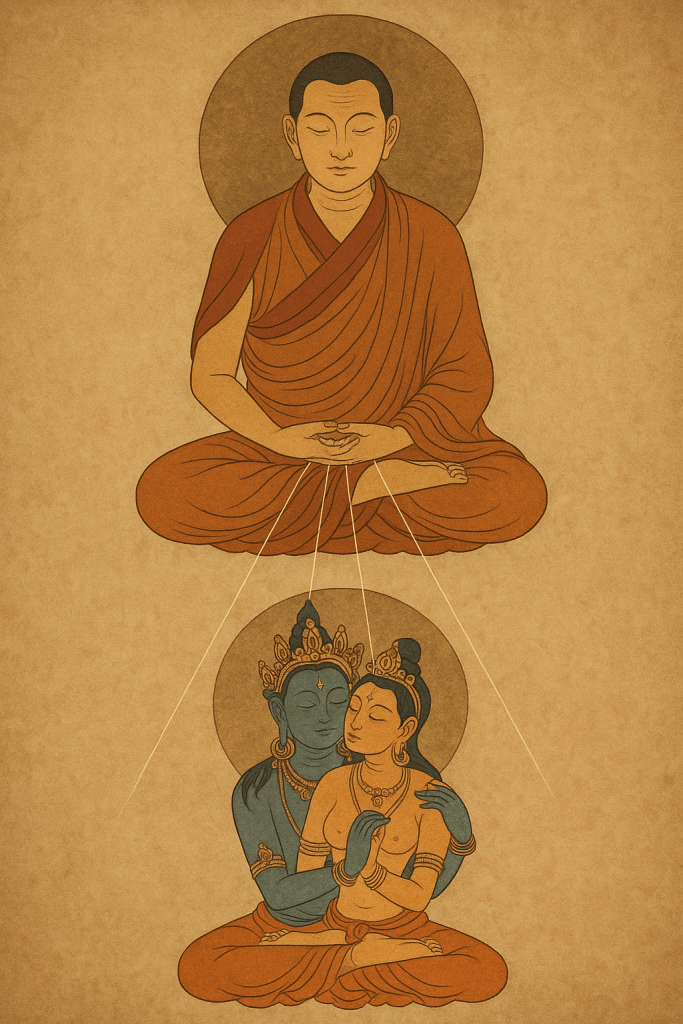
The ideal of tantric union in Vajrayāna Buddhism is described as the merging of wisdom and compassion, form and emptiness, masculine and feminine. In classical Tibetan art this appears as the yab-yum image of male and female deities in embrace.¹ The symbolism points to inner union, yet within the secrecy and hierarchy of tantra this ideal can become distorted. When intimacy, devotion, and power mix, the result can be psychological or sexual harm rather than awakening.

Union beyond the physical

“Union” (las kyi phyag rgya, maithuna) does not always refer to sexual intercourse. Many lineages teach “mental” or “energetic” union, where teacher and student visualize merging through subtle-body channels or shared deity practice.² Scholar Holly Gayley has examined how such “secret consort” (gsang yum) relationships blur lines between spiritual transmission and sexual exploitation.³

Anecdotal reports from practitioners describe non-physical experiences of sexual arousal or even orgasm initiated by the guru, without consent or understanding. For those unprepared, these experiences can feel like psychic invasion and an intrusion into the mind-body field. The ethical question is whether such experiences can ever be consensual in the context of absolute guru devotion.

The mechanism of “mental union”

Tantric theory holds that through visualization, mantra, and subtle-body control, energies (prāṇa, rlung) can be directed between beings. A guru visualized as a deity may “enter” the disciple’s heart or crown chakra, merging mindstreams in blessing.⁴ In positive settings this symbolizes transmission of realization. Yet in cases of coercion the same mechanism becomes violation: the student’s energetic body is penetrated without consent.

Ritual texts sometimes describe the guru entering the disciple’s central channel (tsa uma) through gaze or mantra, symbolic of energetic or spiritual transmission.⁵ Within Hindu Tantra, similar accounts exist of masters manipulating the disciple’s kundalinī or chakras.⁶ These ideas frame the possibility of non-physical sexualized experiences as part of spiritual union. When combined with secrecy and unequal power, the result may feel like mental rape rather than initiation.

Power, secrecy, and consent

The Vajrayāna guru is regarded as embodiment of the awakened state itself.⁷ Devotion to such a figure can override ordinary ethical boundaries. In Western contexts, where students lack cultural preparation, the potential for abuse rises sharply. Alexander Berzin warns that Western practitioners often misunderstand the traditional checks on guru authority and therefore submit to unhealthy relationships.⁸

Secrecy deepens the problem. The samaya vow forbids disclosure of tantric practices, even to peers. Gayley observes that this secrecy “can be used to reinforce sexual violence and silence abuse.”³

Real-world allegations

At Kagyu Samye Ling monastery and its retreat centre on Holy Isle in Scotland, multiple allegations have surfaced over the past decade. Reports describe bullying and psychological pressure during advanced retreats. Recently it was reported that a British woman may have died by suicide after a four-month retreat there. While there is no public evidence of sexual misconduct toward her, other survivors have alleged earlier incidents of “energy access” by the same teacher. Allegations included the use of “subtle body rape/sexual energy invasion,” according to an article by Adele Tomlin on the Dakini Translations website.⁹

The under-discussed nature of subtle-body abuse

Such cases remain largely invisible because tantric language itself obscures boundaries between metaphor and reality. A teacher’s claim of “mind-union” or “blessing” can mask non-consensual psychic intrusion. Students are often told that doubt equals spiritual failure, and that refusal breaks samaya. Without transparent ethics, the very tools meant to free the mind become weapons of domination.

Moving forward

Ethical tantric practice requires explicit, informed consent at every level: physical, psychological, and energetic. Teachers must articulate clearly what practices entail, and students must retain the right to refuse and leave. The spiritual promise of union cannot excuse the violation of personal autonomy. However, this kind of transparency is unheard of. Proper review structures and support for survivors are practically non-existent in most Tibetan Buddhist centers. The allegations surrounding Samye Ling and Holy Isle highlight what scholars such as Gayley describe as tantra’s “shadow”: the ease with which power can transform spiritual intimacy into a form of manipulation and abuse.


References

  1. Buddha Weekly, “What’s a Consort Union in Tantric Buddhism?” https://buddhaweekly.com/whats-consort-union-tantric-buddhism-no-not-sexual-fantasies-psychology-yab-yum-consorts-union-wisdom-compassion/
  2. Oxford Research Encyclopedia of Religion, “Tantra and the Tantric Traditions of Hinduism and Buddhism.” 2016.
  3. Gayley, Holly. “Revisiting the ‘Secret Consort’ (gsang yum) in Tibetan Buddhism.” Religions 9 (2018).
  4. Snellgrove, David. The Hevajra Tantra: A Critical Study. Oxford University Press, 1959.
  5. Wedemeyer, Christian K. Making Sense of Tantric Buddhism: History, Semiology, and Transgression in the Indian Traditions of Buddhist Tantra. Columbia University Press, 2013, esp. chap. 3–4, on symbolic initiation and tantric ritual language.
  6. White, David Gordon. Kiss of the Yoginī: “Tantric Sex” in its South Asian Contexts. University of Chicago Press, 2003.
  7. “The Guru Question: The Crisis of Western Buddhism and Global Future.” Info-Buddhism.com.
  8. Berzin, Alexander. Relating to a Spiritual Teacher: Building a Healthy Relationship. Snow Lion, 2000.
  9. Dakini Translations, “Suicide of Woman Reported in ‘Survivors of Samye Ling Support Group,’” by Adele Tomlin, the sole author of that site. https://dakinitranslations.com/2025/10/28/suicide-of-woman-reported-in-survivors-of-samye-ling-support-group-alleged-bullying-by-drupon-khen-karma-lhabu-teacher-misuse-tantra/
  10. Buddhistdoor Global, “Maithuna: Reflections on the Sacred Tantric Union of Masculine and Feminine.” https://www.buddhistdoor.net/features/maithuna-reflections-on-the-sacred-tantric-union-of-masculine-and-feminine/