
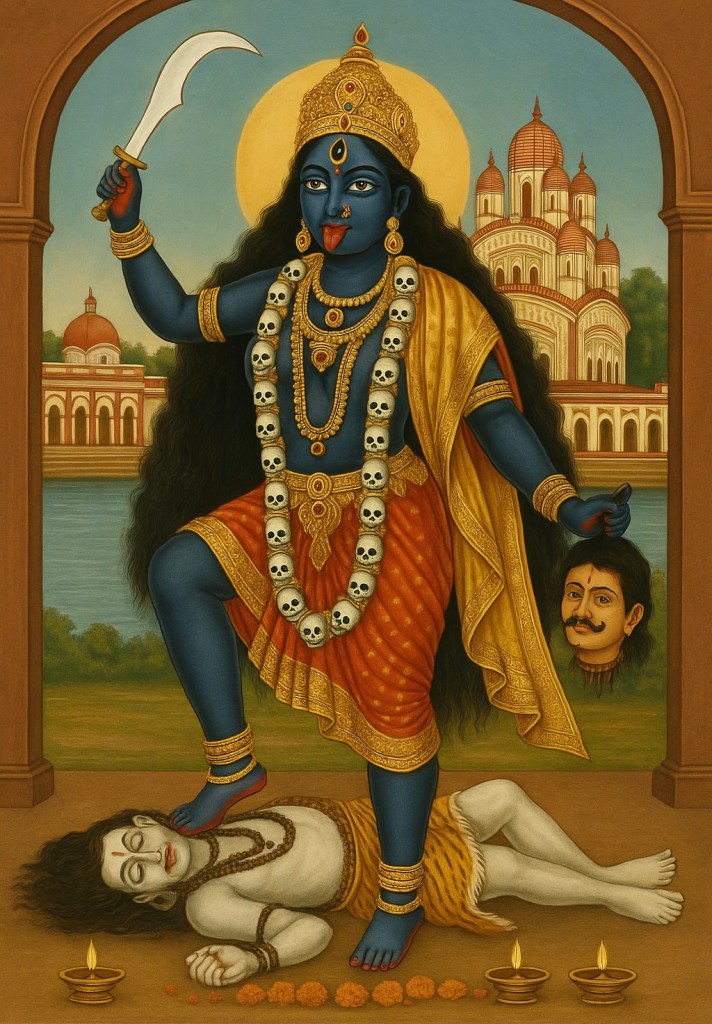
An Encounter with Kali


The descent into Bengal began with a vision. As our plane banked low over the hazy sprawl of Calcutta, I sat in meditation, quietly preparing for a long journey north to Sikkim for a series of tantric empowerments. Then, quite suddenly, a naked dakini appeared before me, dancing and beckoning. She seemed to be greeting me to Calcutta. I knew, or thought I knew, that it was Kali.

We stayed in a modest Baptist guesthouse chosen for its safety and low price, a short walk from Mother Teresa’s compound. It was late October, and the air was warm and humid. Calcutta felt down at heel, yet intellectual and dignified. My companions, all Tibetan Buddhist practitioners, decided to visit Mother Teresa’s place to pay homage. I hung back. They were sincere in their devotion to that famous nun, but something in me pulled in another direction. Although I had been raised Catholic, I felt a faint aversion to anything connected with the Catholic Church. I regarded the religion as problematic at that time. Still, seeing how genuinely excited my friends were, I encouraged them to go.

The next day I hired a taxi and arranged for us to cross the city to the Dakshineswar Kali Temple, the same temple where Ramakrishna had worshipped and experienced his visions of the Divine Mother and became enlightened. “We really must make the effort to see it,” I told the others, although I wasn’t sure why. The journey took nearly an hour through dusty streets and chaotic traffic. I had read that Kali was the patron goddess of Bengal, and that Dakshineswar was one of her most important shrines. The closer we came, the stronger the pull felt.

At the temple, a long line of Indian devotees wound through the courtyard, each waiting to glimpse the goddess and receive her blessing. We appeared to be the only Westerners there. I knew very little about the history of the temple at that point. All I knew was that I had always been intrigued by Ramakrishna among all the Hindu mystics and had always wanted to visit his temple and pay my respects.

The Temple and Its History

The Dakshineswar Kali Temple was founded in the mid-nineteenth century by Rani Rashmoni, a wealthy zamindar who, according to legend, dreamt that the goddess Kali commanded her to build a temple on the banks of the Hooghly River rather than journey by boat to Varanasi¹. Rashmoni had been preparing for the pilgrimage for months and had spent a small fortune, but on the night before her departure, Kali appeared in a dream and told her she need not travel at all. Instead, the goddess instructed her to raise a temple and enshrine an image that Kali herself would inhabit, blessing all who came to worship. The temple was completed in 1855 and the complex stands on land said to resemble a tortoise, a form considered especially auspicious in Shakta-Tantra cosmology².

Architecturally, the main temple is built in the navaratna (nine-spired) style typical of Bengal, raised on a high platform overlooking the river³. Surrounding the sanctum are twelve identical Shiva shrines aligned along the Hooghly’s edge, a small Radha-Krishna temple, and bathing ghats for pilgrims⁴.

Inside the sanctum resides Bhavatarini, a fierce aspect of Kali known as “Saviour of the Universe,” depicted with one foot on Shiva’s chest⁵. The mystic Ramakrishna served as the temple’s priest and carried out years of intense spiritual practice within its grounds, transforming the site into one of India’s holiest centers of Shakti worship⁶. The atmosphere is thick with incense, bells, flowers, and the hum of a thousand mantras. Once inside the gate you feel the city’s chaos fall away.

As we stood in line, something unexpected happened. An Indian guard suddenly appeared, motioned to me and a Buddhist friend, and beckoned us forward. Without explanation, we were led past the waiting crowd directly to the inner sanctum. The goddess stood before us, draped in red and gold, eyes alive in the flicker of ghee lamps. When I received prasad, it tasted sweet and delicious, and I felt a surge of a deep, penetrating love. It was so overwhelming that I began to cry.

As a Tibetan Buddhist, I had always regarded Hindu deities as somehow inferior and secondary to the Tibetan ones who were the representations of the ultimate truth. My practice had centered on Vajrayogini and Chakrasamvara, not on Kali. Yet there, when the experience of divine love engulfed me in the Dakshineswar temple, I felt an unmistakable recognition.

Years later, after surviving the catastrophic unraveling of my own tantric path due to the betrayal by male Buddhist teachers, the exposure of their sexual abuses, and the psychic annihilation that followed, I began to study the origins of tantra in earnest. Through the research of Alexis Sanderson and others, I learned what my experience at Dakshineswar had already shown me: that the yoginī tantras of Tibetan Buddhism arose from the same crucible of medieval Hindu Śaiva and Śākta practice⁷. Vajrayoginī, the red goddess of my own initiations, was in essence a Buddhized form of Kali. The goddess in both traditions can give blessings and boons, but she can become, in an instant, a terrifying and destructive demon with her own set of intentions and cosmic laws.

That insight came at great cost. The deeper I studied, the more clearly I saw that tantra, in both Hindu and Buddhist forms, was inseparable from forces of domination, secrecy, and power. The same ecstatic current that once inspired devotion also lurked behind manipulation and abuse. In the West, these darker currents were long dismissed or hidden, until the many scandals of 2017 tore the veil away.

My visit to Kali’s temple remains a paradox. In that moment I felt only grace: the raw, overwhelming presence of the divine feminine. But in hindsight, I experienced Kali as both mother and destroyer, blessing and devourer. She welcomed me to Calcutta with open arms, but in time, in her Buddhist form as Vajrayogini, she stripped me of everything I held dear in order to completely destroy my body, mind, and soul. By the grace of the highest divinity, the eternal Christian God, I survived and am still alive to tell the tale.


Notes

  1. Dakshineswar Kali Temple, Wikipedia, last modified 2025.
  2. Ibid.
  3. Ibid.
  4. Ibid.; see also Dakshineswar Kali Temple official site, Places in Dakshineshwar (dakshineswarkalitemple.org).
  5. Dakshineswar Kali Temple, Britannica.
  6. Ibid.; Ramakrishna’s association documented in Swami Nikhilananda, The Gospel of Sri Ramakrishna (New York: Ramakrishna-Vivekananda Center, 1942).
  7. Alexis Sanderson, “The Śaiva Age: The Rise and Dominance of Śaivism during the Early Medieval Period,” in Genesis and Development of Tantrism, ed. Shingo Einoo (Tokyo: Institute of Oriental Culture, University of Tokyo, 2009), 41–350.


The Mask of Enlightenment


A Survivor’s Account of Spiritual Abuse

In the modern spiritual landscape, the image of the Tibetan Buddhist guru reigns supreme: a figure of wisdom, compassion, and radiant loving-kindness. They preach mindfulness, selflessness, and sanctity, inviting seekers into what appears to be a sacred journey toward enlightenment. Yet, to me, this image is a facade, a carefully curated performance masking a much darker reality.

I write these words not as a distant observer but as someone who has experienced firsthand the profound betrayal of being targeted by spiritual teachers I once trusted. In my personal journey, three different gurus, revered in their communities for saintly and/or enlightened behavior, turned to black magic rituals against me when I questioned, disagreed, or simply became inconvenient to their carefully maintained personas. This article is an exploration of the deep cognitive dissonance that allows such individuals to publicly embody ideals of compassion while privately committing acts of cruelty.


The Ideal: Loving-Kindness and Compassion as a Mask

Gurus in traditions such as Tibetan Buddhism, Hinduism, and various New Age movements are often held up as embodiments of selfless love and wisdom. Their teachings and writings are saturated with the language of peace and universal compassion. In public, they radiate qualities such as patience and gentleness, reinforcing the image of infallibility.

This idealized projection is not merely for the benefit of followers; it also serves the guru’s own self-concept. They must see themselves, and be seen as holy, thereby reinforcing their authority and maintaining their social and spiritual power.


The Threat: When a Disciple Questions Authority

In the sanitized image of the perfect guru, there is no room for dissent. Questions, criticisms, or any sign of independence from a disciple can be perceived not as opportunities for dialogue, but as existential threats. After all, if a guru’s authority rests on the illusion of flawless wisdom and compassion, any crack in that image could unravel the entire edifice.

When faced with a questioning or independent-minded disciple, an insecure guru may respond not with the compassion they preach, but with fear, rage, and vindictiveness. To protect their power, they must eliminate the threat, not through open dialogue or humility, but through covert aggression.


The Betrayal: Weaponizing Spiritual Power

Traditions rich in esoteric knowledge provide tools that can be used for healing and protection, but also for harm. Tibetan Buddhism, for instance, preserves rituals historically intended to call down curses, obstacles, and psychic attack upon perceived enemies.

In my experience, these gurus invoked black magic against me. These were not random charlatans; they were highly respected spiritual leaders, who waxed eloquently in the language of love and compassion. Yet when challenged, they resorted to covert energetic and magical attacks, using the very tradition they claimed to uphold to violate the sacred trust between teacher and student.


Cognitive Dissonance: Reconciling Saintliness with Malice

How does a guru reconcile the horror of harming a disciple while maintaining their self-image as a bodhisattva, a compassionate enlightened being? The answer must lie in cognitive dissonance: the mental stress of holding two contradictory beliefs simultaneously.

To preserve their self-concept, the guru must justify their actions internally:

  • “I am protecting the dharma.”
  • “This disciple was dangerous, impure, deserving of punishment.”
  • “Sometimes cruel and violent actions are necessary for the greater good.”

Through rationalization, projection, and splitting, they maintain the fiction of compassion while engaging in spiritual violence. They convince themselves that their harmful actions are righteous, necessary, and justified.


The Aftermath for the Disciple

For those of us on the receiving end, the experience is devastating on many levels. It deeply tears at the soul to be targeted by those we once revered. The betrayal fractures trust not only in teachers but in the entire spiritual path. The disciple may grapple at first with:

  • Confusion: “Was it my fault?”
  • Self-doubt: “Did I deserve this?”
  • Spiritual disillusionment: “Is true compassion even real?”

If the disciple survives this first stage, similar to a victim of Stockholm syndrome, there comes a gradual dawning of the truth: the Tibetan Buddhist path, far from being one of light, has revealed itself as a path of darkness. That realization, painful as it is, can ultimately be deeply empowering.

I do not minimize the devastating effects of the powerful magic performed by these modern-day mahasiddhas. Black magic attacks are very real, manifesting as physical illness, emotional despair, and worse. Healing from such trauma requires immense courage and deep inner work. It is one of the most horrific experiences a human being can endure.

Yet, there is a stronger and truly holy force at work in the universe: the Most High God–yes, the biblical God. Sadly, many Tibetan gurus seem to have little experience of Jesus Christ, the Holy Spirit, or the true mercy and compassion that they embody.


The Deeper Horror: Gurus Possessed by False Spirits

It is not enough to say these gurus made mistakes or succumbed to human weakness. When a soul trained in the disciplines of compassion, wisdom, and loving-kindness instead chooses cruelty, retaliation, and spiritual violence, something darker is at work.

One must ask: how can they inflict such harm without being crushed by the weight of their own conscience? The terrifying truth is that many of these gurus may no longer be acting from their own hearts at all. They are, at some deep inner level, possessed, not by the enlightened deities they claim to serve, but by deceptive demonic forces masquerading as gods, bodhisattvas, protectors, and spirits of light.

In their ignorance and self-deception, they have invited darkness into themselves. They have handed over their will to entities that delight in mockery, destruction, and the inversion of sacred teachings. The rituals they once performed for healing and protection now become channels for curses, oppression, and spiritual decay.

And yet, even in this darkness, a greater light shines.

There is a true and living God, the Most High, whose justice is perfect and whose mercy is real. There is Jesus Christ, the Holy Spirit, and the incorruptible power of divine love, utterly beyond the reach of these childish gurus and their counterfeit spiritualities.


What I Thought I Was Practicing in Tibetan Buddhism vs. What It Really Was


When I first encountered Tibetan Buddhism, I was filled with awe, curiosity, and hope. I was drawn to the idea of understanding the nature of mind, developing calm abiding (shamatha), and cultivating compassion and insight. I immersed myself in classic Mahayana texts like the Uttaratantra Shastra, with its soaring vision of Buddha nature, the luminous potential for awakening that each sentient being carries within them.

At that time, I was eager to deepen my meditation practice and learn how to navigate the mental storms of daily life. I believed this was a path of inner wisdom, clarity, and direct realization. I thought I had found something intellectually rigorous and deeply profound.

But after committing years of my life I realized that Tibetan Tantric Buddhism was a spiritual system that operated under authoritarian control, cultural secrecy, and a disturbing atmosphere of fear.

The Surface Beauty: What Drew Me In

  • The language of awareness, wisdom, and nonduality
  • Practices that promised to tame the mind and open the heart
  • Philosophical texts filled with Buddhist logic, the concept of emptiness, and the path of the bodhisattva
  • Encouragement to observe the mind and transcend egoic fixation

Like many sincere Western seekers, I accepted the rigid cultural structure, including the many hours of chanting in Tibetan, the hierarchy, and the ornate rituals, as necessary forms for accessing ancient wisdom. I told myself these were wrappings around the real treasure.

What I Actually Encountered

Instead of freedom, I slowly found myself embedded in a system that demanded unquestioning obedience to the guru, who was said to be indistinguishable from the Buddha himself. We were told the guru’s words were more important than our own inner convictions. If we had doubts, those were signs of impure perception or obstacles on the path.

And so, I suppressed my own sense of truth.

Instead of learning to observe my mind freely, I was encouraged, compelled, really, to submit my perception, my will, and even my moral conscience to someone else’s “realization.” In time, I was told that even misconduct or abuse from a guru must be viewed as pure, and that questioning it was a sign of my spiritual deficiency.

Essentially this was total submission to a human teacher presented as a living deity.

A Necessary Evil… or Something More?

For a long time, I rationalized this aspect of guru devotion. I thought, “This is just part of the package. I’ll take the good parts and accept the hierarchical guru system as a necessary condition to receive the blessings.”

But nothing prepared me for the revelation that this system involved actual practices of deity possession, and in some cases, black magic rituals by a covert spiritual power structure that operated on vengeance. And this wasn’t metaphorical.

The Hidden Core: Deity Possession and Guru Sorcery

Many Tibetan Vajrayana rituals involve āveśa, a concept that translates into spirit or deity possession. The practitioner “invites” a deity to merge with their mindstream. The guru is not just a teacher; he is seen as an embodiment of the deity, and rituals are performed to enforce that identification.

I discovered too late that some high-level gurus use this system to gain psychic and physical access to their disciples, manipulate their minds, and even curse those who disobey or break vows. This is not hyperbole but what has been hidden under the language of compassion and wisdom: a deeply esoteric system of spiritual domination.

My Awakening

It took me years to deprogram myself from the idea that questioning a guru meant spiritual death, and even longer to reclaim my own inner voice, the voice God placed in me. I now walk a different path entirely: One that does not require blind submission, that honors truth over secrecy, and Christ over cosmic manipulation.

If You’re Reading This…

You’re not crazy for feeling that something is off. You’re not wrong to listen to your instincts. What seems like harmless chanting, beautiful thangkas, and inspiring philosophy may hide something far more controlling and spiritually dangerous than you realize.

Jesus Let Me Walk Away; the Gurus Did Not


When I was fifteen, I walked away from the Catholic Church.

There was no drama, no spiritual backlash, no eerie sense of guilt or dread. I simply left. I had questions, and I didn’t know the answers. Like so many teenagers raised in religion, I drifted toward freedom, or what I thought was freedom. But I never stopped believing in Jesus Christ. I always knew He was real.

Still, for eight years, I lived outside the Church. No demons haunted me. No spiritual “agents” came after me. No dark force tried to pull me back or punish me. I was free to explore.

Then, at twenty-three, I was introduced to Tibetan Buddhism by a friend. Spiritual curiosity quickly became commitment. The teachings were deep, the rituals profound, and the promises huge. My belief in Jesus wasn’t challenged outright; instead, the gurus cleverly and swiftly recast Him as a “bodhisattva,” one of many enlightened beings in a cosmic buffet of spiritual options. I was told He was admirable, but not unique. Just another wise, and probably enlightened teacher.

I didn’t realize then how that subtle shift had planted the seeds of spiritual confusion. Over time, the practices became more demanding and more secretive. Eventually questions weren’t welcomed. When I began to notice darker occult elements woven into the heart of the practice, I had troubling doubts. The tantric path spoke of vajra hell, an eternal punishment for those who questioned or broke samaya (spiritual vows to the guru). And not just for betrayal or disobedience, but even for internal doubts.

And when I had them, everything changed.

I was tossed out. Not just socially or emotionally, but spiritually. I was attacked, not just by my former gurus, but by unseen forces. It was violent and supernatural. The very same tradition that had claimed to offer peace and enlightenment unleashed something very dark the moment I started to turn away from the guru.

This wasn’t like walking away from the Catholic Church. It was completely different. I experienced a spiritual assault of such magnitude that no one could believe me. And it begged the question: What kind of spiritual path tortures you for eternity for having doubts?

A demonic path does.The historical Buddha taught to question everything, but tantra did not allow it.

Tibetan Buddhism may parade as a tradition of compassion and peace, but my experience showed otherwise. If it were truly of the Light, it wouldn’t need to threaten vajra hell or unleash invisible tormentors on those who simply ask blunt and honest questions. It wouldn’t need to cloak the guru in infallibility while turning a blind eye to his abuse. And it certainly wouldn’t need to demonically retaliate against a soul simply for having doubts and trauma. The difference between the two paths couldn’t be clearer. When I left the Church, there was silence. When I left Tibetan Buddhism, there was war.