
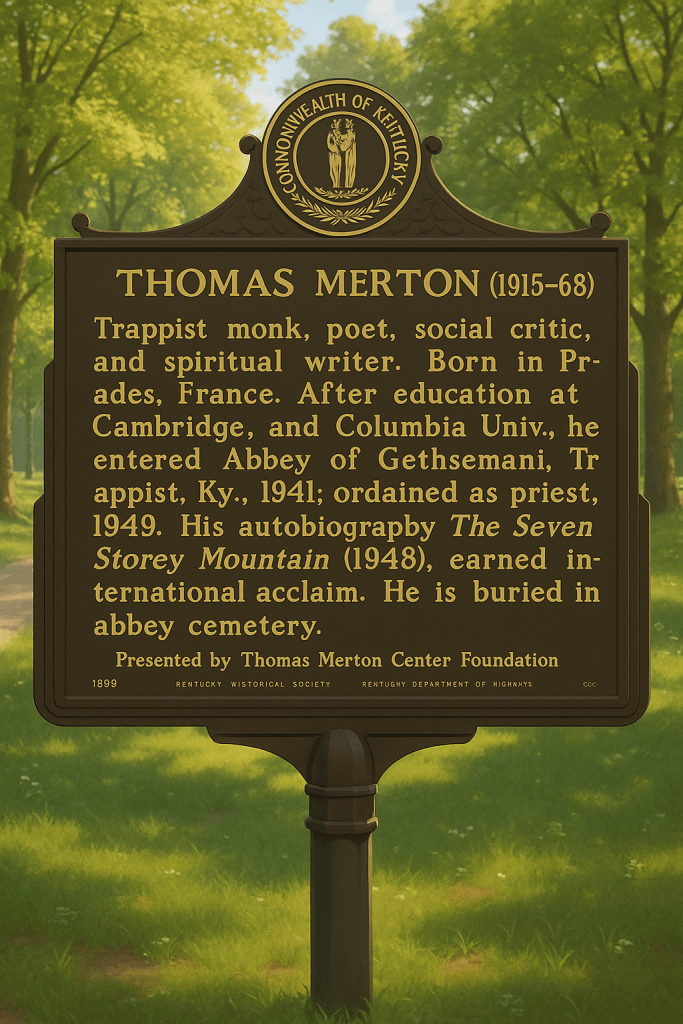
Thomas Merton’s Exploration of Tibetan Buddhist Mysticism and His Untimely Death


Thomas Merton remains one of the most fascinating and controversial figures in modern Catholic spirituality. A Trappist monk whose writing reached millions, he invited readers into a life of contemplation shaped by silence, inner stillness, and spiritual inquiry. By the 1960s, his search had expanded far beyond the borders of Christian tradition and into the world of Eastern mysticism. His journey raises important questions about discernment, authority, and the possibility that some mystical experiences do not come from God at all.

Why Merton looked East

Merton believed that Western Christianity had lost something essential. He felt that institutional concerns and intellectual debate had overshadowed direct experience of God. Eastern religions appeared to preserve a contemplative path in a purer form. Like many in the post–Vatican II era, he saw dialogue with non-Christian religions as an opportunity rather than a threat.

But such openness came with a cost. Many Catholics of his time assumed that all deep mystical traditions shared a common source. The idea that spiritual experiences could arise from contrary or even deceptive origins was rarely discussed. This lack of discernment created a vulnerable generation of seekers who treated Eastern practices as spiritually neutral when they were not.

Merton’s early interest in Asia

Long before traveling to Asia, Merton was reading Zen, Taoism, Advaita Vedanta, and Sufi mystics. He approached them with sincere curiosity, but also with a growing assumption that truth could be gleaned from any direction. His writings from this period suggest a desire for universal contemplative experience, sometimes without sufficient attention to the distinct theological and spiritual claims behind each tradition.

This tendency to universalize mystical experience would shape his final years.

Meeting the Dalai Lama

In 1968, Merton traveled to Dharamsala and spent several days with the Dalai Lama. Their meetings were warm and genuinely contemplative. Merton admired the Dalai Lama’s kindness, discipline, and clarity. The Dalai Lama later remembered Merton as the first Christian monk who came to him not as a tourist or academic but as a fellow practitioner of deep prayer.

Yet admiration does not erase theological differences. Tibetan Buddhism denies a creator God, embraces reincarnation, and employs esoteric tantric practices that involve deities outside the Holy Trinity. From a Christian point of view, this difference is huge. The Church has long taught the discernment of spirits: mystical experiences must be tested, because deceptive spiritual forces can imitate peace, clarity, and even compassion. Merton did not always express this caution.

Encounter with Kalu Rinpoche

Merton also met Kalu Rinpoche, one of the most respected Tibetan meditation masters of the twentieth century. He attended teachings on Mahamudra and was deeply impressed by the monastic discipline he witnessed. Kalu Rinpoche even invited him to undertake a long hermit retreat. Merton seemed drawn to the idea.

But Tibetan Buddhism contains layers of esoteric practice that Merton, like most Westerners of his time, did not fully understand. The serene exterior of Tibetan spirituality often conceals tantric rituals, spirit invocation, and hierarchical guru devotion that are fundamentally incompatible with Christianity. Later revelations of abuse and occult manipulation inside some of the major Tibetan lineages show how incomplete the Western picture had been. Merton could not have known this, yet his enthusiasm reflected a lack of discernment that would affect many who followed in his footsteps.

What else he explored

Merton’s range of interests was broad. He read Zen masters, Taoist sages, Hindu philosophers, and Sufi poets. He studied Christian hesychasm with new energy and sought common threads among all traditions. His impulse was generous, but generosity is not the same as spiritual clarity. Christian prayer directs the soul toward union with God. Eastern meditation, especially tantra, aims at dissolving the ego and merging with non-Christian spiritual entities.

These are not complementary goals but representative of different spiritual destinies.

Bangkok and a mysterious death

After leaving Dharamsala, Merton traveled to Bangkok to speak at an international monastic conference. On December 10, 1968, he died in his cottage shortly after giving a lecture. The official explanation was accidental electrocution from a faulty fan. Yet no autopsy was performed, and the circumstances were poorly documented. The inconsistencies have fueled speculation for decades.

His death came at a moment when he was moving more deeply into Buddhist thought. Whether he intended to integrate aspects of Tibetan practice into Christian monasticism remains unknown. His passing has an unfinished quality, as if he was on the edge of a major spiritual shift whose implications were never tested.

Why Merton still matters

Merton’s life challenges readers to seek authentic spiritual contemplation, not just intellectual understanding. It also warns Christians that not every path that promises depth is aligned with God. Eastern systems often carry metaphysical commitments and spiritual forces that stand in real conflict with Christian revelation. Without a strong framework of discernment, even sincere seekers can be misled.

Merton’s writings still inspire, yet his story also stands as a cautionary tale. The longing for mystical experience is real and often holy, but it must be shaped by sound doctrine and a sober awareness that not every spiritual path leads toward God.
Was the Caduceus Reborn in the East?


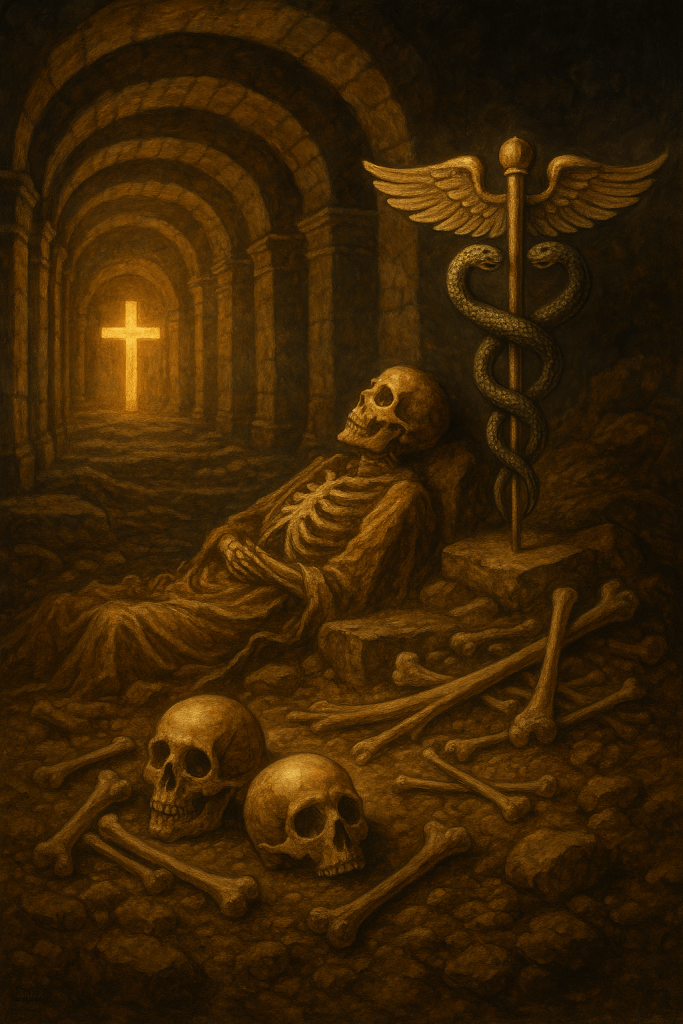
In the ancient catacombs beneath Rome, the bones of countless Christian martyrs still rest. Their blood once soaked the soil of the Eternal City, spilled in arenas and burned at stakes. These early saints stood firm as the empire raged against them, refusing to bow before the gods of Olympus. Their sacrifice helped dismantle an entire pantheon, culminating in the 4th century with the conversion of Emperor Constantine and the eventual abolition of state-sponsored paganism.

This was no mere political shift; it was a metaphysical war. The temples of Mercury, Dionysus, and Asclepius were shuttered or repurposed. The rites of Isis, Mithras, and the Eleusinian mysteries faded into obscurity. The cross had conquered the caduceus.

But pagan gods, the fallen angels never truly die. They reinvent themselves. And sometimes, they reappear in new lands wearing different clothes.

The Echoes of Hermes in the Serpent of Shakti

After Constantine, as Christian Rome rose from the ashes of the pagan world, something remarkable was stirring across the continent in India. By the 5th century, the traditions of Tantra and Kundalini had begun to take shape. Where Rome had cast down the serpent as a symbol of Satan, Indian mysticism raised it up as the dormant energy of the Divine Feminine, Kundalini.

Can we trace a spiritual current from Hermes to Shiva, from the Greek mysteries to the yogic inner fire? This is speculative, but consider the astonishing parallels:

ThemeGreco-Roman (Hermes, Asclepius)Indian Tantra/Kundalini
SerpentsSymbol of wisdom, healing, dualityCoiled energy, Shakti
Staff or AxisCaduceus (Hermes), two snakes coiled around a staffSushumna nadi (central energy channel flanked by solar and lunar channels)
HealingAsclepius, god of medicineKundalini as transformative healing energy
Divine UnionHieros gamos, Dionysian ecstasy, inner union of male and female energiesShiva–Shakti union
Body as microcosm of the universeMystery religions, alchemyTantric yoga, body as vehicle to moksha (liberation)

If we imagine the fall of Greco-Roman religion not as a disappearance but as a transmutation, we might say:

The energy of Hermes migrated eastward, shedding its Western garb and reappearing as Shiva, serpent-lord and cosmic dancer, custodian of the inner path.

A Vision in the Night

Early this morning, something powerful happened to me. I woke up at around 2:30 or 3:00 a.m. and engaged in deep Catholic prayer. Afterwards, I drifted back into sleep and experienced a vivid spiritual battle.

I saw the Caduceus and felt the presence of a dark force, perhaps a demon. Then I sensed small demons leaving as if they shot out of my mouth on puffs of air, accompanied by groaning, crying, even the sound of gunshots, as though a war was raging inside my soul. At the end of the vision, one man remained below, pointing a gun upward. I watched from a higher vantage point. Who was he? The man, I believe, was Satan.

He was not dead and he was poised to keep fighting.

I woke up. What I experienced wasn’t just a dream. It felt like an echo of that ancient struggle in Rome, replayed within the temple of my own body. The Christian martyrs cast down idols with their blood. We, too, must cast down what is false within us at whatever cost; we must uproot and cast out the inner serpent that slithered in during years of practicing the occult.

Rome uprooted the pagan gods and repurposed their shrines into Catholic cathedrals. Sadly, the pagan entities they represented were not destroyed. Perhaps they merely migrated east, into the rituals of Tantra, the breath of yogis, and the rising coil of kundalini.

The Illusion of Harmony: How Eastern Mysticism Misleads Christian Seekers


In today’s spiritual landscape, a troubling trend is emerging: well-meaning Christians are being led to believe that Tibetan Buddhism is not only compatible with Christianity but can even enhance it. This deception, often subtle and clothed in the language of “contemplation” or “interfaith dialogue,” has found its way into Catholic monasteries and retreat centers. At the heart of this distortion is the adoption of Eastern meditative techniques, often inspired by Tibetan Buddhist practices, and the uncritical embrace of yoga as a “neutral” spiritual discipline.

To be clear: Tibetan Buddhism is not a Christian cousin. It is a profoundly different worldview, rooted in concepts like reincarnation, karma, and the ultimate dissolution of the self, doctrines wholly incompatible with Christianity’s vision of a personal, relational God and the eternal dignity of the soul.

Meditation or Manipulation?

The Christian tradition has long held a deep respect for silence, prayer, and contemplation, especially in the monastic practices of the Desert Fathers or the Hesychast tradition of Eastern Orthodoxy. But what is often marketed today as “meditation” bears little resemblance to Christian prayer. Tibetan Buddhism aims at the realization that the self and all phenomena are empty of inherent existence, a direct experience of emptiness (śūnyatā) and the luminous, non-dual nature of awareness.

This goal is diametrically opposed to Christian theology, which insists on the uniqueness of each soul, created in the image of God and destined for eternal communion with Him.

Yet Christian leaders and institutions have increasingly opened the door to these teachings. For example, the late Father Thomas Keating, one of the leaders of the Centering Prayer movement, drew heavily on Eastern techniques, often blurring the line between Christian contemplation and Buddhist meditation. Though his intentions were no doubt sincere, the result was a confusing blend of incompatible truths.

Another case is Father Richard Rohr, a popular Franciscan whose teachings often echo non-dual philosophies far closer to Eastern mysticism than to historic Christianity. Rohr’s discussions of “Christ-consciousness” and the illusion of the separate self bear striking resemblance to Tibetan Buddhist views, yet they are consumed by many Catholics and Protestants as if they are orthodox.

The Yoga Trap

Yoga is another Trojan horse in the spiritual lives of many Christians. Despite its spiritual roots in Hindu and Buddhist traditions, yoga is often presented as a harmless or purely physical practice. In truth, yoga’s asanas (postures) were designed not for exercise, but as physical preparations for meditation and kundalini awakening, specifically, awakening to a worldview that denies the personal God revealed in Jesus Christ.

When Christians engage in yoga or Tibetan-inspired meditation without discernment, they open themselves up not just to foreign practices, but to foreign spirits. This is not religious paranoia but a spiritual reality. St. Paul warned the Corinthians about participating in pagan rituals, saying, “You cannot partake of the table of the Lord and the table of demons” (1 Corinthians 10:21).

The Deception of Compatibility

Tibetan Buddhist teachers are often happy to affirm Christian practices, so long as they are reinterpreted through a Buddhist lens. Some even encourage Christians to see Jesus as an “enlightened teacher” or “bodhisattva.” This allows the surface appearance of interfaith respect while subtly undermining core Christian claims: the Incarnation, the Resurrection, and the uniqueness of Christ as Savior.

This is not compatibility, but syncretism and it poses a spiritual danger.

A Call to Discernment

This is not to instill hostility or fear of Buddhism and other Eastern Religions. Nor is it a rejection of silence, stillness, and physical well-being. But Christians must recover the spiritual discipline of discernment. Not all that brings peace is from God. The Enemy is more than capable of offering counterfeit serenity, especially when it draws people away from the Cross and toward self-deification or belief in idols.

Christianity offers its own deep, mystical tradition rooted not in esoteric techniques or mantras, but in personal relationship with the living God. Prayer, asceticism, sacramental life, and union with Christ are more than sufficient for those seeking transformation. We do not need to import Tibetan concepts or yogic practices to find God. He is already here, knocking at the door.

The growing blend of Tibetan Buddhism and Christianity may feel harmonious on the surface, but this is illusory. At its core, the Gospel is not compatible with systems that deny Christ’s divinity, the soul’s eternal destiny, or the Triune God. As Christians, we must not be seduced by exotic forms of “spirituality” that utilize half-truths, and communion with fallen angels.