Anatomy of a Murder: Consciousness Destruction Ritual in Tibetan Tantra

Hidden in the depths of Tibetan esoteric traditions, certain wrathful rituals exist that are rarely spoken of outside the inner sanctums of designated tantric practitioners. These rituals, designed for the destruction of a consciousness, are meant to dissolve its influence, perceived obstructive intent, or spiritual presence. While these practices claim to protect against malevolent spirits, they have, at times, been weaponized against living humans, including those who threaten to expose misconduct within Buddhist institutions.


The Ritual of Consciousness Annihilation

A specific type of tantric ritual involves an esoteric diagram, similar to the one depicted in the image above, where a human form is inscribed with powerful mantras, seed syllables, and esoteric symbols. There is a six-pointed blade weapon surrounding the victim. The six points of the blade correspond to the double triangle (hexagram-shaped) mandala of the chief deity in this lineage. If the deity and guru/s decide that the practitioner has broken the samayas (tantric laws), according to their system, the deity’s mandala turns into a horrific weapon that destroys the mind/consciousness of the victim. But this ritual doesn’t just affect the mind/consciousness, it also has a profound effect on the physical body. The victim’s body will be tortured extensively through a type of voodoo and the very shape of the person’s body will morph to resemble the figure in the diagram. This ritual serves to bind, neutralize, and dissolve a targeted consciousness, whether it be an external spirit, a human, or a “perceived” karmic obstruction. The ritual process follows a structured framework

  1. Creation of the Diagram
    • The targeted consciousness is symbolically bound within a mandala-like formation.
    • Protective and wrathful mantras seal off escape routes.
    • Crosses and sigils mark the finality of the destruction process.
  2. Invocation of Wrathful Deities
    • Mantras and visualizations call forth powerful, wrathful deities.
    • The deities are instructed to subdue, bind, and annihilate the “perceived” enemy.
    • The practitioner performing the ritual sees themselves as a manifestation of the deity, wielding its power.
  3. Execution of the Consciousness
    • The bound entity is pierced, burned, or dissolved into emptiness.
    • Ritual implements, such as a phurba (ritual dagger), are used to cut through the energy ties of the target.
    • The ritual often ends with the destruction of the paper or material that carried the sigils.

The Four Wrathful Deities that Could be Used in Consciousness Destruction Rituals

1. Mahākāla (The Black-Cloaked Guardian)

Mahākāla is the supreme protector of the Dharma, known for his fierce nature. In the context of destructive rituals, Mahākāla is invoked to crush obstacles and eliminate spiritual threats. His iconography often features a black body, fiery aura, and skull garland, symbolizing the destruction of ignorance and negative forces.

  • Origins: Derived from Hinduism’s Shiva, Mahākāla was integrated into Buddhism as a Dharma protector.
  • Role in Rituals: Practitioners visualize Mahākāla’s fire consuming the obstructive consciousness, reducing it to emptiness.

2. Vajrakīlaya (Dorje Phurba, The Slayer of Demonic Forces)

Vajrakīlaya is one of the most feared wrathful deities in Vajrayana Buddhism. He is depicted holding a three-bladed phurba dagger, which symbolizes his power to penetrate and destroy negative karmic influences and malicious forces.

  • Origins: Introduced into Tibetan Buddhism through the great master Padmasambhava.
  • Role in Rituals: Vajrakīlaya’s phurba is symbolically plunged into the obstructive consciousness, shattering its energy and dispersing it into the void.

3. Dorje Legpa (The Enforcer of Vows)

Dorje Legpa is a lesser-known but highly effective Dharma protector, often depicted riding a snow lion. His primary role is to punish those who violate spiritual oaths and disrupt the Dharma.

  • Origins: A native Tibetan deity later assimilated into Buddhist protector pantheon.
  • Role in Rituals: He is invoked to hunt down malevolent forces, bind them in the diagram, and neutralize their influence.

4. Ekajati (The One-Eyed Protector)

Ekajati is a wrathful female deity, feared for her ability to cut off the life force of negative beings and obstructive forces. She is depicted with one eye, one tooth, and one breast, symbolizing her singular focus on eradicating spiritual threats.

  • Origins: A key protector in the Nyingma and Kagyu traditions, linked to Padmasambhava.
  • Role in Rituals: Practitioners visualize Ekajati severing the energy threads of the targeted consciousness, ensuring complete destruction.

Historically, these rituals were supposed to be used to eliminate spiritual and karmic obstacles, not to harm innocent people. However, in some cases, they have been repurposed as tools of suppression within Buddhist institutions. When fear, secrecy, and power dynamics come into play, these ancient magical practices can be wielded as weapons.

There are instances where individuals who were never a true threat to the Dharma were nonetheless targeted. Some have been subjected to these rituals simply because they possessed knowledge that could expose wrongdoing, particularly cases of sexual misconduct and abuse within monastic settings. Instead of facing accountability, certain powerful tantric figures within these circles have used their esoteric knowledge to attack those they feared might reveal the truth.

Karmic Consequences of Weaponized Tantra

From a Buddhist perspective, the intentional use of spiritual power to harm others, especially for self-serving reasons, carries immense karmic consequences. Perhaps this can explain why certain prominent lineages in Tibetan Buddhism face overwhelming obstacles, such as vicious infighting and shocking treachery.

  • If such a ritual is performed with malicious intent, the negative karma generated will eventually return to the practitioner.
  • Those who use these practices risk invoking their own downfall.

Consciousness destruction rituals are horrific tools of suppression and spiritual manipulation. The existence of these rituals, the fact that they abide within the sacred confines of the so-called Buddha Dharma, raises an important ethical question: Who decides what constitutes an “enemy of the Dharma” and how does this practice line up with the teachings of the historical Buddha that emphasize ahimsa or non-violence? And why aren’t spiritual seekers told the truth about these destructive practices before they sign their names on the proverbial dotted line. Even the most beatific seeming Rinpoche must know this sort of thing goes on behind the scenes. Withholding the truth about the dark side of Tibetan Buddhism is very wrong as it puts innocent people in harm’s way.

Moreover, for those who have been targeted, these rituals represent not just an abuse of spiritual power but a deep betrayal of the very teachings they were meant to uphold. Ultimately, any attempt to silence or destroy others through dark esoteric means will eventually meet its own hellish reckoning.

Betrayed by Tibetan Buddhism: A System of Silencing, Gaslighting, and Abuse


For many seekers, Tibetan Buddhism presents itself as a path of compassion, wisdom, and enlightenment. The colorful rituals, profound teachings, and the promise of an awakened state draw thousands into its fold. Yet, I found that beneath this altruistic exterior lies a deeply disturbing reality that has left many devoted practitioners feeling shattered and betrayed.

The Ignored Epidemic: Sexual Abuse and Victim Blaming

Sexual abuse within Tibetan Buddhist communities is not an isolated phenomenon, it is a systemic issue that has been ignored, dismissed, and, at worst, facilitated. Victims who come forward are met with disbelief and outright hostility. Rather than holding perpetrators accountable, institutions protect the accused, often elevating them to near-divine status, making any accusation seem like an attack on Buddhism itself. Survivors who speak out are gaslit into questioning their own experiences and sanity.

Many have spent years of their lives in service to Buddhist centers and teachers, sacrificing their time, finances, and personal aspirations in the belief that they were contributing to something greater than themselves. But when they are exploited or harmed, they are left with nothing to show for their time and effort.

Devotion Without Reward: The Disillusionment of Lifelong Service

Many who enter Tibetan Buddhist communities do so with sincere intentions, offering years, sometimes decades, of unpaid or underpaid labor to their teachers and centers. They are told that serving a lama is a privilege, a form of spiritual merit that will bring them closer to enlightenment.

But the stark reality is that this so-called merit often leaves people impoverished, physically exhausted, and emotionally drained. The promised rewards of spiritual progress and personal transformation rarely materialize in any meaningful way. Instead, the real benefits accrue to the teachers, who gain wealth, power, and unchallenged authority while their followers struggle to sustain themselves. Those who finally wake up to this exploitation often find themselves discarded, ostracized, and in some cases, actively harmed.

The Dark Side of Tibetan Tantra: Black Magic and Suppression

Tibetan Buddhism is often presented to the world as a practice rooted in loving-kindness and compassion. However, what is rarely discussed is the hidden world of tantric practices that extend into the realm of manipulation and harm.

There exist rituals and practices, known only to initiated insiders, that can be used to attack, suppress, or even destroy those who pose a threat to an abusive teacher. These methods are supernatural and are employed with impunity, while the broader community remains willfully unaware. Advanced practitioners in the know choose to look the other way, refusing to intervene even when witnessing outright harm. Worse, they glorify the abusers, reinforcing their power through public displays of devotion and praise.

The Complicity of the Buddhist Community

The silence and complicity of Tibetan Buddhist institutions and practitioners enables abuse to persist, both mundane and supernatural. In dharma communities where a lama is acting harmfully, those who know the truth either fear retaliation or believe that questioning a lama is a sign of spiritual failure. This culture of submission and blind faith creates a vacuum where predators thrive, shielded by the very people they exploit.

For those who leave, the road to healing is long and painful. The betrayal cuts deeply, not just from the teachers themselves but from the entire community that was supposed to uphold compassion and integrity. The disillusionment is profound, and the scars left behind serve as a haunting reminder of the dangers hidden behind the serene facade of Tibetan Buddhism.

Breaking the Silence

The only way to dismantle this system of abuse is to expose it. Survivors must be heard, their stories believed, and perpetrators held accountable. Blind devotion must give way to critical thinking. The world must recognize that behind the elaborate ceremonies and teachings, a toxic power structure thrives, one that has left too many people in ruins.

Tibetan Buddhism, as it is practiced today in many corners of the world, is not what it claims to be. Until it confronts its dark underbelly, it will continue to betray those who place their trust in its teachings. The truth must be spoken, no matter how uncomfortable it makes those still deceived by the illusion.

Do All Spiritual Paths Lead to God?

The hexagram symbol on the right depicts the mandala of an important Tibetan Buddhist female deity.


I was having a discussion with a former tantric Buddhist practitioner, and it got me thinking about the popular notion that all roads lead to God and that it doesn’t matter whether or not one has practiced in occult traditions as long as they are trying to live virtuous lives. This idea is comforting to many, but from a theological standpoint, it is deeply flawed. Not all spiritual paths lead to God, and certain practices, no matter how well-intentioned, can take people further away from Him rather than closer.

The Illusion of “Enlightenment”

Many believe that high-level Buddhist teachers or gurus have a special ability to perceive the karma of others. This belief leads followers to trust their guidance blindly, assuming they possess supernatural wisdom. But from a theological perspective, what these figures claim to see and know is not divine insight but a form of spiritual deception. The power they wield does not come from God but from spiritual forces that oppose Him.

The very concept of enlightenment in Tibetan Buddhism is fundamentally at odds with Biblical teachings. In this system, enlightenment is not about growing closer to God, but about achieving a state of being that makes one a vessel for spiritual forces that are hostile to Him. The gurus who have attained the so-called spiritual height of “enlightenment” have not reached divine truth but have instead become “perfectly possessed” by the spirits that fuel the tantric path.

The Reality of Spiritual Pacts

Participation in tantric initiations is not merely symbolic. The promises made in these rituals have serious spiritual consequences. When one makes commitments during empowerments, even unknowingly, they are entering into agreements that give authority over their soul to forces that do not serve God.

This is not a matter of personal interpretation. The laws governing these spiritual transactions are real, and those who understand the theology behind them recognize that they operate within a strict legalistic framework. The idea that someone can engage with these practices while remaining spiritually “safe” is misguided. The demons involved do not care whether a person understands what they have agreed to; once the ritual is completed, the spiritual consequences are set in motion.

The False Hope of Virtue Alone

A common misconception in modern spiritual thought is that simply being a good or virtuous person is enough to secure salvation. But righteousness apart from God does not lead to eternal life. If someone is actively engaging in spiritual practices that align with forces opposed to God, no amount of virtue can undo that.

As written in Deuteronomy 18:10-12, “There shall not be found among you anyone who burns his son or his daughter as an offering, anyone who practices divination or tells fortunes or interprets omens, or a sorcerer or a charmer or a medium or a necromancer or one who inquires of the dead, for whoever does these things is an abomination to the Lord.” Tibetan Buddhism’s reliance on occult rituals, divination, and spirit invocations falls into this category.

This is why it is crucial to educate people about these realities. Many well-intentioned individuals are being led into spiritual traps without realizing it. They are promised wisdom, peace, or power, but in reality, they are binding themselves to forces that seek to separate them from God permanently.

The good news is that no one is beyond redemption. Those who have unknowingly or knowingly engaged in these practices can still turn back to Jesus Christ, who alone has the power to break these spiritual bonds. The key is to recognize the deception, reject it, and seek salvation in Christ alone.

Our responsibility is to share this knowledge with others, so they, too, can be set free. It is not enough to hope that people will figure it out on their own. We must share the truth and help guide others away from deception and into the light of God’s salvation.

Flies at the Gate: A Kundalini Awakening and the Hidden Dangers of Tantric Buddhism


For some years, I lived in a small retreat house at a Tibetan Buddhist center, nestled in a quiet, wooded landscape. It was a new, meticulously clean space with no rotting food or garbage. There was nothing that should have attracted swarms of flies. Yet, there they were: clinging to the screens on the front of the house, a dark, buzzing mass that never seemed to disappear. It didn’t matter the season, the weather, or my efforts to get rid of them.

At the time, I was undergoing what many in the spiritual world would call a Kundalini awakening, an intense, often overwhelming process where powerful spiritual energy rises through the spine, the chakras, and the channels of the subtle body. But there was nothing peaceful or transcendent about what I was experiencing. Instead of clarity and enlightenment, I suffered intensely. My body burned, my mind was tormented, and I felt under siege.

During that time, I was receiving visits, both physically and astrally, from various gurus and deities associated with Tibetan Buddhism. They would appear in dreams and visions, and in ways that were difficult to explain in rational terms. Despite these encounters, my suffering deepened. My body felt like it was being torn apart, my mind filled with fear, and my energy drained to the point of collapse.

As I struggled, I began to suspect that the flies weren’t just a coincidence. In spiritual traditions across the world, flies have long been associated with decay, demonic forces, and sorcery. In Christianity, Beelzebub, one of the chief demons, is known as the “Lord of the Flies.” In some indigenous shamanic practices, swarms of flies indicate spiritual corruption or an entity feeding off suffering.

Tibetan Buddhism, for all its outward beauty and mystical allure, is deeply entwined with tantric and shamanic practices that most Westerners don’t fully understand. Tantric rituals involve elaborate visualizations, empowerments, and the summoning of deities. But these deities are not mere symbols but are powerful spiritual forces. When a practitioner takes part in these rituals, they are essentially opening doors to these entities, inviting them into their lives, their minds, and their bodies.

I came to realize that I was not simply experiencing the effects of Kundalini awakening, nor was I being guided by compassionate, enlightened beings. Instead, I was being attacked, manipulated, and drained by forces I had unknowingly allowed in. The gurus I had once trusted, who claimed to be working for my spiritual liberation, were not what they seemed. Whether knowingly or unknowingly, they had unleashed something dark into my life.

The flies at my retreat house were more than just a physical nuisance. They were an omen, a manifestation of the unseen forces at play. They clung to my house as the spiritual attacks intensified, seeming to feed off the energy of my suffering. Eventually after two or three years, the flies dropped off, but my troubles had only begun.

For those drawn to the mystical allure of Tantra and Tibetan Buddhism, I offer a warning: things are not always what they seem. Beneath the beautiful rituals, the elaborate thangkas, and the poetic teachings lies a world that can be deeply dangerous. The spiritual forces summoned in these traditions are real and they do not always have your best interests in mind.

If you find yourself suffering inexplicably, if you are experiencing intense spiritual distress, and if strange phenomena, like the endless buzzing of flies, begin to manifest around you, pay attention. Sometimes, it’s a warning that demons have been summoned to destroy your life.


Why Christianity is the True Religion


For years, I was ensnared in the world of Tantric Buddhism, believing its practices held the key to enlightenment. But instead of finding peace and liberation, I encountered spiritual torment on and off for years, first with sexual abuse by a lama and then when the kundalini energy went completely awry. My guru, whom I had trusted, placed a curse on me, and the so-called enlightened deities of Tibetan Buddhism revealed themselves as tormenting demons. The suffering I endured was beyond anything I could have imagined.

After the linga annihilation ritual, I thought there was no hope. I had been completely immersed in their tantric system for most of my adult life. Thanks to a suggestion from a young man I met who was going through a devastating kundalini awakening, I had the idea to contact a Catholic exorcist. I read his book called Diary of an American Exorcist that came out in 2021 , and for the first time in my life, I started to think I might actually be possessed by the tantric deities I had practiced for years. I had been taught they were perfectly enlightened buddhas, so why had they turned against me, manifesting as demonic forces bent on my total destruction? How could I overcome these forces that seemed so powerful, so intransigent? The answer was something higher, greater, and infinitely more powerful than the tantric magical system. In order for it to work, it had to be completely outside of their deceptive system. That answer was the Biblical God and his son Jesus Christ.

The Power of Christ Over Dark Forces

Tibetan Buddhism presents itself as a perfect path to enlightenment, but what I experienced was a system built on deception and control. The practices I had been taught that used rituals, empowerments, and deity visualizations, brought many experiences, both blissful and horrible. When I started to have grave doubts and investigated the origins of tantra, to question and examine, it became obvious that was not allowed. Then came punishment and the bloody realization that these forces would never let me go.

But ever since I turned to Jesus Christ, slowly, gradually, things have changed. His power is greater than any so-called tantric magic or divine blessing from a guru. The name of Jesus brings healing and casts out demons. He has authority over all the small “g” gods.

Tibetan Buddhism teaches that its deities are compassionate buddhas and bodhisattvas, but in the end, I found them to be nothing but oppressive spirits masquerading as wisdom beings. They were powerless against Christ. The moment I surrendered to Jesus, they started to lose their grip on me. This was not psychological; it was spiritual warfare. I am not unique; many others have experienced the same freedom from demons and darkness.

Evidence in My Own Life: Healing, Hope, and Peace

If Tibetan Buddhism had been the true path, I would have found healing through it. Instead, it nearly destroyed me. The fact that I am now very much recovered, that I am healing and have hope, happiness, and peace, is proof that Christ is real and that He reigns above all. No Buddhist deity, no tantric ritual, no guru’s power is more powerful.

As Psalm 91:13 declares, “You will tread on the lion and the cobra; you will trample the great lion and the serpent.” This scripture became real in my life as Jesus granted me victory over the kundalini spirit and the guru. Although I am not completely free, they still have some control over my dreams and my body, I am so much more healed. I finally see the light at the end of the tunnel.

Why Christianity is the True Religion

  1. Christ’s Power Over Darkness: No tantric deity or Buddhist practice could free me. Only Jesus could break the chains that bound me spiritually.
  2. A Relationship, Not Rituals: Christianity is about knowing a living God, not engaging in endless rituals to appease deities that ultimately bring suffering.
  3. True Healing and Transformation: The peace, hope, and healing I have now are real and lasting. No Buddhist practice ever gave me that.
  4. The Dominion of Christ: The fact that Jesus Christ is triumphing over all the forces that tormented me proves His supremacy over all spiritual powers.

Ritual Killings in Tibetan Tantric Buddhism: A Sensitive Area


Tibetan tantric Buddhism has long fascinated and mystified both scholars and practitioners alike. While much of its practice revolves around meditation, visualization, and philosophical discourse, historical accounts suggest that certain sects engaged in secretive and controversial rites, including subjugation rituals and, in some cases, physical executions. While some tantric lineages justify these as purely symbolic acts of internal transformation, others indicate that ritualized killings were at times part of esoteric practices. These remain one of the most sensitive and least discussed aspects of Vajrayāna Buddhism.

The Justification: Internal Alchemy and Subjugation Rites

Many Tibetan Buddhist schools frame tantric rituals as a means to subdue inner enemies such as destructive emotions, ignorance, and attachments, rather than external foes. Texts such as the Cakrasaṃvara Tantra and the Hevajra Tantra describe wrathful deities engaged in acts of destruction, yet these are often interpreted by Tibetan lamas and Western scholars as symbols of the practitioner’s battle against their own afflictions.

Rituals involving visualized violence, such as slaying demons, cutting through illusion, or drinking ritual substances from a kapala (skull cup), are intended to dismantle the ego and lead to enlightenment. This view holds that the tantric practitioner does not actually kill, but instead undergoes a psychological transformation through these rites.

The Evidence: Historical Accounts of Ritual Killings

Despite this justification, historical records and oral traditions suggest that certain tantric practitioners, particularly within the darker recesses of Tibetan esotericism, may have engaged in actual acts of ritualized violence. The practice of srog sgrol (life liberation or live killing) has been referenced in some sources, where a ritualized execution was believed to transfer the victim’s consciousness to other realms, i.e. to the lower realms or hell.

Reports from Tibetan and Western observers, including early European travelers and Buddhist historians, recount instances where enemies of the dharma, or those deemed spiritually unfit, were objects of ritual subjugation. In these cases, physical acts were justified as a form of karmic retribution.

The Role of Tantric Adepts (Mahasiddhas) in Extreme Practices

Certain Tibetan and Indian Mahasiddhas (tantric masters) were known for their transgressive practices, challenging conventional morality to break through illusions of duality. Some of these figures, such as Padmasambhava and Virupa, were associated with wrathful magical feats and subjugation rituals, though their actions are often interpreted metaphorically. However, other figures, particularly in later Tibetan history, were accused of employing lethal tantric techniques to eliminate obstacles and enemies, both spiritual and political.

Controversy and Silence: Why Modern Authorities Avoid This Topic

In contemporary Tibetan Buddhism, discussions of these practices are largely absent or carefully avoided. The emphasis in modern Vajrayāna teachings is placed on compassion, wisdom, and ethical conduct, aligning with broader Buddhist principles. However, the existence of such rituals in historical contexts poses challenging questions:

  • Were these practices ever widely accepted, or were they fringe activities of rogue tantric practitioners?
  • To what extent were physical acts considered necessary versus metaphorical transformations?
  • How do modern Tibetan lineages reconcile these historical accounts with their present-day teachings that successfully whitewash the truth?

The intersection of symbolic transformation and real-world ritual violence remains one of the least understood aspects of Tibetan Buddhist history. While most tantric traditions today publicly emphasize nonviolence and ethical discipline, the shadows of past practices linger in historical accounts and most likely continue to this day. What we do know is that actual executions took place in Tibet and later in the Tibetan diaspora outside of Tibet. There is little reason to believe that this has changed. This illustrates that tantric Buddhism has always walked a fine line between virtue and evil. This begs the question: Is the virtue just window dressing for darker practices? Just look at the photos on Facebook of some of the big drupchos (series of rituals, prayers, and meditation practices) done at the large Tibetan monasteries in India. What do you see? Are the so-called wrathful deities invoked in Tibetan Buddhist rituals really enlightened buddhas and bodhisattvas? This issue deserves sincere examination and honest discussion among Tibetan lamas and Rinpoches who go to great lengths to whitewash and obfuscate these matters.

Parallels Between Tibetan Buddhism and Satanic Ritual Abuse


The following article explores perceived similarities between Tibetan Buddhism and Satanic Ritual Abuse (SRA) in terms of control mechanisms, ritual practices, and psychological manipulation. The comparisons drawn are based on specific interpretations and are not intended to generalize or misrepresent either tradition as a whole.

Both Tibetan Buddhism and Satanic Ritual Abuse (SRA) represent complex systems that involve ritual, hierarchical structures, and psychological influences. While they originate from different cultural and spiritual frameworks, certain similarities in their use of control tactics, dualistic personas, and ritualistic practices warrant closer examination. This article explores these parallels, particularly in the context of mind control, fear-based manipulation, and the use of dual identities in both systems.

1. Mind Control and Psychological Manipulation

In accounts of SRA, mind control plays a pivotal role, often involving the deliberate fragmentation of an individual’s psyche to create multiple alter personalities. These alters are frequently compartmentalized into ‘front’ and ‘back’ personalities, serving different purposes based on the handler’s intent. Demonic entities are often assigned to control these alters, reinforcing obedience and perpetuating fear.

Tibetan Buddhism, while traditionally viewed as a spiritual path toward enlightenment, contains elements that can be interpreted as psychological manipulation. The use of fear tactics, such as warnings of karmic retribution or spiritual downfall, serves to maintain authority within the monastic hierarchy. Additionally, initiations into various deities, some peaceful, others wrathful, can create psychological dichotomies within practitioners. These deities, which could be perceived as symbolic representations of different mental states, play roles that parallel the concept of alters in SRA.

2. The Use of Dualistic Personas: Peaceful and Wrathful Entities

A significant parallel between SRA and Tibetan Buddhism lies in the use of dualistic personas. In SRA, handlers create front alters that appear functional and benign, while back alters may be programmed for destructive or hidden purposes. This duality fosters confusion and reinforces the handler’s control.

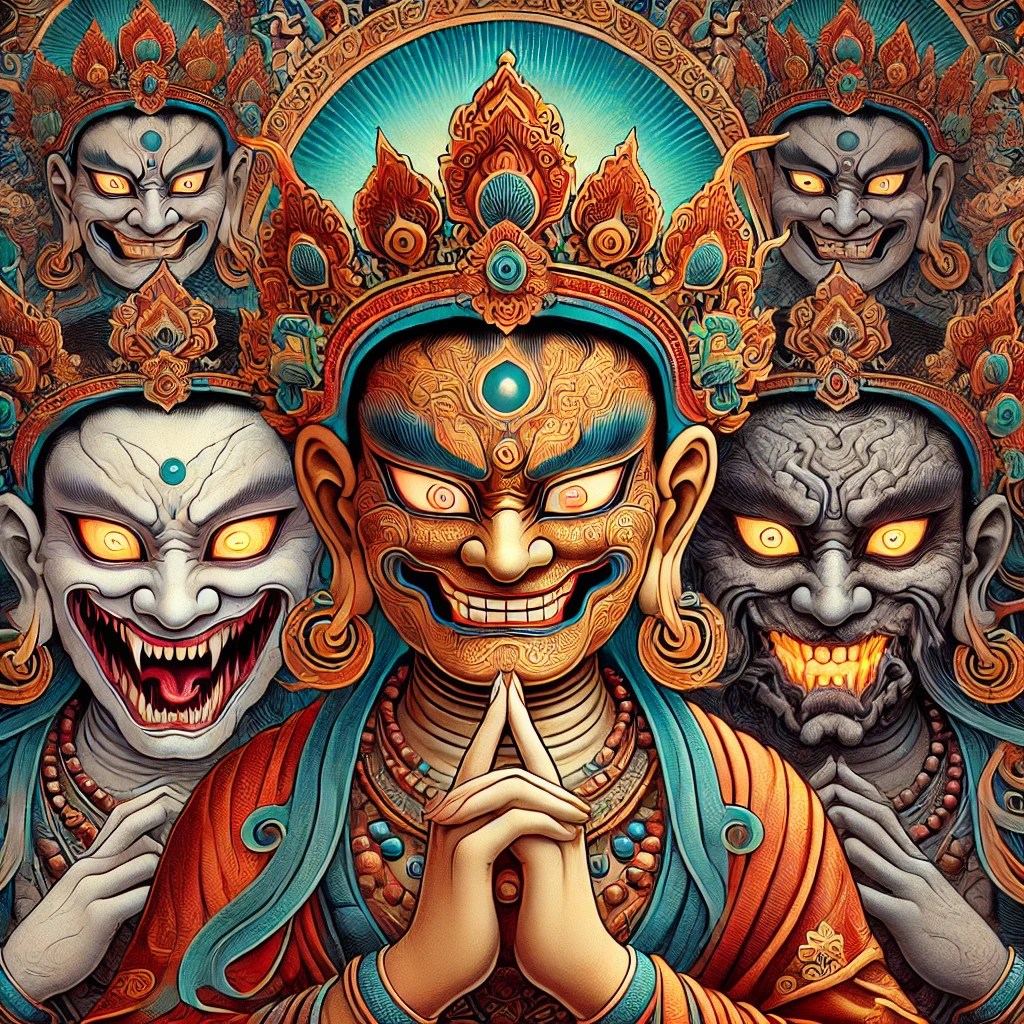
Similarly, Tibetan Buddhism employs the concept of peaceful and wrathful deities. Figures like Chenrezig (Avalokiteshvara), the deity of compassion, embody the peaceful aspect, while wrathful manifestations like Mahakala represent fierce, protective energies. The Mahasiddha, an enlightened being considered beyond good and evil, can manifest these dual personas depending on the circumstances. In some cases, a spiritual teacher (or Root Guru) may embody a compassionate demeanor publicly, but exhibit wrathful behavior when “necessary” for spiritual subjugation or destruction. This duality can create cognitive dissonance in disciples.

3. Ritual Practices and the Role of Fear

Both systems incorporate ritualistic practices designed to reinforce psychological control. In SRA, rituals often involve symbolic or literal acts of violence, aimed at instilling fear and breaking down individual resistance. The presence of demonic entities within these rituals further amplifies the psychological trauma and sense of helplessness in victims.

Tibetan Buddhism’s rituals, while usually viewed as spiritually transformative, can also be interpreted through this lens. The rituals of subjugation, for instance, are designed to exert control over both human and spiritual entities. Wrathful deities are invoked to overcome obstacles, enemies, or internal psychological barriers, often through complex ceremonies that may include visualizations of violence or destruction. For disciples who are vulnerable or questioning, these practices can evoke fear and reinforce the guru’s power over their spiritual and personal lives.

4. The Guru as a Central Authority Figure

In both Tibetan Buddhism and SRA, the central authority figure, whether a Root Guru or a handler, wields significant control over individuals. The guru, much like the SRA handler, is often viewed as infallible, possessing superior knowledge or spiritual insight that justifies their behavior, whether compassionate or wrathful. The disciple’s trust in the guru’s wisdom can lead to unquestioning obedience, even in the face of apparent contradictions or abuse.

The Mahasiddha’s role, being beyond conventional morality, mirrors the handler’s manipulation in SRA, where actions are justified as necessary for the victim’s transformation or initiation. This dynamic can trap individuals in dangerous situations and tortured mental states.

While Tibetan Buddhism and Satanic Ritual Abuse arise from distinct cultural and spiritual backgrounds, their methods of control, use of dual personas, and ritualistic practices reveal striking similarities in how they can manipulate individuals psychologically and spiritually. Recognizing these parallels is crucial for understanding the broader mechanisms of power that aim to trap and curtail individual freedom and agency.

Revealing the Overlooked Connection Between Kashmir Shaivism and Tibetan Buddhist Tantra


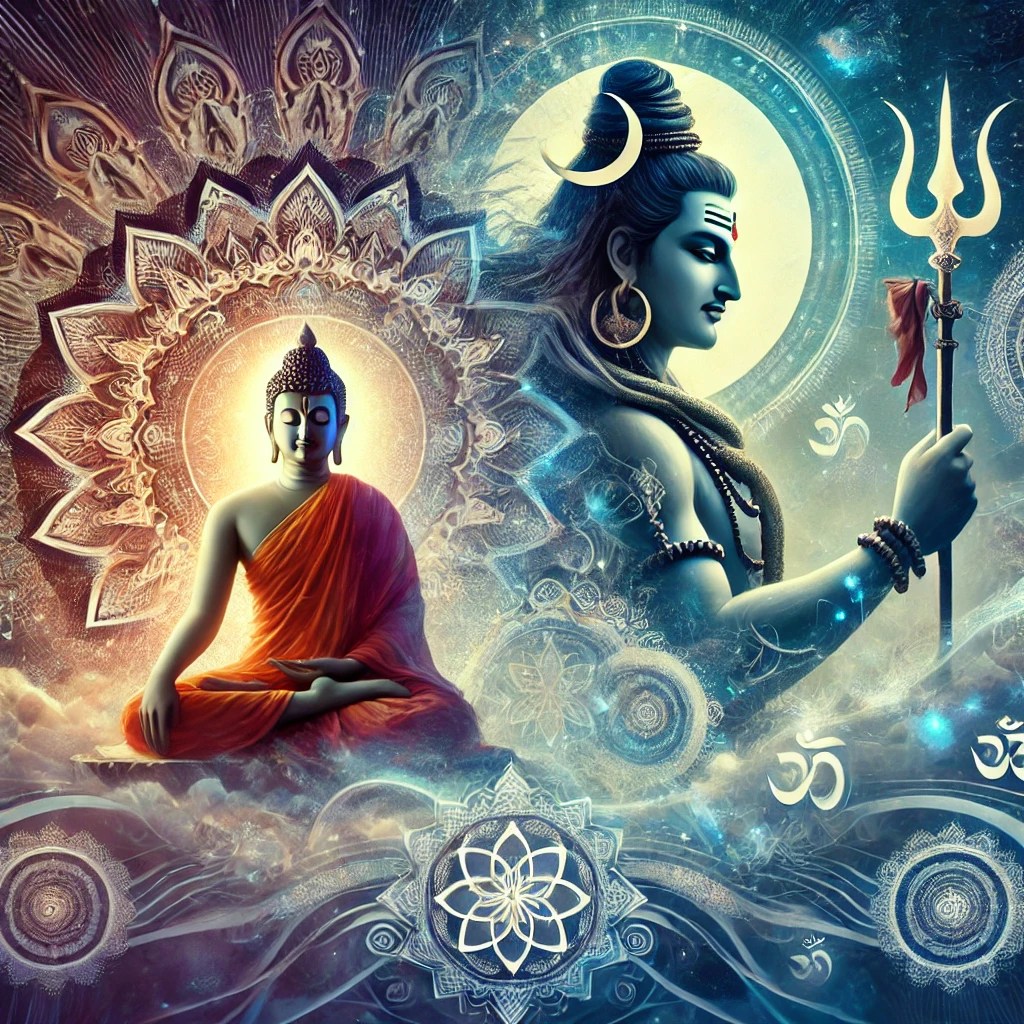
The rich interplay between Hindu and Buddhist Tantric traditions has been a subject of rigorous scholarly inquiry, yet much of this relationship has remained obscured in popular understandings of Tibetan Buddhism. Three seminal works, Francesco Sfewa’s “Some Considerations on the Relationship Between Hindu and Buddhist Tantras”, Alexis Sanderson’s “Vajrayāna: Origin and Function in Buddhism”, and Robert Mayer’s “The Figure of Maheśvara/Rudra in the rÑiṁ-ma-pa Tantric Tradition,” shed light on the foundational role of Kashmir Shaivism in shaping the Yoginītantras of Tibetan Buddhism. These articles offer compelling evidence that Tibetan Buddhist Tantras, particularly the Yoginītantras, were heavily influenced by Saiva texts and practices, directly linking Tibetan Buddhism to the figure of Śiva himself.

In the transmission of Tibetan Buddhism to the West, Tibetan masters often downplayed or ignored this profound connection. Instead, they ascribed the Tantras to the Buddha himself, claiming that he taught these esoteric teachings in a transcendent form after his parinirvāṇa (passing away). According to traditional accounts, these teachings were revealed at specific sacred locations, such as Mount Malaya, situated in present day Sri Lanka. These teachings, it is said, were preserved in the realms of gods and nāgas (serpentine spirits) before being transmitted to humanity through visionary masters. By presenting the Tantras as originating from the Buddha rather than acknowledging their Saivite roots, Tibetan masters aimed to establish their authority and distinguish their tradition from external influences.

However, as Sanderson, Sfewa, and Mayer document, the Yoginītantras in Tibetan Buddhism were not created in isolation. They borrowed extensively from Saivite texts like the Brahmayāmala, Siddhayogeśvarīmata, and Picumata, incorporating not only ritual frameworks but also mythological narratives. This borrowing represents what scholars call “pious plagiarism,” where Saivite materials were recontextualized to align with Buddhist soteriological goals. The myths, rituals, and iconography of the Yoginītantras, which are central to Tibetan Buddhist Tantra, thus owe their origins to Śiva and his Tantras.

Recognizing this connection does not diminish the uniqueness of Tibetan Buddhism but rather situates it within a broader, interconnected spiritual landscape. It underscores how traditions evolve through dynamic cultural exchanges, offering a deeper understanding of Tantra’s history.

Shared Foundations and “Pious Plagiarism”

Francesco Sfewa’s analysis highlights the undeniable overlap between Hindu and Buddhist Tantra. He suggests that this commonality arises not from coincidental similarities but from deliberate borrowings. Sfewa notes the phenomenon of “pious plagiarism,” where texts from the Hindu Saivite tradition were adapted into Buddhist contexts, particularly the Yoginītantras. He emphasizes the need to move beyond vague notions of a “shared religious substratum” and instead examine direct textual dependencies.

Alexis Sanderson: Tracing Scriptural Borrowings

Sanderson’s meticulous philological work underscores this dependency. He demonstrates how Buddhist Vajrayāna texts, especially the Yoginītantras, borrowed heavily from Saiva sources such as the Brahmayāmala and the Siddhayogeśvarīmata. For example, he shows that ritual frameworks and mythic narratives in Buddhist texts like the Hevajra Tantra align closely with Saiva models. Sanderson argues that these borrowings are not isolated but reflect a systematic incorporation of Saivite elements into Buddhist Tantra.

Mythology as a Lens: Robert Mayer’s Insights

Robert Mayer takes a mythological approach, examining the narrative of the “Taming of Maheśvara/Rudra.” This myth, central to many Buddhist Tantras, portrays the subjugation of Saiva deities by Buddhist figures, symbolizing the assimilation of Saivite practices into Buddhist frameworks. Mayer sees this narrative as a “charter myth” that legitimizes Buddhist Vajrayāna’s adoption of Saiva elements. He also highlights how Tibetan Buddhist traditions reinterpreted these myths, assigning Buddhist meanings to Saivite symbols while acknowledging their origins.

Reconciling Differences: A Shared Soteriology?

Despite their doctrinal differences, Sfewa, Sanderson, and Mayer point to a shared soteriological framework underpinning both traditions. Both Hindu and Buddhist Tantras emphasize liberation through a union with the divine, facilitated by initiations, meditative practices, and ritual. This common ground enabled a seamless exchange of ideas, even as each tradition reinterpreted borrowed elements to align with its goals.

Implications for Modern Scholarship

The work of these scholars challenges us to rethink the boundaries between Hindu and Buddhist Tantric traditions. Rather than viewing them as isolated systems, we see them as part of a dynamic cultural and religious interplay. This perspective not only clarifies our understanding of Tantra but also offers broader insights into how religious traditions evolve through interaction. This, in turn, calls into question the myth that tantric Buddhism came directly from the Buddha himself.

Recognizing the historical and cultural debts of Tibetan Buddhism to Kashmir Shaivism, particularly in the Yoginītantras, does not detract from its significance. Instead, it situates Tibetan Buddhist Tantra within a tapestry of spiritual exchange, affirming the adaptability of religious traditions across time and space.