
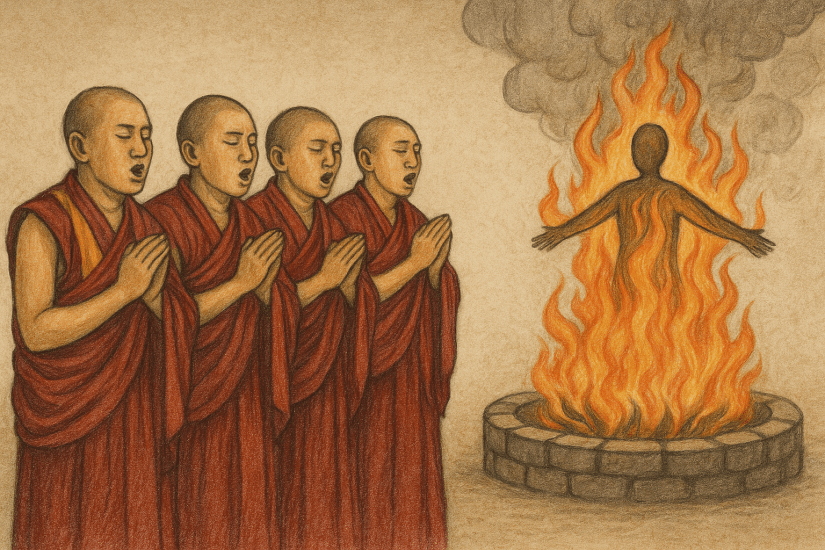
Lin Kai’s: “Meanings of Violence in Tibetan Buddhism”


In his essay Meanings of Violence in Tibetan Buddhism, Lin Kai develops themes first raised by Elliot Sperling: Tibetan Buddhism has never been simply the peaceful, pacifist tradition imagined in Western romantic projections. Both history and ritual demonstrate how violence was woven into Tibetan religious and political life¹, continuing into the present. As Kai underscores, and as Sperling noted before him, both Western interpreters and Tibetan voices have often gone to great lengths to overlook or obscure this troubling facet of Tibetan Buddhism.

Kai highlights how rulers, including the Fifth Dalai Lama, relied on military force to consolidate power and punish rebellion. As Sperling documented, the Dalai Lama issued explicit orders in the seventeenth century to annihilate enemies, words that expose a stark contrast to the modern image of Tibet².

The Fifth Dalai Lama’s commands were phrased in brutal, almost ritualistic terms:

Make the children and grandchildren like eggs smashed against rocks;
Make the servants and followers like heaps of grass consumed by fire;
In short, annihilate any traces of them, even their names.²

This edict was aimed at other Tibetan Buddhists, mind you. Amidst such warfare, Kai notes, not all monks accepted this with ease. Some were unsettled by the amount of time and resources demanded for war rituals, though few dared openly resist their lamas. A particularly striking passage from the Fifth Dalai Lama’s autobiography shows him wrestling with his own position as a Buddhist leader at war. He recounts the following dream:

“Looking through an open window on the eastern side of the protector-chapel, stood the treasurer [Sonam Rabten] and a crowd of well-dressed monks with disapproving looks. Shoving the ritual dagger into my belt, I went outside. Thinking that if any of those monks said anything, I would strike him with the dagger, I walked resolutely straight through them. They all lowered their eyes and just stood there. When I awoke, my illness and impurities had been completely removed; not even the slightest bit remained. I was absolutely overflowing with amazement and faithful devotion.” — Fifth Dalai Lama¹

This moment captures the tension at the heart of Tibetan statecraft: the bodhisattva ideal of compassion colliding with the felt necessity of violence. Kai also emphasizes ritual violence, where wrathful deities and fierce imagery symbolize the annihilation of obstacles to enlightenment. These practices were not simply symbolic. They paralleled real political campaigns, where violent suppression against human beings was justified as protecting the Dharma¹.

Western audiences, however, have often distorted this history. Kai argues that Orientalist fantasies, especially those that cast Tibet as a timeless land of peace, obscure the record of blood and retribution¹. Sperling made the same point, noting how the Dalai Lama’s reputation as a Nobel Peace laureate stands in sharp tension with the historical evidence².

“Violence in Tibetan Buddhism cannot be neatly categorized as either barbaric or compassionate. It exists within a worldview where wrathful action and compassion may coincide, depending on context and intent.” —Lin Kai¹

In this worldview, compassion and violence were not opposites. Wrathful action could be seen as alright when it was thought to protect the Dharma or eliminate obstacles, even human ones. What emerges, then, is a very complicated and unsettling picture: violence was not an exception but an integral part of Tibetan Buddhist practice.

Kai’s work reinforces Sperling’s warning: if we want to understand Tibetan Buddhism as it is, rather than as we wish it to be, we must confront the ways in which violence was and still is sacralized within the tradition.
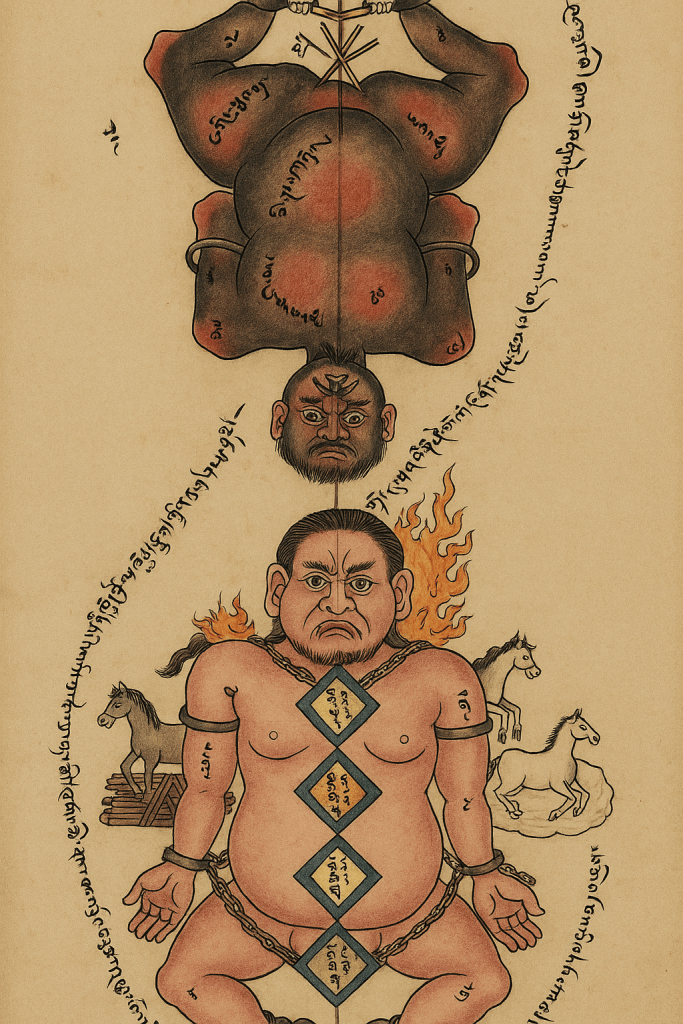
This type of linga resembles one depicted in the Secret Visions of the Fifth Dalai Lama, a visionary autobiography. It shows two figures to be ritually ‘liberated’ or killed, typical of effigies used in Tibetan Buddhist rites against so-called ‘enemies of the dharma.’ Such effigy sacrifices remain part of Tibetan Buddhist ritual practice today.


Footnotes

¹ Lin Kai, Meanings of Violence in Tibetan Buddhism, Substack, 2025.
² Elliot Sperling, Orientalism and Aspects of Violence in the Tibetan Tradition, Info-Buddhism, 2004.

Truth Behind the Myth: Violence in Tibetan Buddhism


In his article Orientalism and Aspects of Violence in the Tibetan Tradition, Elliot Sperling uses the term Orientalism in the sense made famous by Edward Said. It describes how Western scholars, writers, and media have often portrayed Asian and Middle Eastern societies in ways that are exotic, stereotypical, and distorted (Sperling 2001, p. 317). [1]

In this context, Elliot Sperling is pointing out that Tibet, especially Tibetan Buddhism, has been framed in the West not as a complex, politically active society but as a mystical and pacifist Shangri-la (Sperling 2001, p. 318). That romanticized portrayal fits the Orientalist mold because it projects Western fantasies and agendas onto a culture instead of showing it in its full, often messy, historical reality.

Here, Orientalism is not just about misunderstanding or stereotyping. It is about how those misconceptions feed into selective histories, in this case downplaying or erasing the tradition’s capacity for political maneuvering, power struggles, and violence.

It is important to cut through the sugar-coated narratives about Tibetan Buddhism as an always peaceful, otherworldly faith. Historian Elliot Sperling, a top authority on Tibet and China history, attempts to do this in his essay. He shreds the romanticized “compassionate lama” image and reintroduces the messy, political, and yes, violent realities of Tibetan history (Sperling 2001, p. 320).

  • Tibetan Buddhism was not pacifism incarnate. Sperling points out that the Fifth Dalai Lama did not shy away from military force when Gelugpa interests were on the line in the 17th century. In the early 20th century, the Thirteenth Dalai Lama actively sanctioned armed resistance against Qing forces in Lhasa (Sperling 2001, pp. 323–324).
  • Modern Western portrayals have softened the truth. The prevailing global image of Tibetan Buddhism, as inherently gentle, infallibly peaceful, and untouched by politics, is largely a product of Western assimilation and the Tibetan exile community’s framing of their own image (Sperling 2001, pp. 317–318).

Why It Matters

If you are buying into the “peace only” ideal, Sperling’s essay demands reconsideration. He forces you to recognize Tibetan Buddhism as a tradition entwined in power and violence when necessary (Sperling 2001, p. 317). The strident idealism selling Tibet as a spiritual Shangri-la does not hold up under scrutiny. In 1660, the Fifth Dalai Lama faced a rebellion in Tsang. Declaring he acted for the good of the people in the region, he issued uncompromising orders for the complete destruction of his enemies, men, women, children, servants, and property, leaving no trace of them. This directive, written in his own hand, reveals a leader willing to use extreme military force to secure his government’s power, a stark contrast to the modern image of the Dalai Lama as an unshakable symbol of peace.

[Of those in] the band of enemies who have despoiled the duties entrusted to them:
Make the male lines like trees that have had their roots cut;
Make the female lines like brooks that have dried up in winter;
Make the children and grandchildren like eggs smashed against rocks;
Make the servants and followers like heaps of grass consumed by fire;
Make their dominion like a lamp whose oil has been exhausted;
In short, annihilate any traces of them, even their names (Sperling 2001, p. 325).

This brutal passage, is a powerful and chilling indictment. It underscores the darker potential within any ideology. When power, anger, or fear take hold, even so-called peaceful spiritual traditions can sanction annihilation. Sperling’s work reminds us to stop buying into the marketing of Tibetan Buddhism as a compassionate, peaceful idyll. His historical analysis and the many examples of tantric annihilation rituals used against human targets says otherwise. It is time to drop the myth and acknowledge the tradition for what it truly is: a living, political, and sometimes violent force (Sperling 2001, p. 329).

  1. Elliot Sperling, “Orientalism and Aspects of Violence in the Tibetan Tradition” (2001), info-buddhism.com, originally published in Imagining Tibet: Perceptions, Projections, & Fantasies, ed. Thierry Dodin and Heinz Räther, Wisdom Publications. Available at: https://info-buddhism.com/Orientalism_Violence_Tibetan_Buddhism_Elliot_Sperling.html