The Squeamishness of Scholarship: Cameron Bailey’s Critique of Sam van Schaik’s book on Buddhist Magic


Sam van Schaik’s Buddhist Magic: Divination, Healing, and Enchantment through the Ages (2020) attends to the often-overlooked domain of spells, incantations, divination, healing rituals, and what one might call “magic” in Buddhist traditions. The book offers, among other things, a translation of a Tibetan spell-book from the Dunhuang corpus and situates it in a broad historical trajectory of Buddhist ritual technologies. Yet in his 2021 review for H-Net, Cameron Bailey argues that the book suffers from significant omissions, conceptual limitations, and a subtle apologetic tone toward the more aggressive, violent, and transgressive forms of magic found in tantric Buddhism.¹ Bailey suggests that this tone is not simply stylistic but stems from deeper disciplinary biases about what “real” Buddhism is and what kinds of ritual power are acceptable to the scholarly gaze.

For readers of Tantric Deception, which is concerned with hidden ritual power, subversive techniques, and coercive practices in the “shadow” side of tantra, Bailey’s critique is especially pertinent. The benign, therapeutic, protective aspects of magic are only half the story; the aggressive, destructive, boundary-breaking elements are equally constitutive. Here the critique unfolds on three levels: (1) Bailey’s reading of Chapter 3 of van Schaik’s book (on the Ba ri be’u ’bum); (2) his broader objections to how van Schaik defines “magic” and frames the field; and (3) implications for the study of tantric magic and deception.

Bailey’s Critique of Chapter 3: “A Tibetan Book of Spells”

Bailey looks at Chapter 3, which discusses the Tibetan spell-book known as the Ba ri be’u ’bum, compiled by Ba ri Lotsāwa in the eleventh century.² Van Schaik concludes the chapter by pointing to the presence of violent magical ritual, what might be called “black magic,” in Buddhist spell-books and tantric scriptures such as the Vajrabhairava Tantra

Bailey’s critique is threefold:

  1. Understatement of prevalence. Van Schaik, he argues, seriously understates how widespread aggressive or destructive ritual practices are in tantric sources: “He could also have discussed the army-repelling magic in the Hevajra Tantra, the legendary violent magical exploits of the great tantric sorcerer Rwa Lotsāwa, or Nyingma Mahayoga scriptures, which are often positively brimming with black magic.”⁴
  2. Authorial discomfort. Bailey detects an obvious unease with “aggressive” magic and with rituals that use human remains as ingredients, suggesting van Schaik takes an apologetic tone when discussing them.⁵
  3. Scholarly bias. He links this tone to the longstanding tendency of Buddhist studies to privilege an idealized, pacifist Buddhism: “This kind of squeamishness … unconsciously replicates the biases of past generations of Buddhist scholars …. It is ultimately an artifact of Western observers thinking they know more about what should constitute normative Buddhism than their sources do …”⁶

For Bailey, this is not simply an omission but a rhetorical framing that soft-pedals the destructive dimensions of tantric magic.

Defining “Magic”: Bailey’s Broader Critique

Bailey extends his criticism to van Schaik’s opening chapters, where the author defines his working category of “Buddhist magic.” Van Schaik adopts a “family-resemblance” approach, noting that no direct equivalent of the Western word magic exists in Sanskrit or Tibetan.⁷ He describes magical practices as “focused on worldly ends, including healing, protection, divination, manipulation of emotions, and sometimes killing. The effects of these techniques are either immediate or come into effect in a defined, short-term period. The techniques themselves are usually brief, with clear instructions that do not need much interpretation, and are gathered together in books of spells.”⁸

Bailey objects that this framing:

  • Over-narrows the field by confining magic to short-term, worldly ends, thereby excluding tantric practices that are long, soteriological, and embedded in complex ritual technologies.⁹
  • Privileges text and literacy, focusing on manuals and specialists while sidelining oral, embodied, and popular forms of practice.¹⁰
  • Sanitizes the topic by foregrounding healing and protection while downplaying cursing, corpse-magic, and enemy destruction.¹¹

He concludes: “The way he defines and explains ‘magic,’ and describes how magical practices have traditionally been used by Buddhists across Asia, ends up inadvertently reinforcing many of the historical scholarly prejudices against magic that he ostensibly is trying to correct.”¹²

Van Schaik’s framework thus risks reproducing the very boundaries it seeks to challenge.

A Wider Blind Spot: Aggressive Magic and the Tantric World

Bailey argues that van Schaik should have engaged more fully with texts such as the Hevajra Tantra (with its army-repelling spells), the violent exploits of Rwa Lotsāwa, and the Nyingma Mahayoga scriptures filled with wrathful deities, corpse-magic, and enemy-destruction rites.¹³ By not doing so, or by treating such material as peripheral, van Schaik, he claims, sanitizes Tibetan Buddhism. “Van Schaik displays an obvious discomfort with the presence of ‘aggressive’ magic … and takes an apologetic tone when discussing them.”¹⁴

For scholars of tantra, this omission matters because tantric systems operate through extremes such as creation and annihilation, compassion and wrath, life-force and death. To highlight only healing and protection produces a partial picture of ritual power, one aligned with modern therapeutic Buddhism but detached from the coercive, political, and martial realities of historical tantric practice.

Bailey notes that while van Schaik does acknowledge violent spells (for example, in the Dunhuang materials), he does not trace how these recur and become canonical in later tantric systems.¹⁵ The result is a book that opens the field but keeps its most provocative elements at the margins.

Implications for the Study of Tantric Magic and Deception

Bailey’s critique has clear implications for the study of tantric ritual power:

  • Broaden the definition of magic. Magic in Buddhist contexts is not confined to short spells. It includes deity-yoga, state-sponsored rituals, corpse-assemblage, body technologies, and institutions of ritual power.
  • Recognize multiple aims. Magic serves soteriological as well as worldly purposes such awakening, subjugation, and mediation between spirits and humans.
  • Acknowledge popular practice. Lay and non-monastic forms of magic interpenetrate elite traditions. Focusing solely on literate specialists truncates the field.¹⁶

Examining the Aggressive and Transgressive

To understand tantric magic fully, scholarship must confront its aggressive, destructive, and taboo aspects such as spells to kill or incapacitate, invocations of wrathful deities, rituals using human remains, and forms of mystical violence justified through tantric cosmology. When these are treated as aberrations, the study of tantric sovereignty, ethics, and power becomes impoverished.

Deception, Hidden Power, and Normativity

Bailey’s review also raises a methodological issue: the scholar’s discomfort can itself become a form of concealment. Reluctance to confront violent or transgressive material filters what is studied and what remains hidden. Bailey argues that van Schaik’s apologetic tone mirrors earlier generations of scholarship that preferred a morally “respectable” Buddhism.¹⁷

For research into deception, secrecy, and power in tantra, this is crucial. Reflexivity is required: how much of what we present as Buddhism is sanitized by our own unease with its violent, ambiguous realities?

Conclusion

Cameron Bailey’s critique of Buddhist Magic is more than a review. It is a reminder that scholarly framing shapes what becomes visible and what remains unseen in the study of ritual power. Van Schaik’s work makes an important contribution by bringing spells and enchantments to the center of Buddhist studies. Yet, as Bailey insists, by downplaying the aggressive and coercive sides of tantric magic, it perpetuates a pacified image of [Tibetan] Buddhism.

For those exploring tantra, deception, and hidden power, the shadow side of magic demands attention. Spells of domination and annihilation, corpse-magic, and state-sorcery are part of the story. Scholarly discomfort cannot determine what counts as legitimate tantric Buddhism. True understanding must include the violent and transgressive alongside the healing and protective.

Van Schaik opened the door; Bailey challenges us to step through. In tantra, concealment is not accidental, it is a method and a weapon. So too must scholarship have the courage to unmask it.


Notes

  1. Cameron Bailey, “Review of Sam van Schaik, Buddhist Magic: Divination, Healing, and Enchantment through the Ages,” H-Buddhism (H-Net Reviews), July 2021. https://www.h-net.org/reviews/showrev.php?id=56639.
  2. Ibid.
  3. Ibid.
  4. Ibid., p. 3.
  5. Ibid.
  6. Ibid., p. 4.
  7. Van Schaik, Buddhist Magic: Divination, Healing, and Enchantment through the Ages (Boulder: Shambhala Publications, 2020), pp. 6–8; Bailey, review.
  8. Quoted in “Think Again Before You Dismiss Magic,” Lions Roar, April 2020.
  9. Bailey, review, p. 3.
  10. Ibid.
  11. Ibid.
  12. Ibid., p. 2.
  13. Ibid., p. 3.
  14. Ibid.
  15. Ibid.
  16. Ibid.
  17. Ibid., p. 4.

References

Bailey, Cameron. “Review of Sam van Schaik, Buddhist Magic: Divination, Healing, and Enchantment through the Ages.” H-Buddhism (H-Net Reviews), 2021. https://www.h-net.org/reviews/showrev.php?id=56639.
Van Schaik, Sam. Buddhist Magic: Divination, Healing, and Enchantment through the Ages. Boulder: Shambhala Publications, 2020.
“Think Again Before You Dismiss Magic.” Lions Roar, April 2020.
The Grimoire of Secret Gnosis


A Hidden Side of Tantric Buddhism

Buddhism is usually presented in the West as a religion of mindfulness and compassion. But hidden in its tantric wing is something darker. In the eighteenth century, Sélung Shepa Dorjé (Sle lung Bzhad pa’i rdo rje) compiled a sixteen-volume cycle called Secret Gnosis Dakini (Gsang ba ye shes mkha’ ’gro, or GYCK). This was not just a collection of esoteric philosophy, but also a grimoire filled with magical spells.

According to Cameron Bailey in The Magic of Secret Gnosis: A Theoretical Analysis of a Tibetan Buddhist “Grimoire,” grimoires of spell instructions are common in Tibetan Buddhism. They often appear inside larger tantric cycles like the GYCK or in the collected works of great lamas. As the scholar Berounsky, cited by Bailey, put it, the operations in such texts are “an amalgam of tantric interventions combined with popular magic.” [1]

Volumes four and twelve of the GYCK preserve dozens of rituals for worldly power. The twelfth volume in particular reads like a magician’s handbook. It does not hide its intent; it offers ninety-two spells to heal, protect, enrich, and subjugate.

Rituals of Control

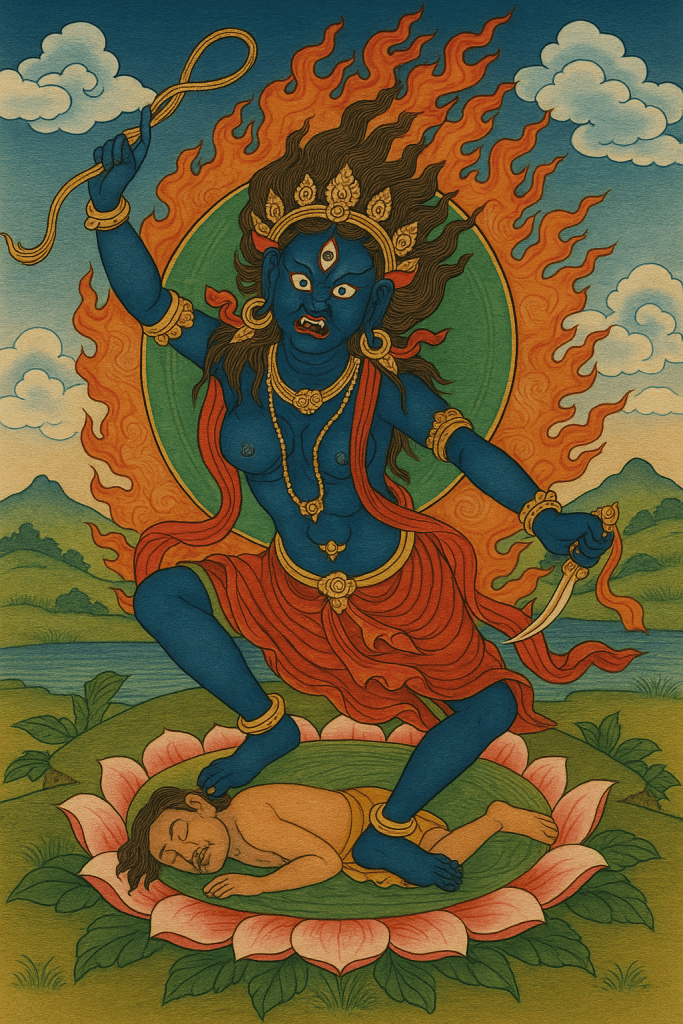
Among these spells are some dedicated to domination. Far from the common image of Buddhism as a purely gentle path of liberation, the Secret Gnosis spells allowed practitioners to bind and control others. One entire text, The Magic Lasso, instructs adepts on capturing their targets through visualization and mantra. Other spells direct them to create talismans and effigies, ritually charged to influence or destroy enemies.

Bailey emphasizes that these rituals work by merging tantric deity yoga with ritual techniques: the practitioner visualizes themselves as a wrathful god, projects light rays at the target, and seals the action with mantra. Your meditation becomes, in effect, a weapon.

The Spellbook as Technology

The grimoire aspect of the Secret Gnosis cycle cannot be overlooked. It contains practical instructions for bending reality to one’s desire. Substances like herbs, turquoise, and even urine or flesh are prescribed as tools of ritual practice.

Bailey notes that these spells are framed within a bodhisattva ethic. They are said to protect the Dharma or defend communities. Yet to modern eyes, they read unmistakably as instructions for control. This is where interpretation diverges. Bailey highlights the philosophical and ritual integration, while a critical lens reveals the coercive logic beneath the compassionate rhetoric.

A Tradition of Ambivalence

Figures like Milarepa warned against sorcery, even though his story is entangled with it. The Buddhist tradition as a whole often drew a line between miracle powers that “arise naturally” from meditation and deliberate ritual magic. But that line was blurred from the beginning. The Secret Gnosis makes clear how deeply magical domination was preserved within the canon.

Conclusion

The Secret Gnosis Dakini cycle exposes a side of tantric Buddhism rarely acknowledged publicly. Bailey shows that its grimoire-like sections are integral to tantric practice, not just marginal curiosities. What I emphasize here is that these spells—especially those of subjugation—show a system where manipulation was not an aberration but an option built into the tradition. What is presented today as a path of compassion was also, sometimes, a path of great harm.


[1] Cameron Bailey, “The Magic of Secret Gnosis: A Theoretical Analysis of a Tibetan Buddhist ‘Grimoire,’” Journal of the Korean Association for Buddhist Studies 93 (2020): 535–570.

Ritual Violence: the Bairaṇa Rites of Vajrayana Buddhism


In the hidden corners of Vajrayana Buddhism lies a strand of practice that few dare to discuss openly: bairaṇa (Sanskrit: vairana) rituals. These are wrathful rites aimed at the destruction of enemies, both spiritual and human.

Often sanitized or dismissed as purely symbolic by modern interpreters, the historical and textual record suggests something more visceral, more deadly: these rituals were, and in some cases, still are, performed with the explicit intention to eliminate human beings. This underscores the urgent need for transparency in the study and transmission of Vajrayana practices, especially as many naive spiritual seekers are drawn to Tibetan Buddhism by its outward promise of peace, compassion, and enlightenment, often without awareness of its esoteric and potentially violent dimensions.

What Is a Bairaṇa Ritual?

The term bairaṇa appears in the tantric classification of the four karmas: four magical functions that a Vajrayana practitioner may perform:

  • Pacifying (śānti)
  • Enriching (puṣṭi or vaśya)
  • Subjugating (stambhana)
  • Destroying (bairaṇa)

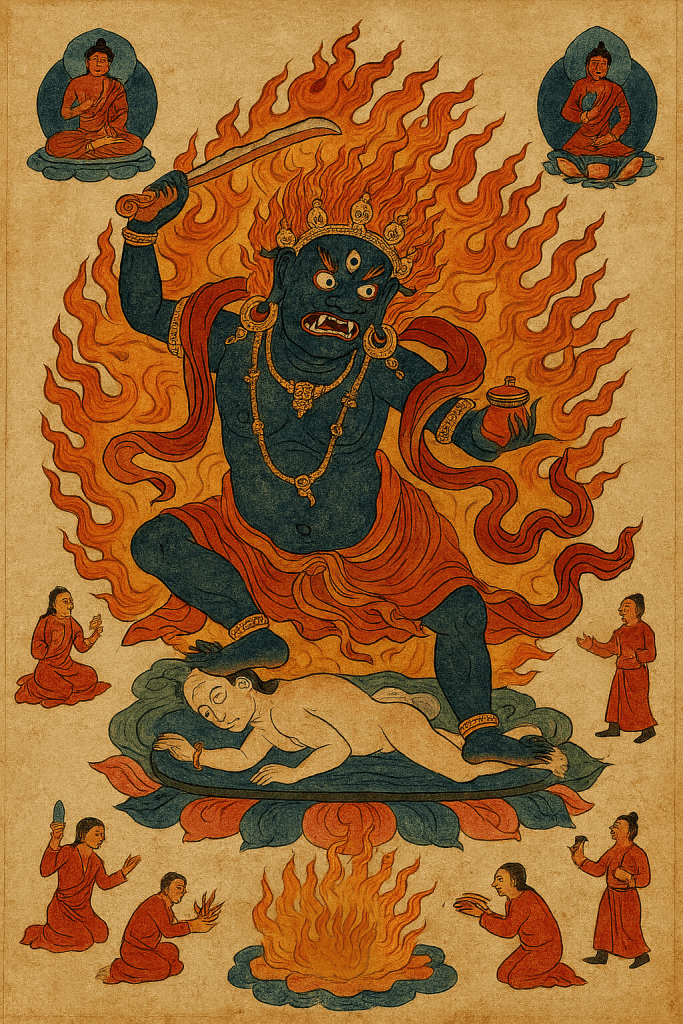
The purpose of the fourth category, “subjugating,” is unambiguous: obliteration. Within Tibetan Buddhist traditions, especially in the rites of wrathful deities such as Vajrakīla, Yamantaka, and Mahākāla, bairaṇa rituals are used to eliminate:

  • Samaya breakers: Those who violate sacred tantric vows
  • Enemies: Individuals perceived to be actively working against the practitioner
  • Obstructive spirits: Demonic forces, ghosts, or elemental energies believed to cause illness, insanity, or misfortune
  • Political enemies: In historical contexts, entire state-level rituals were conducted against rival kings or invading armies

Ritual Actions: Effigy Creation and Destruction

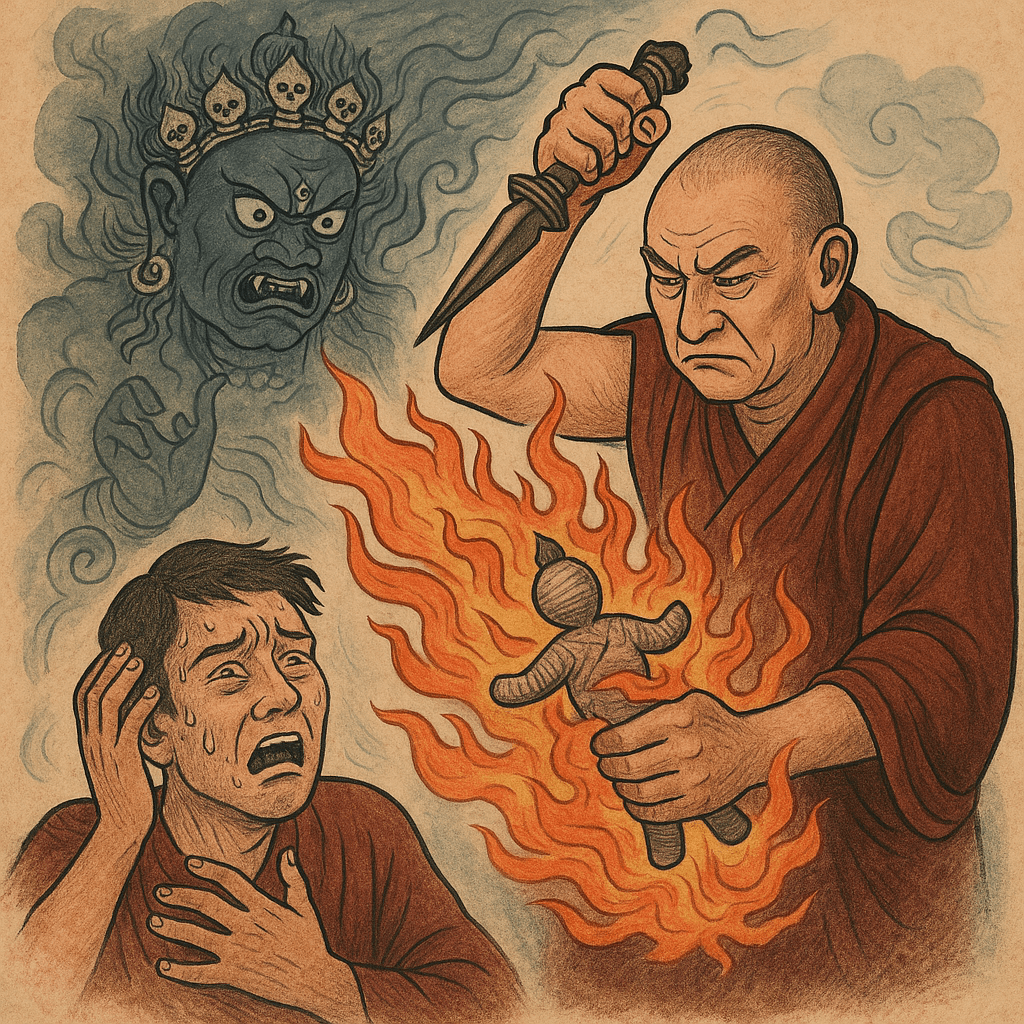
Texts such as The Cult of the Deity Vajrakīla describe in detail the creation of effigies to represent obstructive forces. These are crafted using materials such as cloth taken from the target, filled with charnel substances, and inscribed with mantras.(1) The effigy is then subjected to violent ritual acts such as stabbing with ritual daggers (phurba), binding, burning, or drowning.

Example: Vajrakīla Tantras (summary from Boord, The Cult of the Deity Vajrakīla)

“Fashion a figure of the enemy from black wool… fill it with the five meats and five nectars. Tie it with red thread, place it beneath the kīla (ritual dagger). Stab it while reciting the mantra… Then, place it in the fire, imagining flames consuming the soul of the enemy.”

This is not metaphor. The rite involves constructing a magical double of the target and ritually executing it. The “enemy” may be a real, named person.

Fire Offerings and Mantra Recitation

Often, the effigy is placed in a consecrated fire pit and incinerated while wrathful mantras are recited, invoking deities to consume and destroy the obstacle.

Example: From the Dujum Namchok Putri Ritual

“To receive these five aggregates of the malefactors who are our hostile enemies and obstructing spirits (causing harm)! We now feed them into your (wide open) mouths; may you accept (these morsels and devour them)—Kharam Khahi!”

This passage metaphorically frames the act of feeding the enemy to wrathful deities, representing a kind of karmic annihilation. In tantric contexts, this has often been interpreted as a sanctioned form of ritual killing.

Another Example: From the Rituals of the Secret Assembly Tantra

“Bind the name and essence of the breaker of samaya into the effigy… May his limbs be broken, his breath cease, and his karmic stains be consumed in fire.”

How Were These Used Historically?

Scholars like Ronald Davidson and Martin Boord have documented numerous instances where wrathful rites were used to eliminate perceived threats, including human beings. These were not fringe practices. They were part of the institutionalized ritual life of powerful lamas and state-sponsored religion.

For example:

  • In the 17th century, the Gelugpa used wrathful rites against rival schools.
  • The Fifth Dalai Lama reportedly employed Vajrakīla rituals to eliminate political enemies and to legitimize military campaigns.
  • In the Nyingma tradition, terma (revealed teachings) include instructions for magical actions against sorcerers and heretics.

Ethics of Wrathful Means

Here lies the uncomfortable truth: Vajrayana Buddhism is not a pacifist tradition. It is a path of power, and power is always ambiguous.

Proponents argue that wrathful actions arise from compassion, a fierce compassion that liberates by force when necessary. Critics, both within and outside the tradition, question whether such acts truly serve liberation or whether they reveal the manipulation of tantric power for worldly gain.

Conclusion: A Tradition of Dangerous Possibilities

The bairaṇa rituals of Vajrayana are not relics of a mythic past. They are living technologies, still transmitted under specific conditions to qualified initiates.

Yet when removed from their sacred context, or cloaked in euphemism, they reveal a deeper concern: the boundary between symbolic and literal violence in Tibetan Buddhism has often been porous. The image of Tibetan Buddhism as purely peaceful and benevolent does not survive close scrutiny.

(1) In Tantric practice, particularly within cremation-ground or charnel-ground rituals, practitioners engage directly with “charnel substances.” These substances include human bones (such as skulls and femurs), cremation ashes, decomposed flesh, fat, blood, and bodily fluids, as well as soil and items saturated with the energy of death. Some rituals involve the use of skull cups (kapalas) for offerings, bone ornaments worn on the body, or the smearing of ash.


Sources and Suggested Reading

  • Boord, Martin. The Cult of the Deity Vajrakīla: According to the Texts of the Northern Treasures Tradition of Tibet. Tring: The Institute of Buddhist Studies, 1993.
  • Davidson, Ronald M. Indian Esoteric Buddhism: A Social History of the Tantric Movement. Columbia University Press, 2002.
  • Dalton, Jacob. The Taming of the Demons: Violence and Liberation in Tibetan Buddhism. Yale University Press, 2011.
  • Hirshberg, Daniel. Remembering the Lotus-Born: Padmasambhava in the History of Tibet’s Golden Age. Wisdom Publications, 2016.
  • Samuel, Geoffrey. Civilized Shamans: Buddhism in Tibetan Societies. Smithsonian Institution Press, 1993.
  • Snellgrove, David L. The Hevajra Tantra: A Critical Study. Oxford University Press, 1959.
  • Cantwell, Cathy & Mayer, Rob. Early Tibetan Documents on Phur pa from Dunhuang. Wien: Verlag der Österreichischen Akademie der Wissenschaften, 2008.

Wrathful Rituals and “Black Magic” in Tibetan Guru-Disciple Relationships

It is not far fetched to assert that it is the lama himself bringing about the karmic retribution on the student through black magic rituals using effigies and curses.


The Tibetan Buddhist tradition, especially its Vajrayana (tantric) aspect, contains teachings on wrathful rituals and even sorcery-like practices. These practices have occasionally been used (or misused) by gurus to punish or frighten disciples who violate guru devotion or samaya (sacred vows). Both classical texts and modern accounts document such phenomena:

  • Scriptural Warnings of Dire Consequences: Tantric scriptures and commentaries explicitly warn of terrible karmic punishment if a disciple betrays or criticizes their guru. For example, the Kalachakra Tantra says that even a moment of anger toward one’s guru destroys vast amounts of merit and causes rebirth in hell for eons (The Disadvantages of Incorrect Devotion to a Guru | Lama Yeshe Wisdom Archive).

  • Another text states that simply failing to properly honor a guru after receiving teachings can result in “rebirth for one hundred lifetimes as a dog” and then rebirth as a low-caste person or even a scorpion lamayeshe.com. In short, breaking samaya is portrayed as spiritually catastrophic, leading to suffering in this life and the next. These warnings, while couched as impersonal karmic law, create a climate in which gurus are held almost above criticism.

  • Oath-Breakers and Protector Deities: Tantric cosmology includes Dharmapāla (Dharma protectors) bound by oath to protect Buddhist teachings and teachers. Those who break their sacred vows or harm their guru are sometimes called “samaya-breakers” or oath-breakers. Historical texts indicate that oath-breakers were targeted by wrathful rituals. A striking example comes from a 13th-century Tibetan master at Kublai Khan’s court, Ga Anyen Dampa. In a decree mixing politics and magic, Dampa forbade harming his followers through curses or demons, but warned that if anyone disobeyed him, he would “unleash the fierce punishment of the Dharma Protectors” so that their heads would split into a hundred pieces (War Magic: Tibetan Sorcery | Rubin Museum). In other words, the guru swore to call upon wrathful deities to brutally destroy anyone who violated his command. Such records (in this case preserved as a protective charm) show that invoking black magic and protective deities as punishment for disobedience was not unheard of.

  • Effigies and “Black Magic” in Tantric Practice: Tibetan lamas developed elaborate ritual technologies to deal with enemies or detractors. Human effigies and dough figures (torma) are traditional ritual implements used to represent a target in magical rites. According to scholars, a “wide array of images, such as human effigies…or ritual dough-offering sculptures, were employed to…subdue or destroy one’s enemies” (War Magic: Tibetan Sorcery | Rubin Museum). In wrathful rites (such as the gTor dabs or torma-throwing ritual), the lama empowers an effigy with mantras and offers it to wrathful spirits or deities, directing the ensuing harm toward the intended victim. War Magic was even used at state levels, for instance, 12th-century Lama Zhang, a militant yogi, sent cursed tormas and spells against his foes and had protector goddesses like Shri Devi “assist” in battle (War Magic: Tibetan Sorcery | Rubin Museum). These historical uses of violent sorcery, while aimed at external enemies, set a background against which a guru might also target an “enemy” disciple who they feel has betrayed them.

  • Historical Case – The “Cursed Boots” Plot: In 1900, an incident in Lhasa suggests the reality of such magical punishments. The 13th Dalai Lama survived an assassination attempt involving black magic: a certain gifted pair of boots, which caused illness to the wearer, upon close inspection had “a harmful mantra hidden in the sole.” (Treasury of Lives: The Case of the Dalai Lama’s Cursed Boots – Tricycle: The Buddhist Review) The inquiry revealed that the boots were prepared as a curse by a lama famous for sorcery, acting on behalf of a former regent. That sorcerer (Lama Nyaktrul) confessed he was recruited to enchant the boots “as a means to sap the vitality of the Dalai Lama and cause his eventual death” (Treasury of Lives: The Case of the Dalai Lama’s Cursed Boots – Tricycle: The Buddhist Review). The plotters, including the ex-regent, were arrested, confirming this was not mere superstition but a documented attempt to use ritual magic to punish or eliminate a high lama. While this is a political case, it shows that Tibetan lamas did employ curses (mantras on effigies or objects) to secretly harm human targets. It’s a short step to imagine a vindictive guru doing similar things to a personal disciple who is seen as a traitor.

  • Even when literal demons aren’t invoked, the threat of supernatural harm is a powerful tool. Some Vajrayana insiders have noted that gurus sometimes wield samaya as a weapon of fear, warning that if a student breaks their devotion, it will hinder the guru’s life or send the student to Vajra Hell. This can psychologically terrorize students into silence and obedience.

  • Samaya and Guru Devotion as a Control Mechanism: The reverence for gurus in Tibetan Buddhism, while spiritually meaningful in that system, can be abused. Devoted students are taught to see the guru as embodying all Buddhas (The Disadvantages of Incorrect Devotion to a Guru | Lama Yeshe Wisdom Archive), and therefore criticizing the guru is equivalent to criticizing the Buddha himself. This makes any challenge tantamount to sacrilege. Teachers who demand absolute loyalty may invoke wrathful consequences to enforce it. In the lore, breaking samaya not only brings karmic punishment but may incite the guru’s protector spirits to take revenge. For instance, many guardian deities are oath-bound to “strike down those who break their vows” to the guru or teachings. A protector like Dorje Shugden, controversially, is believed by his devotees to punish monks who “betray” their lineage, an idea which has led to real-world fear and schisms ( Go On, Break Your Samaya | Tsem Rinpoche). Thus, within the context of guru devotion, the line between religious oath and curse can blur: a disciple who disobeys is told they invite not only bad karma but possibly violent divine retribution.

  • To go one step further, it is not far fetched to assert that it is the lama himself bringing about the karmic retribution on the student through black magic rituals using effigies and curses. These practices are particularly potent because the disciple would have opened themselves up to being possessed by the guru’s yidams and protectors through the empowerments and teachings they received from the guru. In addition, the guru is able to enter the mind and body of the disciple magically. See Tantric Astral Projection, the Guru’s Power to Liberate or Condemn. So basically, the potential enemy is already camped within the body/mind/spirit of the victim, waiting to strike should there be any samaya breakage. Although the tantric methods contain practices to repair broken samaya, the student/victim is not always aware that he has offended the guru and been condemned as an “unripe vessel” until it is too late.

In summary, credible sources, from canonical texts to academic studies and personal testimonies, support the claim that some Tibetan Buddhist gurus have used wrathful magic to punish dissenters. Traditional scriptures describe horrific fates for disciples who violate samaya, and Tibetan histories recount lamas employing curses, effigies, and protective deities to destroy enemies and “oath-breakers.” These examples, past and present, illustrate how the immense power ascribed to Vajrayana masters can morph into a tool of coercion, a “dark side” of guru devotion that Buddhist scholars and leaders are increasingly acknowledging. The evidence is admittedly esoteric, but it paints a consistent picture: under the pretext of protecting the Dharma or upholding sacred vows, some gurus have indeed used wrathful magic, rituals, or effigies to inflict harm on those who oppose or disobey them.

Sources: