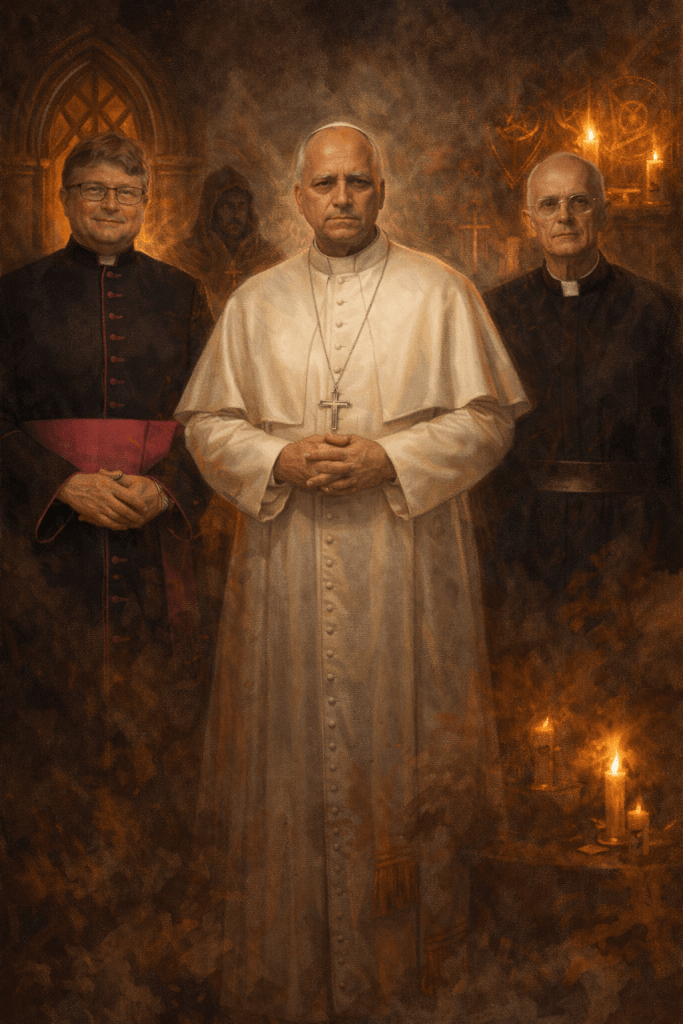
A recent Vatican meeting between Pope Leo XIV and the International Association of Exorcists underscores growing concern within the Church about the spread of occult practices and their spiritual consequences.
According to the exorcists, there has been a “noticeable rise” in involvement with “occultism, esotericism, and Satanism,” developments they associate with increasing cases of spiritual distress.¹ These trends are not viewed as abstract cultural shifts, but as realities encountered in pastoral work.
The delegation stressed that many individuals who engage in such practices experience serious harm, describing “grave spiritual suffering” among those affected.¹ In their view, these are not isolated incidents but part of a broader pattern requiring a structured response from the Church.
“Ignoring these realities leaves many people without an adequate response to grave spiritual suffering.”¹
For this reason, the exorcists emphasized the importance of ensuring that every diocese has properly trained clergy capable of addressing these situations. They called for stronger formation, clearer discernment, and greater institutional readiness.
At the same time, they acknowledged the complexity of these cases. The meeting highlighted the need for collaboration with medical and psychological professionals to distinguish between spiritual affliction and mental health conditions.¹ This cooperation is seen as essential for responsible pastoral care.
The Vatican framed the issue as one of accompaniment and guidance. Many who turn to occult or esoteric practices are described as searching for meaning or relief from personal struggles.¹ From the exorcists’ standpoint, this search can expose individuals to demonic influences that require careful spiritual intervention.
Overall, the meeting reflects a coordinated effort within the Church to respond to what exorcists describe as a growing pastoral challenge: one that involves both spiritual discernment and practical support for those affected.
St. Michael the Archangel, defender of the faithful, stands as heaven’s warrior casting down the forces of darkness and waging relentless battle against demonic powers.
Footnote
Marty Vergel Baes, “Pope Leo XIV Hosts Exorcists at Vatican — Surge in Satanism Cases Raises Concern for Vulnerable Believers,” International Business Times UK, March 23, 2026.
For years, I followed the path of Tibetan Buddhism and tantric practice. I studied its rituals, visualizations, deities, and especially its central concept of “non-dual realization,” considered the highest goal in Mahayana and Vajrayana philosophy.[1]
I chanted the mantras, invoked the buddhas, bodhisattvas and dakinis, and merged myself with yidams, believing I was on the path to ultimate truth or enlightenment.
But the truth I’ve realized now is very different. It was only after leaving the system and encountering Christ again that I saw what I had actually opened myself up to. What was presented to me as wisdom was, in reality, a surrender of my soul to dark powers wearing radiant masks.
What Is “Non-Dual Realization”?
In Mahayana and Vajrayana Buddhism, “non-dual realization” is taught as the highest goal. It means transcending the conceptual distinctions of self vs. other, good vs. evil, sacred vs. profane, based on the belief that these opposites are mental constructs and ultimately empty. It means realizing that everything is empty of inherent existence, that distinctions are illusions, and that even the self is not truly existent.
In Tibetan Buddhist tantric practice, this realization is pursued through deity yoga: one visualizes an external deity like a dakini, peaceful bodhisattva, or wrathful buddha, visualizes oneself as the deity, merges with the external form, and dissolves the sense of a separate self into that visualization. The goal is to transcend the sense of individual self and merge into what is presented as enlightened awareness.
This sounds beautiful on the surface. But what is actually happening behind the scenes?
Possession Disguised as Enlightenment
From a Christian perspective, this practice can lead to spiritual possession.
The moment you invite a being to take over your mind, body, or spirit, especially one that does not proclaim Jesus Christ as Lord (1 John 4:1-3), you are offering your soul to a power that is not of God.
Tantric practices train you to dissolve your boundaries. They break down your identity and present a being who is radiant, powerful, and loving, and invite you to unite with it.
In reality, this is surrender to a counterfeit. It is a deceptively woven net, spiritually binding, and ruthlessly enforced.
The Dakini’s Magical Net: A Trap, Not a Blessing
In Tibetan Buddhism, dakinis are presented as enlightened feminine energies, guides to wisdom, and protectors of the dharma. But now, I see clearly that the “net” of the dakinis isn’t a web of wisdom, but a spiritual snare.
These magical nets are said to catch the mind stream of those who violate tantric vows. They bind, dismantle, and destroy the consciousness of the practitioner who steps out of line. That is not divine justice but spiritual murder. It is demonic.
The Hidden Power Structure Behind Vajrayana
It’s important to add a caveat here: Tibetan Buddhists often shield themselves from criticism by appealing to the ethical and philosophical framework of early Buddhism, the so-called first and second turnings of the wheel. They claim that Vajrayana is inseparably bound to the moral and philosophical teachings of Hinayana and Mahayana.
However, in practice, it is the tantric laws that prevail. When push comes to shove, tantric expediency overrides all. What you get is a kind of spiritual gangsterism, a mafia-like code of silence, loyalty, and fear, all cloaked in the sanctity of Buddhist language and lineage.
But this never felt right to me. True love does not coerce and true wisdom does not enslave. The Holy Spirit convicts, but He never violates the soul’s freedom.
The Blood of Jesus Dissolves Every Net
The day I returned to Jesus Christ, after being spiritually attacked and nearly destroyed by the tantric Buddhist forces I once invoked, I renounced all former vows, empowerments, and deities. I asked God to set me free from every magical net and every spiritual power that claimed me. So many years before, after I had left the Catholic Church, I had gone through a long period of agnosticism before I took refuge in Tibetan Buddhism. I didn’t know if God existed or not. This left me open to deception by occult systems such as Tibetan Buddhism.
What I found in trying to break free from tantric occultism is that God is real and the blood of Jesus Christ is stronger than any tantric empowerment. It dissolves all bindings and shatters and severs every demonic contract.
We Are Not an Illusion
We are not empty. We are not reducible to pure awareness or dismissed as illusion. On the contrary, our existence is real, grounded, and full of meaning.
We are persons, created in the image of God (Genesis 1:27), with eternal souls, essential wills, and a purpose that cannot be replaced.
Jesus did not ask us to dissolve into Him. He calls us to relationship, not dissolution and especially not annihilation. He redeems, restores, and makes whole. In Christ, our identity is not erased but fulfilled. If you’ve been entangled in the deceptive beauty of tantric non-duality doublespeak, know this: it is not too late; there is a way out.
[1] Note on “Non-Dual Realization” in Tibetan Buddhism: In Mahayana and Vajrayana Buddhism, particularly within Madhyamaka philosophy and the Mahamudra tradition of the Karma Kagyu lineage, “non-dual realization” refers to the direct experiential understanding that all phenomena, including the perceiving mind and external objects, are empty of inherent existence. This does not mean merging into a single cosmic entity, but rather realizing that the distinction between subject and object is conceptually constructed and ultimately illusory. In Mahamudra practice, this is described as the union of clarity (luminosity) and emptiness, a non-conceptual awareness that is self-liberated and ungraspable. The practitioner seeks to transcend dualistic fixation and abide in the natural state of mind, free from elaboration. However, while this view is upheld within the tradition as a path to enlightenment, my experience revealed it as a spiritual vulnerability. Furthermore, the process of dissolving self-boundaries and engaging in deity identification opened the door to oppressive spiritual influences disguised as wisdom. What is framed as “non-dual realization” can, in practice, become the annihilation of personal agency and discernment and leave one open to possession by demonic entities.
Magic has long held a powerful allure in Western culture, woven into childhood stories, entertainment, and even everyday practices. From the entrancing fairy tales of Europe to modern pop culture phenomena like Harry Potter, the fascination with the mystical and supernatural has deeply shaped our collective imagination. Yet, while magic appears enchanting and harmless, Scripture warns us of its true nature and the dangers it poses to our souls.
The Allure of Magic in Childhood and Popular Culture
From an early age, children are introduced to magical themes through classic fairy tales and princess stories. Cinderella has a fairy godmother who transforms her fate with a wave of a wand. Sleeping Beauty and Snow White showcase witches casting spells, while Beauty and the Beast features an enchantress who curses a prince. These tales, though seemingly innocent, normalize the idea that magic is often a force for good.
Modern fantasy literature and films have reinforced this fascination with the supernatural. Harry Potter popularized wizardry and spellcasting, portraying them as exciting and even virtuous. Meanwhile, Ouija boards are marketed as mere games, despite their real connections to spirit communication. The 1973 horror film The Exorcist, based on a true story, illustrates the dangers of such practices. In reality, a young boy became possessed after playing with a Ouija board with his aunt. Though the film dramatized certain elements, the actual events were even more chilling. Additionally, fortune telling, astrology, tarot cards, and horoscopes have become widely accepted as harmless entertainment, masking the serious spiritual risks they pose.
These magical themes desensitize people, especially children, to the reality of occult practices. What begins as entertainment can lead to deeper interest and eventual participation in practices that God expressly forbids.
Biblical Warnings Against Magic and the Occult
The Bible is clear in its condemnation of witchcraft, sorcery, and all forms of divination. These practices are not neutral or harmless but rather open doors to demonic influences. God commands His people to stay away from such things:
Witchcraft is forbidden – “Thou shalt not suffer a witch to live.” (Exodus 22:18)
Divination is detestable – “There shall not be found among you anyone who… uses divination, practices witchcraft, or interprets omens.” (Deuteronomy 18:10-12)
Necromancy is condemned – “Do not turn to mediums or seek out spiritists, for you will be defiled by them.” (Leviticus 19:31)
Magic and sorcery are tied to judgment – “But the cowardly, unbelieving, abominable, murderers, sexually immoral, sorcerers, idolaters, and all liars shall have their part in the lake which burns with fire and brimstone.” (Revelation 21:8)
The story of King Saul consulting the witch of Endor (1 Samuel 28:6-7) illustrates the grave consequences of seeking guidance outside of God’s will. Similarly, Acts 19:19 records how new believers burned their books of magic as a sign of their repentance.
The Hidden Dangers of the Occult
Many who delve into magic, Wicca, and New Age practices do so out of curiosity or a desire for control over their lives. However, these practices deceive people into thinking they are gaining wisdom and power when, in reality, they are exposing themselves to spiritual bondage.
The devil masquerades as an angel of light (2 Corinthians 11:14), making magic appear appealing and even beneficial. Yet, as Zechariah 10:2 warns, “The idols speak deceit and diviners see visions that lie.” Engaging in these practices can lead to oppression, deception, and separation from the only true God.
Engaging in witchcraft, even so-called “white magic” spells, places one in deep spiritual debt to demonic forces. Many practitioners believe that white magic is harmless or even benevolent, but Scripture makes no distinction, all forms of witchcraft come from the same dark source. When someone casts a spell, invokes spirits, or seeks supernatural aid outside of God, they are entering into an agreement with demonic entities, whether they realize it or not. Demons do not offer power or knowledge freely; they always demand something in return. At first, their influence may seem subtle and provide results. This can increase fascination with magic, or offer a false sense of control. However, over time, this influence grows, leading the practitioner further into spiritual deception and dependence. This can quickly evolve into obsession, addiction, and ultimately, spiritual enslavement. Isaiah 8:19 warns, “When they say to you, ‘Consult the mediums and the spiritists who whisper and mutter,’ should not a people consult their God? Should they consult the dead on behalf of the living?” Seeking power outside of God’s will always comes at a cost. Those who engage in witchcraft often find themselves plagued with spiritual attacks, demonic oppression or possession, and an increasing inability to break free from their involvement.
Acts 16:16 tells of a slave girl who practiced divination and brought her owners great profit. However, when Paul cast out the spirit that enabled her fortune-telling, she immediately lost her powers, revealing that her abilities had come from demonic oppression, not personal skill. This account underscores the reality that magical practices are not self-generated, but are granted by spirits who expect repayment.
Guarding Ourselves and Our Children
As Christians, we must be vigilant in protecting ourselves and our families from the influence of the occult. Here are some practical ways to guard against the infiltration of magic in our lives:
Teach children biblical truth – Instill in them a love for God’s Word so they can discern between good and evil. (Proverbs 22:6)
Remove occult influences – Get rid of books, movies, games, and objects that promote witchcraft or supernatural themes contrary to Scripture. (Acts 19:19)
Pray for discernment – Ask the Holy Spirit for wisdom in recognizing hidden occult influences. (James 1:5)
Encourage a love for Christ, not magic – Rather than looking for excitement in the supernatural, teach children to find joy in a relationship with Jesus Christ.
Magic is deeply embedded in Western culture, from childhood fairy tales to modern entertainment. While it may seem harmless and fun, the Bible warns us that magic and the occult are gateways to spiritual deception. As believers, we must remain vigilant, guarding our hearts and homes against practices that draw us away from God. Instead, let us cling to the truth of Scripture, teaching our children to trust in the Lord and reject the false allure of magic.
“Have nothing to do with the fruitless deeds of darkness, but rather expose them.” (Ephesians 5:11)





 Tantric Deception