

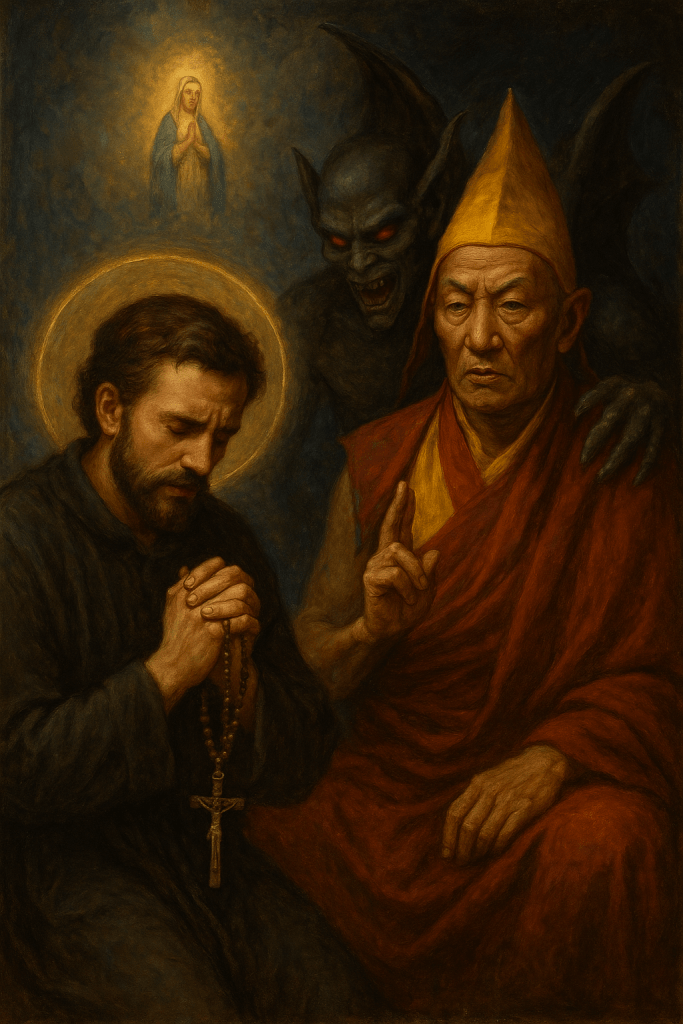
In the late 19th century, a young Italian lawyer named Bartolo Longo wandered the outskirts of Pompeii consumed by despair. Once a zealous Catholic, Bartolo had been “consecrated a satanic priest” in a Neapolitan occult circle, even promising his soul to a demon. He presided over dark rituals and blasphemed the Church, but the wages of serving Satan swiftly took their toll. Haunted by diabolical visions, paranoia, and suicidal depression, Bartolo felt his sanity slipping. On the brink of taking his own life, he suddenly heard a familiar voice – the voice of his old Dominican mentor echoing in his mind, repeating the Virgin Mary’s promise: “One who propagates my Rosary shall be saved.” In that moment, light pierced his darkness. Bartolo fell to his knees and vowed to devote the rest of his life to God, spreading the Holy Rosary as a penance and path to salvation. The former Satanist renounced the occult and embraced a life of heroic virtue. He would go on to build the Basilica of Our Lady of the Rosary in Pompeii and be acclaimed by Pope St. John Paul II as the “Apostle of the Rosary.” He will be canonized a saint in the fall of 2025. Bartolo Longo’s dramatic conversion sets the stage for a stark spiritual contrast: the true charisms of the saints versus the counterfeit “siddhi” powers of occult mystics.
Charisms: Miracles Born of Holiness and Submission to God
In Catholic tradition, charisms are supernatural gifts granted by the Holy Spirit to holy men and women for the building up of the Church. Whether humble or extraordinary, every authentic charism serves God’s glory and the good of souls, not the ego of the individual. These wonders blossom only in the soil of sanctity for they are fruits of a life surrendered to God’s will. The Church teaches that charisms must be discerned and always align with charity and truth. In other words, genuine miracles flow from holiness and obedience, never from personal ambition or curiosity.
The lives of the saints abound with such holy marvels. For example, St. Padre Pio of Pietrelcina (1887–1968) manifested numerous charisms that stunned the world. This humble Capuchin friar bore the bleeding wounds of Christ (the stigmata) for 50 years and endured vicious demonic attacks at night in union with Christ’s passion. Thousands of witnesses attest that Padre Pio could read hearts and souls in the confessional, knowing penitents’ sins before they spoke. He was often observed in bilocation, mysteriously appearing to comfort people hundreds of miles away while simultaneously remaining in his monastery. He healed the sick by his prayers (sometimes before they even asked), and he gave prophetic counsel. Famously, he foretold that a young Polish priest (Karol Wojtyła) would ascend to “the highest post in the Church,” years before Wojtyła became Pope John Paul II. All these miracles Padre Pio worked he attributed entirely to God. “I am only a humble friar,” he would insist, pointing all acclaim back to the Lord. His motto, “Pray, hope, and don’t worry,” reflected total trust in divine Providence. In every sense, Padre Pio’s charisms were gifts from God, signs following the faith of one who sought only to do God’s will.
Other saints, too, manifested astounding gifts by God’s grace. St. Joseph of Cupertino, a 17th-century Franciscan, was known as “the Flying Friar” for his frequent levitations during ecstatic prayer. Scores of witnesses, including skeptics, saw Joseph lifted off the ground, sometimes soaring high above the altar, whenever he fell into rapturous contemplation of God. This was no occult trick but a God-given ecstasy, so reliable that it embarrassed Joseph and his superiors (who often transferred him to avoid drawing crowds). Similarly, St. Catherine of Siena in the 14th century had a charism for casting out demons, such was her holiness in spiritual warfare. St. Martin de Porres (1579–1639) humbly bilocated and performed miraculous healings among the poor and sick of Lima. St. John Vianney, the Curé of Ars, could read souls and endured demonic harassment nightly as he drew throngs of sinners back to God. From the earliest apostles (healing the sick with St. Peter’s shadow in Acts 5:15) to modern blesseds like Bartolo Longo himself (whose restored Marian shrine in Pompeii became a locus of miracles), the Church recognizes these phenomena as authentic charisms only when they align with holiness and truth.
Importantly, the saints never sought supernatural gifts for their own sake. On the contrary, many pleaded with God to remove such signs, fearing they might attract attention or pride. Padre Pio, for example, prayed that his visible stigmata would vanish so he could suffer in secret. The holiest souls flee notoriety, embracing suffering and humility. Miracles then follow as God wills, to bear witness to the Gospel. The Catechism of the Catholic Church emphasizes that even remarkable charisms must be exercised in humble conformity to God’s love, and always subject to discernment by Church authorities. In short, the saints did not control or command these gifts, they received them. And they received them only because they first surrendered their lives in total obedience to Christ. The true power behind charisms is God Himself. As Scripture says, “No prophecy ever came by the will of man, but men moved by the Holy Spirit spoke from God” (2 Pet. 1:21). So it is with every healing, prophecy, or miracle of the saints: it is the Holy Spirit at work, a divine gift freely given, never a humanly engineered skill.
Siddhis: Occult Powers and Deceptive Feats of Tibetan Gurus
Contrast this with the siddhis, the flashy supernatural powers claimed by certain Eastern mystics, such as Tibetan Buddhist gurus and Hindu yogis. In the yogic Buddhist tradition, siddhis are paranormal abilities supposedly acquired through esoteric meditation practices or occult rituals. They include feats like clairvoyance (third-eye “vision”), telepathy, levitation, astral travel, bi-location, materialization of objects, extreme control over bodily processes (e.g. stopping the heartbeat or generating intense inner heat), and even the manipulation of matter and weather. The Tibetan landscape of legends and hagiographies is rich with such tales, but from a Catholic perspective, these awe-inspiring siddhis are dangerous illusions springing not from sanctity, but from the influence of demonic forces.
Tibetan Buddhist lore celebrates figures known as mahasiddhas (“great adepts”) who achieved mystical powers. Perhaps the most famous is Milarepa (c. 1052–1135), a yogi revered in Tibet as a great saint. Milarepa’s life story itself is telling: as a young man he learned black magic to avenge a family injustice, invoking demons to slaughter his enemies with a magical hailstorm, an act for which he later repented. After apprenticing under a Buddhist master, Milarepa underwent austere meditation retreats in mountain caves for years. He is rumored to have attained an array of astonishing powers, including the ability to levitate and fly, to walk or sleep while suspended in mid-air, and to transform his body into any shape he wished, even transmuting into fire or water. He could supposedly heat his body internally through tummo yoga to survive subzero winters clad only in a thin cotton cloth. Tibetan paintings often depict Milarepa in a cave, hand cupped to his ear, while effortlessly defying gravity in meditation. Notably, even in Buddhist accounts these abilities were regarded with caution. They were “occult powers” (in Milarepa’s own tradition, siddhis are considered byproducts of spiritual practice, not the goal). In Catholic eyes, such feats are not miracles from God, for Milarepa did not worship the true God; rather, they smack of the preternatural tricks of fallen angels. Indeed, the levitation of Milarepa and others like him stands in stark counterpoint to the levitations of a St. Joseph of Cupertino, one source being occult and the other divine.
Even in modern times, Tibetan Buddhist leaders continue to be credited with paranormal siddhis. Devotees of the late 16th Karmapa, Rangjung Rigpe Dorje (the head of the Karma Kagyu sect, who died in 1981) recount numerous extraordinary deeds. As a child, the 16th Karmapa reportedly displayed clairvoyance, unerringly telling local villagers where their lost animals had wandered. He was fond of birds and was said to put dying birds into a trance so that they stood upright for days after death, a ritual interpreted as guiding the birds’ consciousness to a better rebirth. In 1974, during a visit to a Hopi Indian reservation, the Karmapa performed a ceremony wearing his ritual Black Crown and, as the story goes, ended a 75-day drought by summoning a sudden downpour of rain. There are accounts of Tibetan masters (in various schools) who allegedly teleported or projected astral doubles of themselves across great distances, or who upon death shrunk their corpses to a fraction of normal size accompanied by rainbow lights, the famed “rainbow body”phenomenon that Tibetan Buddhists consider a sign of ultimate realization. All of these siddhis are celebrated within their respective circles as evidence of spiritual attainment. But are they from God? The Catholic answer is a resounding no.
From a Christian standpoint, it is suspicious that these powers arise in those who do not even acknowledge Jesus Christ as Lord, and often in tandem with pagan or occult rituals. The 16th Karmapa, for instance, appeared to be a kind and compassionate man by worldly accounts, even meeting Pope Paul VI, but the source of his “miracles” is highly suspect. Some lamas who knew about his secret magical activities were afraid of him, and after he died, his lineage split apart in a bitter conflict that continues to this day. Performing rain ceremonies invoking Tibetan and territorial or “local” deities (in reality, demons masquerading as gods) is a form of sorcery, explicitly forbidden by Scripture and the Church. The clairvoyance displayed by such gurus parallels the “second sight” of spirit mediums, an ability which the Catechism identifies as false divination that “conceals a desire for power over time, history and other human beings”, in competition with trust in God. And while Catholic saints healed by prayer or expelled demons in the name of Christ, Tibetan lamas employ mantras, secret empowerments, and spirit invocations to wield siddhis.
Jesus warned that “false christs and false prophets will arise and show great signs and wonders to deceive” (Matthew 24:24). The siddhi-working guru fits this warning: no matter how benevolent they seem, if they lead people away from the True God, their wonders are meant to deceive. The Church Fathers and theologians have long taught that demons can produce preternatural phenomena to ape God’s miracles; these are known as “lying wonders”intended to ensnare the unwary. St. Thomas Aquinas affirmed that demons, by their angelic nature, can manipulate matter and human perception, performing impressive tricks (though never true creation ex nihilo) to bolster false religions. An occult practitioner “levitating” or a lama conjuring rain is akin to Pharaoh’s magicians mimicking Moses: infernal sleight-of-hand permitted to test the faithful. What’s more, any apparent good that comes from siddhis is a bait on the hook (I can attest to this from personal experience), and a brief benefit to bind people to demonic influence in the long run.
The True Source: Holy Spirit vs. Occult Spirits
To discern the difference between a saint’s charism and a guru’s siddhi, one must examine the source and fruit of each. True spiritual gifts originate from the Holy Spirit and bear the fruits of the Spirit such as conversion, humility, charity, peace, and truth. By contrast, occult powers (no matter how wondrous) stem from unholy spirits and ultimately yield rotten fruit such as pride, confusion, spiritual bondage, fear, harm, and falsehood. The Catholic Church explicitly warns that seeking supernatural power apart from God’s will is a grave sin that opens one to demonic influence. The Catechism states unequivocally: “All forms of divination are to be rejected: recourse to Satan or demons, conjuring up the dead or other practices falsely supposed to ‘unveil’ the future… Consulting horoscopes, astrology, palm reading, tarot, interpretation of omens and lots, the phenomena of clairvoyance, and recourse to mediums all conceal a desire for power… They contradict the honor, respect, and loving fear that we owe to God alone.”
Likewise, “all practices of magic or sorcery, by which one attempts to tame occult powers… to have a supernatural power over others, even if for the sake of restoring health, are gravely contrary to the virtue of religion.” In short, to seek or use siddhis is to break the First Commandment, usurping God’s authority and bartering with demons for knowledge or power. No matter if one’s intention seems good (“healing” or “enlightenment”), the act of grasping at occult ability is a Faustian bargain and an invitation for the demonic to take control.
By contrast, the Church praises the charisms of the saints precisely because the saints never sought them. They sought only God, and God freely bestowed gifts as He pleased. There is no technique in the Catholic Church to get a charism: no incantation or secret method, only growth in holiness and prayer, which is itself at God’s initiative. Charisms are received in prayerful surrender, whereas siddhis are seized through ritual manipulation. A Tibetan guru meticulously follows occult protocols (chants, visualizations, yoga postures, ritual offerings) specifically to gain powers (the ordinary and extraordinary siddhis), a fundamentally prideful endeavor, however cloaked in spiritual language. A saint, on the other hand, often doesn’t even know they have a gift until it manifests unexpectedly to meet a need. Consider the fruits: When a saint works a miracle, people are healed physically and spiritually. Bodies are mended and hearts turned to Christ. When an occultist displays a wonder, observers might be astonished or entertained, but are they led to repentance and faith in the true God? Or are they lured deeper into fascination with the supernatural for its own sake? The answer is clear. God’s miracles always point back to God increasing faith, hope, and love. Demonic wonders point away from God toward ego, secret knowledge, or exotic spiritualities divorced from Christ.
Even the emotional aura surrounding these phenomena differs. True charisms, though extraordinary, convey a sense of peace, joy, and sacredness. Witnesses of a saint’s miracle often report a deepened devotion or the presence of God’s love. By contrast, siddhis and occult feats often carry an air of thrill, fear, or agitation (i.e. the kundalini phenomena produces a range of frightening symptoms). The devil can dazzle the senses, but he cannot impart true peace. How telling that Bartolo Longo, when he was deep in the occult, was tormented by depression and insanity; only when he returned to Christ did he find freedom and joy. Many who dabble in New Age or Eastern occult practices experience initial wonder, but later are plagued by nightmares, oppression, or a crippling pride. The devil demands a pound of flesh for every favor. As Jesus said, “By their fruits you will know them” (Matt. 7:20). The fruits of siddhis, no matter how impressive, are ultimately bitter. The fruits of the Holy Spirit are sweet and life-giving.
Testimonies of Deliverance: Warnings from Those Who Escaped the Occult
The stark difference between charisms and siddhis is not just theoretical, it is confirmed by the testimonies of those who have escaped the snare of occult practices. Modern Catholic exorcists and former occultists have sounded the alarm with firsthand experiences. Monsignor Stephen Rossetti, an exorcist, recounts numerous cases of people who thought they had natural “psychic” or healing gifts, when in fact these abilities were coming from demons. One woman who had worked as a New Age healer could see spirits and perform cures; after her return to the Church, Msgr. Rossetti counseled that her former “gift” was really an occult third-eye opened by demonic influence, not a charism from God. Only through renouncing all occult ties and intense deliverance prayers over years could such preternatural abilities be purged of dark influences. This illustrates a crucial point: Satan may grant a person a facsimile of healing or clairvoyance for a time, but it’s a Trojan horse, enslaving that soul to his dominion.
A particularly striking testimony comes from a woman who spent 35 years deeply involved in Tibetan Buddhism. She believed in the gurus’ powers and the Buddhist deities until she started to see strange behaviors and have doubts. The deities and the gurus considered her doubts to be “wrong views” and attacked her. The guru performed a horrific annihilation ritual upon her using an effigy ( a form of black magic). She reported a terrible realization: “I was tricked and deceived into believing that Buddha was the same as God… The group’s deities were actually demons and the gurus were their minions.” Ultimately, the gurus cursed her and threatened her with ‘the worst hell imaginable’, and she began suffering intense physical and mental assaults from demonic forces. Only through the power of Jesus, frequent confession, attending Mass, praying the Rosary, did she start finding liberation. This survivor now works to warn others: what Tibetan Buddhism presents as enlightened masters and benevolent spirit guides were, in truth, agents of Satan dragging souls to perdition. Her story is a sobering confirmation that occult powers always come at a terrible price. The devil may masquerade as an angel of light or even as a compassionate “bodhisattva,” but when unmasked, the fangs show. As the survivor put it, those who unwittingly worship these “gods” are in fact worshipping demons, and they often suffer hellish oppression as a result.
The Catholic Church urges us to seek the higher gifts (1 Cor. 12:31), faith, hope, and charity, and to leave extraordinary gifts to God’s providence. If ever we encounter phenomena of a mystical nature, we must test the spirits (1 Jn 4:1) under the Church’s guidance. Does it glorify Jesus Christ? Does it accord with Scripture and sacred Tradition? Does it promote virtue or feed curiosity and ego? The answers will quickly unveil the source.
Let Bartolo Longo’s story stand as a beacon: He tasted the darkest occult powers and found only despair, but when he turned to Our Lady and her Rosary, he found redemption and true spiritual authority over the darkness. In the end, the charisms of the saints point to the triumph of Christ, whereas the siddhis of the Tibetan masters (and all occultists) are a devilish dead-end. One path leads to eternal life; the other, if not abandoned, leads to spiritual death.
Christ or the occult? Each of us must choose. The stakes are nothing less than salvation. May all be moved to embrace the light of Christ, renouncing Satan and all his empty show. Let us therefore strive to become saints, not sorcerers, for in the end, every knee will bow to the true God, and all false gods and their lying wonders will be cast down.
Sources: The Catholic Church’s teaching on charisms and occult practices (Catechism of the Catholic Church 799-801, 2115-2117); Lives of Blessed Bartolo Longo; Testimony of ex-Tibetan Buddhist; Accounts of Padre Pio’s gifts; Tibetan siddhi claims (16th Karmapa, Milarepa); Msgr. Stephen Rossetti on occult “gifts” vs. divine charisms.
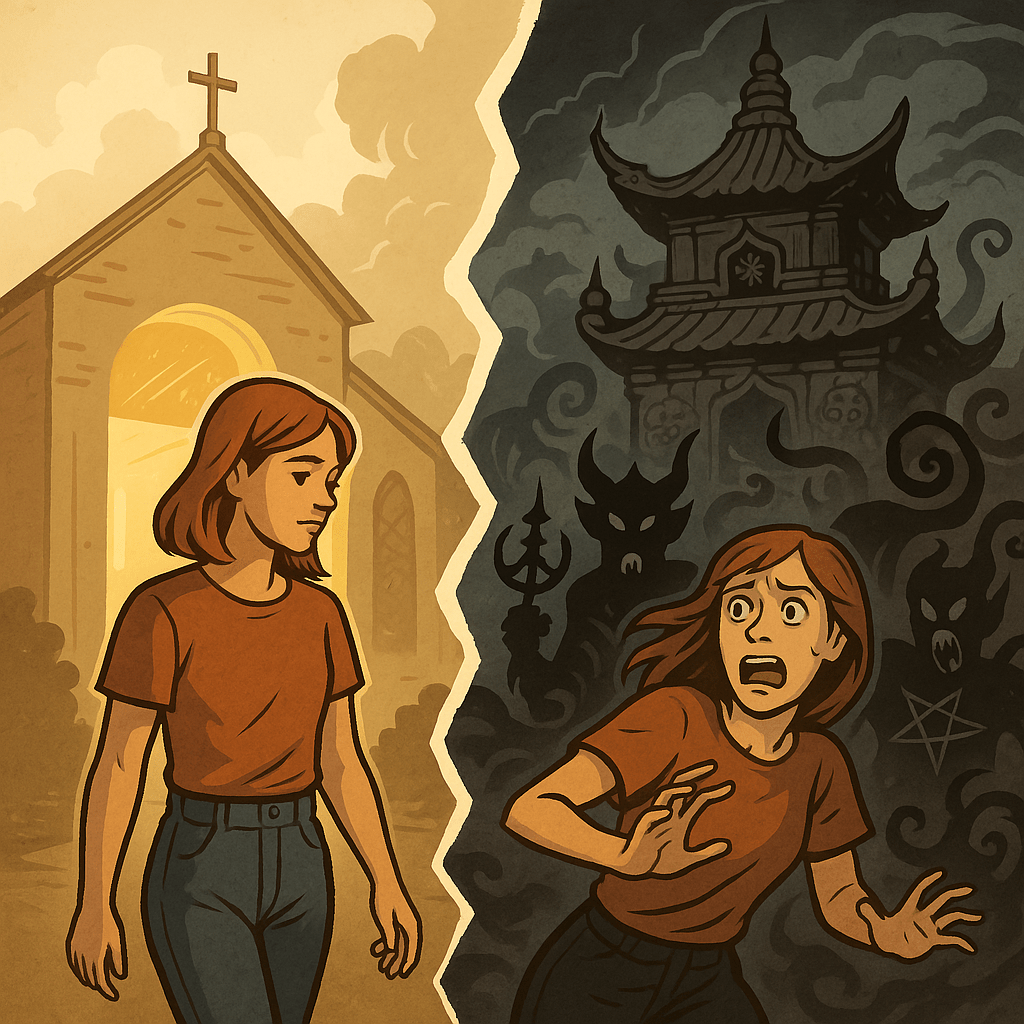
 Tantric Deception