

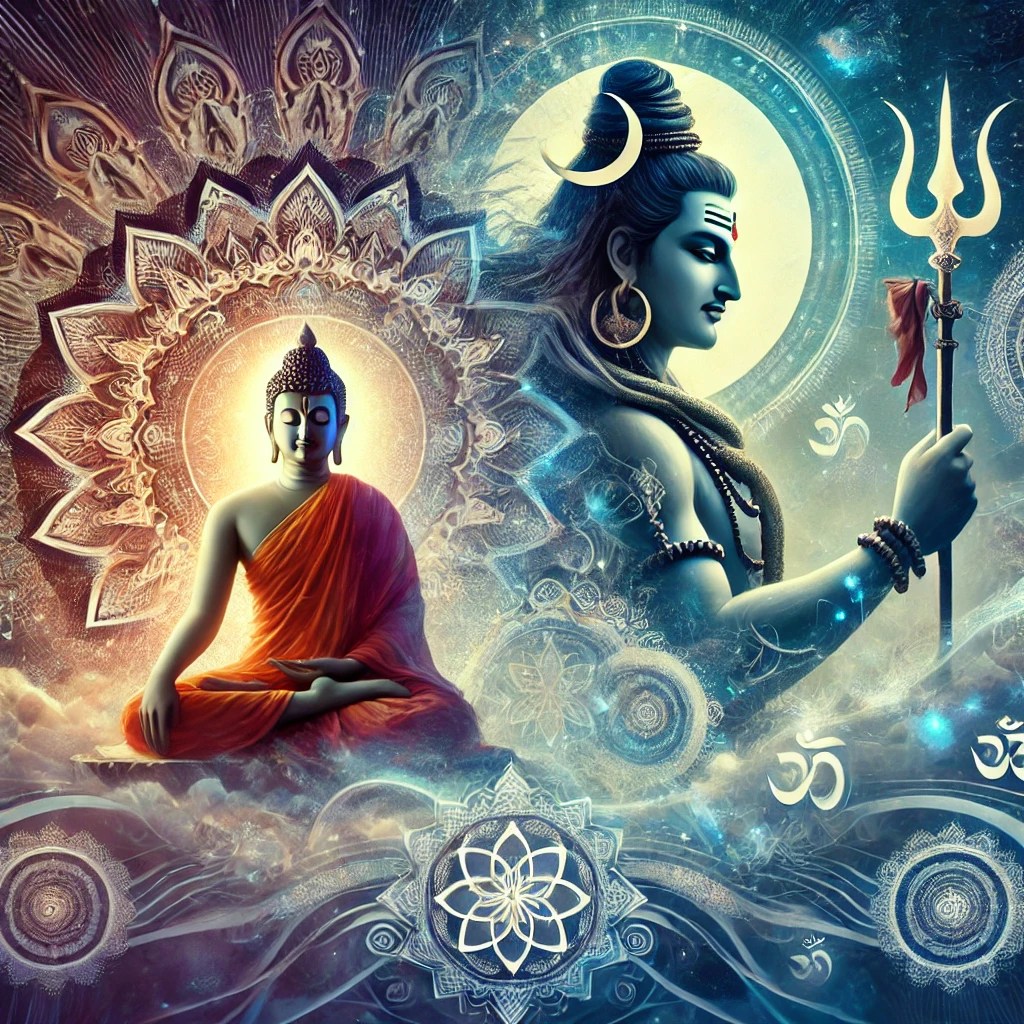
The rich interplay between Hindu and Buddhist Tantric traditions has been a subject of rigorous scholarly inquiry, yet much of this relationship has remained obscured in popular understandings of Tibetan Buddhism. Three seminal works, Francesco Sfewa’s “Some Considerations on the Relationship Between Hindu and Buddhist Tantras”, Alexis Sanderson’s “Vajrayāna: Origin and Function in Buddhism”, and Robert Mayer’s “The Figure of Maheśvara/Rudra in the rÑiṁ-ma-pa Tantric Tradition,” shed light on the foundational role of Kashmir Shaivism in shaping the Yoginītantras of Tibetan Buddhism. These articles offer compelling evidence that Tibetan Buddhist Tantras, particularly the Yoginītantras, were heavily influenced by Saiva texts and practices, directly linking Tibetan Buddhism to the figure of Śiva himself.
In the transmission of Tibetan Buddhism to the West, Tibetan masters often downplayed or ignored this profound connection. Instead, they ascribed the Tantras to the Buddha himself, claiming that he taught these esoteric teachings in a transcendent form after his parinirvāṇa (passing away). According to traditional accounts, these teachings were revealed at specific sacred locations, such as Mount Malaya, situated in present day Sri Lanka. These teachings, it is said, were preserved in the realms of gods and nāgas (serpentine spirits) before being transmitted to humanity through visionary masters. By presenting the Tantras as originating from the Buddha rather than acknowledging their Saivite roots, Tibetan masters aimed to establish their authority and distinguish their tradition from external influences.
However, as Sanderson, Sfewa, and Mayer document, the Yoginītantras in Tibetan Buddhism were not created in isolation. They borrowed extensively from Saivite texts like the Brahmayāmala, Siddhayogeśvarīmata, and Picumata, incorporating not only ritual frameworks but also mythological narratives. This borrowing represents what scholars call “pious plagiarism,” where Saivite materials were recontextualized to align with Buddhist soteriological goals. The myths, rituals, and iconography of the Yoginītantras, which are central to Tibetan Buddhist Tantra, thus owe their origins to Śiva and his Tantras.
Recognizing this connection does not diminish the uniqueness of Tibetan Buddhism but rather situates it within a broader, interconnected spiritual landscape. It underscores how traditions evolve through dynamic cultural exchanges, offering a deeper understanding of Tantra’s history.
Shared Foundations and “Pious Plagiarism”
Francesco Sfewa’s analysis highlights the undeniable overlap between Hindu and Buddhist Tantra. He suggests that this commonality arises not from coincidental similarities but from deliberate borrowings. Sfewa notes the phenomenon of “pious plagiarism,” where texts from the Hindu Saivite tradition were adapted into Buddhist contexts, particularly the Yoginītantras. He emphasizes the need to move beyond vague notions of a “shared religious substratum” and instead examine direct textual dependencies.
Alexis Sanderson: Tracing Scriptural Borrowings
Sanderson’s meticulous philological work underscores this dependency. He demonstrates how Buddhist Vajrayāna texts, especially the Yoginītantras, borrowed heavily from Saiva sources such as the Brahmayāmala and the Siddhayogeśvarīmata. For example, he shows that ritual frameworks and mythic narratives in Buddhist texts like the Hevajra Tantra align closely with Saiva models. Sanderson argues that these borrowings are not isolated but reflect a systematic incorporation of Saivite elements into Buddhist Tantra.
Mythology as a Lens: Robert Mayer’s Insights
Robert Mayer takes a mythological approach, examining the narrative of the “Taming of Maheśvara/Rudra.” This myth, central to many Buddhist Tantras, portrays the subjugation of Saiva deities by Buddhist figures, symbolizing the assimilation of Saivite practices into Buddhist frameworks. Mayer sees this narrative as a “charter myth” that legitimizes Buddhist Vajrayāna’s adoption of Saiva elements. He also highlights how Tibetan Buddhist traditions reinterpreted these myths, assigning Buddhist meanings to Saivite symbols while acknowledging their origins.
Reconciling Differences: A Shared Soteriology?
Despite their doctrinal differences, Sfewa, Sanderson, and Mayer point to a shared soteriological framework underpinning both traditions. Both Hindu and Buddhist Tantras emphasize liberation through a union with the divine, facilitated by initiations, meditative practices, and ritual. This common ground enabled a seamless exchange of ideas, even as each tradition reinterpreted borrowed elements to align with its goals.
Implications for Modern Scholarship
The work of these scholars challenges us to rethink the boundaries between Hindu and Buddhist Tantric traditions. Rather than viewing them as isolated systems, we see them as part of a dynamic cultural and religious interplay. This perspective not only clarifies our understanding of Tantra but also offers broader insights into how religious traditions evolve through interaction. This, in turn, calls into question the myth that tantric Buddhism came directly from the Buddha himself.
Recognizing the historical and cultural debts of Tibetan Buddhism to Kashmir Shaivism, particularly in the Yoginītantras, does not detract from its significance. Instead, it situates Tibetan Buddhist Tantra within a tapestry of spiritual exchange, affirming the adaptability of religious traditions across time and space.
 Tantric Deception