An Encounter with Kali


The descent into Bengal began with a vision. As our plane banked low over the hazy sprawl of Calcutta, I sat in meditation, quietly preparing for a long journey north to Sikkim for a series of tantric empowerments. Then, quite suddenly, a naked dakini appeared before me, dancing and beckoning. She seemed to be greeting me to Calcutta. I knew, or thought I knew, that it was Kali.

We stayed in a modest Baptist guesthouse chosen for its safety and low price, a short walk from Mother Teresa’s compound. It was late October, and the air was warm and humid. Calcutta felt down at heel, yet intellectual and dignified. My companions, all Tibetan Buddhist practitioners, decided to visit Mother Teresa’s place to pay homage. I hung back. They were sincere in their devotion to that famous nun, but something in me pulled in another direction. Although I had been raised Catholic, I felt a faint aversion to anything connected with the Catholic Church. I regarded the religion as problematic at that time. Still, seeing how genuinely excited my friends were, I encouraged them to go.

The next day I hired a taxi and arranged for us to cross the city to the Dakshineswar Kali Temple, the same temple where Ramakrishna had worshipped and experienced his visions of the Divine Mother and became enlightened. “We really must make the effort to see it,” I told the others, although I wasn’t sure why. The journey took nearly an hour through dusty streets and chaotic traffic. I had read that Kali was the patron goddess of Bengal, and that Dakshineswar was one of her most important shrines. The closer we came, the stronger the pull felt.

At the temple, a long line of Indian devotees wound through the courtyard, each waiting to glimpse the goddess and receive her blessing. We appeared to be the only Westerners there. I knew very little about the history of the temple at that point. All I knew was that I had always been intrigued by Ramakrishna among all the Hindu mystics and had always wanted to visit his temple and pay my respects.

The Temple and Its History

The Dakshineswar Kali Temple was founded in the mid-nineteenth century by Rani Rashmoni, a wealthy zamindar who, according to legend, dreamt that the goddess Kali commanded her to build a temple on the banks of the Hooghly River rather than journey by boat to Varanasi¹. Rashmoni had been preparing for the pilgrimage for months and had spent a small fortune, but on the night before her departure, Kali appeared in a dream and told her she need not travel at all. Instead, the goddess instructed her to raise a temple and enshrine an image that Kali herself would inhabit, blessing all who came to worship. The temple was completed in 1855 and the complex stands on land said to resemble a tortoise, a form considered especially auspicious in Shakta-Tantra cosmology².

Architecturally, the main temple is built in the navaratna (nine-spired) style typical of Bengal, raised on a high platform overlooking the river³. Surrounding the sanctum are twelve identical Shiva shrines aligned along the Hooghly’s edge, a small Radha-Krishna temple, and bathing ghats for pilgrims⁴.

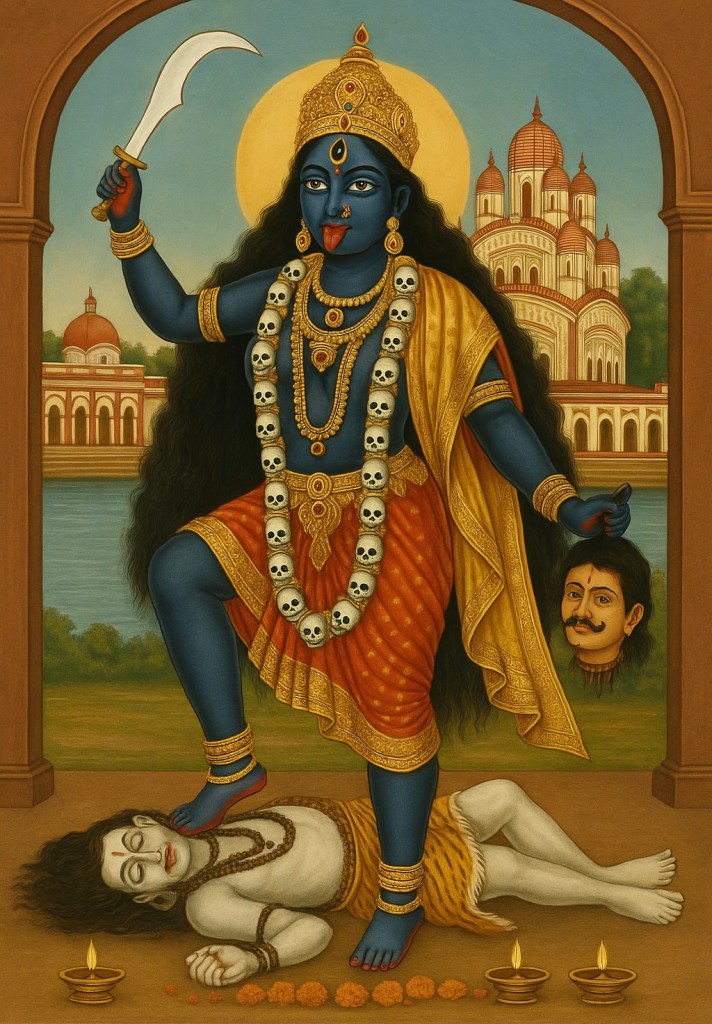
Inside the sanctum resides Bhavatarini, a fierce aspect of Kali known as “Saviour of the Universe,” depicted with one foot on Shiva’s chest⁵. The mystic Ramakrishna served as the temple’s priest and carried out years of intense spiritual practice within its grounds, transforming the site into one of India’s holiest centers of Shakti worship⁶. The atmosphere is thick with incense, bells, flowers, and the hum of a thousand mantras. Once inside the gate you feel the city’s chaos fall away.

As we stood in line, something unexpected happened. An Indian guard suddenly appeared, motioned to me and a Buddhist friend, and beckoned us forward. Without explanation, we were led past the waiting crowd directly to the inner sanctum. The goddess stood before us, draped in red and gold, eyes alive in the flicker of ghee lamps. When I received prasad, it tasted sweet and delicious, and I felt a surge of a deep, penetrating love. It was so overwhelming that I began to cry.

As a Tibetan Buddhist, I had always regarded Hindu deities as somehow inferior and secondary to the Tibetan ones who were the representations of the ultimate truth. My practice had centered on Vajrayogini and Chakrasamvara, not on Kali. Yet there, when the experience of divine love engulfed me in the Dakshineswar temple, I felt an unmistakable recognition.

Years later, after surviving the catastrophic unraveling of my own tantric path due to the betrayal by male Buddhist teachers, the exposure of their sexual abuses, and the psychic annihilation that followed, I began to study the origins of tantra in earnest. Through the research of Alexis Sanderson and others, I learned what my experience at Dakshineswar had already shown me: that the yoginī tantras of Tibetan Buddhism arose from the same crucible of medieval Hindu Śaiva and Śākta practice⁷. Vajrayoginī, the red goddess of my own initiations, was in essence a Buddhized form of Kali. The goddess in both traditions can give blessings and boons, but she can become, in an instant, a terrifying and destructive demon with her own set of intentions and cosmic laws.

That insight came at great cost. The deeper I studied, the more clearly I saw that tantra, in both Hindu and Buddhist forms, was inseparable from forces of domination, secrecy, and power. The same ecstatic current that once inspired devotion also lurked behind manipulation and abuse. In the West, these darker currents were long dismissed or hidden, until the many scandals of 2017 tore the veil away.

My visit to Kali’s temple remains a paradox. In that moment I felt only grace: the raw, overwhelming presence of the divine feminine. But in hindsight, I experienced Kali as both mother and destroyer, blessing and devourer. She welcomed me to Calcutta with open arms, but in time, in her Buddhist form as Vajrayogini, she stripped me of everything I held dear in order to completely destroy my body, mind, and soul. By the grace of the highest divinity, the eternal Christian God, I survived and am still alive to tell the tale.


Notes

  1. Dakshineswar Kali Temple, Wikipedia, last modified 2025.
  2. Ibid.
  3. Ibid.
  4. Ibid.; see also Dakshineswar Kali Temple official site, Places in Dakshineshwar (dakshineswarkalitemple.org).
  5. Dakshineswar Kali Temple, Britannica.
  6. Ibid.; Ramakrishna’s association documented in Swami Nikhilananda, The Gospel of Sri Ramakrishna (New York: Ramakrishna-Vivekananda Center, 1942).
  7. Alexis Sanderson, “The Śaiva Age: The Rise and Dominance of Śaivism during the Early Medieval Period,” in Genesis and Development of Tantrism, ed. Shingo Einoo (Tokyo: Institute of Oriental Culture, University of Tokyo, 2009), 41–350.
Kali and Vajrayoginī: A Biblical Perspective


In both Hindu and Buddhist tantric traditions, Kali and Vajrayoginī stand as iconic figures of immense power. Wrathful, seductive, and liberating, they are revered as goddesses who destroy ignorance and ego, leading practitioners to freedom through terrifying grace. They drink blood, wear garlands of skulls, and dance on corpses. These are not symbols for the faint of heart.

Kali, in Hinduism, is the goddess of time and death. She is the dark mother who slays demons, severs illusion, and devours ego. Vajrayoginī, in Vajrayāna Buddhism, is a female buddha who leads devotees to enlightenment through the annihilation of dualistic perception, often through erotic and wrathful means.

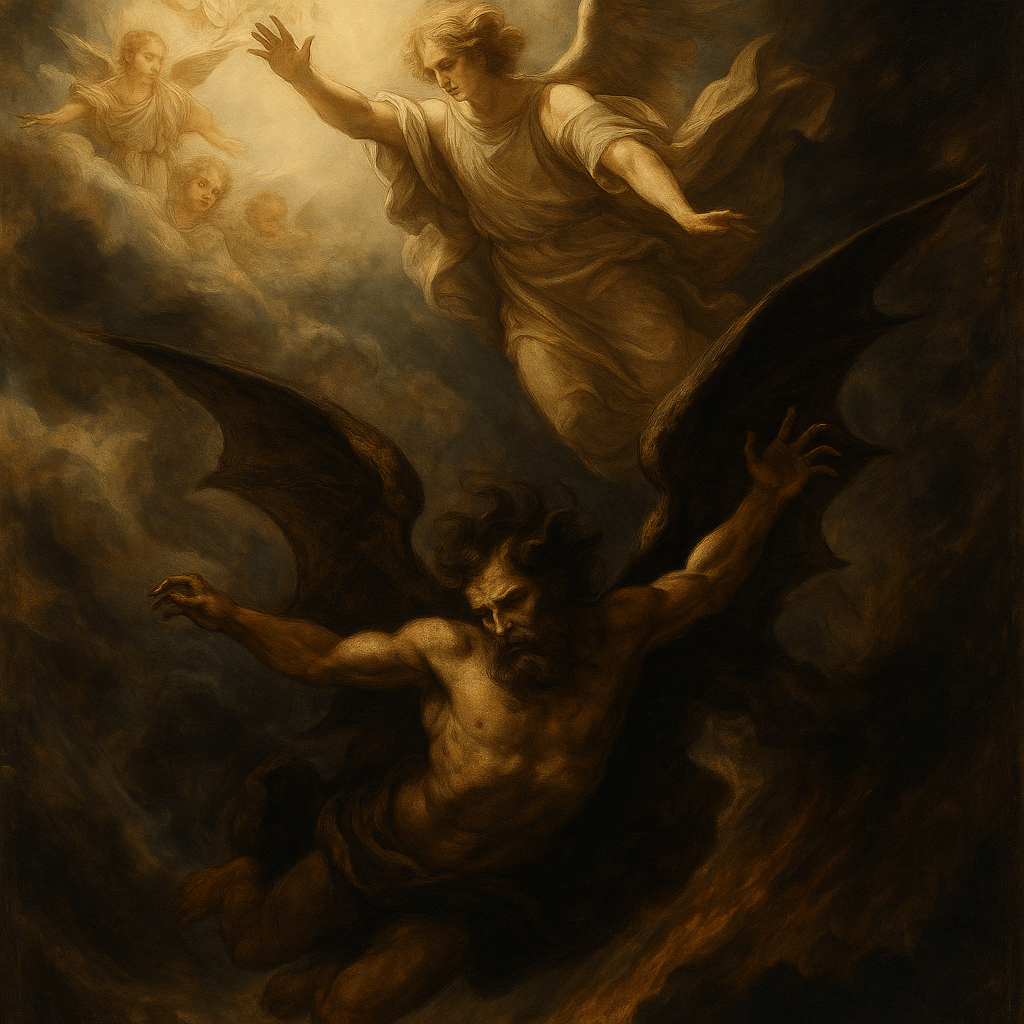
Today, many feminists embrace these goddesses as symbols of female empowerment, strength, and liberation from patriarchal religion. But this overlooks the possibility that these figures, far from celebrating womanhood, may actually represent a deep spiritual hostility toward it. The ego-annihilation they demand may not be empowering at all, but destructive, both spiritually and psychologically. When viewed through a biblical lens, one must consider whether these so-called icons of empowerment are in fact hostile agents cloaked in feminine form. From a biblical worldview, who are they really?


Fallen Beings or Demonic Entities

If we take the Bible as the sole and literal authority:

  • There is one true God (YHWH), and worship is due to Him alone.
  • Any supernatural beings outside of YHWH and His angels fall under:
    • Idols (Psalm 96:5 – “For all the gods of the nations are idols”)
    • Deceiving spirits or demons (1 Corinthians 10:20 – “The sacrifices of pagans are offered to demons, not to God.”)

From this view:

DeityBiblical Interpretation
KaliA manifestation of a demonic spirit that seduces worshippers through fear and false power
VajrayoginīA spirit of deception using mystical allure to imitate divine enlightenment

Why They’re Considered Dangerous

1. They Accept Worship Not Meant for Them

  • Worship of any being other than the God of Israel is strictly forbidden. (Exodus 20:3 – “You shall have no other gods before Me.”)
  • Revering supernatural powers outside of God constitutes rebellion and idolatry.

2. They Promote False Teachings

3. They Offer Counterfeit Spiritual Power

  • These goddesses can induce real mystical experiences through the occult third eye, but from a biblical view, such power is not from God.
  • They mimic light and transcendence, offering access to preternatural realms that ensnare souls in spiritual bondage.

Biblical Warnings Relevant to These Figures

  • 2 Corinthians 11:14 – “Even Satan disguises himself as an angel of light.”
  • Deuteronomy 13:1–3 – Even if a sign or wonder comes to pass, if it leads you to follow other gods, it is a test from the Lord.
  • Revelation 9:20 – Condemns worship of “idols of gold and silver… which cannot see or hear or walk.”

Summary (from a Biblical Lens)

Kali and Vajrayoginī are not misunderstood archetypes or symbolic feminine faces of divine truth. From a biblical standpoint, they are false gods or fallen spirits who lure seekers through mysticism, ecstasy, and power into worship that ultimately defies the true and living God.

Their powers are spiritual deceptions, designed to mimic enlightenment while leading souls away from salvation and the truth of Jesus Christ.

To those recovering from tantric abuse or deception: the biblical path does not deny spiritual reality, it affirms that spiritual warfare is real, and that freedom is found in Christ alone, not through altered states, or the worship of seductive wrathful or peaceful goddesses, or any other small “g” god for that matter.

You shall have no other gods before Me.” — Exodus 20:3

Rethinking Kundalini Awakening


Kundalini has long been described as a latent energy residing in the root chakra, an evolutionary force waiting to be awakened. Across various esoteric traditions, this energy is believed to rise through the subtle body, purging karmic imprints, and ultimately merging with the crown chakra, culminating in what is often called spiritual enlightenment. But is this awakening truly a path to liberation, or is it something more insidious?

The Traditional Narrative of Kundalini

In Hinduism, kundalini is depicted as a coiled serpent at the base of the spine, lying dormant until activated through practices such as yoga, mantra recitation, or tantric rituals. Its ascent is said to be accompanied by profound energetic experiences such heat, visions, bodily tremors, and radical shifts in consciousness. Similarly, Tibetan Buddhism invokes powerful deities like Vajrayogini through tantric practice, where practitioners visualize and merge with these beings to achieve heightened states of awareness.

But what if kundalini is not simply an impersonal, evolutionary force? What if it is an entity, a being that takes possession of the initiate?

My Personal Awakening: The Force That Felt “Other”

During my three-year Tibetan Buddhist retreat, I engaged in rigorous tantric practices designed to accelerate spiritual transformation. I was instructed to visualize deities, recite mantras, engage in an extreme form of yoga and breath manipulation, replace my ordinary identity with that of the enlightened being, and then dissolve that conceptual construct into emptiness. At the culmination of my practice, I experienced a massive kundalini awakening, a phenomenon that, at the time, was being reported by many across various spiritual modalities, particularly in the nascent days of internet forums and search engines.

I was assured that kundalini was a benevolent force, the fuel for spiritual enlightenment, and a necessary purification process. But the experience was horrific. At its peak, in the midst of unbearable energetic torment, I saw the tantric deity I had been invoking appear above my head. She was trying to enter my body. I intuitively understood that what I was experiencing was her attempt to expand my nervous system so she could fully inhabit it. Whether that was for good or for ill I wasn’t sure. The kundalini energy always felt alien. Finally it dawned on me: it felt other because it is other. I have come to the conclusion that Kundalini is not just an neutral spiritual energy but a possessing spirit.

The Ancient Serpent Spirit Across Cultures


The realization that kundalini is a sentient force aligns with countless historical accounts of spirit possession in esoteric traditions. In Hinduism, Shiva and Kali are both associated with immense, transformative energy, often depicted in forms that suggest possession. Shiva’s wild, ascetic frenzy matches Kali’s violent, all-consuming nature. In Tibetan Buddhism, Vajrayogini and some other tantric deities are depicted in a similar manner. They are summoned and merged with the practitioner, suggesting an external force taking control of the body.

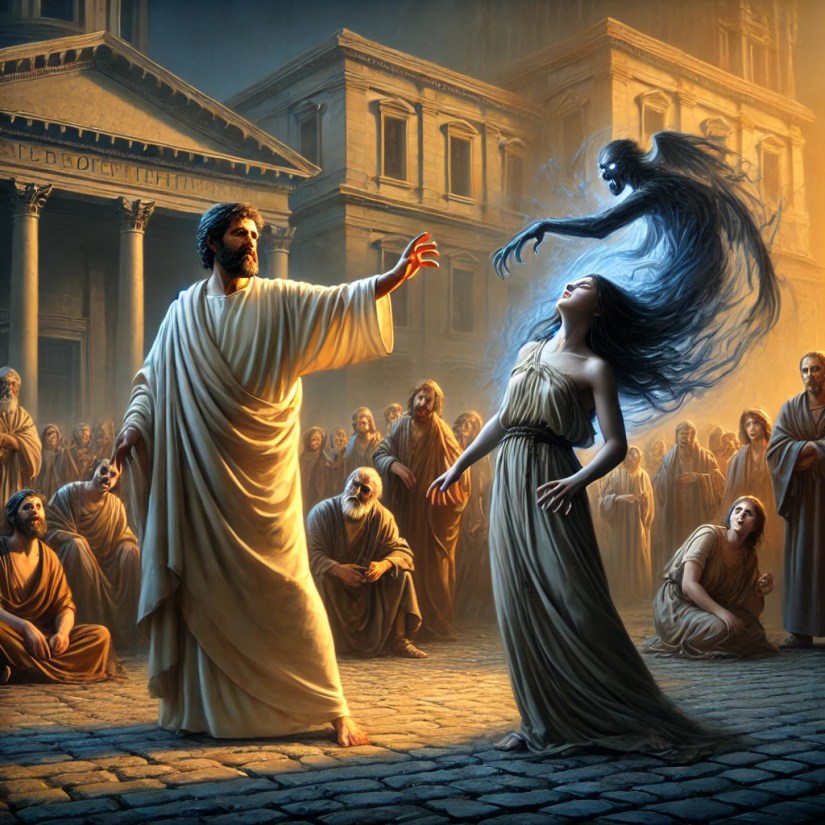
The ancient Greeks spoke of the Python spirit, a demonic entity associated with divination and oracles. The Bible recounts how the Apostle Paul encountered a slave girl possessed by the “python spirit,” a demon of fortune-telling, and cast it out in the name of Jesus Christ (Acts 16:16-18). The parallels between the descriptions of the python spirit and kundalini are striking. The spasms, altered states, and prophetic visions are all common signs of both kundalini awakenings and spirit possession.

Apostle Paul casting out the demon of divination from the servant girl.

Kundalini: The Spirit of the Serpent

What if kundalini is not the divine energy it claims to be? What if the spiritual transformations it promises are merely a baited hook leading to deeper and deeper possession? Many undergoing kundalini awakenings report disturbing symptoms: involuntary body movements, extreme heat, uncontrollable weeping, and even a complete breakdown of identity. These are not signs of enlightenment but of something powerful taking over.

In Christian theology, the serpent has always been a deceiver, from the Garden of Eden to the python spirit Paul cast out. In many indigenous traditions, serpent spirits are revered but also feared, as they often demand submission in exchange for their so-called “gifts.”

If kundalini is truly a possessing spirit, then its widespread activation in modern spiritual movements is not a path to liberation but a global initiation into deception. Esoteric traditions have long venerated the serpent, but history and scripture warns against it.

For those undergoing kundalini awakenings, it is crucial to question the nature of this force. Is it truly an impersonal divine energy, or is it an entity seeking a vessel? And if so, how can one break free from its grip?

The time has come to reconsider the nature of kundalini, not as an evolutionary force but as the ancient spirit of the serpent who, as deceiver, has masqueraded for centuries under the guise of enlightenment.