

Southern India: The Virgin Who Heals vs. Goddesses Who Possess


In a dusty corner of southern India, something strange is happening. Among the Catholic untouchables of Tamil Nadu the Virgin Mary reigns. These are the Dalit communities who converted to Christianity to escape caste oppression. Here the Virgin Mary is not just the mother of Christ or the Queen of Heaven. She’s the protector from demons, the healer of the possessed, and the exorcist of lustful spirits who prey on young women. [1]

Her name here is Arockyai Mary, “Our Lady of Good Health,” and unlike the goddesses of India’s native pantheon, she never harms. She doesn’t demand blood, or rage, or possess.

This makes her an anomaly in a world where possession is an everyday threat and where menstruation, pregnancy, and the liminal chaos of female sexuality are believed to attract wandering spirits, often the ghosts of those who died violently or before their time. These spirits, it is said, latch onto the vulnerable, especially women, and drive them into trances and convulsions.

And then there are the Hindu goddesses like Mariyamman [2] and Kaliamman [3], powerful but volatile. They heal, but they can also possess, punish, and destroy. Unlike the Virgin Mary, who is seen as unconditionally loving and healing, Mariyamman and Kaliamman’s protection must be earned through ritual and sacrifice. Their presence is often feared as much as it is venerated, revealing a form of feminine divinity that is transactional, fierce, and unpredictable.

The deeper thread that ties this to my own journey through Eastern mysticism and into Catholic truth is that the female deities of India are not so much saviors as they are owners. They ride their devotees like horses often through an overpowering kundalini experience. They enter bodies without informed consent. They demand submission, sacrifice, and pain. This is what possession looks like when the divine manifests as fierce femininity unmoored from moral restraint.

But the Virgin Mary is different in kind, not just degree. She doesn’t exploit vulnerability; she protects it. Her power is rooted in love, not domination. She doesn’t punish women for their sexuality; she guards them from the predators that do.

Many of us who were drawn into the tantric and yogic traditions found ourselves worshiping goddesses we didn’t truly understand such as Kali, Vajrayogini, and Durga. These powerful beings granted “blessings” that often came in the form of disorientation, illness, and spiritual invasion. What we called “awakening” was perhaps possession, wrapped in ritual and mystique.

In the story of the Paraiyar women, we see this clearly. Demonic possession is a warning as well. The culture teaches women that if they stray outside ritual boundaries, if they become too sexually visible, if they travel alone at dusk or cross the wrong river, they open the door to attack. And it’s the Virgin Mary, not Kali, who shows up to cast the darkness out.

Humanity does not need more divine rage, but the one Woman who is pure benevolence: the Mother of Jesus who through her perfection is feared by and can cast out spirits and demonic goddesses.

[1] Source article: Deliège, Robert. “La Possession démoniaque chez les Intouchables catholiques de l’Inde du sud / Demoniac Possession Among the Catholic Untouchables in Southern India.” Archives de sciences sociales des religions, no. 79, 1992, pp. 115–134. Available online.

[2] Mariyamman is a powerful village goddess widely worshipped in South India, especially in Tamil Nadu. Her name combines “mari,” meaning rain or disease, and “amman,” meaning mother—making her the Mother of Rain and Disease. She is especially associated with illnesses like smallpox, fevers, and skin diseases, but also with fertility, childbirth, and protection from evil spirits. Visually, she often appears fierce—sometimes with fiery red skin, holding a trident, and crowned with flames—bearing a resemblance to goddesses like Kali or Durga. Her shrines are typically modest, and her worship is deeply rooted in folk rituals. Devotees may offer animal sacrifices, participate in firewalking, or fall into trances believed to be divine possessions. In many cases, women are the ones possessed by Mariyamman, and these episodes are interpreted as both blessings and warnings—depending on whether the goddess has been properly appeased.

[3] Kaliammam is a fierce village manifestation of the goddess Kali, worshipped primarily in Tamil Nadu and other parts of South India. The name “Kaliamman” translates to “Mother Kali,” reflecting her role as a local protective mother goddess rooted in folk traditions. Like Kali, she is associated with destruction, power, and the eradication of evil, but in the village context, she is also invoked for healing, fertility, and protection from malevolent spirits. Kaliamman is often depicted with dark skin, a lolling tongue, wild hair, and multiple arms holding weapons—symbolizing her unrestrained spiritual power. Her worship includes rituals that are intense and sometimes violent: offerings of blood, possession trances, firewalking, and dramatic acts of devotion are common. She is believed to possess her devotees—often women—either to bless them, deliver a warning, or punish neglect. She must be honored and feared. Her presence reinforces moral and ritual boundaries in the community, demanding reverence through sacrifice and submission rather than drawing near in mercy or compassion.
Shape-Shifting in Tantra and Shamanism


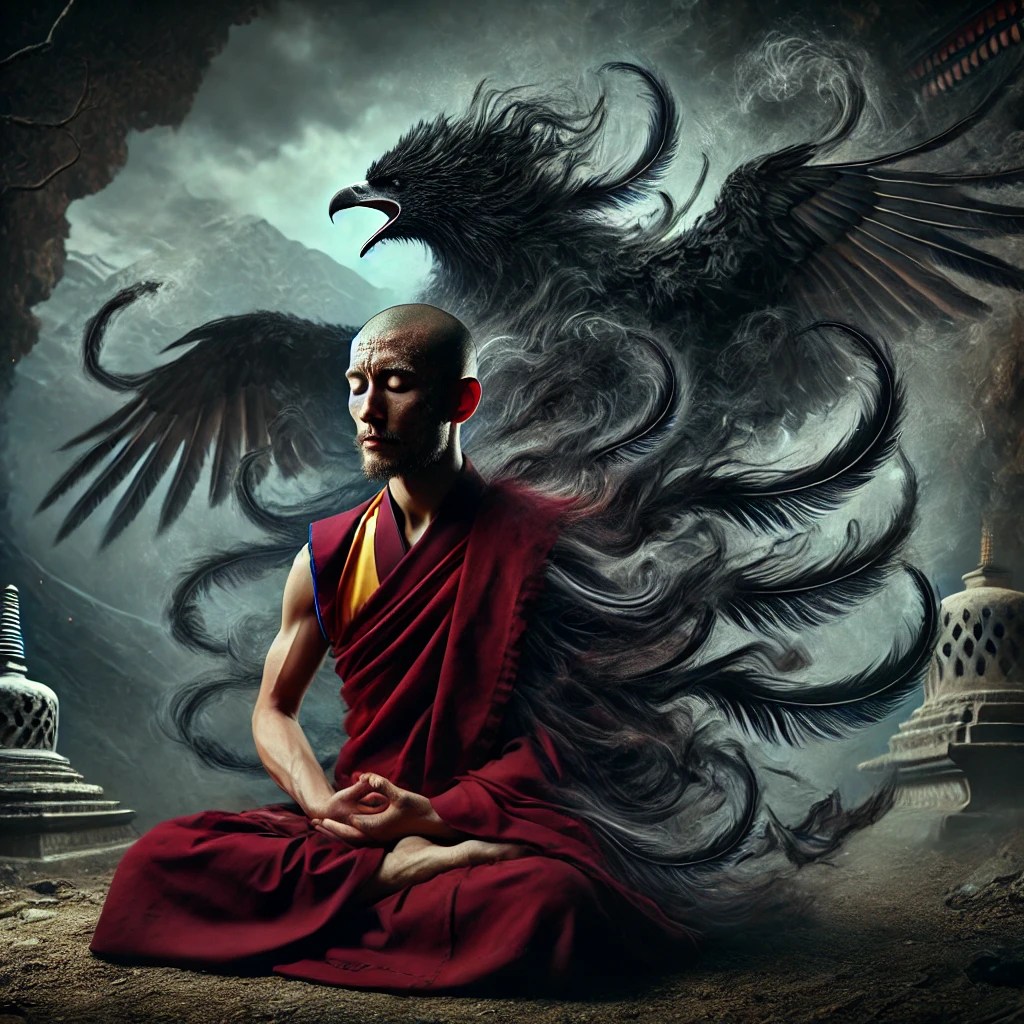
Shape-shifting has long been a recurring theme in mystical traditions across the world, appearing in shamanic practices, tantric rituals, and folklore. In Tibetan Buddhism, the Chakrasamvara Tantra contains instructions for shape-shifting, particularly into animals such as hawks and eagles. The presence of these spells in a sacred text raises an intriguing question: where do these siddhis (spiritual powers) truly originate from? Are they manifestations of enlightenment, or do they come at a cost, placing the practitioner in debt to unseen forces?

Shape-Shifting in the Cakrasamvara Tantra

The Cakrasamvara Tantra is one of the most esoteric and influential texts within the Anuttarayoga (highest yoga) class of Tantric Buddhism. Among its many rituals, it contains precise instructions for practitioners to take on non-human forms, including that of a bird. David Gray, in his translation and commentary on the text, notes that these shape-shifting spells are not mere metaphors but were understood as actual yogic attainments.

The text outlines multiple methods for transformation. One passage describes a ritual in which a practitioner can enchant a cord made from the sinew or hair of an animal and bind it around their neck to assume that animal’s form. This includes birds such as hawks, owls, and vultures, as well as larger quadrupeds (Cakrasamvara Tantra, Chapter XLVII, p. 363). Another section states that by consuming or even touching an enchanted substance, the yogin may take on a divine or animal form (Cakrasamvara Tantra, Chapter XLIX, p. 369). These instructions suggest that shape-shifting was considered a real and attainable siddhi for advanced practitioners.

In Vajrayana, these extraordinary abilities, known as siddhis, are divided into two categories:

  • Mundane siddhis (laukika siddhis), which include powers such as flight, invisibility, and shape-shifting.
  • Supreme siddhis (lokottara siddhis), which refer to enlightenment itself.

While the latter is the ultimate goal of practice, the existence of spells for mundane abilities suggests that some practitioners were actively seeking, and attaining, more earthly, supernatural powers.

But why would a Buddhist tantra contain shape-shifting spells? The standard response is that these abilities help advanced practitioners aid sentient beings and overcome obstacles. However, if the goal were purely benevolent, why does the very same tantra contain spells for harming, controlling, and even destroying sentient beings? The presence of violent and coercive rituals alongside shape-shifting practices suggests that acquiring such siddhis was not solely about compassion or enlightenment. Instead, these abilities may have served more ambiguous or self-serving purposes, whether for power, domination, and even destruction. Moreover, history is filled with accounts of people acquiring mystical abilities at a hidden cost, often through pacts with forces beyond their ultimate control or comprehension. If a yogin can assume the form of an animal, what else might they be gaining or losing in the process?

Debt to the Unseen: Shape-Shifting and Supernatural Pacts

The idea that magical transformations require spiritual debt is not unique to Tantra. Across cultures, shape-shifting often comes with hidden agreements between the practitioner and demonic entities.

  • Shamanism and Possession: In many indigenous traditions, a shaman does not shape-shift alone but must first enter a trance state, often facilitated by spirits or tutelary deities. This raises the question, when a shaman transforms into an animal, are they truly in control, or is something else working through them?
  • Vampirism and the Undead Pact: The myth of the vampire is closely related to shape-shifting, with folklore describing their ability to turn into bats, wolves, or mist. Yet, vampires are universally depicted as cursed beings who exist by taking the life force of others. Their transformations are not self-generated but come as a consequence of an external force, a dark exchange that binds them to an unnatural state.
  • Faustian Bargains in Occult Traditions: From medieval grimoires to modern occultism, the idea persists that those who seek supernatural abilities must often enter into a contract with demonic non-human entities. The magician gains knowledge or power but loses something in return, whether it be autonomy or a portion of their soul.

Could the siddhis described in tantric texts function similarly? If shape-shifting is possible, does it occur through the practitioner’s own spiritual mastery, or is it facilitated by a demonic force to which they become indebted?

The Cost of Siddhis: Are They Truly Benevolent?

Tantric Buddhism teaches that mundane siddhis should never be sought for their own sake. In the Hevajra Tantra, a text closely related to Chakrasamvara, the practitioner is warned that seeking supernatural abilities out of attachment can lead to ruin. Some Buddhist teachers even caution that siddhis can become obstacles on the path to liberation, enticing practitioners away from true spiritual realization.

If shape-shifting and similar siddhis are real, should they be seen as gifts of an awakened mind or as evidence of hidden transactions with demonic forces? If the latter, what do these forces ultimately seek in return?

For those who have witnessed such transformations firsthand, the question remains: What is really behind them?

[1] Gray, David B. (2007). The Cakrasamvara Tantra (The Discourse of Śrī Heruka): A Study and Annotated Translation. New York: American Institute of Buddhist Studies at Columbia University. ISBN: 978-0975373460. See Chapter XLVII, p. 363, and Chapter XLIX, p. 369 for descriptions of shape-shifting methods.

The Shadow Wars of Tibetan Buddhism: Black Magic, Power Struggles, and the Case for Contemporary Spiritual Warfare


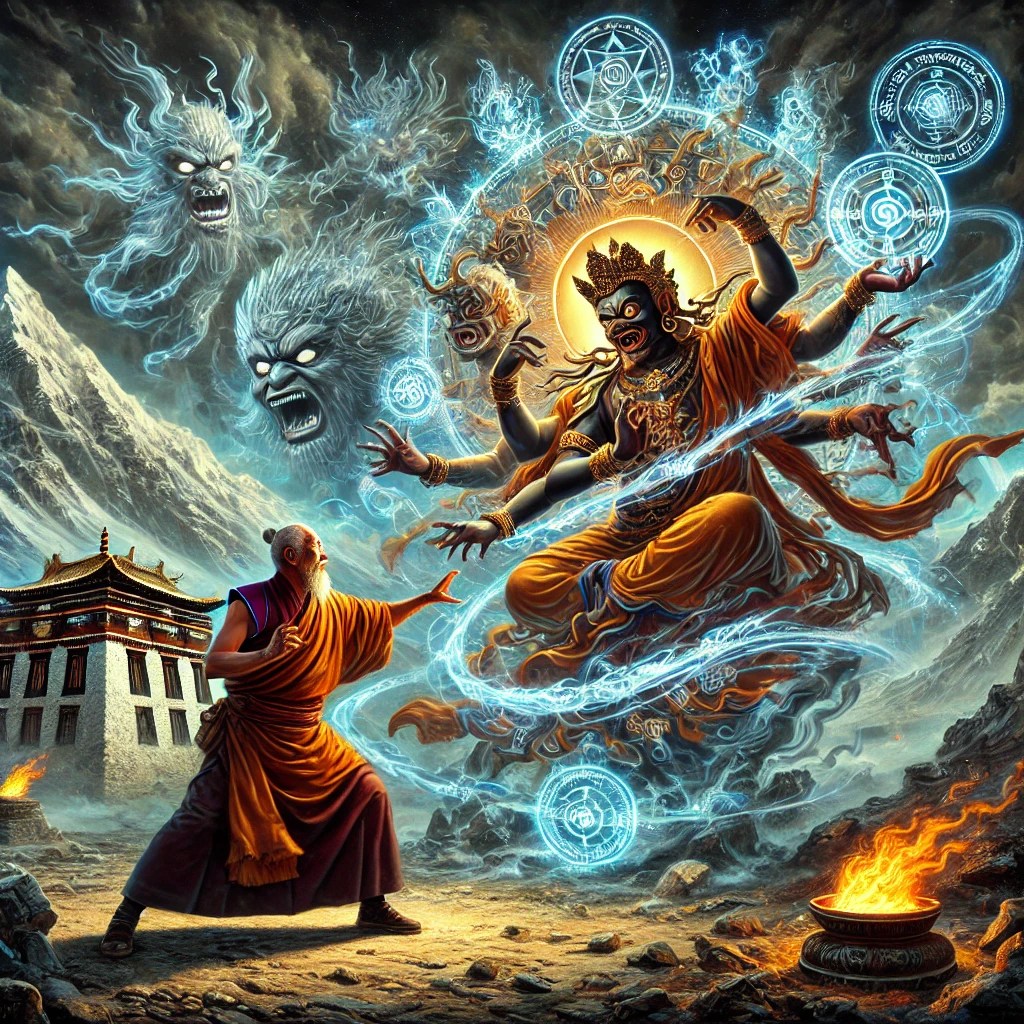
Throughout Tibetan history, occult warfare has been an enduring element of religious and political life. The case of Jamgon Kongtrul the Great, one of Tibet’s most revered scholars and visionaries, illustrates this reality. The texts documenting Kongtrul’s life recount a dramatic confrontation with an adversary named Kuntrul, who sought to harm him through violent and magical means. Kongtrul, deeply engaged in esoteric practices, responded with his own ritual countermeasures, emerging victorious in a struggle that was as much metaphysical as it was physical. Notably, some accounts suggest that Kongtrul’s rituals were not merely protective but also offensive, raising questions about whether his actions aligned with the pacifist image of Tibetan Buddhism.

Given the ubiquity of such accounts in Tibetan history, it is striking that contemporary adherents of Tibetan Buddhism often dismiss similar experiences when they occur today, particularly when they involve those who challenge the power structures of the tradition.

The Occult Battles of Jamgon Kongtrul

Jamgon Kongtrul’s conflict with Kuntrul was a high-stakes struggle marked by sorcery and supernatural intervention. Historical sources describe how Kuntrul employed a mix of mundane and esoteric strategies, including bribing local leaders to attack Kongtrul’s camp. Faced with this threat, Kongtrul and his party resorted to protective rituals, invoking powerful deities such as Tārā and performing rites designed to repel harmful influences. Despite being outnumbered and targeted, Kongtrul survived unscathed, a testament, in the view of his followers, to the efficacy of his spiritual defenses.

His ritual responses played a role in neutralizing Kuntrul as a threat. “As Gardener surmises, it does not just appear that Kongtrul protected his companions and himself with various rituals and so on, but that they positively ‘vanquished their enemies’ like the victor in a ‘deadly black magic contest.’” [1] What is evident is that Tibetan Buddhist magic was not just about shielding oneself from harm but also about eliminating threats in a direct and forceful manner. This calls into question the modern perception of Tibetan Buddhism as purely compassionate and pacifist, when in reality, its historical figures wielded spiritual power as a weapon.

Kongtrul’s deep knowledge of tantric practices, including wrathful deity invocations, can be better understood through his own writings in The Treasury of Knowledge. In this monumental work, Kongtrul systematically outlines the structure of Buddhist tantra, including the use of rituals for both protection and destruction. [2] His mastery of these teachings suggests that his confrontation with Kuntrul was not an isolated event but part of a broader understanding of how spiritual power could be wielded in Tibetan Buddhism.

The 5th Dalai Lama and Ritual Warfare

One of the most well-documented cases of tantric warfare in Tibetan history is the political ascent of the 5th Dalai Lama (1617–1682). The Great Fifth, as he is known, engaged in elaborate tantric rituals to subdue his enemies, particularly those who opposed the Gelugpa school’s dominance. His autobiography describes how he invoked wrathful deities to ensure the downfall of his opponents, including the destruction of the Jonang and the suppression of rival sects. The Dalai Lama’s spiritual and political strategies were deeply interwoven, demonstrating how ritual power was a critical tool in Tibetan statecraft. [3]

The Silence Around Modern Black Magic Warfare

Given the historical reality of occult battles in Tibetan Buddhism, why is it so difficult for contemporary practitioners, especially those invested in maintaining the tradition’s public image, to acknowledge that similar tactics might still be used today?

This question is especially pertinent to my own experiences after participating in the public exposure of my first teacher as a sexual predator. Tibetan Buddhism has a long history of protecting its elite figures through both institutional suppression and supernatural means. If even luminaries such as Kongtrul were subjected to ritual attacks and responded with powerful countermeasures, why should it be inconceivable that similar tactics would be employed against those who disrupt the modern power structures of Tibetan Buddhism?

The cognitive dissonance here is profound. Those who deeply believe in the efficacy of Tibetan magic when it serves the tradition’s interests refuse to acknowledge its potential use against those who challenge the status quo. This selective skepticism allows abuse and corruption to persist while shielding the tradition from scrutiny.

Conclusion

Tibetan Buddhism has never been a purely pacifist tradition; it has always wielded spiritual power in service of political and institutional control. The case of Jamgon Kongtrul the Great, as well as the 5th Dalai Lama’s strategic use of tantric rituals, reveals that black magic battles were historically a real and recognized aspect of Tibetan life.

To dismiss similar experiences today, particularly when they involve whistleblowers or those who expose misconduct, is not only inconsistent but a deliberate act of denial.

If the Tibetan Buddhist establishment was willing to deploy supernatural means to protect its authority in the past, why would it not do so in the present?


Sources:

  1. Dakini Translations. Murder Plots, Omens, Black Magic, and Kalacakra: Tantric Hero Jamgon Kongtrul’s Dangerous First Trip to Jonang Monastery. September 20, 2019. https://dakinitranslations.com/2019/09/20/murder-plots-omens-black-magic-and-kalacakra-tantric-hero-jamgon-kongtruls-dangerous-first-trip-to-jonang-monastery/.
  2. Kongtrul, Jamgon. The Treasury of Knowledge: Book Six, Part Four: Systems of Buddhist Tantra. Translated by Elio Guarisco and Ingrid McLeod. Ithaca, NY: Snow Lion Publications, 2008.
  3. Ngawang Lobsang Gyatso, Fifth Dalai Lama. The Autobiography of the Fifth Dalai Lama. Translated by Zahiruddin Ahmad. Bloomington: Indiana University Press, 1998.
  4. Smith, Gene. Among Tibetan Texts: History and Literature of the Himalayan Plateau. Boston: Wisdom Publications, 2001.
  5. Gardner, Alexander. The Life of Jamgon Kongtrul the Great. Boston: Shambhala Publications, 2019.

The Cross-Cultural Practice of Mirror Divination


The practice of divination has long been embedded in the religious and esoteric traditions of cultures across the world. One particularly striking example is the use of mirror divination, or prasena, a ritual in which a prepubescent child gazes into a reflective surface to reveal hidden knowledge or foresee the future. This practice, as highlighted by scholar Sam van Schaik in a recent interview, appears in both Ethiopian and Tibetan traditions and has possible roots tracing back to ancient Babylonian magic. [1]

Such continuity across vastly different cultures raises compelling questions about the transmission and persistence of esoteric knowledge throughout history.

The Ritual and Its Cultural Manifestations

Mirror divination has been historically practiced in multiple religious traditions, often involving a spiritual mediator, typically a child, who, under the guidance of a ritual master, peers into a reflective surface to receive supernatural insights. In Ethiopian traditions, this practice is documented in both ancient manuscripts and contemporary ritualistic settings. In Tibetan Buddhism, it appears in esoteric texts and continues to be used in divinatory rituals conducted by monks and lay practitioners alike.

The use of children in such rituals is significant. Many cultures have believed that children, being less conditioned by worldly concerns, are more receptive to supernatural or spiritual forces. These divinatory practices align with similar practices found in the Greco-Roman world, where oracles and seers would enter trance states to communicate divine messages.

A Babylonian Legacy?

Van Schaik suggests that mirror divination may have originated in Babylonian magic before spreading both eastward and westward. Babylon, as a major center of esoteric learning, was home to extensive traditions of divination, astrology, and ritual magic. Texts from Mesopotamia describe forms of lecanomancy (divination using liquid in a bowl) and katoptromancy (mirror scrying), practices that share structural similarities with the Ethiopian and Tibetan rituals.

This hypothesis aligns with broader historical patterns of cultural diffusion. The Silk Road and other trade routes served as conduits for not only commerce but also religious and magical knowledge. Babylonian astrological systems influenced both Greek and Indian traditions, just as mystical and ritualistic practices traveled alongside Buddhist monks and lay merchants. The presence of mirror divination in both Ethiopia and Tibet suggests that it may be a fragment of a much older and interconnected system of spiritual technologies.

Esoteric Transmission and the Kundalini Connection

The cross-cultural presence of mirror divination raises intriguing parallels with other esoteric practices, including the concept of kundalini. Just as divination involves opening oneself to external spiritual influences, kundalini awakening in tantric traditions is described as an energetic activation that fundamentally alters consciousness. In both cases, the practitioner becomes a vessel for forces beyond the self, forces that can be interpreted as divine or, in some cases, as possessing spirits.

For those who have experienced kundalini awakenings through tantric or meditative practices, the sensation of an “other” presence taking control is strikingly similar to descriptions found in spirit possession traditions. The parallel suggests that some esoteric practices, whether labeled as divination, energy work, or spiritual awakening, may stem from the same underlying phenomenon, one that has been variously interpreted depending on cultural and religious frameworks.

Implications for Understanding the Occult Legacy

If mirror divination has indeed traveled from Babylon to the far reaches of Ethiopia and Tibet, it serves as a potent reminder that esoteric traditions are rarely confined to one religion or civilization. They emerge, transform, and persist across centuries, carried by those who practice them and reshaped by the cultures that adopt them.

For those exploring the intersection of ancient magic and spiritual deception, this historical continuity offers a crucial insight: many seemingly distinct mystical practices may share a common origin, one that predates organized religions and crosses the boundaries of geography and belief. As such, these traditions warrant deeper examination, especially for those who, like myself, have encountered their hidden dangers firsthand.


[1] Sam van Schaik, interviewed by Jonathan Samuels, Interview with Sam van Schaik (January 15-16, 2019), p. 12.