

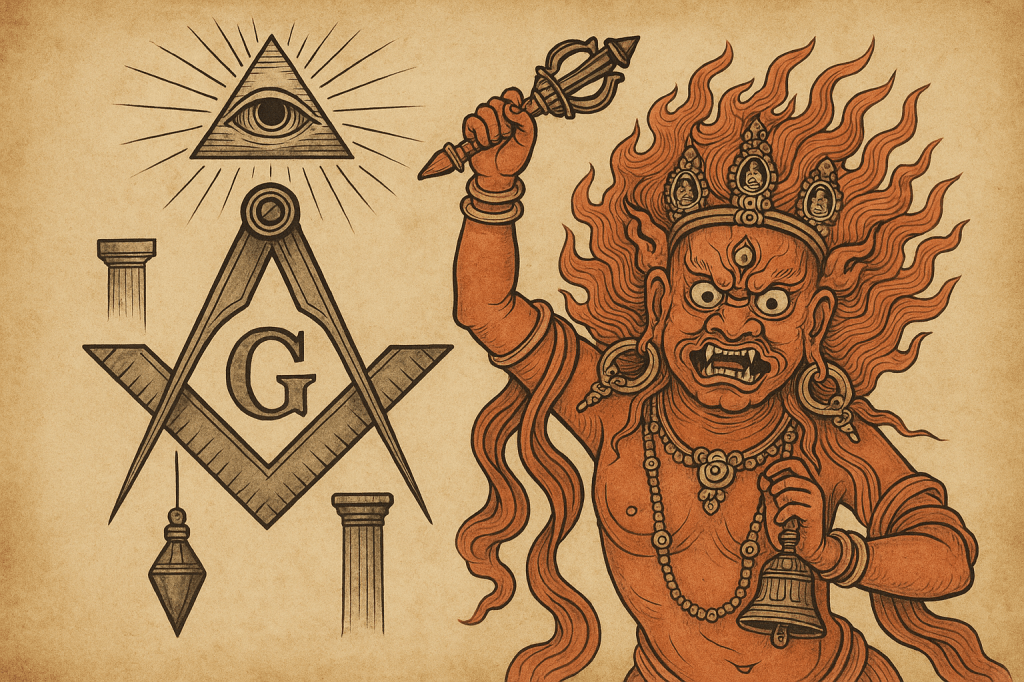
When most people hear the term Freemasonry, they think of an old-world fraternity, moral instruction through symbolism, and discreet handshakes. When they hear Tibetan tantric Buddhism, they imagine serene monks, compassion, and meditation. The public image of both is carefully cultivated, and in both cases, that image obscures a deeper, more esoteric reality.
Layers of Secrecy
Freemasonry is famously structured in degrees. Early initiates learn benign moral allegories; the deeper teachings are said to be revealed only at the highest levels, with rumors persisting about a Luciferian current unveiled around the 33rd degree. Likewise, Tibetan tantric Buddhism presents an accessible outer face, with philosophical teachings and an emphasis on compassionate practices, while reserving its most potent techniques for advanced initiates. These require formal empowerment ceremonies (wangkur) and vows (samaya) that bind the disciple not only to the guru but also to the unseen entities invoked in the practice.
Initiations and Oaths
In both systems, entry into the deeper mysteries requires swearing oaths. In Masonry, the vows historically invoked dire consequences for betrayal, couched in symbolic language. In tantric Buddhism, the initiatory vows carry the threat of karmic ruin, disease, or worse for breaking them. From a critical perspective, these oaths are more than quaint tradition. They function as binding contracts with what practitioners believe are spiritual forces. Those who view the occult with suspicion might identify these forces not as enlightened beings or symbols, but as demonic entities.
Hidden Entities and Magical Practice
Strip away the Buddhist philosophical overlay and Tibetan tantra reveals a highly ritualized form of magic. Complex visualizations, mantras, and mudras serve not merely as meditation aids, but as precise methods of summoning and merging with non-human intelligences. This is not unlike the ceremonial magic that underpins parts of Masonic symbolism, particularly in its higher degrees, where the initiate engages with archetypes, symbols, and names drawn from older mystery traditions. Both traditions cloak these operations in the language of self-improvement and enlightenment, but the mechanics of calling upon unseen forces, entering altered states, and channeling power remain strikingly similar to ancient magical rites.
Shared Roots in Ancient Occultism
Freemasonry draws openly from the Hermetic and Kabbalistic streams of Western esotericism, both of which trace their roots back to the mystery schools of the ancient world. Tibetan tantric Buddhism, though filtered through the Buddhist canon, absorbed elements from pre-Buddhist Bön shamanism, Indian Tantra, and Himalayan spirit-worship. From this angle, both may be considered descendants of the same primordial magical worldview: that reality can be manipulated through ritual, symbol, and alliance with non-physical beings.
The Public Face vs. the Hidden Core
The genius of both systems is their dual-layered structure. The public face draws in seekers with ideals of morality, compassion, and personal growth. The hidden core, accessible only through successive initiations, operates in a world of occult allegory, ritual precision, and spirit interaction. Whether one calls those spirits Buddhas, angels, demons, or archetypes depends largely on one’s interpretive lens. From a Christian lens, it is clear that both systems engage with fallen angels.
Freemasonry and Tibetan tantric Buddhism, at first glance, seem to occupy opposite ends of the cultural spectrum, one a Western fraternal order, the other an Eastern spiritual tradition. Yet both can be read as initiatory magical systems that mask their deeper workings behind an accessible moral or philosophical front. For the uninitiated, this outer layer is all they will ever see. For those who pass through the degrees or empowerments, the real initiation may lie in forging a relationship with the very forces their public image denies. And that is where the parallels become most disturbing.
These similarities are not vague or coincidental. They are structural, symbolic, and functional. Strip away the public image and both systems follow the same blueprint: they lure the seeker with ideals, bind them with oaths, then initiate them into rituals that channel demonic forces. Below is a side-by-side look at how the two traditions mirror each other in startling detail.
Freemasonry vs. Tibetan Tantric Buddhism: Structural & Occult Parallels
| Aspect | Freemasonry | Tibetan Tantric Buddhism |
|---|---|---|
| Outer Presentation | Fraternal order promoting moral improvement, philanthropy, brotherhood | Compassion-based philosophy, meditation, cultural preservation |
| Initiatory Structure | 3 public degrees (Entered Apprentice → Master Mason) followed by higher Scottish Rite or York Rite degrees culminating in the 33rd degree | Three turnings of the wheel of Dharma leading to tantric initiation (Vajrayana), then advanced empowerments and yogas |
| Vows/Oaths | Oaths of secrecy and loyalty; historical versions included symbolic penalties | Samaya vows taken during empowerments, with karmic penalties for violation (illness, misfortune, spiritual ruin) |
| Hidden Curriculum | Esoteric symbolism, Kabbalistic and Hermetic philosophy, rituals involving archetypal forces | Advanced deity yoga, mantra recitation, visualization, and energy-body work aimed at merging with yidams (tutelary deities) |
| Entities Invoked | Allegorical architect figure, angels, and names from older magical traditions; higher degrees hint at Lucifer as light-bearer | Deities, protectors, and Buddhas invoked in ritual, often fierce or wrathful forms with clear pre-Buddhist shamanic traits |
| Magical Tools | Compass, square, tracing boards, symbolic implements; ritual words and gestures | Vajra (dorje), bell, mandalas, mudras, mantras, tormas (substitutes for sacrificial offerings), visualized palaces |
| Source Traditions | Hermeticism, Kabbalah, Rosicrucianism, medieval guild ritual | Bön shamanism, Indian Tantra, Himalayan spirit practices overlaid with Buddhist philosophy |
| Outer vs. Inner Teachings | Publicly moral, privately esoteric; higher levels teach occult philosophy | Publicly compassionate, privately tantric; higher levels teach deity invocation and magical union |
| Binding Mechanism | Oaths tie member to lodge and brotherhood, reinforced through ritual drama | Samaya ties disciple to guru and the deities invoked, reinforced through ritual visualization and mantra |
| Potential Root Parallels | Mystery schools of antiquity, ritual magic, symbolic initiations | Mystery schools of antiquity, ritual magic, symbolic initiations (via Eastern streams) |
When we see these parallels laid bare, the comforting illusion of ancient wisdom starts to crumble. The robes and rituals, whether in a Masonic lodge or a Himalayan temple, are not neutral cultural artifacts. They are technology for binding humans to hidden powers, likely demons. Those who hold the keys to these systems know exactly what they are doing. The question is not whether the forces behind them exist, but whether the seeker truly understands who or what is answering when the call is made.
 Tantric Deception