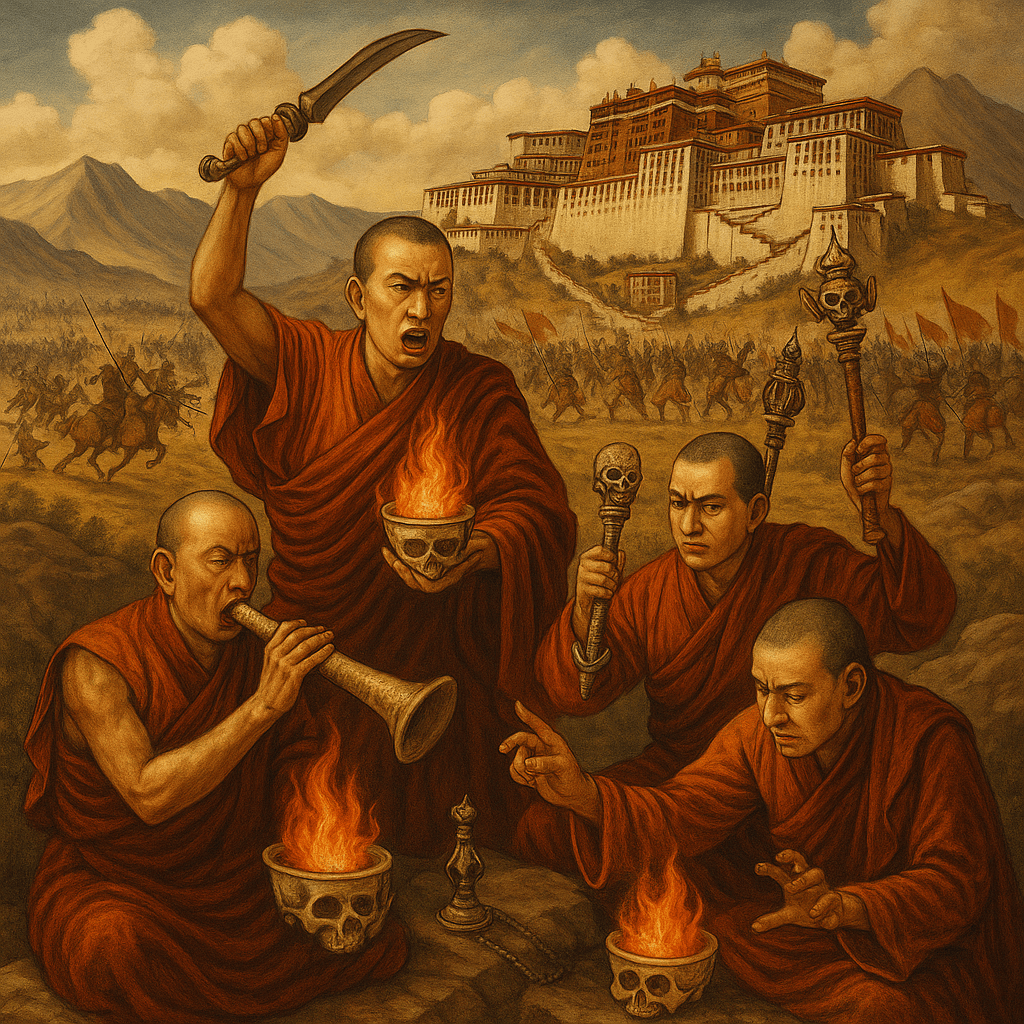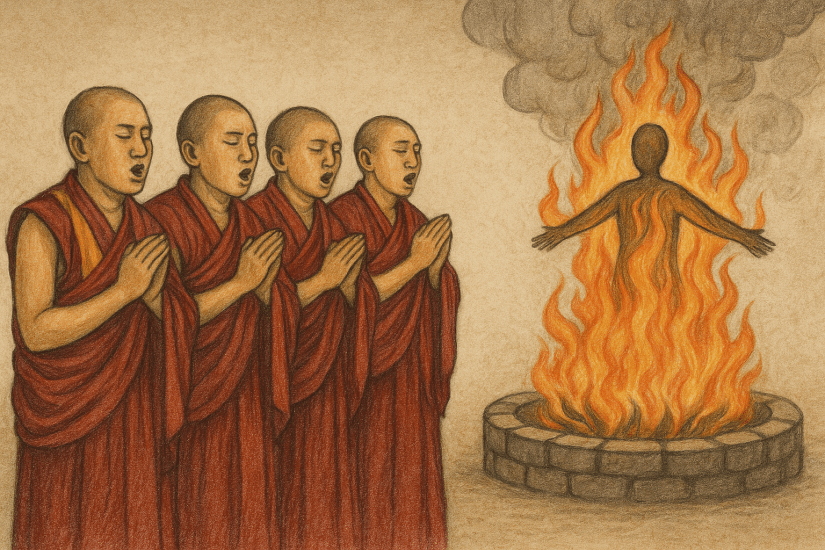
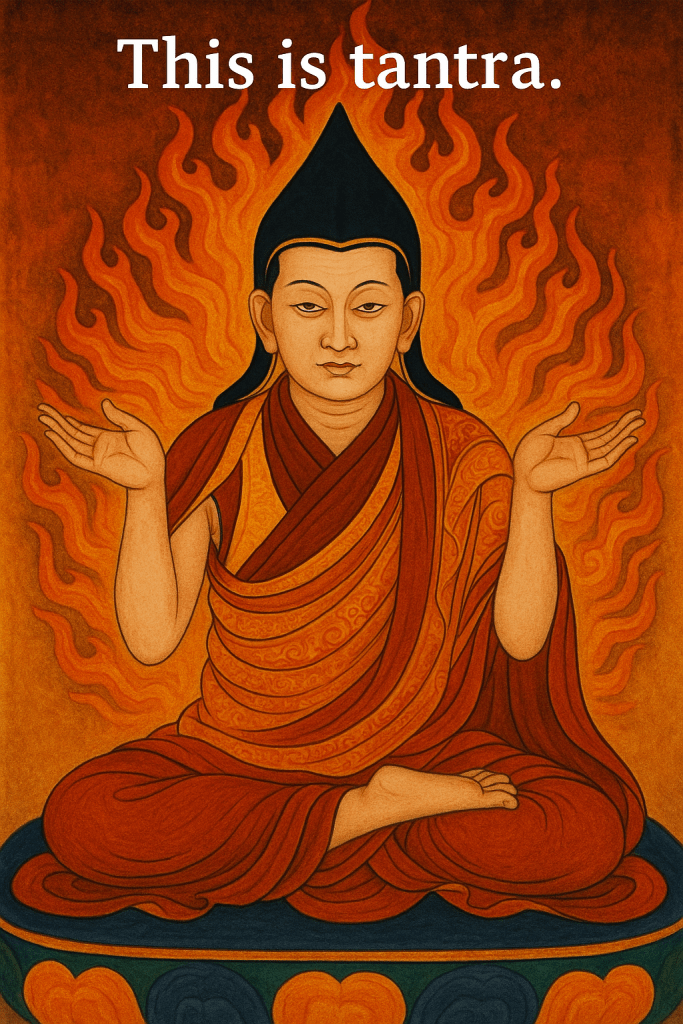
The Moral Logic of Ritual Killing in the Wrathful Practices of Tibetan Buddhism


This piece follows up on my previous essay, “Tantric Deception: Black Magic and Power in Tibetan Buddhism,” which explored Solomon FitzHerbert’s study of tantric statecraft and the normalization of ritual violence in seventeenth-century Tibet. In this post, I turn to an even more revealing feature of FitzHerbert’s findings: the Fifth Dalai Lama’s own moral reasoning about ritual killing.

In his autobiography, the Fifth Dalai Lama confronts the criticism that tantric rituals of destruction should not be directed “against ordinary people.” His response is stunning in its candor: “We do not need to be ashamed of this,” he writes, “as it is taught in the Tantras.”¹ He goes further, citing the eight kinds of spirits who “fiercely execute the punishment” on behalf of the enlightened adept.²

Here the Great Fifth is not apologizing for violence; he is codifying it. FitzHerbert explains that the Dalai Lama invokes a moral category known as the ten fields of liberation (sgrol ba’i zhing bcu), a rubric for identifying the kinds of people whose killing can be ritually justified in tantric Buddhism.³ These include those who “cause harm to the Buddhist religion,” “bring dishonour to the Three Jewels,” “endanger the life of the guru,” “slander the Mahāyāna,” “sow discord among the vajra community,” “prevent others from attaining siddhi,” or “pervert views concerning karma and its retribution.”⁴

In other words, violence against the enemies of the dharma was not merely tolerated; it was systematized. The moral categories of Buddhist tantra aligned precisely with the ideological boundaries of religious loyalty. To kill an “enemy of the faith” was to enact liberation through wrathful compassion, a punitive act performed in the name of spiritual duty. In this context, the term liberation does not refer to enlightenment but serves as tantric code for killing.

The crucial question, then, is this: who decides who counts as an enemy of the dharma? It is the guru, a figure endowed with godlike authority, who makes that determination and authorizes the strike, much as a mafia boss sanctions a hit within his own organization.

Such ideas did not remain abstract. As FitzHerbert shows elsewhere, the Dalai Lama’s government ritualized the deployment of these doctrines in warfare and political suppression.⁵ What we see in these passages is the theological backbone of that policy: a cosmological logic that made violence both righteous and karmically justified.


When the “Fields of Liberation” Become Personal

The ethical implications of this doctrine extend far beyond the seventeenth century. Its structure, dividing the world between defenders and destroyers of the dharma, still echoes in the tantric imagination today. Within closed guru/disciple networks, where authority is absolute and ritual power is personalized, this logic can turn inwards toward vulnerable disciples.

When a teacher is accused of abuse–sexual, financial, or psychological–some may interpret criticism of that teacher as slander of the Mahāyāna or harm to the guru, two of the very offenses listed in the ten fields of liberation. Under this view, the accuser becomes a threat to the vajra community itself. The rhetoric of “vajra hell,” karmic downfall, or spiritual ruin can be mobilized as a form of punishment.

Even when no public or obvious ritual of destruction is performed, the doctrinal framework legitimizing wrathful retribution remains intact and the teacher may privately extract revenge. A teacher who sees himself as an accomplished tantric adept may claim to act from “enlightened wrath.” Certainly he convinces himself that is the case. He may claim his retribution is not from malice but from a compassion that destroys obscurations and seeks to protect his community from dissenters. In this way, spiritual authority can blur into coercion, and the old metaphysics of tantric punishment can be redeployed against dissenting students.

Thus, the problem is not simply historical. It lies in a theological grammar that still allows destructive acts to be reframed as enlightened means. When criticism is recast as “slander of the dharma,” and when the guru’s person is identified with the deity itself, retaliation can be justified as upholding the sacred order.

Facing the Doctrine Honestly

When Western seekers encounter Tibetan Buddhism, we are often presented with an image of serene compassion, untainted by coercion or cruelty. Yet the Fifth Dalai Lama himself dismantles that illusion. He writes without hesitation that violent tantric rites are legitimate instruments of enlightened rule. The “theatre state” of seventeenth-century Tibet was the political expression of doctrines like the ten fields of liberation.

If the tradition is to be understood honestly, these passages should be part of an open and very public conversation. The Fifth Dalai Lama’s own words make clear that within tantric ethics, destruction is allowed, and killing can be framed as an act of perverted compassion. The challenge for modern practitioners and scholars alike is to recognize how this same moral architecture can exist whenever authority claims transcendence from accountability.


Footnotes

  1. Solomon G. FitzHerbert, “The Fifth Dalai Lama and the Tantric Politics of State Formation in Seventeenth-Century Tibet,” Arts Asiatiques 27 (2018): 88.
  2. Ibid.
  3. Ibid., 89.
  4. Ibid.
  5. Ibid., 74–83.

Tantric Deception: Black Magic and Power in Tibetan Buddhism


I am amazed that the PR for Tibetan Buddhism in the West managed for so long to conceal the extent of black magic practiced by lamas in Tibet historically and even to the present day. This concealment, aided and abetted by the squeamishness and obliviousness of some scholars, has to stop. In the dharma centers I was involved in, anything dark in Tibetan lore was relegated to the Bön religion, and the implication was that once Buddhism took hold in Tibet, any kind of evil acts such as harming or killing sentient beings was completely off the table. The truth is that black magic is in the lexicon of the highest lamas in the lineage as well as ngakpas and others. I believe these techniques are used liberally and current scholarship is finally exposing it.

Solomon G. FitzHerbert’s study of the mid-seventeenth century makes the core point plainly. I came across FitzHerbert’s article via a post on Adele Tomlin’s website www.dakinitranslations.com. He argues that tantric ritual and the rhetoric of ritual violence were central to how the Ganden Phodrang state established and legitimated power, not a peripheral curiosity. He writes that Tibetan sources “more than compensate” for the lack of hard military data with abundant materials about the “legitimation and maintenance of authority” through ritual technologies and narratives.¹

Before the rise of the Fifth Dalai Lama, Tibet’s Tsang rulers were already forging political alliances through tantric warfare. FitzHerbert shows that the Tsang kings deliberately patronized lamas famed for their mastery of wrathful and repelling rites. The most favored were the hierarchs of the Karma Kagyu, the “black hat” Karmapa and the “red hat” Zhamarpa, along with the Jonang scholar Taranatha, who was also enjoined to perform repelling rituals on behalf of his patrons.² Their alliances were explicitly religious and martial: an “ecumenical alliance in the name of defending religion and Tibet from foreign armies.”³

Among the Tsang rulers’ most celebrated ritual specialists was the Nyingma master Sokdokpa Lodrö Gyeltsen (1552–1624), self-styled “Repeller of Mongols.”⁴ A disciple of Zhikpo Lingpa, Sokdokpa was the main heir to the revealed cycle Twenty-Five Ways of Repelling Armies (Dmag zlog nyi shu rtsa lnga).⁵ His Mongol-repelling rites were widely famed, and he worked directly with the Tsang ruler Phuntsok Namgyel. One elaborate rite performed in 1605 to coincide with a Tsang military offensive involved producing “some 150,000 paper effigies of enemy soldiers.”⁶ These were ritually destroyed to annihilate the opposing force, with Bonpo specialists also enlisted for their expertise in magical harm.⁷

According to FitzHerbert, Phüntsok Namgyel successfully forged a broad anti-Geluk alliance using tantric technologies of protection and destruction.⁸ After his death, “reputedly at the hands of offensive magic being hurled at him by the Zhabsdrung Ngag dbang rnam rgyal (1594–1651), founder of the state of Bhutan,”⁹ his son Karma Tenkyong (1604–1642) inherited a weakened position. The Shabdrung’s tantric assault, still treated in Bhutanese and Tibetan sources as a historical fact, thus became the legendary moment when a ruler famed for weaponizing ritual power was himself undone by it. It is one of the rare episodes where the logic of esoteric warfare entered the realm of accepted political history.

This is where the Fifth Dalai Lama comes into focus. FitzHerbert shows that in the 17th century the Great Fifth cultivated and systematized an official repertoire of destructive and protective rites in service of government aims. In his words, the Dalai Lama showed a “lifelong concern with learning, authoring and instituting an armory of defensive and offensive rituals for the mobilization of unseen forces” for the state.¹⁰ That program contributed to the Ganden Phodrang’s reputation for “magical power,” and helped stage what FitzHerbert calls the grandest “theatre state” in Tibetan Buddhist history.¹¹

FitzHerbert details three overlapping strategies. First, the new government suppressed, marginalized, or co-opted rival traditions of war magic associated with other schools, including Karma Kagyu and strands within Nyingma, while appropriating selective cycles that could be redeployed under Geluk authority.¹² Second, it rebuilt Nyingma institutions such as Dorjé Drak and Mindröling under Ganden Phodrang patronage, folding their esoteric prestige into the state project.¹³ Third, it sponsored new state rituals based on the Dalai Lama’s own visionary experiences, further centralizing ritual power in Lhasa.¹⁴

The rhetoric was not merely devotional. Lamas and ritual specialists acted as “bodyguards” whose professional task was destructive magic on behalf of patrons.¹⁵ Chroniclers attributed battlefield outcomes to the rites of powerful tantrikas. FitzHerbert highlights Chökyi Drakpa, famed for the Yamantaka cycle known as the “Ultra-Repelling Fiery Razor,” which centered on rites of “protecting, repelling and killing.”¹⁶ In one report, after deploying these rites against a Tümed encampment, “nothing was left behind but a name.”¹⁷

To grasp how such violence could be framed as meritorious, FitzHerbert shows the tantric logic that recasts killing as an enlightened “action” when performed by an empowered adept. The adept receives empowerment, performs extensive propitiation to forge identification with the deity, and then “incite[s]” and “dispatch[es]” oath-bound spirits to defend the dharma. By manipulating the five elements and the “public non-reality” of appearances, the practitioner can pacify, increase, control, or destroy, including against human enemies.¹⁸ The moral frame is clear in the sources he cites and translates. Killing is made licit because it is tantric, ritually purified and redirected as enlightened activity.¹⁹

FitzHerbert also situates Tibetan practices within a longer Indo-Buddhist lineage of war magic. He surveys Indian materials that speak of sainyastambha or army-repelling rites, and notes that the Hevajra states that “black magic for paralyzing armies,” is part of its “manifold purpose” and that the Kālacakra includes descriptions of war machines and siege methods such as “catapults, traps, siege towers, and so on,” alongside esoteric harm and protection.²⁰ He further notes the use of human effigies and effigy destruction in offensive rites against enemies, a hallmark of Tibetan ritual repertoires that drew on wider South Asian and even Indo-European precedents.²¹

Western idealization of Tibetan Buddhism has depended on ignoring this record. The lamas who administered and celebrated these rites were not outliers. They were the architects of a political order that fused charisma, ritual terror, and doctrinal justifications into a program of power. State-sponsored ritual violence was normalized in chronicles and hagiographies as enlightened means. The fact pattern is no longer obscure. It is all in the sources, and FitzHerbert has laid them out.

Although FitzHerbert’s focus is on state-sponsored ritual violence, similar technologies of harm have long been used by individual lamas against perceived enemies including, at times, their own disciples. The anthropologist Geoffrey Samuel has noted that the ritual power claimed by tantric masters can be turned inward, weaponizing spiritual authority to punish dissent or enforce obedience.²² In one well-documented episode from the nineteenth century, the treasure-revealer (tertön) Dorje Lingpa was said to have struck down a rival practitioner through wrathful ritual means, his death interpreted locally as a karmic consequence of opposing the lama’s command.²³ Such stories attest to a cultural logic in which ritual, psychic, or physical violence by enlightened masters could be valorized as the just expression of awakened power. I have personally been a victim of this deluded violent ritual power by Tibetan masters.

If Tibetan Buddhism is to be understood honestly outside Tibet, this history needs to be taught in dharma centers and discussed in scholarship without euphemism. The tradition’s own categories allow for destructive ritual and sanctified killing under certain conditions. Pretending otherwise does not protect the innocent devotees who arrive at dharma centers with open hearts seeking methods for developing compassion and loving kindness in service of enlightenment. Indeed, one must ask what kind of enlightenment tradition could allow, even glorify such violence.


Notes

  1. FitzHerbert, Rituals as War Propaganda, 91. FitzHerbert, Solomon G. “Rituals as War Propaganda in the Establishment of the Tibetan Ganden Phodrang State in the Mid-17th Century.” Cahiers d’Extrême-Asie 27 (2018): 49–119.
    https://www.persee.fr/doc/asie_0766-1177_2018_num_27_1_1508
  2. Ibid., 95–96.
  3. Ibid., 95.
  4. Ibid., 96.
  5. Ibid., 96.
  6. Ibid., 97.
  7. Ibid., 97.
  8. Ibid., 101.
  9. Ibid., 102–103.
  10. Ibid., 94.
  11. Ibid., 95.
  12. Ibid., 96.
  13. Ibid., 97.
  14. Ibid., 98.
  15. Ibid., 93.
  16. Ibid., 100.
  17. Ibid., 101.
  18. Ibid., 71.
  19. Ibid., 72.
  20. Ibid., 98–99.
  21. Ibid., 99.
  22. Geoffrey Samuel, Civilized Shamans: Buddhism in Tibetan Societies (Washington: Smithsonian Institution Press, 1993), pp. 429–432.
  23. Cathy Cantwell and Robert Mayer, “Representations of wrathful deities in treasure literature,” in Tantric Revisionings: New Understandings of Tibetan Buddhism and Indian Religion (Leiden: Brill, 2008), pp. 131–133.


The Shadow Side of Tantra: Magic and Violence Lurk Behind the Mask of Compassion

A ritual battle scene: Kschetrapala rising from a burning sacrificial torma outside Lhasa, facing the monstrous nine-headed Chinese demon in a clash of spirit armies.


This article contains excerpts from The Shadow of the Dalai Lama: Sexuality, Magic and Politics in Tibetan Buddhism by Victor and Victoria Trimondi

Who were the Trimondis?

Victor and Victoria Trimondi are the pen names of German cultural historians Herbert and Mariana Röttgen. In the 1980s and early 1990s, they were active supporters of the Dalai Lama, translating and publishing his works into German and helping to organize international events in support of Tibet. Initially, they saw Tibetan Buddhism as a beacon of compassion and ethical renewal.

But their perspective changed. Over years of study, they became disillusioned by what they regarded as the darker, concealed aspects of Tibetan tantric Buddhism: ritual magic, sexual practices, secrecy, and the fusion of religion with political power. Their critical work The Shadow of the Dalai Lama: Sexuality, Magic and Politics in Tibetan Buddhism (2003) full text here seeks to expose these elements, drawing heavily on Tibetan source texts and the earlier ethnographic research of figures like René de Nebesky-Wojkowitz (Oracles and Demons of Tibet, 1956) and Matthias Hermanns.

Because of this trajectory, from enthusiastic supporters of Tibetan Buddhism to outspoken critics, the Trimondis occupy a controversial position. Admirers of Tibetan Buddhism accuse them of exaggeration and hostility, but their book nonetheless catalogs texts, rituals, and historical examples that complicate the popular image of Tibetan Buddhism as peaceful and compassionate.


Excerpts from The Shadow of the Dalai Lama

Part II, Chapter 8: Magic as a Political Instrument

The following excerpts illustrate how the Trimondis argue that ritual magic was systematically integrated into Tibetan politics and warfare:

Invocation of demons
Since time immemorial ritual magic and politics have been one in Tibet. A large proportion of these magic practices are devoted to the annihilation of enemies, and especially to the neutralizing of political opponents. The help of demons was necessary for such ends. And they could be found everywhere — the Land of Snows all but overflowed with terror gods, fateful spirits, vampires, ghouls, vengeful goddesses, devils, messengers of death and similar entities, who, in the words of Matthias Hermanns, “completely overgrow the mild and goodly elements [of Buddhism] and hardly let them reveal their advantages” (Hermanns, 1965, p. 401).

For this reason, invocations of demons were not at all rare occurrences nor were they restricted to the spheres of personal and family life. They were in general among the most preferred functions of the lamas. Hence, “demonology” was a high science taught at the monastic universities, and ritual dealings with malevolent spirits were — as we shall see in a moment — an important function of the lamaist state.


The war demon Kschetrapala
Once the gods had accepted the sacrifice they stood at the ritual master’s disposal. The four-armed protective deity, Mahakala, was considered a particularly active assistant when it came to the destruction of enemies. In national matters his bloodthirsty emanation, the six-handed Kschetrapala, was called upon. The magician in charge wrote the war god’s mantra on a piece of paper in gold ink or blood from the blade of a sword together with the wishes he hoped to have granted, and began the invocation.

Towards the end of the forties the Gelugpa lamas sent Kschetrapala into battle against the Chinese. He was cast into a roughly three-yard high sacrificial cake (or torma). This was then set alight outside Lhasa, and whilst the priests lowered their victory banner the demon freed himself and flew in the direction of the threatened border with his army. A real battle of the spirits took place here, as a “nine-headed Chinese demon”, who was assumed to have assisted the Communists in all matters concerning Tibet, appeared on the battlefield. Both spirit princes (the Tibetan and the Chinese) have been mortal enemies for centuries. Obviously the nine-headed emerged from this final battle of the demons as the victor.


“Voodoo magic” in Tibetan Buddhism
The practice widely known from the Haitian voodoo religion of making a likeness of an enemy or a doll and torturing or destroying this in their place is also widespread in Tibetan Buddhism. Usually, some substance belonging to the opponent, be it a hair or a swatch from their clothing, has to be incorporated into the substitute. It is, however, sufficient to note their name on a piece of paper…

Such “voodoo practices” were no rare and unhealthy products of the Nyingmapa sect or the despised pre-Buddhist Bonpos. Under the Fifth Dalai Lama they became part of the elevated politics of state. The “Great Fifth” had a terrible “recipe book” (the Golden Manuscript) recorded on black thangkas which was exclusively concerned with magical techniques for destroying an enemy.


Why all this matters

These passages highlight a side of Tibetan Buddhism that is largely hidden from public view: the integration of destructive magic and spirit warfare into the machinery of the lamaist state. Nebesky-Wojkowitz’s research on ritual manuals, Hermanns’ cultural observations, and the Trimondis’ synthesis all converge on the same conclusion: alongside compassion and wisdom, Tibetan Buddhism preserved and continues to use technologies of coercion and violence.

For modern practitioners and students in the West, this raises unavoidable questions:

  • Are newcomers told that tantric ritual includes not only deities of compassion but also demon invocations and rites of subjugation? What risks do these violent magical technologies pose for the unsuspecting student?
  • What does “consent” mean if disciples are invited to take refuge in Tibetan Buddhism and receive empowerments without knowledge of these dimensions?
  • How much of this is framed as symbolic or metaphorical today, and is that distinction clearly explained? Evidence suggests that such practices continue much as they did in the past, which makes a thorough and honest examination all the more urgent.

Conclusion

The Trimondis’ work is controversial, but it is also important because it insists on remembering what is usually forgotten or denied. If the compassionate face of Tibetan Buddhism is to be embraced honestly, then its shadow side, the reality of political magic, demon invocations, and coercive ritual, must also be acknowledged. Only then can students and practitioners engage with full awareness, rather than be fooled by the illusion of partial truths.


References and Further Reading

  • Victor & Victoria Trimondi, The Shadow of the Dalai Lama: Sexuality, Magic and Politics in Tibetan Buddhism (2003).
  • René de Nebesky-Wojkowitz, Oracles and Demons of Tibet (1956).
  • Matthias Hermanns, The Indo-Tibetan Religion of the Great Goddess of the Land (1965).
  • Melvyn C. Goldstein & A. Grunfeld, The Making of Modern Tibet (1996).
  • Samten Karmay, The Secret Visions of the Fifth Dalai Lama (1988).

Lin Kai’s: “Meanings of Violence in Tibetan Buddhism”


In his essay Meanings of Violence in Tibetan Buddhism, Lin Kai develops themes first raised by Elliot Sperling: Tibetan Buddhism has never been simply the peaceful, pacifist tradition imagined in Western romantic projections. Both history and ritual demonstrate how violence was woven into Tibetan religious and political life¹, continuing into the present. As Kai underscores, and as Sperling noted before him, both Western interpreters and Tibetan voices have often gone to great lengths to overlook or obscure this troubling facet of Tibetan Buddhism.

Kai highlights how rulers, including the Fifth Dalai Lama, relied on military force to consolidate power and punish rebellion. As Sperling documented, the Dalai Lama issued explicit orders in the seventeenth century to annihilate enemies, words that expose a stark contrast to the modern image of Tibet².

The Fifth Dalai Lama’s commands were phrased in brutal, almost ritualistic terms:

Make the children and grandchildren like eggs smashed against rocks;
Make the servants and followers like heaps of grass consumed by fire;
In short, annihilate any traces of them, even their names.²

This edict was aimed at other Tibetan Buddhists, mind you. Amidst such warfare, Kai notes, not all monks accepted this with ease. Some were unsettled by the amount of time and resources demanded for war rituals, though few dared openly resist their lamas. A particularly striking passage from the Fifth Dalai Lama’s autobiography shows him wrestling with his own position as a Buddhist leader at war. He recounts the following dream:

“Looking through an open window on the eastern side of the protector-chapel, stood the treasurer [Sonam Rabten] and a crowd of well-dressed monks with disapproving looks. Shoving the ritual dagger into my belt, I went outside. Thinking that if any of those monks said anything, I would strike him with the dagger, I walked resolutely straight through them. They all lowered their eyes and just stood there. When I awoke, my illness and impurities had been completely removed; not even the slightest bit remained. I was absolutely overflowing with amazement and faithful devotion.” — Fifth Dalai Lama¹

This moment captures the tension at the heart of Tibetan statecraft: the bodhisattva ideal of compassion colliding with the felt necessity of violence. Kai also emphasizes ritual violence, where wrathful deities and fierce imagery symbolize the annihilation of obstacles to enlightenment. These practices were not simply symbolic. They paralleled real political campaigns, where violent suppression against human beings was justified as protecting the Dharma¹.

Western audiences, however, have often distorted this history. Kai argues that Orientalist fantasies, especially those that cast Tibet as a timeless land of peace, obscure the record of blood and retribution¹. Sperling made the same point, noting how the Dalai Lama’s reputation as a Nobel Peace laureate stands in sharp tension with the historical evidence².

“Violence in Tibetan Buddhism cannot be neatly categorized as either barbaric or compassionate. It exists within a worldview where wrathful action and compassion may coincide, depending on context and intent.” —Lin Kai¹

In this worldview, compassion and violence were not opposites. Wrathful action could be seen as alright when it was thought to protect the Dharma or eliminate obstacles, even human ones. What emerges, then, is a very complicated and unsettling picture: violence was not an exception but an integral part of Tibetan Buddhist practice.

Kai’s work reinforces Sperling’s warning: if we want to understand Tibetan Buddhism as it is, rather than as we wish it to be, we must confront the ways in which violence was and still is sacralized within the tradition.

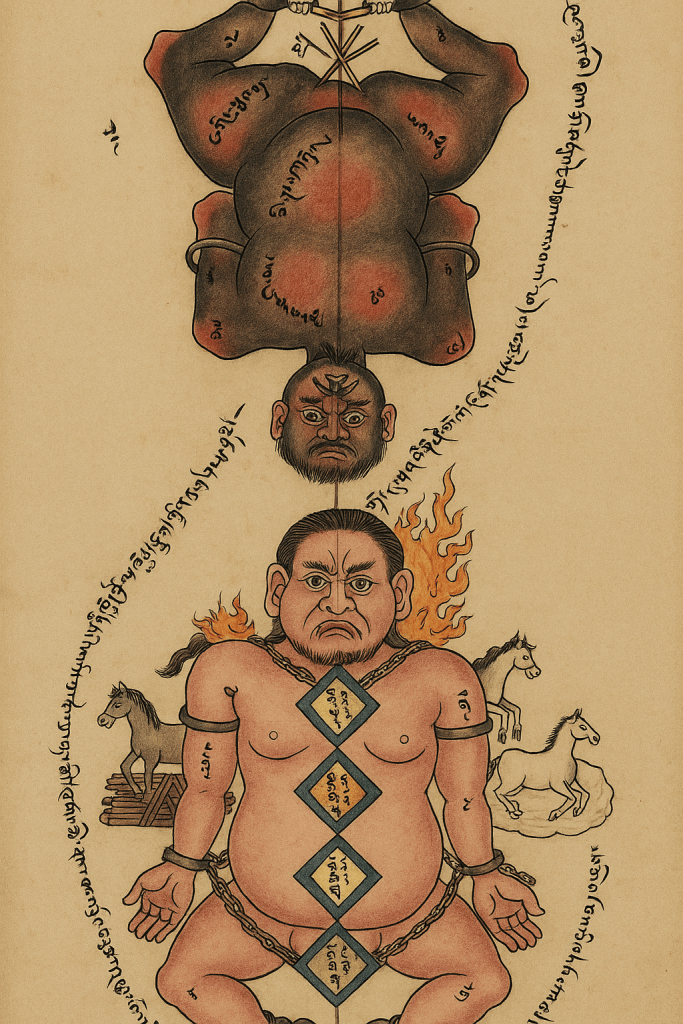
This type of linga resembles one depicted in the Secret Visions of the Fifth Dalai Lama, a visionary autobiography. It shows two figures to be ritually ‘liberated’ or killed, typical of effigies used in Tibetan Buddhist rites against so-called ‘enemies of the dharma.’ Such effigy sacrifices remain part of Tibetan Buddhist ritual practice today.


Footnotes

¹ Lin Kai, Meanings of Violence in Tibetan Buddhism, Substack, 2025.
² Elliot Sperling, Orientalism and Aspects of Violence in the Tibetan Tradition, Info-Buddhism, 2004.

Truth Behind the Myth: Violence in Tibetan Buddhism


In his article Orientalism and Aspects of Violence in the Tibetan Tradition, Elliot Sperling uses the term Orientalism in the sense made famous by Edward Said. It describes how Western scholars, writers, and media have often portrayed Asian and Middle Eastern societies in ways that are exotic, stereotypical, and distorted (Sperling 2001, p. 317). [1]

In this context, Elliot Sperling is pointing out that Tibet, especially Tibetan Buddhism, has been framed in the West not as a complex, politically active society but as a mystical and pacifist Shangri-la (Sperling 2001, p. 318). That romanticized portrayal fits the Orientalist mold because it projects Western fantasies and agendas onto a culture instead of showing it in its full, often messy, historical reality.

Here, Orientalism is not just about misunderstanding or stereotyping. It is about how those misconceptions feed into selective histories, in this case downplaying or erasing the tradition’s capacity for political maneuvering, power struggles, and violence.

It is important to cut through the sugar-coated narratives about Tibetan Buddhism as an always peaceful, otherworldly faith. Historian Elliot Sperling, a top authority on Tibet and China history, attempts to do this in his essay. He shreds the romanticized “compassionate lama” image and reintroduces the messy, political, and yes, violent realities of Tibetan history (Sperling 2001, p. 320).

  • Tibetan Buddhism was not pacifism incarnate. Sperling points out that the Fifth Dalai Lama did not shy away from military force when Gelugpa interests were on the line in the 17th century. In the early 20th century, the Thirteenth Dalai Lama actively sanctioned armed resistance against Qing forces in Lhasa (Sperling 2001, pp. 323–324).
  • Modern Western portrayals have softened the truth. The prevailing global image of Tibetan Buddhism, as inherently gentle, infallibly peaceful, and untouched by politics, is largely a product of Western assimilation and the Tibetan exile community’s framing of their own image (Sperling 2001, pp. 317–318).

Why It Matters

If you are buying into the “peace only” ideal, Sperling’s essay demands reconsideration. He forces you to recognize Tibetan Buddhism as a tradition entwined in power and violence when necessary (Sperling 2001, p. 317). The strident idealism selling Tibet as a spiritual Shangri-la does not hold up under scrutiny. In 1660, the Fifth Dalai Lama faced a rebellion in Tsang. Declaring he acted for the good of the people in the region, he issued uncompromising orders for the complete destruction of his enemies, men, women, children, servants, and property, leaving no trace of them. This directive, written in his own hand, reveals a leader willing to use extreme military force to secure his government’s power, a stark contrast to the modern image of the Dalai Lama as an unshakable symbol of peace.

[Of those in] the band of enemies who have despoiled the duties entrusted to them:
Make the male lines like trees that have had their roots cut;
Make the female lines like brooks that have dried up in winter;
Make the children and grandchildren like eggs smashed against rocks;
Make the servants and followers like heaps of grass consumed by fire;
Make their dominion like a lamp whose oil has been exhausted;
In short, annihilate any traces of them, even their names (Sperling 2001, p. 325).

This brutal passage, is a powerful and chilling indictment. It underscores the darker potential within any ideology. When power, anger, or fear take hold, even so-called peaceful spiritual traditions can sanction annihilation. Sperling’s work reminds us to stop buying into the marketing of Tibetan Buddhism as a compassionate, peaceful idyll. His historical analysis and the many examples of tantric annihilation rituals used against human targets says otherwise. It is time to drop the myth and acknowledge the tradition for what it truly is: a living, political, and sometimes violent force (Sperling 2001, p. 329).

  1. Elliot Sperling, “Orientalism and Aspects of Violence in the Tibetan Tradition” (2001), info-buddhism.com, originally published in Imagining Tibet: Perceptions, Projections, & Fantasies, ed. Thierry Dodin and Heinz Räther, Wisdom Publications. Available at: https://info-buddhism.com/Orientalism_Violence_Tibetan_Buddhism_Elliot_Sperling.html

Yamantaka and the Truth About Violent Rituals in Tibetan Buddhism


The following is based on Aleksandra Wenta’s article “Tantric Ritual and Conflict in Tibetan Buddhist Society: The Cult of Yamāntaka” (2022).

Public perception paints Buddhism as the ultimate religion of compassion. The Dalai Lama’s cheerful smile and monks chanting in maroon robes conjure images of peace in the Western imagination. But the historical record tells quite another story, one most Buddhist institutions would prefer to bury. Violent ritual has always had a place in Tibetan Buddhist practice, and the cult of the wrathful deity Yamantaka is one of the clearest examples.

The Deity of Destruction

Yamantaka, whose name means “Ender of Death,” is no serene Buddha. In tantric lore he is a ferocious, multi-headed, weapon-wielding deity invoked to annihilate enemies. These enemies might be inner demons in metaphor, but in many cases they were very real human targets. As Wenta’s research shows, Tibetan Buddhist ritual specialists used Yamantaka rites as deliberate acts of destruction, both spiritual and physical.

Politics and Ritual Warfare

The historical examples are difficult to dismiss. In the ninth century, the Buddhist master Gnubs chen Sangs rgyas yeshes allegedly used Yamantaka magic against King Lang Darma, a ruler seen as hostile to the Dharma. Centuries later, during the political struggles of the seventeenth century, the Fifth Dalai Lama employed Yamantaka rituals to consolidate power over rival factions. These were not fringe experiments, but state-linked religious acts intended to remove opponents.

The reach of these rites went beyond Tibet. The Manchu Qianlong emperor adopted Yamantaka worship to project legitimacy over his subjects, while Mongolian and Japanese traditions incorporated similar ritual violence into their own religious-political frameworks.

Violent Compassion as Justification

Practitioners did not see these rites as morally corrupt. They justified them through the doctrine of “violent compassion,” the belief that killing or harming could liberate an enemy from a worse rebirth. Wenta notes that tantric philosophy, particularly the doctrine of emptiness, was used to argue that concepts like killer or victim do not ultimately exist. In this logic, an enlightened being could commit an act of violence without accruing negative karma.

Ritualized Destruction

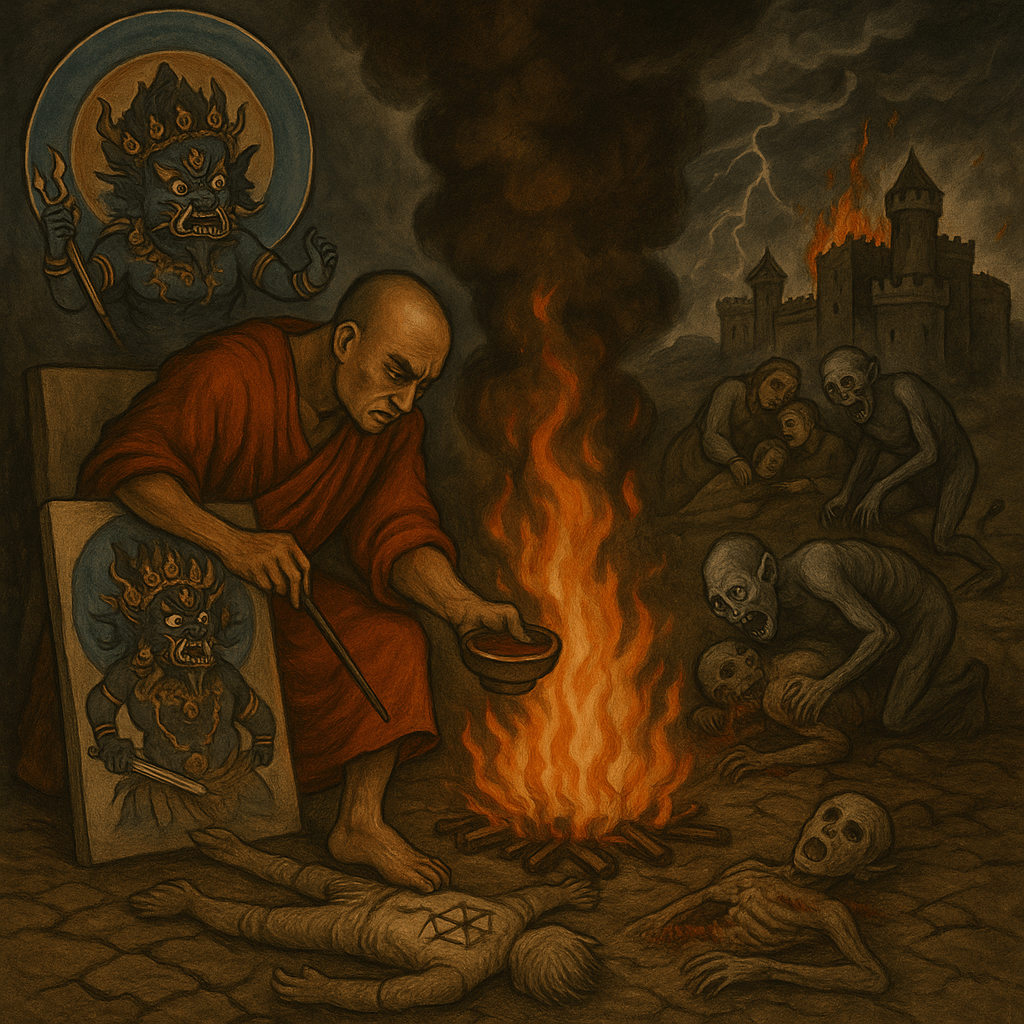
From the Mañjuśriyamūlakalpa’s “Ritual Against the Wicked Kings” comes one of the most explicit and brutal examples. The text instructs the practitioner to paint Yamantaka in terrifying form, then perform fire offerings of human blood, flesh, and powdered bone mixed with poisons and toxic plants to unleash plague, famine, storms, and demonic infestations upon the target. The king’s family is to die in sequence: son on the first day, wife and ministers on the second, the king himself on the third, while his court is overrun by flesh-eating spirits and his land struck by drought, fire from the sky, rockfall, and invasion. A human effigy bearing the victim’s birth star in cremation-ground charcoal is trampled during mantric recitation so the enemy dies, goes mad, or is devoured by demons. This is ritualized destruction in its most literal, calculated form.

One section of the same text reads like a manual for calculated devastation. The practitioner is instructed to heap human blood, flesh, powdered bone, poisons, and the roots of deadly plants onto a ritual fire in front of the painted deity. After 1008 offerings, not only is the enemy destroyed, but their family, ministers, and allies are swept away as well. The text promises droughts, plagues, famine, and storms, even fire and rocks falling from the sky, while demonic forces overrun the victim’s court. In some variations, a single datura root is enough to drive the target insane, or a few spoonfuls of spiced offerings can induce fatal fevers within days.

The text also states, “If he wants to kill someone, then having made a puppet (kṛtiṃ) he should write a name: the deity name or a nakṣatra (‘asterism under which the target was born’) using a charcoal of the cremation ground, which should be placed on the ground in front of the paṭa. Standing on [the puppet’s] head with his foot, he should be in a wrathful state, and do the recitation. He (the king) will become overpowered by a major disease, or he will die on the spot. That lord of men will be seized by piercing pains for no apparent reason, or he will be killed by an animal, or he will become crippled. He will be eaten by fierce rākṣasas, and various impure beings that have arisen from non-human birth (kravyādin), pūtanas, piśācas, pretas and the mothers, or he will be killed immediately by his own attendants.” 1

Conflict Inside the Tradition

Even within Tibetan Buddhism, the legitimacy of destructive rituals such as these was contested. Some figures, such as Rwa lo tsā ba, became famous for their wrathful practices but were denounced by peers as frauds or heretics. Reformers like Yeshes ’od tried to curtail the most extreme acts, replacing “live liberation” killings with symbolic substitutes like effigy destruction. But these reforms did not erase the underlying acceptance of ritual violence; they only tamed it for public consumption.

Another Piece of the Puzzle

Wenta’s work adds yet another piece of hard evidence to the growing pile that Tibetan Buddhism has long included practices designed to harm or destroy. These rituals were not simply metaphorical, and they were not limited to obscure sects. They were woven into the political and religious fabric of Tibet and beyond.

For those willing to look past Tibetan Buddhism’s carefully crafted PR image, the cult of Yamantaka exposes a reality in which the language of compassion hid a persistent undercurrent of deliberate harm.

Footnotes

1) Aleksandra Wenta, Tantric Ritual and Conflict in Tibetan Buddhist Society: The Cult of Yamāntaka, in Esimoncini, 19 Wenta CHIUSO, available at https://tibetanbuddhistencyclopedia.com/en/images/0/0b/Esimoncini%2C%2B19_Wenta_CHIUSO.pdf.