
The Lie of Non-Duality: How Tantra Disguises Possession as Enlightenment


For years, I followed the path of Tibetan Buddhism and tantric practice. I studied its rituals, visualizations, deities, and especially its central concept of “non-dual realization,” considered the highest goal in Mahayana and Vajrayana philosophy.[1]

I chanted the mantras, invoked the buddhas, bodhisattvas and dakinis, and merged myself with yidams, believing I was on the path to ultimate truth or enlightenment.

But the truth I’ve realized now is very different. It was only after leaving the system and encountering Christ again that I saw what I had actually opened myself up to. What was presented to me as wisdom was, in reality, a surrender of my soul to dark powers wearing radiant masks.

What Is “Non-Dual Realization”?

In Mahayana and Vajrayana Buddhism, “non-dual realization” is taught as the highest goal. It means transcending the conceptual distinctions of self vs. other, good vs. evil, sacred vs. profane, based on the belief that these opposites are mental constructs and ultimately empty. It means realizing that everything is empty of inherent existence, that distinctions are illusions, and that even the self is not truly existent.

In Tibetan Buddhist tantric practice, this realization is pursued through deity yoga: one visualizes an external deity like a dakini, peaceful bodhisattva, or wrathful buddha, visualizes oneself as the deity, merges with the external form, and dissolves the sense of a separate self into that visualization. The goal is to transcend the sense of individual self and merge into what is presented as enlightened awareness.

This sounds beautiful on the surface. But what is actually happening behind the scenes?

Possession Disguised as Enlightenment

From a Christian perspective, this practice can lead to spiritual possession.

The moment you invite a being to take over your mind, body, or spirit, especially one that does not proclaim Jesus Christ as Lord (1 John 4:1-3), you are offering your soul to a power that is not of God.

Tantric practices train you to dissolve your boundaries. They break down your identity and present a being who is radiant, powerful, and loving, and invite you to unite with it.

In reality, this is surrender to a counterfeit. It is a deceptively woven net, spiritually binding, and ruthlessly enforced.

The Dakini’s Magical Net: A Trap, Not a Blessing

In Tibetan Buddhism, dakinis are presented as enlightened feminine energies, guides to wisdom, and protectors of the dharma. But now, I see clearly that the “net” of the dakinis isn’t a web of wisdom, but a spiritual snare.

These magical nets are said to catch the mind stream of those who violate tantric vows. They bind, dismantle, and destroy the consciousness of the practitioner who steps out of line. That is not divine justice but spiritual murder. It is demonic.

The Hidden Power Structure Behind Vajrayana

It’s important to add a caveat here: Tibetan Buddhists often shield themselves from criticism by appealing to the ethical and philosophical framework of early Buddhism, the so-called first and second turnings of the wheel. They claim that Vajrayana is inseparably bound to the moral and philosophical teachings of Hinayana and Mahayana.

However, in practice, it is the tantric laws that prevail. When push comes to shove, tantric expediency overrides all. What you get is a kind of spiritual gangsterism, a mafia-like code of silence, loyalty, and fear, all cloaked in the sanctity of Buddhist language and lineage.

But this never felt right to me. True love does not coerce and true wisdom does not enslave. The Holy Spirit convicts, but He never violates the soul’s freedom.

The Blood of Jesus Dissolves Every Net

The day I returned to Jesus Christ, after being spiritually attacked and nearly destroyed by the tantric Buddhist forces I once invoked, I renounced all former vows, empowerments, and deities. I asked God to set me free from every magical net and every spiritual power that claimed me. So many years before, after I had left the Catholic Church, I had gone through a long period of agnosticism before I took refuge in Tibetan Buddhism. I didn’t know if God existed or not. This left me open to deception by occult systems such as Tibetan Buddhism.

What I found in trying to break free from tantric occultism is that God is real and the blood of Jesus Christ is stronger than any tantric empowerment. It dissolves all bindings and shatters and severs every demonic contract.

We Are Not an Illusion

We are not empty. We are not reducible to pure awareness or dismissed as illusion. On the contrary, our existence is real, grounded, and full of meaning.

We are persons, created in the image of God (Genesis 1:27), with eternal souls, essential wills, and a purpose that cannot be replaced.

Jesus did not ask us to dissolve into Him. He calls us to relationship, not dissolution and especially not annihilation. He redeems, restores, and makes whole. In Christ, our identity is not erased but fulfilled. If you’ve been entangled in the deceptive beauty of tantric non-duality doublespeak, know this: it is not too late; there is a way out.

[1] Note on “Non-Dual Realization” in Tibetan Buddhism:
In Mahayana and Vajrayana Buddhism, particularly within Madhyamaka philosophy and the Mahamudra tradition of the Karma Kagyu lineage, “non-dual realization” refers to the direct experiential understanding that all phenomena, including the perceiving mind and external objects, are empty of inherent existence. This does not mean merging into a single cosmic entity, but rather realizing that the distinction between subject and object is conceptually constructed and ultimately illusory.
In Mahamudra practice, this is described as the union of clarity (luminosity) and emptiness, a non-conceptual awareness that is self-liberated and ungraspable. The practitioner seeks to transcend dualistic fixation and abide in the natural state of mind, free from elaboration.
However, while this view is upheld within the tradition as a path to enlightenment, my experience revealed it as a spiritual vulnerability. Furthermore, the process of dissolving self-boundaries and engaging in deity identification opened the door to oppressive spiritual influences disguised as wisdom. What is framed as “non-dual realization” can, in practice, become the annihilation of personal agency and discernment and leave one open to possession by demonic entities.
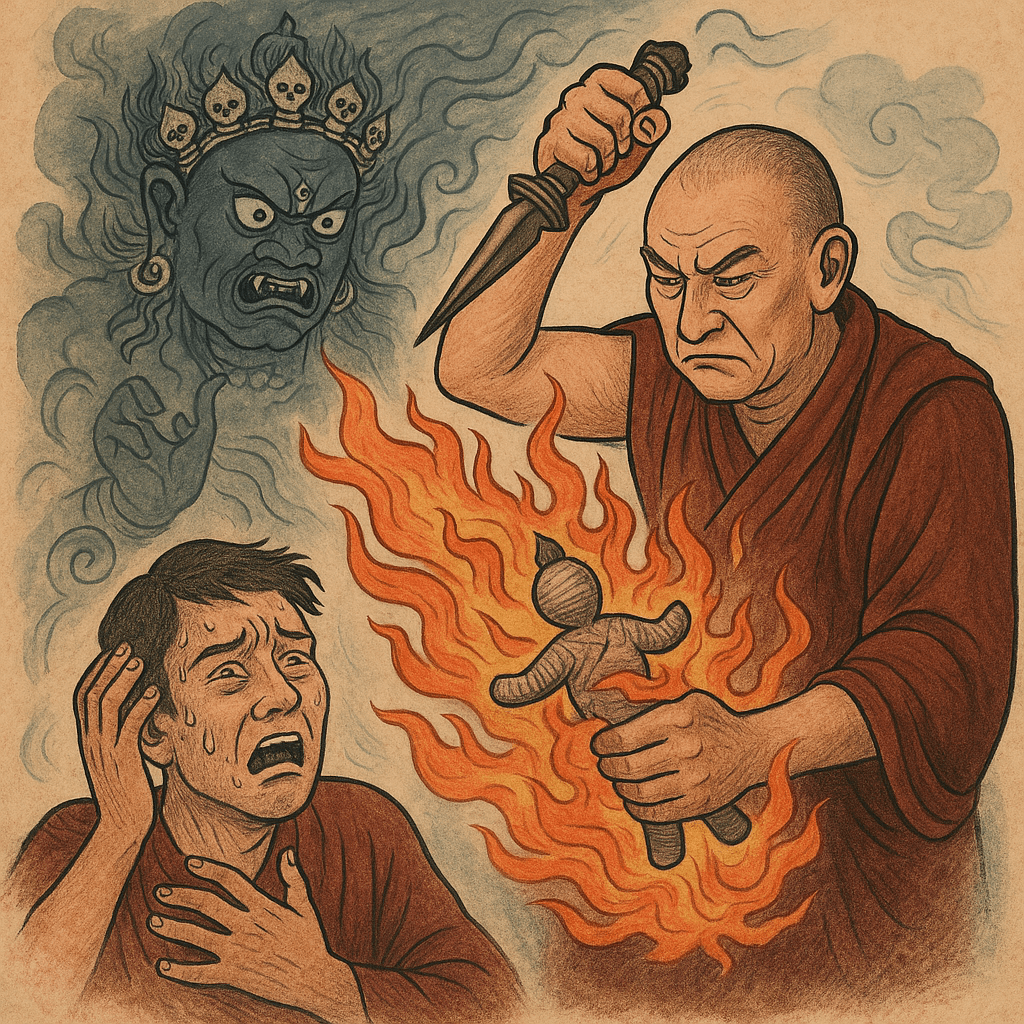
Wrathful Rituals and “Black Magic” in Tibetan Guru-Disciple Relationships

It is not far fetched to assert that it is the lama himself bringing about the karmic retribution on the student through black magic rituals using effigies and curses.


The Tibetan Buddhist tradition, especially its Vajrayana (tantric) aspect, contains teachings on wrathful rituals and even sorcery-like practices. These practices have occasionally been used (or misused) by gurus to punish or frighten disciples who violate guru devotion or samaya (sacred vows). Both classical texts and modern accounts document such phenomena:

  • Scriptural Warnings of Dire Consequences: Tantric scriptures and commentaries explicitly warn of terrible karmic punishment if a disciple betrays or criticizes their guru. For example, the Kalachakra Tantra says that even a moment of anger toward one’s guru destroys vast amounts of merit and causes rebirth in hell for eons (The Disadvantages of Incorrect Devotion to a Guru | Lama Yeshe Wisdom Archive).

  • Another text states that simply failing to properly honor a guru after receiving teachings can result in “rebirth for one hundred lifetimes as a dog” and then rebirth as a low-caste person or even a scorpion lamayeshe.com. In short, breaking samaya is portrayed as spiritually catastrophic, leading to suffering in this life and the next. These warnings, while couched as impersonal karmic law, create a climate in which gurus are held almost above criticism.

  • Oath-Breakers and Protector Deities: Tantric cosmology includes Dharmapāla (Dharma protectors) bound by oath to protect Buddhist teachings and teachers. Those who break their sacred vows or harm their guru are sometimes called “samaya-breakers” or oath-breakers. Historical texts indicate that oath-breakers were targeted by wrathful rituals. A striking example comes from a 13th-century Tibetan master at Kublai Khan’s court, Ga Anyen Dampa. In a decree mixing politics and magic, Dampa forbade harming his followers through curses or demons, but warned that if anyone disobeyed him, he would “unleash the fierce punishment of the Dharma Protectors” so that their heads would split into a hundred pieces (War Magic: Tibetan Sorcery | Rubin Museum). In other words, the guru swore to call upon wrathful deities to brutally destroy anyone who violated his command. Such records (in this case preserved as a protective charm) show that invoking black magic and protective deities as punishment for disobedience was not unheard of.

  • Effigies and “Black Magic” in Tantric Practice: Tibetan lamas developed elaborate ritual technologies to deal with enemies or detractors. Human effigies and dough figures (torma) are traditional ritual implements used to represent a target in magical rites. According to scholars, a “wide array of images, such as human effigies…or ritual dough-offering sculptures, were employed to…subdue or destroy one’s enemies” (War Magic: Tibetan Sorcery | Rubin Museum). In wrathful rites (such as the gTor dabs or torma-throwing ritual), the lama empowers an effigy with mantras and offers it to wrathful spirits or deities, directing the ensuing harm toward the intended victim. War Magic was even used at state levels, for instance, 12th-century Lama Zhang, a militant yogi, sent cursed tormas and spells against his foes and had protector goddesses like Shri Devi “assist” in battle (War Magic: Tibetan Sorcery | Rubin Museum). These historical uses of violent sorcery, while aimed at external enemies, set a background against which a guru might also target an “enemy” disciple who they feel has betrayed them.

  • Historical Case – The “Cursed Boots” Plot: In 1900, an incident in Lhasa suggests the reality of such magical punishments. The 13th Dalai Lama survived an assassination attempt involving black magic: a certain gifted pair of boots, which caused illness to the wearer, upon close inspection had “a harmful mantra hidden in the sole.” (Treasury of Lives: The Case of the Dalai Lama’s Cursed Boots – Tricycle: The Buddhist Review) The inquiry revealed that the boots were prepared as a curse by a lama famous for sorcery, acting on behalf of a former regent. That sorcerer (Lama Nyaktrul) confessed he was recruited to enchant the boots “as a means to sap the vitality of the Dalai Lama and cause his eventual death” (Treasury of Lives: The Case of the Dalai Lama’s Cursed Boots – Tricycle: The Buddhist Review). The plotters, including the ex-regent, were arrested, confirming this was not mere superstition but a documented attempt to use ritual magic to punish or eliminate a high lama. While this is a political case, it shows that Tibetan lamas did employ curses (mantras on effigies or objects) to secretly harm human targets. It’s a short step to imagine a vindictive guru doing similar things to a personal disciple who is seen as a traitor.

  • Even when literal demons aren’t invoked, the threat of supernatural harm is a powerful tool. Some Vajrayana insiders have noted that gurus sometimes wield samaya as a weapon of fear, warning that if a student breaks their devotion, it will hinder the guru’s life or send the student to Vajra Hell. This can psychologically terrorize students into silence and obedience.

  • Samaya and Guru Devotion as a Control Mechanism: The reverence for gurus in Tibetan Buddhism, while spiritually meaningful in that system, can be abused. Devoted students are taught to see the guru as embodying all Buddhas (The Disadvantages of Incorrect Devotion to a Guru | Lama Yeshe Wisdom Archive), and therefore criticizing the guru is equivalent to criticizing the Buddha himself. This makes any challenge tantamount to sacrilege. Teachers who demand absolute loyalty may invoke wrathful consequences to enforce it. In the lore, breaking samaya not only brings karmic punishment but may incite the guru’s protector spirits to take revenge. For instance, many guardian deities are oath-bound to “strike down those who break their vows” to the guru or teachings. A protector like Dorje Shugden, controversially, is believed by his devotees to punish monks who “betray” their lineage, an idea which has led to real-world fear and schisms ( Go On, Break Your Samaya | Tsem Rinpoche). Thus, within the context of guru devotion, the line between religious oath and curse can blur: a disciple who disobeys is told they invite not only bad karma but possibly violent divine retribution.

  • To go one step further, it is not far fetched to assert that it is the lama himself bringing about the karmic retribution on the student through black magic rituals using effigies and curses. These practices are particularly potent because the disciple would have opened themselves up to being possessed by the guru’s yidams and protectors through the empowerments and teachings they received from the guru. In addition, the guru is able to enter the mind and body of the disciple magically. See Tantric Astral Projection, the Guru’s Power to Liberate or Condemn. So basically, the potential enemy is already camped within the body/mind/spirit of the victim, waiting to strike should there be any samaya breakage. Although the tantric methods contain practices to repair broken samaya, the student/victim is not always aware that he has offended the guru and been condemned as an “unripe vessel” until it is too late.

In summary, credible sources, from canonical texts to academic studies and personal testimonies, support the claim that some Tibetan Buddhist gurus have used wrathful magic to punish dissenters. Traditional scriptures describe horrific fates for disciples who violate samaya, and Tibetan histories recount lamas employing curses, effigies, and protective deities to destroy enemies and “oath-breakers.” These examples, past and present, illustrate how the immense power ascribed to Vajrayana masters can morph into a tool of coercion, a “dark side” of guru devotion that Buddhist scholars and leaders are increasingly acknowledging. The evidence is admittedly esoteric, but it paints a consistent picture: under the pretext of protecting the Dharma or upholding sacred vows, some gurus have indeed used wrathful magic, rituals, or effigies to inflict harm on those who oppose or disobey them.

Sources:

When Demons Leave the Way They Came: Breath, Tantra, and the Kalachakra Deception


Lately, I’ve been praying for God to continue revealing the truth about what I was involved in during my years of deep immersion in Tibetan Tantra. I’ve asked Him to uncover every layer of deception and to expose every way in which these practices are demonic. And He is answering.

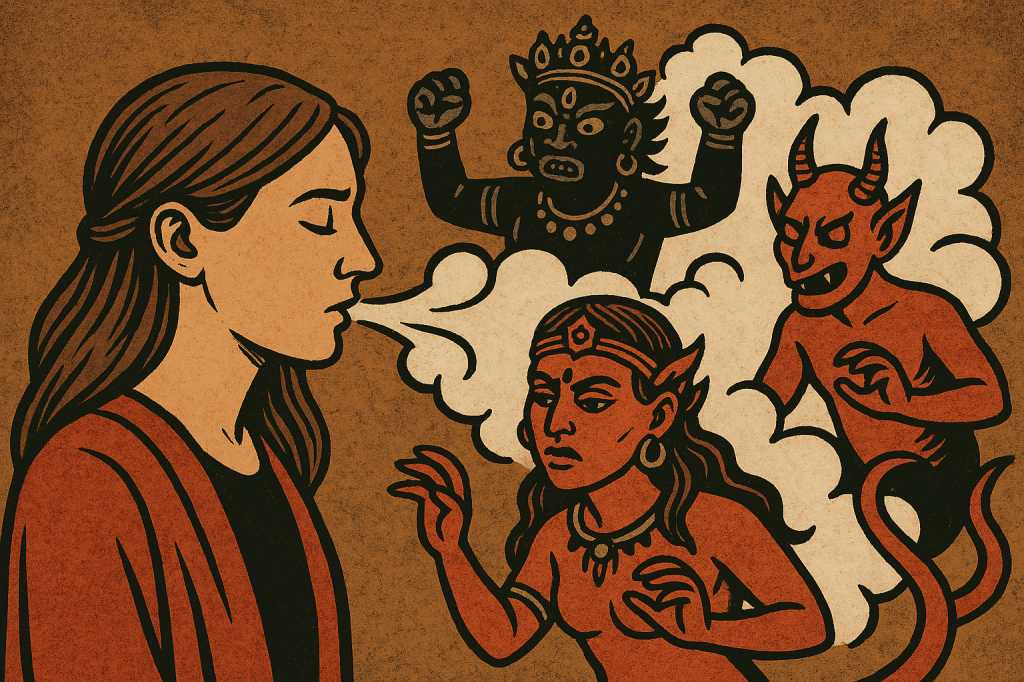
This past week, something profound happened: I experienced mass deliverance through my breath. As I exhaled, demons left me. Over and over again. It was undeniable. And then it hit me: of course they left on the breath. They came in on the breath.

This is not metaphorical. This is how tantra works. The breath is a key mechanism through which demonic entities enter one’s being. Yogic and tantric practices revolve around breath control: deep manipulation and intentional retention of the breath to open oneself to possession by what are euphemistically called “deities” but are, according to Christianity, demons.

In my three-year retreat, the main entities I invoked and merged with were Vajrayogini, the Red Dakini, and her consort. These were not simple meditations or visualizations. These were acts of surrender and identity dissolution. In essence, the goal was full-blown possession, even though it wasn’t couched in those terms and I didn’t realize that is what was happening.

Vajrayogini doesn’t come alone. Her retinue includes approximately 120 assistants, each with its own functions and qualities. That number is staggering, and that’s just one system of practice. In addition to her, I practiced the sadhana of a wrathful black deity with a massive host of demonic attendants. I should stress that these are not benign energies. They are demanding, and potentially violent and spiritually lethal.

But even beyond retreat, I continued to receive more initiations, or so-called empowerments. One that stands out is the Kalachakra initiation in 2011 from the Dalai Lama in Washington, D.C. It was a 10-day, all-day affair. I was zealous, determined to catch every detail of the ritual. I arrived early each morning to watch the Dalai Lama prepare himself by “self-generating” as the deity Kalachakra. It was amazing to watch; he was ritually becoming the deity.

Kalachakra, which means “Wheel of Time,” is a tantric deity surrounded by a staggering retinue of 722 deities. But these aren’t heavenly hosts. According to Christianity, they are demons. Every one of them. The entire system is a carefully constructed spiritual snare designed to bind souls to counterfeit light.

Thousands, maybe millions, have received these same initiations. The Dalai Lama has made it his mission to offer the Kalachakra globally. People believe they are receiving a blessing. But in reality, they are being spiritually colonized. Demonic systems are being seeded into the nations. These rituals are not neutral cultural events. They are portals for dark power.

If you want a glimpse into what may really happening during these ceremonies, I encourage you to read this article that lays it out plainly:
Dalai Lama and the Kalachakra

As for me, I’m continuing to pray and seek God’s help in cleansing every layer of my being. What I’m realizing is horrifying but I am confident that God is showing me the truth and setting me free.