

Thomas Merton’s Exploration of Tibetan Buddhist Mysticism and His Untimely Death


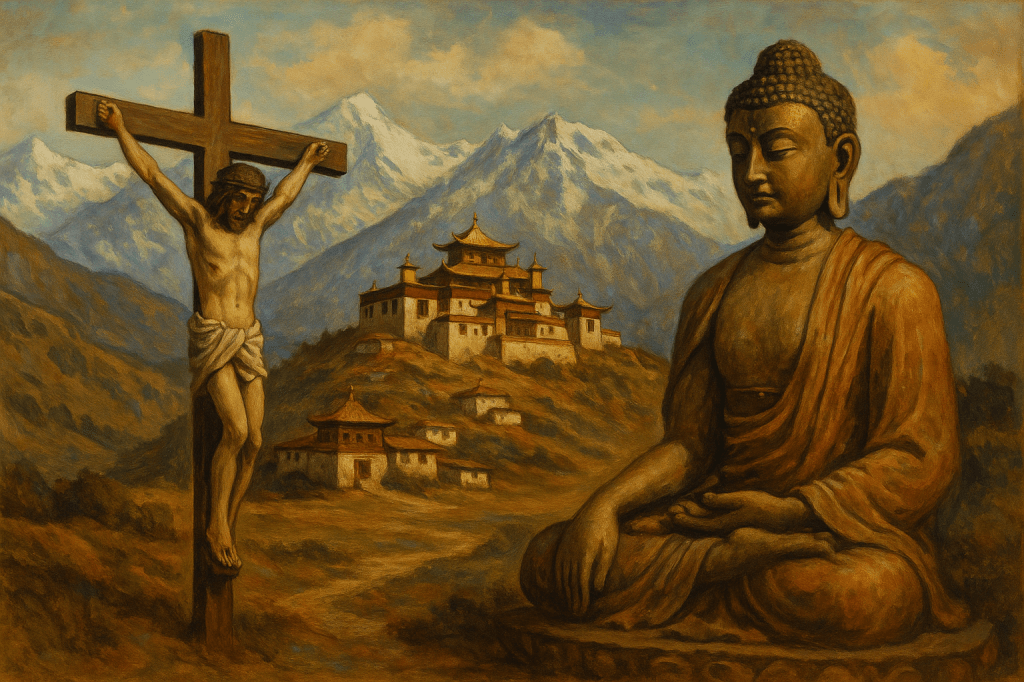
Thomas Merton remains one of the most fascinating and controversial figures in modern Catholic spirituality. A Trappist monk whose writing reached millions, he invited readers into a life of contemplation shaped by silence, inner stillness, and spiritual inquiry. By the 1960s, his search had expanded far beyond the borders of Christian tradition and into the world of Eastern mysticism. His journey raises important questions about discernment, authority, and the possibility that some mystical experiences do not come from God at all.

Why Merton looked East

Merton believed that Western Christianity had lost something essential. He felt that institutional concerns and intellectual debate had overshadowed direct experience of God. Eastern religions appeared to preserve a contemplative path in a purer form. Like many in the post–Vatican II era, he saw dialogue with non-Christian religions as an opportunity rather than a threat.

But such openness came with a cost. Many Catholics of his time assumed that all deep mystical traditions shared a common source. The idea that spiritual experiences could arise from contrary or even deceptive origins was rarely discussed. This lack of discernment created a vulnerable generation of seekers who treated Eastern practices as spiritually neutral when they were not.

Merton’s early interest in Asia

Long before traveling to Asia, Merton was reading Zen, Taoism, Advaita Vedanta, and Sufi mystics. He approached them with sincere curiosity, but also with a growing assumption that truth could be gleaned from any direction. His writings from this period suggest a desire for universal contemplative experience, sometimes without sufficient attention to the distinct theological and spiritual claims behind each tradition.

This tendency to universalize mystical experience would shape his final years.

Meeting the Dalai Lama

In 1968, Merton traveled to Dharamsala and spent several days with the Dalai Lama. Their meetings were warm and genuinely contemplative. Merton admired the Dalai Lama’s kindness, discipline, and clarity. The Dalai Lama later remembered Merton as the first Christian monk who came to him not as a tourist or academic but as a fellow practitioner of deep prayer.

Yet admiration does not erase theological differences. Tibetan Buddhism denies a creator God, embraces reincarnation, and employs esoteric tantric practices that involve deities outside the Holy Trinity. From a Christian point of view, this difference is huge. The Church has long taught the discernment of spirits: mystical experiences must be tested, because deceptive spiritual forces can imitate peace, clarity, and even compassion. Merton did not always express this caution.

Encounter with Kalu Rinpoche

Merton also met Kalu Rinpoche, one of the most respected Tibetan meditation masters of the twentieth century. He attended teachings on Mahamudra and was deeply impressed by the monastic discipline he witnessed. Kalu Rinpoche even invited him to undertake a long hermit retreat. Merton seemed drawn to the idea.

But Tibetan Buddhism contains layers of esoteric practice that Merton, like most Westerners of his time, did not fully understand. The serene exterior of Tibetan spirituality often conceals tantric rituals, spirit invocation, and hierarchical guru devotion that are fundamentally incompatible with Christianity. Later revelations of abuse and occult manipulation inside some of the major Tibetan lineages show how incomplete the Western picture had been. Merton could not have known this, yet his enthusiasm reflected a lack of discernment that would affect many who followed in his footsteps.

What else he explored

Merton’s range of interests was broad. He read Zen masters, Taoist sages, Hindu philosophers, and Sufi poets. He studied Christian hesychasm with new energy and sought common threads among all traditions. His impulse was generous, but generosity is not the same as spiritual clarity. Christian prayer directs the soul toward union with God. Eastern meditation, especially tantra, aims at dissolving the ego and merging with non-Christian spiritual entities.

These are not complementary goals but representative of different spiritual destinies.

Bangkok and a mysterious death

After leaving Dharamsala, Merton traveled to Bangkok to speak at an international monastic conference. On December 10, 1968, he died in his cottage shortly after giving a lecture. The official explanation was accidental electrocution from a faulty fan. Yet no autopsy was performed, and the circumstances were poorly documented. The inconsistencies have fueled speculation for decades.

His death came at a moment when he was moving more deeply into Buddhist thought. Whether he intended to integrate aspects of Tibetan practice into Christian monasticism remains unknown. His passing has an unfinished quality, as if he was on the edge of a major spiritual shift whose implications were never tested.

Why Merton still matters

Merton’s life challenges readers to seek authentic spiritual contemplation, not just intellectual understanding. It also warns Christians that not every path that promises depth is aligned with God. Eastern systems often carry metaphysical commitments and spiritual forces that stand in real conflict with Christian revelation. Without a strong framework of discernment, even sincere seekers can be misled.

Merton’s writings still inspire, yet his story also stands as a cautionary tale. The longing for mystical experience is real and often holy, but it must be shaped by sound doctrine and a sober awareness that not every spiritual path leads toward God.
A Brief History of Christianity in Tibet


Early Traces: The Nestorians and the Eighth Century

The history of Christianity in Tibet stretches back far earlier than most assume. The earliest Christian presence likely came from the Nestorian Church of the East, which had spread along Silk Road routes from Mesopotamia into China by the 7th century. Evidence from the Xi’an Stele of 781 CE shows that Nestorian missionaries were active under the Tang Dynasty, and given Tibet’s close relations with Tang China, it is plausible that Christian communities emerged within the Tibetan cultural sphere during the 8th century.1 However, these early Christian enclaves left no sustained legacy; Tibet’s conversion to Buddhism under Trisong Detsen soon dominated its spiritual landscape.

Jesuits in Guge: Antonio de Andrade and the Lost Kingdom

The next major encounter between Christianity and Tibet came through the Jesuit missions of the 17th century. In 1624, the Portuguese Jesuit Antonio de Andrade became the first known European to enter Tibet. He reached Tsaparang, the capital of the Guge Kingdom in western Tibet, where he was warmly received by King Tri Tashi Dakpa (also called Chadakpo). The king even laid the cornerstone for Tibet’s first church, completed in 1626.2

De Andrade’s arrival, however, sparked tensions. His success in converting local nobles alienated the powerful Buddhist clergy. A political conflict between the king and his brother, who was aligned with Buddhist monastics, led to the downfall of the Guge mission. Around 1630, the king was overthrown with assistance from the Ladakhi ruler Sengge Namgyal, who viewed Guge’s alliance with Catholic missionaries as a provocation.3 The Jesuits were expelled or killed, and Guge itself disappeared from the political map soon thereafter.

The Jesuits in Lhasa: Ippolito Desideri and the Capuchin Controversy

After Guge’s fall, the next great missionary endeavor came with Ippolito Desideri, an Italian Jesuit who reached Lhasa in 1716. Desideri immersed himself in Tibetan culture, mastered the language, and composed treatises comparing Christian and Buddhist metaphysics. His conciliatory approach, attempting dialogue rather than confrontation, won him both local sympathy and later admiration among scholars.4

Desideri’s work, however, was undone not by Tibetans but by Church politics in Rome. The Vatican’s Congregation for the Propagation of the Faith (Propaganda Fide) restructured Asian missions and in 1703 assigned Tibet to the Capuchins, a Franciscan order. The Jesuits were ordered to withdraw, leading to Desideri’s forced departure in 1721. The decision reflected not only internal rivalry but also a Vatican preference for an order more controllable and less inclined toward syncretic engagement.5

Suppression and Exile: The 18th and 19th Centuries

After the Jesuits’ departure, Capuchin missionaries continued their work until the 1740s. A crisis erupted in 1742, when a Tibetan convert refused to bow before the Dalai Lama, an act perceived as defiance against both religion and state. The government expelled the missionaries and banned Christianity in Central Tibet, a policy enforced by 1760.6

Despite this, individual attempts persisted. In the 19th century, the British missionary Annie Royle Taylor undertook a daring journey toward Lhasa in 1892, becoming the first Western woman to reach central Tibet, though she was ultimately turned back by Tibetan guards.7 Her journey epitomized the enduring fascination and futility of Christian outreach in a land long closed to foreigners.

Elsewhere, especially in eastern Tibet (Kham), anti-Christian sentiment often flared into violence. During the 1905 Batang Uprising, missionaries and Tibetan converts were targeted and killed. Among those martyred were André Soulié (1858–1905) and Jean-Théodore Monbeig-Andrieu (1875–1914), who are commemorated in Catholic hagiographies as victims of faith-driven hostility.8

The Vatican’s Strategic Shift: Why the Jesuits Were Replaced

The Vatican’s decision to replace the Jesuits with Capuchins was rooted in both theological and geopolitical concerns. The Chinese Rites Controversy (late 17th–early 18th centuries), in which Jesuits were accused of tolerating Confucian and local religious practices, had eroded papal trust. The Propaganda Fide viewed Jesuit accommodationism, especially Desideri’s open dialogue with Buddhist philosophy, as dangerous relativism. Capuchins, by contrast, were stricter and less likely to blur doctrinal lines. As historian Donald Lach notes, “the Capuchins represented the centralizing impulse of the Counter-Reformation, where obedience outweighed intellectual innovation.”9

Christianity and Modern Tibet: A Restricted Faith

Under Chinese administration since the 1950s, Tibet’s relationship with Christianity has remained tightly controlled. The People’s Republic of China recognizes only state-sanctioned religious institutions, and Catholic practice in the Tibet Autonomous Region exists only under the auspices of the Chinese Catholic Patriotic Association, which does not recognize Vatican authority. The Holy See’s cautious diplomacy, especially during Pope Francis’s efforts to reestablish relations with Beijing, has led to a de facto acceptance of limited Catholic presence, primarily among Han Chinese residents in Lhasa rather than ethnic Tibetans.10

The Vatican continues to regard Tibet as part of its mission territory, but evangelization remains almost nonexistent. Tibetan Buddhism remains dominant, and Christian symbols such as crosses, churches, even icons are scarce across the plateau.

Legacy

From the Nestorian wanderers to Jesuit polymaths and Franciscan ascetics, Christianity’s story in Tibet is one of ambition, misunderstanding, and endurance. While never a major presence, its traces linger in forgotten ruins in Tsaparang, in Desideri’s Tibetan manuscripts preserved in Rome, and in the historical memory of dialogue between two of the world’s most mystical spiritual traditions.

Footnotes

  1. Samuel H. Moffett, A History of Christianity in Asia, Vol. I: Beginnings to 1500 (Maryknoll: Orbis Books, 1992), 291–295.
  2. Antonio de Andrade, Novo Descobrimento do Gram Cathayo ou dos Reinos de Tibet (Lisbon, 1626); Timo Schmitz, An Overview of Tibetan History (2025), 91–92.
  3. Le Calloc’h, J. (1991). “Antonio de Andrade and the Mission in Western Tibet.” Archivum Historicum Societatis Iesu, 60: 57–60.
  4. Ippolito Desideri, Notizie Istoriche del Tibet (Rome, 1727); Hattaway, Paul. Tibet: The Roof of the World (2021), 41.
  5. Peter Clarke, The Jesuits in Asia (Cambridge University Press, 1993), 204–207.
  6. Schmitz, Timo An Overview of Tibetan History, 91–92; Hattaway, 2021: 41–44.
  7. Hattaway, 2021: 68–71.
  8. Servin, Michael. “Christian Martyrs of Tibet.” Journal of Asian Church History 11 (2010): 23–39.
  9. Donald F. Lach, Asia in the Making of Europe, Vol. III (University of Chicago Press, 1977), 225–228.
  10. Holy See Press Office, “Relations between the Vatican and China,” L’Osservatore Romano, 2020.

The Slow Dawning: Rethinking Tibetan Tantric Buddhism


It has taken me decades to admit something that began as a faint suspicion, then settled into unease, and now has crystallized into a sober conclusion: Tibetan tantric Buddhism is not what I thought it was. Nor is it what I believed when I first encountered it many years ago, a bit before the time His Holiness the Dalai Lama received the Nobel Peace Prize in 1989.

Back then, the first wave of Tibetan lamas and rinpoches were arriving in the West. To many of us, they seemed like emissaries from a lost Shangrila. Coming out of the disillusionment of the Vietnam War years, with trust in government and organized religion badly shaken, we were primed to seek something transcendent and pure. And here were these men, holy men trained in the monasteries of old Tibet, carrying with them an aura of mystery and profound wisdom. Meeting them felt like an unimaginable stroke of good fortune.

The historical Buddha’s teachings struck us as luminous and deeply humane. The philosophical treatises were subtle, the meditation techniques precise and effective. And then there was tantra. We were told, almost in passing, that tantra too came directly from the Buddha. No mention was made of its roots in Shaivism, or its overlaps with the worship of Shiva, Kali, and the other tantric currents in Indian religion. Yes, there were references to the 84 Siddhas, some of whom practiced in Hindu traditions, but it was presented as a kind of colorful backdrop rather than something that demanded careful inquiry. The task, we were told, was to study the dharma, not to ask too many uncomfortable questions.

And yet, the Buddha himself had urged his students to test his words as one tests gold: cutting, burning, hammering to see if it is true. I carried that instruction into Tibetan Buddhism. But the environment I found myself in didn’t encourage such testing. Quite the opposite.

Very quickly, I was drawn into the highest yoga tantras. After a series of initiations that were performed in Tibetan, a language I didn’t understand, I was informed by a lama I scarcely knew that from now on, I had to do whatever he told me. Cognitive dissonance set in immediately. Around me, others spoke of him as a fully enlightened buddha. Terms like samaya and vajra hell were introduced without context, wrapped in a swirl of historical Buddha teachings and cryptic tantric concepts. Critical thought was not just discouraged; it was quietly undermined. The lama was king, and the student’s role was obedience.

For Westerners raised with democratic ideals and an education that stressed inquiry, this was a bewildering fit. Many of us unconsciously overlaid our early religious conditioning onto what was, in fact, a foreign and feudal religious structure with a pantheon of strange and colorful deities. The result of treating the lama as an omniscient god created confusion, sometimes tragedy. I have heard of suicides, psychotic breaks, and lives unmoored. At the same time, I know people who genuinely believe they have benefited from Tibetan Buddhism. For years, I counted myself among them, until my own turn came.

I was privately attacked by my gurus during a tantric ritual for what I considered minor offenses related to situations outside of my control. What followed was worse: a series of what can only be described as black magical assaults. I now look back at those suicides I had once heard about and wonder: had they endured similar attacks, subtle or overt, after questioning or disappointing their teachers? Perhaps. I cannot know for sure. But I do know this: the mask of compassion many lamas wear often drops when they feel challenged or exposed. Not all, certainly. But enough to form a pattern.

That slow dawning that Tibetan tantric Buddhism was not what it was presented to be has been deeply painful. The disillusionment runs far beyond personal disappointment; it speaks to a betrayal of trust, the suppression of critical thought, and the dangers that arise when power is handed to unaccountable gurus who claim authority over hidden magical practices and wield them at will. Brought into a Western culture of sincere but searching seekers, this has created a toxic mix that leaves people vulnerable at the very moment they are most open.