

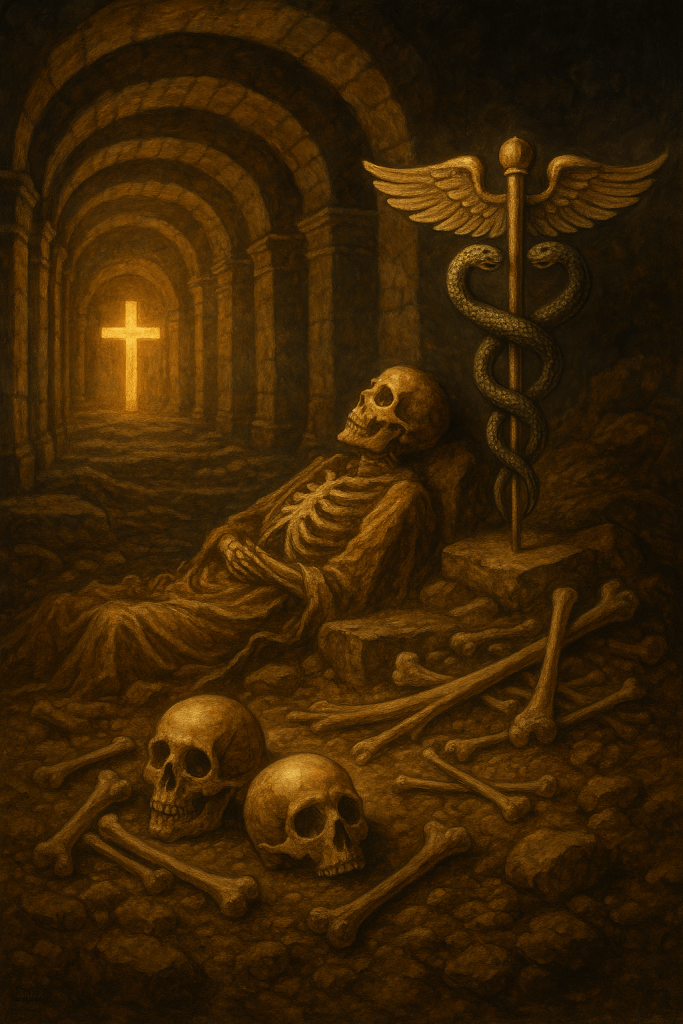
In the ancient catacombs beneath Rome, the bones of countless Christian martyrs still rest. Their blood once soaked the soil of the Eternal City, spilled in arenas and burned at stakes. These early saints stood firm as the empire raged against them, refusing to bow before the gods of Olympus. Their sacrifice helped dismantle an entire pantheon, culminating in the 4th century with the conversion of Emperor Constantine and the eventual abolition of state-sponsored paganism.
This was no mere political shift; it was a metaphysical war. The temples of Mercury, Dionysus, and Asclepius were shuttered or repurposed. The rites of Isis, Mithras, and the Eleusinian mysteries faded into obscurity. The cross had conquered the caduceus.
But pagan gods, the fallen angels never truly die. They reinvent themselves. And sometimes, they reappear in new lands wearing different clothes.
The Echoes of Hermes in the Serpent of Shakti
After Constantine, as Christian Rome rose from the ashes of the pagan world, something remarkable was stirring across the continent in India. By the 5th century, the traditions of Tantra and Kundalini had begun to take shape. Where Rome had cast down the serpent as a symbol of Satan, Indian mysticism raised it up as the dormant energy of the Divine Feminine, Kundalini.
Can we trace a spiritual current from Hermes to Shiva, from the Greek mysteries to the yogic inner fire? This is speculative, but consider the astonishing parallels:
| Theme | Greco-Roman (Hermes, Asclepius) | Indian Tantra/Kundalini |
|---|---|---|
| Serpents | Symbol of wisdom, healing, duality | Coiled energy, Shakti |
| Staff or Axis | Caduceus (Hermes), two snakes coiled around a staff | Sushumna nadi (central energy channel flanked by solar and lunar channels) |
| Healing | Asclepius, god of medicine | Kundalini as transformative healing energy |
| Divine Union | Hieros gamos, Dionysian ecstasy, inner union of male and female energies | Shiva–Shakti union |
| Body as microcosm of the universe | Mystery religions, alchemy | Tantric yoga, body as vehicle to moksha (liberation) |
If we imagine the fall of Greco-Roman religion not as a disappearance but as a transmutation, we might say:
The energy of Hermes migrated eastward, shedding its Western garb and reappearing as Shiva, serpent-lord and cosmic dancer, custodian of the inner path.
A Vision in the Night
Early this morning, something powerful happened to me. I woke up at around 2:30 or 3:00 a.m. and engaged in deep Catholic prayer. Afterwards, I drifted back into sleep and experienced a vivid spiritual battle.
I saw the Caduceus and felt the presence of a dark force, perhaps a demon. Then I sensed small demons leaving as if they shot out of my mouth on puffs of air, accompanied by groaning, crying, even the sound of gunshots, as though a war was raging inside my soul. At the end of the vision, one man remained below, pointing a gun upward. I watched from a higher vantage point. Who was he? The man, I believe, was Satan.
He was not dead and he was poised to keep fighting.
I woke up. What I experienced wasn’t just a dream. It felt like an echo of that ancient struggle in Rome, replayed within the temple of my own body. The Christian martyrs cast down idols with their blood. We, too, must cast down what is false within us at whatever cost; we must uproot and cast out the inner serpent that slithered in during years of practicing the occult.
Rome uprooted the pagan gods and repurposed their shrines into Catholic cathedrals. Sadly, the pagan entities they represented were not destroyed. Perhaps they merely migrated east, into the rituals of Tantra, the breath of yogis, and the rising coil of kundalini.
 Tantric Deception