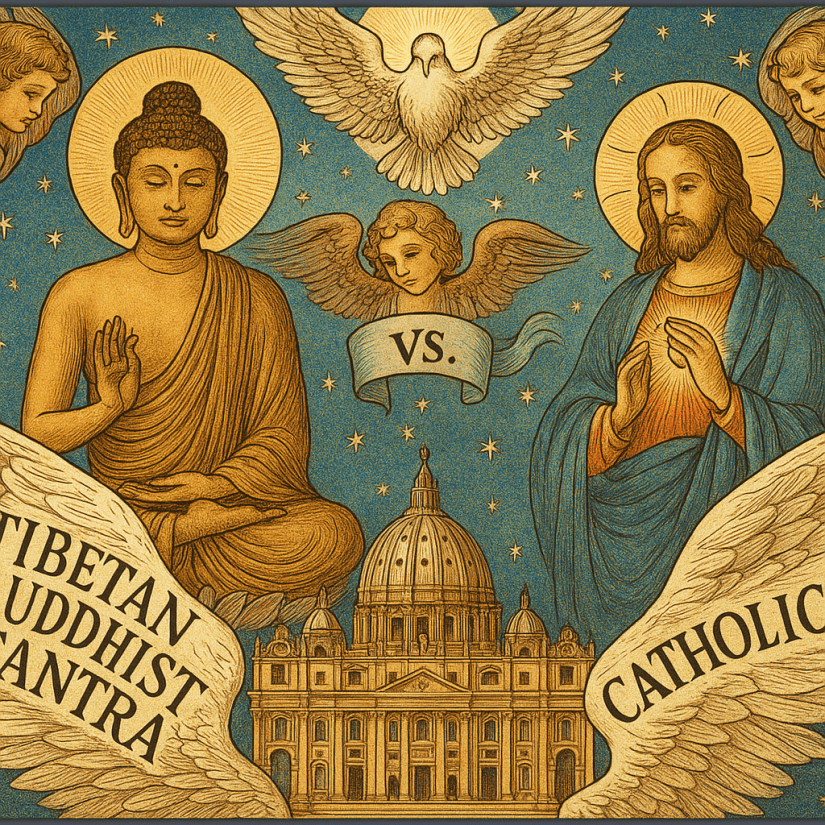
Tibetan Buddhism and Christianity: Traditions Very Much at Odds


As a young person, I was assured by a respected Tibetan Buddhist rinpoche that one could be both Christian and Buddhist. [1] He acknowledged that many had faith in Jesus Christ and claimed there was no contradiction between the two traditions. Yet, this assertion directly contradicts biblical Christianity. Whether well-intentioned or deceptive, he was wrong.

Tibetan Buddhism is often presented in the West as a tradition of wisdom and compassion, sometimes compared to Christianity. However, its fundamental tenets conflict with Christian doctrine, not only in rejecting a Creator God but also in its deep commitment to tantric practices that diverge from biblical teachings. Tibetan Buddhism’s fusion of Indian Buddhist philosophy, tantric practices, and Tibetan shamanism has resulted in a system where esoteric tantric laws supersede even the historical Buddha’s teachings, let alone Christian principles.

Tantric Roots: Beyond the Buddha’s Teachings

It is important to note that Tibetan Buddhism is not solely derived from the historical Buddha’s teachings but incorporates various esoteric influences, including elements from broader South Asian tantric traditions. Scholar Jacob Dalton notes that early Buddhist tantra developed ritualized practices such as mantra recitation and yogic breath-control techniques. Over centuries, Tibetan Buddhist tantra evolved beyond the Buddha’s original teachings, shaped by ongoing ritual innovations and textual developments rather than direct continuity with the Buddha’s doctrine (Dalton, “On the Early Development of Sexual Union in Buddhist Tantric Practice”) [2]

The Buddha’s original teachings emphasized ethics, meditation, and wisdom, not esoteric rituals, deity invocations, or secret empowerments, which later became central to Tibetan Buddhist practice. The introduction of tantric elements centuries after his death fundamentally altered Buddhism, aligning it more closely with Hindu tantra than with its original foundations.

The Fusion of Buddhism, Tantra, and Tibetan Shamanism

Tibetan Buddhism is not a pure continuation of the Buddha’s teachings but a blend of:

  • Mahayana Buddhism: Contributed philosophical concepts like emptiness (shunyata) and the bodhisattva ideal.
  • Kashmir Shaivism & Indian Tantra: Introduced deity yoga, secret initiations, and esoteric sexual rituals.
  • Tibetan Bon Shamanism: Integrated animistic practices, spirit invocations, and sorcery.

This synthesis was fraught with contradictions. The Buddha’s ethical teachings often clashed with tantra’s disregard for conventional morality, which, according to tantric texts, must be transcended for enlightenment. Tantric laws ultimately took precedence over traditional Buddhist ethics, justifying actions that the Buddha explicitly condemned, such as ritual intoxication, sexual practices, and deceptive methods of control.

Dalton’s book, The Taming of the Demons: Violence and Liberation in Tibetan Buddhism, highlights how tantric law overshadowed Buddhist nonviolence, allowing for ritual violence against perceived enemies of the dharma (Dalton, The Taming of the Demons). [3] This unresolved tension continues in Tibetan Buddhist circles, where lamas justify behaviors the Buddha would have rejected.

Idol Worship and the Biblical Condemnation of Tibetan Buddhism

Christianity explicitly condemns the core practices of Tibetan Buddhism, particularly idol worship, sorcery, and reliance on spiritual intermediaries outside of God. Scripture warns against such practices:

  • Isaiah 42:8 “I am the Lord; that is my name! I will not yield my glory to another or my praise to idols.”
  • Galatians 1:8 “Even if we or an angel from heaven should preach a gospel other than the one we preached to you, let them be under God’s curse!”
  • Deuteronomy 18:10-12 “There shall not be found among you anyone who… practices divination, tells fortunes, or interprets omens… For whoever does these things is an abomination to the Lord.”
  • 1 Corinthians 10:20-21 “The sacrifices of pagans are offered to demons, not to God, and I do not want you to be participants with demons.”

Tibetan Buddhism actively promotes deity worship, ritual magic, and tantric initiations that invoke spiritual forces, aligning it with practices the Bible condemns as deceptive and demonic.

Two Paths That Cannot Be Reconciled

Despite modern claims of compatibility, Christianity and Tibetan Buddhism are fundamentally irreconcilable. Tibetan Buddhism is rooted in tantric laws that contradict the teachings of both the Buddha and Christ. It is not merely a philosophy but an esoteric system steeped in idol worship, occult rituals, and doctrines opposed to biblical truth.

  1. An honorific title used to refer to highly respected teachers.
  2. Jacob Dalton, On the Early Development of Sexual Union in Buddhist Tantric Practice, Journal of the International Association of Buddhist Studies, vol. 32, no. 1–2, 2009.
  3. Jacob Dalton, The Taming of the Demons: Violence and Liberation in Tibetan Buddhism (New Haven: Yale University Press, 2011).

Do All Spiritual Paths Lead to God?

The hexagram symbol on the right depicts the mandala of an important Tibetan Buddhist female deity.


I was having a discussion with a former tantric Buddhist practitioner, and it got me thinking about the popular notion that all roads lead to God and that it doesn’t matter whether or not one has practiced in occult traditions as long as they are trying to live virtuous lives. This idea is comforting to many, but from a theological standpoint, it is deeply flawed. Not all spiritual paths lead to God, and certain practices, no matter how well-intentioned, can take people further away from Him rather than closer.

The Illusion of “Enlightenment”

Many believe that high-level Buddhist teachers or gurus have a special ability to perceive the karma of others. This belief leads followers to trust their guidance blindly, assuming they possess supernatural wisdom. But from a theological perspective, what these figures claim to see and know is not divine insight but a form of spiritual deception. The power they wield does not come from God but from spiritual forces that oppose Him.

The very concept of enlightenment in Tibetan Buddhism is fundamentally at odds with Biblical teachings. In this system, enlightenment is not about growing closer to God, but about achieving a state of being that makes one a vessel for spiritual forces that are hostile to Him. The gurus who have attained the so-called spiritual height of “enlightenment” have not reached divine truth but have instead become “perfectly possessed” by the spirits that fuel the tantric path.

The Reality of Spiritual Pacts

Participation in tantric initiations is not merely symbolic. The promises made in these rituals have serious spiritual consequences. When one makes commitments during empowerments, even unknowingly, they are entering into agreements that give authority over their soul to forces that do not serve God.

This is not a matter of personal interpretation. The laws governing these spiritual transactions are real, and those who understand the theology behind them recognize that they operate within a strict legalistic framework. The idea that someone can engage with these practices while remaining spiritually “safe” is misguided. The demons involved do not care whether a person understands what they have agreed to; once the ritual is completed, the spiritual consequences are set in motion.

The False Hope of Virtue Alone

A common misconception in modern spiritual thought is that simply being a good or virtuous person is enough to secure salvation. But righteousness apart from God does not lead to eternal life. If someone is actively engaging in spiritual practices that align with forces opposed to God, no amount of virtue can undo that.

As written in Deuteronomy 18:10-12, “There shall not be found among you anyone who burns his son or his daughter as an offering, anyone who practices divination or tells fortunes or interprets omens, or a sorcerer or a charmer or a medium or a necromancer or one who inquires of the dead, for whoever does these things is an abomination to the Lord.” Tibetan Buddhism’s reliance on occult rituals, divination, and spirit invocations falls into this category.

This is why it is crucial to educate people about these realities. Many well-intentioned individuals are being led into spiritual traps without realizing it. They are promised wisdom, peace, or power, but in reality, they are binding themselves to forces that seek to separate them from God permanently.

The good news is that no one is beyond redemption. Those who have unknowingly or knowingly engaged in these practices can still turn back to Jesus Christ, who alone has the power to break these spiritual bonds. The key is to recognize the deception, reject it, and seek salvation in Christ alone.

Our responsibility is to share this knowledge with others, so they, too, can be set free. It is not enough to hope that people will figure it out on their own. We must share the truth and help guide others away from deception and into the light of God’s salvation.

Why Christianity is the True Religion


For years, I was ensnared in the world of Tantric Buddhism, believing its practices held the key to enlightenment. But instead of finding peace and liberation, I encountered spiritual torment on and off for years, first with sexual abuse by a lama and then when the kundalini energy went completely awry. My guru, whom I had trusted, placed a curse on me, and the so-called enlightened deities of Tibetan Buddhism revealed themselves as tormenting demons. The suffering I endured was beyond anything I could have imagined.

After the linga annihilation ritual, I thought there was no hope. I had been completely immersed in their tantric system for most of my adult life. Thanks to a suggestion from a young man I met who was going through a devastating kundalini awakening, I had the idea to contact a Catholic exorcist. I read his book called Diary of an American Exorcist that came out in 2021 , and for the first time in my life, I started to think I might actually be possessed by the tantric deities I had practiced for years. I had been taught they were perfectly enlightened buddhas, so why had they turned against me, manifesting as demonic forces bent on my total destruction? How could I overcome these forces that seemed so powerful, so intransigent? The answer was something higher, greater, and infinitely more powerful than the tantric magical system. In order for it to work, it had to be completely outside of their deceptive system. That answer was the Biblical God and his son Jesus Christ.

The Power of Christ Over Dark Forces

Tibetan Buddhism presents itself as a perfect path to enlightenment, but what I experienced was a system built on deception and control. The practices I had been taught that used rituals, empowerments, and deity visualizations, brought many experiences, both blissful and horrible. When I started to have grave doubts and investigated the origins of tantra, to question and examine, it became obvious that was not allowed. Then came punishment and the bloody realization that these forces would never let me go.

But ever since I turned to Jesus Christ, slowly, gradually, things have changed. His power is greater than any so-called tantric magic or divine blessing from a guru. The name of Jesus brings healing and casts out demons. He has authority over all the small “g” gods.

Tibetan Buddhism teaches that its deities are compassionate buddhas and bodhisattvas, but in the end, I found them to be nothing but oppressive spirits masquerading as wisdom beings. They were powerless against Christ. The moment I surrendered to Jesus, they started to lose their grip on me. This was not psychological; it was spiritual warfare. I am not unique; many others have experienced the same freedom from demons and darkness.

Evidence in My Own Life: Healing, Hope, and Peace

If Tibetan Buddhism had been the true path, I would have found healing through it. Instead, it nearly destroyed me. The fact that I am now very much recovered, that I am healing and have hope, happiness, and peace, is proof that Christ is real and that He reigns above all. No Buddhist deity, no tantric ritual, no guru’s power is more powerful.

As Psalm 91:13 declares, “You will tread on the lion and the cobra; you will trample the great lion and the serpent.” This scripture became real in my life as Jesus granted me victory over the kundalini spirit and the guru. Although I am not completely free, they still have some control over my dreams and my body, I am so much more healed. I finally see the light at the end of the tunnel.

Why Christianity is the True Religion

  1. Christ’s Power Over Darkness: No tantric deity or Buddhist practice could free me. Only Jesus could break the chains that bound me spiritually.
  2. A Relationship, Not Rituals: Christianity is about knowing a living God, not engaging in endless rituals to appease deities that ultimately bring suffering.
  3. True Healing and Transformation: The peace, hope, and healing I have now are real and lasting. No Buddhist practice ever gave me that.
  4. The Dominion of Christ: The fact that Jesus Christ is triumphing over all the forces that tormented me proves His supremacy over all spiritual powers.

The Deceptive Allure of Occult Practices and the Indelible Mark of Christian Baptism


Many individuals in the Western world grow up in homes steeped in Judaeo-Christian traditions, often baptized as children and raised with an understanding of Jesus Christ as the central figure of faith. Yet, as they mature, many are drawn into Eastern religious practices that promise inner peace and spiritual enlightenment. This pull toward Eastern religions, particularly Tibetan Buddhism and its practices, is sometimes presented as harmless, even compatible with Christian teachings. In my own experience, some Tibetan Buddhist teachers have claimed that there is no conflict between the teachings of Christ and those of Tibetan Buddhism. While this may sound like a comforting and inclusive message, it is, at best, misleading, and at worst, a dangerous lie that leads many Christians astray.

For individuals baptized into the Christian faith as infants or children, an indelible spiritual imprint occurs on the soul, one that marks them as belonging to the God of the Bible. This sacred act establishes a direct relationship with the Creator, which stands in stark contrast to the beliefs and practices found in Eastern religions. Despite this foundational truth, many are lured into a syncretic blend of Christian teachings with the mystical, spiritual practices of Buddhism, Hinduism, or other occult traditions. The danger lies in the fact that this mixture ultimately dilutes or distorts one’s Christian identity and opens individuals to the influence of deceptive spiritual forces.

The Danger of Syncretism: Mixing Christian Faith with Pagan Practices

The claim that Jesus’ teachings and Tibetan Buddhism can coexist is rooted in a concept known as syncretism, the blending of two or more belief systems. While this may seem like a path to spiritual open-mindedness and personal growth, the Bible clearly warns against such practices. The Old Testament is filled with injunctions against idolatry and the worship of foreign gods, whether in the form of pagan deities or mystical spiritual practices.

In Deuteronomy 18:9-14, God commands His people to avoid any form of divination, sorcery, or magic, practices that are prevalent in many Eastern traditions. These acts are considered detestable to God and directly oppose the purity of worshiping the one true Creator God. These prohibitions apply just as much today as they did thousands of years ago, even if modern expressions of occultism have evolved and adapted into seemingly more “acceptable” forms, like meditation or chakra healing.

When individuals who have been baptized in the Christian faith engage in practices like Buddhist meditation, energy work, or divination, they risk opening themselves up to dark spiritual forces. The Bible warns against such practices not only because they involve the worship of false gods but because they undermine the central role of Christ as the sole mediator between God and humanity. Jesus himself makes this clear in John 14:6 when He says, “I am the way, the truth, and the life. No one comes to the Father except through me.” To engage in Eastern religious practices is to step away from that singular path to salvation.

The Spiritual Imprint of Baptism: A Mark of Belonging to the Christian God

Moreover, for those baptized as children, the Bible teaches that baptism is not merely a symbolic act but a profound spiritual marking of the soul. In baptism, one is initiated into the life of Christ and made part of His Church. This sacred act is intended to be the foundation of a lifelong relationship with God, one that is in direct opposition to pagan practices.

Romans 6:3-4 tells us that in baptism, we are “buried with him through baptism into death in order that, just as Christ was raised from the dead through the glory of the Father, we too may live a new life.” This new life is one marked by obedience to God and rejection of all that seeks to draw us away from Him. Pagan religious systems, including Eastern occult practices, offer a counterfeit spirituality that leads away from Christ, not toward Him. The baptismal mark on a Christian soul is a direct line of connection to the one true God and should not be confused with the spiritual practices that often accompany other belief systems.

While Eastern religions may offer an alluring promise of inner peace or spiritual awakening, they can never replace the saving grace found in Christ. The temptation to seek answers outside of the Christian faith leads individuals into dangerous spiritual territory, where demonic influence can gain a foothold. The apostle Paul warns in 2 Corinthians 11:14-15 that “Satan himself masquerades as an angel of light,” and many false teachers will appear to offer what seems like truth but ultimately lead people astray.

The Spirit of Divination: The Third Eye and Demonic Portals

The Bible also highlights the dangers of divination, which are common practices in many Eastern traditions, including Tibetan Buddhism. One vivid example is found in Acts 16:16-18, where the apostle Paul encounters a slave girl who possesses a spirit of divination. This spirit enables her to predict the future. The girl follows Paul and his companions, shouting that they are servants of the Most High God, which seems to align with truth, but in reality, the spirit she possesses is a demonic force.

Paul, recognizing the deception, casts out the demon of divination, saying, “In the name of Jesus Christ, I command you to come out of her!” (Acts 16:18). This moment is significant because it reveals the true nature of divination: it is not a benign spiritual gift or insight, but rather a demonic influence. The spirit of divination that Paul confronts is the very same one that oversees the opening of the occult “third eye,” a concept in Eastern occultism often linked to psychic abilities and spiritual awakening.

The “third eye” or so-called “wisdom eye” is considered by many as a metaphysical organ that allows one to access hidden spiritual realms and tap into supernatural knowledge. However, the Bible warns against such practices because they open a door to the preternatural world, a world where demonic spirits can influence and deceive those who seek power outside of God. This “third eye” is not a gateway to divine enlightenment but a portal that leads into the realm of darkness, where demons dwell and influence human lives. Jesus is the only true source of spiritual insight and enlightenment. Any attempt to open one’s spiritual eyes outside of Christ is a dangerous invitation to demonic oppression.

The Spiritual Dangers of Divination, Meditation, and Yoga

Eastern religious practices often involve forms of meditation or yoga that encourage individuals to connect with unseen spiritual forces. Tibetan Buddhist meditation, for example, often involves visualizing deities or engaging in rituals that invite spiritual forces into one’s body and mind. Energy work and chakra healing, popular in New Age practices, propose that spiritual power can be manipulated through physical means or harnessed from the universe. However, the Bible teaches that all spiritual power comes from God alone and that seeking power outside of Him is an act of rebellion. In Ephesians 6:12, Paul reminds us that our battle is not against flesh and blood but against “the rulers, the authorities, the powers of this dark world and against the spiritual forces of evil in the heavenly realms.” Engaging in occult practices, however begin they may seem, opens individuals to these forces of darkness.

Conclusion: Remain Faithful to Your Christian Roots

It is crucial for those of the Christian faith to understand the deep spiritual dangers that arise from dabbling in occult practices, particularly those from Eastern religions. The temptation to blend the Biblical teachings with those of pagan systems is not new, but it remains just as dangerous today as it was in ancient times. God calls His people to remain pure in their worship, to avoid the seductive allure of false spiritual practices, and to stand firm in the faith that was once for all entrusted to the saints (Jude 1:3).

Christ is the only way to salvation, and any attempt to mix Him with other gods or spiritual practices ultimately leads to deception and destruction. Baptism marks a Christian as belonging to God, and that identity must not be compromised by the pursuit of false teachings. Therefore, stand firm in the faith, and guard hearts and minds against the dangerous allure of Eastern occult practices.

The Authority of Scripture in Spiritual Warfare: Fighting Demons with God’s Word


Throughout the Bible, God’s Word is described as a powerful and transformative force capable of addressing the deepest struggles of humanity, including the battle against evil. For Christians who are engaging in spiritual warfare and fighting against demonic forces, using the Bible is not only permissible but deeply rooted in scriptural authority. Here, we explore how the Bible provides this foundation and clarify why this practice is far removed from the realm of magic.

The Sword of the Spirit: The Word as a Weapon

Ephesians 6:17 declares, “Take the helmet of salvation, and the sword of the Spirit, which is the word of God.” Paul describes the Word of God as a vital piece of the “armor of God,” emphasizing its role as an offensive weapon against spiritual challenges. This imagery highlights the Bible’s unique power to confront and dismantle evil. Hebrews 4:12 echoes this sentiment, calling the Word “living and active, sharper than any two-edged sword” that can discern and pierce the heart’s deepest intentions.

Unlike physical combat, spiritual warfare relies on divine power, as Paul reminds us in 2 Corinthians 10:4-5: “For the weapons of our warfare are not of the flesh but have divine power to destroy strongholds.” Here, Scripture becomes a tool to demolish false arguments and thoughts that stand against the knowledge of God.

 The Tongue’s Role in Warfare

Proverbs 18:21 asserts that “Death and life are in the power of the tongue.” Words hold immense spiritual weight, capable of uplifting or destroying. When believers declare God’s promises and truths against demonic attacks, they engage in a profound act of spiritual resistance. This isn’t incantation; it is aligning one’s voice with God’s truth, as demonstrated in Jesus’ own confrontations with Satan (Matthew 4:1-11).

David’s Example: Seeking Divine Intervention

Many Psalms, including Psalm 35 and Psalm 18, depict David calling upon God to intervene against his enemies. Psalm 35:3 implores, “Draw the spear and javelin against my pursuers! Say to my soul, ‘I am your salvation!’” These passages illustrate that God is actively involved in protecting His people. The believer’s reliance on Scripture as a form of prayer and declaration invokes God’s power rather than personal ability.

Spiritual Warfare Is Not Magic

It is essential to distinguish between the use of Scripture in spiritual warfare and the practice of magic. Magic seeks to manipulate spiritual forces through rituals or incantations. Spiritual warfare, by contrast, is rooted in submission to God’s authority and reliance on His power. Jeremiah 23:29 underscores the potency of God’s Word, describing it as a “fire” and a “hammer” that breaks rock into pieces. This power is not harnessed through human will but through divine will, activated by faith.

Cosmic and Divine Intervention

Judges 5:20 provides an intriguing insight: “From the heavens the stars fought, from their courses they fought against Sisera.” This poetic account reveals that God’s creation itself aligns with His purposes to combat evil. Believers today can trust that when they rely on God’s Word, they are not fighting alone but are part of a divine strategy against darkness.

Faithfulness and Authority

Revelation 2:26-27 promises authority to those who remain faithful: “To the one who is victorious and does my will to the end, I will give authority over the nations…” This passage reassures Christians that their victory in spiritual warfare is part of their inheritance in Christ. They wield God’s Word not as a mystical tool but as an authoritative proclamation of His truth.

 A Call to Action

In engaging in spiritual warfare, Christians are called to:

1. Equip Themselves with Scripture: Memorize and meditate on verses like Ephesians 6:17 and Hebrews 4:12 to understand the authority of God’s Word.
2. Speak with Faith: Use the tongue to declare God’s promises, as Proverbs 18:21 encourages.
3. Submit to God: Recognize that victory comes from His power, not human strength, as emphasized in 2 Corinthians 10:4-5.
4. Rely on God’s Intervention: Trust in His active involvement, as depicted in the Psalms and throughout the Bible.

Spiritual warfare using God’s Word is not an act of mysticism but a profound alignment with His divine authority. As believers stand firm in Scripture, they demonstrate faith in the living and active power of God, wielding the “sword of the Spirit” with confidence and trust. By doing so, they participate in a battle already won by Christ, assured of ultimate victory.

Daily Prayers to Deal with Demonic Oppression


Begin your prayer with a declaration of trust and surrender:

    “Rest assured, the Lord is with me. He is my strength, and he will fight for me. I abandon myself to Him.”


 Psalm Meditations

   Slowly read and meditate on each Psalm and Scripture verse, letting the words penetrate deeply:


   Psalm 23

    “The Lord is my shepherd; I shall not want.  

   He makes me lie down in green pastures.  

   He leads me beside still waters.  

   He restores my soul.  

   He leads me in paths of righteousness for his name’s sake.  

   Even though I walk through the valley of the shadow of death,  

   I will fear no evil, for you are with me;  

   your rod and your staff, they comfort me.  

   You prepare a table before me in the presence of my enemies;  

   you anoint my head with oil; my cup overflows.  

   Surely goodness and mercy shall follow me all the days of my life,  

   and I shall dwell in the house of the Lord forever.”

   Reflect on the Lord’s care, protection, and companionship.


   Psalm 54

    “Save me, O God, by your name,  

   and vindicate me by your might.  

   Hear my prayer, O God;  

   give ear to the words of my mouth.  

   For strangers have risen against me;  

   ruthless men seek my life;  

   they do not set God before themselves.  

   Behold, God is my helper;  

   the Lord is the upholder of my life.  

   He will return the evil to my enemies;  

   in your faithfulness put an end to them.  

   With a freewill offering I will sacrifice to you;  

   I will give thanks to your name, O Lord, for it is good.  

   For he has delivered me from every trouble,  

   and my eye has looked in triumph on my enemies.”

   Offer any fears, anxieties, or needs to God, trusting in His power and justice.


   Psalm 140:8

    “Grant not, O Lord, the desires of the wicked;  

   do not further their evil plot, or they will be exalted.”


Pray for protection from any harmful influence or opposition, asking God to thwart any ill intent directed towards you.


   Isaiah 41:10-15

    “Fear not, for I am with you;  

   be not dismayed, for I am your God;  

   I will strengthen you, I will help you,  

   I will uphold you with my righteous right hand.  

   Behold, all who are incensed against you  

   shall be put to shame and confounded;  

   those who strive against you  

   shall be as nothing and shall perish.  

   You shall seek those who contend with you,  

   but you shall not find them;  

   those who war against you  

   shall be as nothing at all.  

   For I, the Lord your God,  

   hold your right hand;  

   it is I who say to you, ‘Fear not,  

   I am the one who helps you.’  

   Fear not, you worm of Jacob,  

   you men of Israel!  

   I am the one who helps you, declares the Lord;  

   your Redeemer is the Holy One of Israel.  

   Behold, I make of you a threshing sledge,  

   new, sharp, and having teeth;  

   you shall thresh the mountains and crush them,  

   and you shall make the hills like chaff.”


Reflect on God’s strength and His assurance that He is with you, offering victory over any challenge.


 Surrender to the Lord

    “Lord, I ask You to take possession of me, my mind, heart, soul, and spirit. I surrender my entire being to Your guidance and will.”


Renunciation of Evil

    “In the name of Jesus Christ, I renounce any influence or hold that any evil may have over me. I reject the power of darkness and refuse to allow any space for fear, doubt, or oppression in my life. Jesus, You alone are my protector and redeemer.”


 Declaration of Faith in Jesus as Savior

    “Jesus, I accept You as my personal Lord and Savior. I place my trust in You and You alone. Fill me with Your Holy Spirit, and let my life be a reflection of Your love and peace. Guide me each day to walk in Your light.”


 Closing Affirmation

    “Thank You, Lord, for being my strength, my defender, and my source of hope. I walk confidently in Your presence, knowing that You are always with me. Amen.”