The Moral Logic of Ritual Killing in the Wrathful Practices of Tibetan Buddhism


This piece follows up on my previous essay, “Tantric Deception: Black Magic and Power in Tibetan Buddhism,” which explored Solomon FitzHerbert’s study of tantric statecraft and the normalization of ritual violence in seventeenth-century Tibet. In this post, I turn to an even more revealing feature of FitzHerbert’s findings: the Fifth Dalai Lama’s own moral reasoning about ritual killing.

In his autobiography, the Fifth Dalai Lama confronts the criticism that tantric rituals of destruction should not be directed “against ordinary people.” His response is stunning in its candor: “We do not need to be ashamed of this,” he writes, “as it is taught in the Tantras.”¹ He goes further, citing the eight kinds of spirits who “fiercely execute the punishment” on behalf of the enlightened adept.²

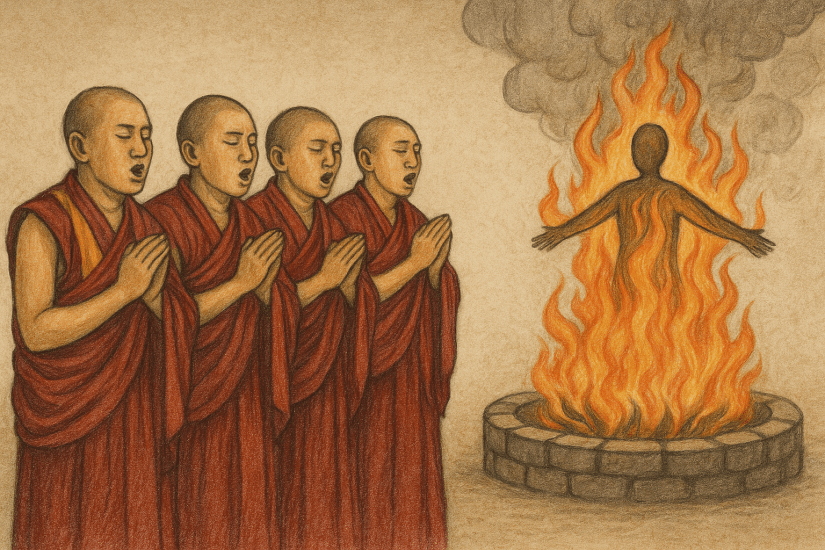
Here the Great Fifth is not apologizing for violence; he is codifying it. FitzHerbert explains that the Dalai Lama invokes a moral category known as the ten fields of liberation (sgrol ba’i zhing bcu), a rubric for identifying the kinds of people whose killing can be ritually justified in tantric Buddhism.³ These include those who “cause harm to the Buddhist religion,” “bring dishonour to the Three Jewels,” “endanger the life of the guru,” “slander the Mahāyāna,” “sow discord among the vajra community,” “prevent others from attaining siddhi,” or “pervert views concerning karma and its retribution.”⁴

In other words, violence against the enemies of the dharma was not merely tolerated; it was systematized. The moral categories of Buddhist tantra aligned precisely with the ideological boundaries of religious loyalty. To kill an “enemy of the faith” was to enact liberation through wrathful compassion, a punitive act performed in the name of spiritual duty. In this context, the term liberation does not refer to enlightenment but serves as tantric code for killing.

The crucial question, then, is this: who decides who counts as an enemy of the dharma? It is the guru, a figure endowed with godlike authority, who makes that determination and authorizes the strike, much as a mafia boss sanctions a hit within his own organization.

Such ideas did not remain abstract. As FitzHerbert shows elsewhere, the Dalai Lama’s government ritualized the deployment of these doctrines in warfare and political suppression.⁵ What we see in these passages is the theological backbone of that policy: a cosmological logic that made violence both righteous and karmically justified.


When the “Fields of Liberation” Become Personal

The ethical implications of this doctrine extend far beyond the seventeenth century. Its structure, dividing the world between defenders and destroyers of the dharma, still echoes in the tantric imagination today. Within closed guru/disciple networks, where authority is absolute and ritual power is personalized, this logic can turn inwards toward vulnerable disciples.

When a teacher is accused of abuse–sexual, financial, or psychological–some may interpret criticism of that teacher as slander of the Mahāyāna or harm to the guru, two of the very offenses listed in the ten fields of liberation. Under this view, the accuser becomes a threat to the vajra community itself. The rhetoric of “vajra hell,” karmic downfall, or spiritual ruin can be mobilized as a form of punishment.

Even when no public or obvious ritual of destruction is performed, the doctrinal framework legitimizing wrathful retribution remains intact and the teacher may privately extract revenge. A teacher who sees himself as an accomplished tantric adept may claim to act from “enlightened wrath.” Certainly he convinces himself that is the case. He may claim his retribution is not from malice but from a compassion that destroys obscurations and seeks to protect his community from dissenters. In this way, spiritual authority can blur into coercion, and the old metaphysics of tantric punishment can be redeployed against dissenting students.

Thus, the problem is not simply historical. It lies in a theological grammar that still allows destructive acts to be reframed as enlightened means. When criticism is recast as “slander of the dharma,” and when the guru’s person is identified with the deity itself, retaliation can be justified as upholding the sacred order.

Facing the Doctrine Honestly

When Western seekers encounter Tibetan Buddhism, we are often presented with an image of serene compassion, untainted by coercion or cruelty. Yet the Fifth Dalai Lama himself dismantles that illusion. He writes without hesitation that violent tantric rites are legitimate instruments of enlightened rule. The “theatre state” of seventeenth-century Tibet was the political expression of doctrines like the ten fields of liberation.

If the tradition is to be understood honestly, these passages should be part of an open and very public conversation. The Fifth Dalai Lama’s own words make clear that within tantric ethics, destruction is allowed, and killing can be framed as an act of perverted compassion. The challenge for modern practitioners and scholars alike is to recognize how this same moral architecture can exist whenever authority claims transcendence from accountability.


Footnotes

  1. Solomon G. FitzHerbert, “The Fifth Dalai Lama and the Tantric Politics of State Formation in Seventeenth-Century Tibet,” Arts Asiatiques 27 (2018): 88.
  2. Ibid.
  3. Ibid., 89.
  4. Ibid.
  5. Ibid., 74–83.

Tantric Deception: Black Magic and Power in Tibetan Buddhism


I am amazed that the PR for Tibetan Buddhism in the West managed for so long to conceal the extent of black magic practiced by lamas in Tibet historically and even to the present day. This concealment, aided and abetted by the squeamishness and obliviousness of some scholars, has to stop. In the dharma centers I was involved in, anything dark in Tibetan lore was relegated to the Bön religion, and the implication was that once Buddhism took hold in Tibet, any kind of evil acts such as harming or killing sentient beings was completely off the table. The truth is that black magic is in the lexicon of the highest lamas in the lineage as well as ngakpas and others. I believe these techniques are used liberally and current scholarship is finally exposing it.

Solomon G. FitzHerbert’s study of the mid-seventeenth century makes the core point plainly. I came across FitzHerbert’s article via a post on Adele Tomlin’s website www.dakinitranslations.com. He argues that tantric ritual and the rhetoric of ritual violence were central to how the Ganden Phodrang state established and legitimated power, not a peripheral curiosity. He writes that Tibetan sources “more than compensate” for the lack of hard military data with abundant materials about the “legitimation and maintenance of authority” through ritual technologies and narratives.¹

Before the rise of the Fifth Dalai Lama, Tibet’s Tsang rulers were already forging political alliances through tantric warfare. FitzHerbert shows that the Tsang kings deliberately patronized lamas famed for their mastery of wrathful and repelling rites. The most favored were the hierarchs of the Karma Kagyu, the “black hat” Karmapa and the “red hat” Zhamarpa, along with the Jonang scholar Taranatha, who was also enjoined to perform repelling rituals on behalf of his patrons.² Their alliances were explicitly religious and martial: an “ecumenical alliance in the name of defending religion and Tibet from foreign armies.”³

Among the Tsang rulers’ most celebrated ritual specialists was the Nyingma master Sokdokpa Lodrö Gyeltsen (1552–1624), self-styled “Repeller of Mongols.”⁴ A disciple of Zhikpo Lingpa, Sokdokpa was the main heir to the revealed cycle Twenty-Five Ways of Repelling Armies (Dmag zlog nyi shu rtsa lnga).⁵ His Mongol-repelling rites were widely famed, and he worked directly with the Tsang ruler Phuntsok Namgyel. One elaborate rite performed in 1605 to coincide with a Tsang military offensive involved producing “some 150,000 paper effigies of enemy soldiers.”⁶ These were ritually destroyed to annihilate the opposing force, with Bonpo specialists also enlisted for their expertise in magical harm.⁷

According to FitzHerbert, Phüntsok Namgyel successfully forged a broad anti-Geluk alliance using tantric technologies of protection and destruction.⁸ After his death, “reputedly at the hands of offensive magic being hurled at him by the Zhabsdrung Ngag dbang rnam rgyal (1594–1651), founder of the state of Bhutan,”⁹ his son Karma Tenkyong (1604–1642) inherited a weakened position. The Shabdrung’s tantric assault, still treated in Bhutanese and Tibetan sources as a historical fact, thus became the legendary moment when a ruler famed for weaponizing ritual power was himself undone by it. It is one of the rare episodes where the logic of esoteric warfare entered the realm of accepted political history.

This is where the Fifth Dalai Lama comes into focus. FitzHerbert shows that in the 17th century the Great Fifth cultivated and systematized an official repertoire of destructive and protective rites in service of government aims. In his words, the Dalai Lama showed a “lifelong concern with learning, authoring and instituting an armory of defensive and offensive rituals for the mobilization of unseen forces” for the state.¹⁰ That program contributed to the Ganden Phodrang’s reputation for “magical power,” and helped stage what FitzHerbert calls the grandest “theatre state” in Tibetan Buddhist history.¹¹

FitzHerbert details three overlapping strategies. First, the new government suppressed, marginalized, or co-opted rival traditions of war magic associated with other schools, including Karma Kagyu and strands within Nyingma, while appropriating selective cycles that could be redeployed under Geluk authority.¹² Second, it rebuilt Nyingma institutions such as Dorjé Drak and Mindröling under Ganden Phodrang patronage, folding their esoteric prestige into the state project.¹³ Third, it sponsored new state rituals based on the Dalai Lama’s own visionary experiences, further centralizing ritual power in Lhasa.¹⁴

The rhetoric was not merely devotional. Lamas and ritual specialists acted as “bodyguards” whose professional task was destructive magic on behalf of patrons.¹⁵ Chroniclers attributed battlefield outcomes to the rites of powerful tantrikas. FitzHerbert highlights Chökyi Drakpa, famed for the Yamantaka cycle known as the “Ultra-Repelling Fiery Razor,” which centered on rites of “protecting, repelling and killing.”¹⁶ In one report, after deploying these rites against a Tümed encampment, “nothing was left behind but a name.”¹⁷

To grasp how such violence could be framed as meritorious, FitzHerbert shows the tantric logic that recasts killing as an enlightened “action” when performed by an empowered adept. The adept receives empowerment, performs extensive propitiation to forge identification with the deity, and then “incite[s]” and “dispatch[es]” oath-bound spirits to defend the dharma. By manipulating the five elements and the “public non-reality” of appearances, the practitioner can pacify, increase, control, or destroy, including against human enemies.¹⁸ The moral frame is clear in the sources he cites and translates. Killing is made licit because it is tantric, ritually purified and redirected as enlightened activity.¹⁹

FitzHerbert also situates Tibetan practices within a longer Indo-Buddhist lineage of war magic. He surveys Indian materials that speak of sainyastambha or army-repelling rites, and notes that the Hevajra states that “black magic for paralyzing armies,” is part of its “manifold purpose” and that the Kālacakra includes descriptions of war machines and siege methods such as “catapults, traps, siege towers, and so on,” alongside esoteric harm and protection.²⁰ He further notes the use of human effigies and effigy destruction in offensive rites against enemies, a hallmark of Tibetan ritual repertoires that drew on wider South Asian and even Indo-European precedents.²¹

Western idealization of Tibetan Buddhism has depended on ignoring this record. The lamas who administered and celebrated these rites were not outliers. They were the architects of a political order that fused charisma, ritual terror, and doctrinal justifications into a program of power. State-sponsored ritual violence was normalized in chronicles and hagiographies as enlightened means. The fact pattern is no longer obscure. It is all in the sources, and FitzHerbert has laid them out.

Although FitzHerbert’s focus is on state-sponsored ritual violence, similar technologies of harm have long been used by individual lamas against perceived enemies including, at times, their own disciples. The anthropologist Geoffrey Samuel has noted that the ritual power claimed by tantric masters can be turned inward, weaponizing spiritual authority to punish dissent or enforce obedience.²² In one well-documented episode from the nineteenth century, the treasure-revealer (tertön) Dorje Lingpa was said to have struck down a rival practitioner through wrathful ritual means, his death interpreted locally as a karmic consequence of opposing the lama’s command.²³ Such stories attest to a cultural logic in which ritual, psychic, or physical violence by enlightened masters could be valorized as the just expression of awakened power. I have personally been a victim of this deluded violent ritual power by Tibetan masters.

If Tibetan Buddhism is to be understood honestly outside Tibet, this history needs to be taught in dharma centers and discussed in scholarship without euphemism. The tradition’s own categories allow for destructive ritual and sanctified killing under certain conditions. Pretending otherwise does not protect the innocent devotees who arrive at dharma centers with open hearts seeking methods for developing compassion and loving kindness in service of enlightenment. Indeed, one must ask what kind of enlightenment tradition could allow, even glorify such violence.


Notes

  1. FitzHerbert, Rituals as War Propaganda, 91. FitzHerbert, Solomon G. “Rituals as War Propaganda in the Establishment of the Tibetan Ganden Phodrang State in the Mid-17th Century.” Cahiers d’Extrême-Asie 27 (2018): 49–119.
    https://www.persee.fr/doc/asie_0766-1177_2018_num_27_1_1508
  2. Ibid., 95–96.
  3. Ibid., 95.
  4. Ibid., 96.
  5. Ibid., 96.
  6. Ibid., 97.
  7. Ibid., 97.
  8. Ibid., 101.
  9. Ibid., 102–103.
  10. Ibid., 94.
  11. Ibid., 95.
  12. Ibid., 96.
  13. Ibid., 97.
  14. Ibid., 98.
  15. Ibid., 93.
  16. Ibid., 100.
  17. Ibid., 101.
  18. Ibid., 71.
  19. Ibid., 72.
  20. Ibid., 98–99.
  21. Ibid., 99.
  22. Geoffrey Samuel, Civilized Shamans: Buddhism in Tibetan Societies (Washington: Smithsonian Institution Press, 1993), pp. 429–432.
  23. Cathy Cantwell and Robert Mayer, “Representations of wrathful deities in treasure literature,” in Tantric Revisionings: New Understandings of Tibetan Buddhism and Indian Religion (Leiden: Brill, 2008), pp. 131–133.


The Squeamishness of Scholarship: Cameron Bailey’s Critique of Sam van Schaik’s book on Buddhist Magic


Sam van Schaik’s Buddhist Magic: Divination, Healing, and Enchantment through the Ages (2020) attends to the often-overlooked domain of spells, incantations, divination, healing rituals, and what one might call “magic” in Buddhist traditions. The book offers, among other things, a translation of a Tibetan spell-book from the Dunhuang corpus and situates it in a broad historical trajectory of Buddhist ritual technologies. Yet in his 2021 review for H-Net, Cameron Bailey argues that the book suffers from significant omissions, conceptual limitations, and a subtle apologetic tone toward the more aggressive, violent, and transgressive forms of magic found in tantric Buddhism.¹ Bailey suggests that this tone is not simply stylistic but stems from deeper disciplinary biases about what “real” Buddhism is and what kinds of ritual power are acceptable to the scholarly gaze.

For readers of Tantric Deception, which is concerned with hidden ritual power, subversive techniques, and coercive practices in the “shadow” side of tantra, Bailey’s critique is especially pertinent. The benign, therapeutic, protective aspects of magic are only half the story; the aggressive, destructive, boundary-breaking elements are equally constitutive. Here the critique unfolds on three levels: (1) Bailey’s reading of Chapter 3 of van Schaik’s book (on the Ba ri be’u ’bum); (2) his broader objections to how van Schaik defines “magic” and frames the field; and (3) implications for the study of tantric magic and deception.

Bailey’s Critique of Chapter 3: “A Tibetan Book of Spells”

Bailey looks at Chapter 3, which discusses the Tibetan spell-book known as the Ba ri be’u ’bum, compiled by Ba ri Lotsāwa in the eleventh century.² Van Schaik concludes the chapter by pointing to the presence of violent magical ritual, what might be called “black magic,” in Buddhist spell-books and tantric scriptures such as the Vajrabhairava Tantra

Bailey’s critique is threefold:

  1. Understatement of prevalence. Van Schaik, he argues, seriously understates how widespread aggressive or destructive ritual practices are in tantric sources: “He could also have discussed the army-repelling magic in the Hevajra Tantra, the legendary violent magical exploits of the great tantric sorcerer Rwa Lotsāwa, or Nyingma Mahayoga scriptures, which are often positively brimming with black magic.”⁴
  2. Authorial discomfort. Bailey detects an obvious unease with “aggressive” magic and with rituals that use human remains as ingredients, suggesting van Schaik takes an apologetic tone when discussing them.⁵
  3. Scholarly bias. He links this tone to the longstanding tendency of Buddhist studies to privilege an idealized, pacifist Buddhism: “This kind of squeamishness … unconsciously replicates the biases of past generations of Buddhist scholars …. It is ultimately an artifact of Western observers thinking they know more about what should constitute normative Buddhism than their sources do …”⁶

For Bailey, this is not simply an omission but a rhetorical framing that soft-pedals the destructive dimensions of tantric magic.

Defining “Magic”: Bailey’s Broader Critique

Bailey extends his criticism to van Schaik’s opening chapters, where the author defines his working category of “Buddhist magic.” Van Schaik adopts a “family-resemblance” approach, noting that no direct equivalent of the Western word magic exists in Sanskrit or Tibetan.⁷ He describes magical practices as “focused on worldly ends, including healing, protection, divination, manipulation of emotions, and sometimes killing. The effects of these techniques are either immediate or come into effect in a defined, short-term period. The techniques themselves are usually brief, with clear instructions that do not need much interpretation, and are gathered together in books of spells.”⁸

Bailey objects that this framing:

  • Over-narrows the field by confining magic to short-term, worldly ends, thereby excluding tantric practices that are long, soteriological, and embedded in complex ritual technologies.⁹
  • Privileges text and literacy, focusing on manuals and specialists while sidelining oral, embodied, and popular forms of practice.¹⁰
  • Sanitizes the topic by foregrounding healing and protection while downplaying cursing, corpse-magic, and enemy destruction.¹¹

He concludes: “The way he defines and explains ‘magic,’ and describes how magical practices have traditionally been used by Buddhists across Asia, ends up inadvertently reinforcing many of the historical scholarly prejudices against magic that he ostensibly is trying to correct.”¹²

Van Schaik’s framework thus risks reproducing the very boundaries it seeks to challenge.

A Wider Blind Spot: Aggressive Magic and the Tantric World

Bailey argues that van Schaik should have engaged more fully with texts such as the Hevajra Tantra (with its army-repelling spells), the violent exploits of Rwa Lotsāwa, and the Nyingma Mahayoga scriptures filled with wrathful deities, corpse-magic, and enemy-destruction rites.¹³ By not doing so, or by treating such material as peripheral, van Schaik, he claims, sanitizes Tibetan Buddhism. “Van Schaik displays an obvious discomfort with the presence of ‘aggressive’ magic … and takes an apologetic tone when discussing them.”¹⁴

For scholars of tantra, this omission matters because tantric systems operate through extremes such as creation and annihilation, compassion and wrath, life-force and death. To highlight only healing and protection produces a partial picture of ritual power, one aligned with modern therapeutic Buddhism but detached from the coercive, political, and martial realities of historical tantric practice.

Bailey notes that while van Schaik does acknowledge violent spells (for example, in the Dunhuang materials), he does not trace how these recur and become canonical in later tantric systems.¹⁵ The result is a book that opens the field but keeps its most provocative elements at the margins.

Implications for the Study of Tantric Magic and Deception

Bailey’s critique has clear implications for the study of tantric ritual power:

  • Broaden the definition of magic. Magic in Buddhist contexts is not confined to short spells. It includes deity-yoga, state-sponsored rituals, corpse-assemblage, body technologies, and institutions of ritual power.
  • Recognize multiple aims. Magic serves soteriological as well as worldly purposes such awakening, subjugation, and mediation between spirits and humans.
  • Acknowledge popular practice. Lay and non-monastic forms of magic interpenetrate elite traditions. Focusing solely on literate specialists truncates the field.¹⁶

Examining the Aggressive and Transgressive

To understand tantric magic fully, scholarship must confront its aggressive, destructive, and taboo aspects such as spells to kill or incapacitate, invocations of wrathful deities, rituals using human remains, and forms of mystical violence justified through tantric cosmology. When these are treated as aberrations, the study of tantric sovereignty, ethics, and power becomes impoverished.

Deception, Hidden Power, and Normativity

Bailey’s review also raises a methodological issue: the scholar’s discomfort can itself become a form of concealment. Reluctance to confront violent or transgressive material filters what is studied and what remains hidden. Bailey argues that van Schaik’s apologetic tone mirrors earlier generations of scholarship that preferred a morally “respectable” Buddhism.¹⁷

For research into deception, secrecy, and power in tantra, this is crucial. Reflexivity is required: how much of what we present as Buddhism is sanitized by our own unease with its violent, ambiguous realities?

Conclusion

Cameron Bailey’s critique of Buddhist Magic is more than a review. It is a reminder that scholarly framing shapes what becomes visible and what remains unseen in the study of ritual power. Van Schaik’s work makes an important contribution by bringing spells and enchantments to the center of Buddhist studies. Yet, as Bailey insists, by downplaying the aggressive and coercive sides of tantric magic, it perpetuates a pacified image of [Tibetan] Buddhism.

For those exploring tantra, deception, and hidden power, the shadow side of magic demands attention. Spells of domination and annihilation, corpse-magic, and state-sorcery are part of the story. Scholarly discomfort cannot determine what counts as legitimate tantric Buddhism. True understanding must include the violent and transgressive alongside the healing and protective.

Van Schaik opened the door; Bailey challenges us to step through. In tantra, concealment is not accidental, it is a method and a weapon. So too must scholarship have the courage to unmask it.


Notes

  1. Cameron Bailey, “Review of Sam van Schaik, Buddhist Magic: Divination, Healing, and Enchantment through the Ages,” H-Buddhism (H-Net Reviews), July 2021. https://www.h-net.org/reviews/showrev.php?id=56639.
  2. Ibid.
  3. Ibid.
  4. Ibid., p. 3.
  5. Ibid.
  6. Ibid., p. 4.
  7. Van Schaik, Buddhist Magic: Divination, Healing, and Enchantment through the Ages (Boulder: Shambhala Publications, 2020), pp. 6–8; Bailey, review.
  8. Quoted in “Think Again Before You Dismiss Magic,” Lions Roar, April 2020.
  9. Bailey, review, p. 3.
  10. Ibid.
  11. Ibid.
  12. Ibid., p. 2.
  13. Ibid., p. 3.
  14. Ibid.
  15. Ibid.
  16. Ibid.
  17. Ibid., p. 4.

References

Bailey, Cameron. “Review of Sam van Schaik, Buddhist Magic: Divination, Healing, and Enchantment through the Ages.” H-Buddhism (H-Net Reviews), 2021. https://www.h-net.org/reviews/showrev.php?id=56639.
Van Schaik, Sam. Buddhist Magic: Divination, Healing, and Enchantment through the Ages. Boulder: Shambhala Publications, 2020.
“Think Again Before You Dismiss Magic.” Lions Roar, April 2020.

The “Civilized” Shaman: Geoffrey Samuel and the Tension at the Heart of the Tibetan Religion


In Civilized Shamans: Buddhism in Tibetan Societies, Geoffrey Samuel offers a sweeping anthropology of Tibetan religion that refuses to take Tibetan Buddhism at face value. He finds a living tradition shaped by older and more unruly forces beneath the polished scholastic surface of the monasteries. What emerges is a civilization of monks and magicians, of disciplined philosophers and ecstatic ritualists. His argument is simple but radical: Tibetan Buddhism is the result of Indian Buddhist ethics and philosophy meeting the shamanic substratum of the high plateau.¹

Two orientations: clerical and shamanic

Samuel organizes Tibetan religion around two poles. The first, the clerical or monastic orientation, descends from Indian Buddhism with its monasteries, ethical codes, and scholastic systems of thought. It values restraint, karmic causality, and the gradual cultivation of enlightenment. The second, the shamanic orientation, grows from indigenous Tibetan practices centered on ritual efficacy, spirit interaction, and the manipulation of unseen forces. This orientation values power (dbang) more than purity and treats ritual specialists not as moral exemplars but as technicians of spiritual power.²

These two strands were never simply reconciled. Tibetan civilization attempted to domesticate the shaman. The ecstatic healer and spirit-fighter was refashioned into a lama, wrapped in robes and scriptures yet still capable of commanding spirits, averting misfortune, or destroying an enemy through ritual means. The civilized shaman is not a metaphor. It is a social type, the institutionalized magician of a literate Buddhist society.³

Dark rituals and the question of subjugation

The most uncomfortable continuity between these worlds lies in the domain of ritual violence, what Tibetan sources call drag-po or wrathful rites. These practices are directed not toward enlightenment but toward control: the binding, subduing, or annihilation of obstructing forces, whether demonic, psychic, or human.⁴

Samuel interprets these rites not as moral aberrations but as necessary expressions of the shamanic orientation within a Buddhist frame. Indian Buddhism had long flirted with magical power but kept it at the margins of monastic life. In Tibet, ritual mastery became central. The same lama who taught compassion might also perform a subjugation rite, using effigies, mantras, and visualizations of wrathful deities to annihilate obstacles, whether spiritual or human. Such practices, found in the Nyingma and Kagyu tantric cycles and institutionalized in monastic ritual manuals, embody a logic foreign to classical Indian soteriology yet native to shamanic cosmology, the idea that power must be met with power.⁵

What makes these rites “civilized” is not their ethical domestication but their integration into a bureaucratic religion. The Tibetan monastery became a regulated arena for managing violence and transforming it into ritual performance. The monastic code that forbade killing also licensed symbolic destruction: paper effigies burned, dough figures pierced, and demons tamed through mantras.⁶ This was how a society of monks could still believe in, and even engage in, acts of ritual aggression.

Power and legitimacy

Samuel’s analysis is more about social structure than theology. The clerical orientation secured legitimacy through moral authority and learning, while the shamanic orientation maintained relevance through immediate and pragmatic results. The former built monasteries; the latter kept communities going amid famine, disease, and invasion. Tibetan Buddhism’s durability, he argues, comes from this uneasy synthesis. The scholar-monk and the ritual adept needed each other: the first to lend doctrine and order, the second to command the spirits that haunted every valley and household.⁷

In this light, the dark rituals of subjugation are not aberrations but instruments of governance. They discipline the chaotic powers of the landscape just as the monastery disciplines the passions of the mind. To them, the wrathful deity is not a contradiction of compassion but its shadow: compassion armed.

Rethinking the “Buddhist” in Tibetan Buddhism

Samuel’s greatest contribution may be to unsettle what we think “Buddhist” means. By treating Tibetan religion as a field of interacting orientations rather than a single orthodoxy, he exposes the limits of modern, idealized Buddhism. The vision of Tibet as a purely pacific, philosophical culture depends on forgetting the tantric rites that promise to destroy human enemies or subjugate spirits.⁸ Samuel does not moralize about this tension; he historicizes it. The so-called civilized shaman is a figure born of necessity, mediating between an imported moral system and an indigenous world of volatile gods.⁹

A note on tantra as the mediating field

Samuel does not treat Hindu tantra as a third, independent strand within Tibetan Buddhism. Rather, he presents tantric practice as the meeting ground of the clerical and shamanic orientations. By the time tantra reached Tibet, Indian Buddhism had already absorbed many Śaiva and Śākta elements. What Tibet inherited, therefore, was a fully developed tantric Buddhism rather than a simple blend of Buddhist and Hindu ideas. In Samuel’s account, tantra provided the channel through which shamanic power could operate within a clerical framework. It was the mechanism that allowed ecstatic and ritual techniques to coexist with the disciplines of monastic scholarship.

He also describes tantric Buddhism in Tibet as a two-way exchange. The imported Indian systems of Hevajra, Guhyasamāja, Cakrasaṃvara, and others were reinterpreted through local cosmologies of mountain gods, territorial spirits, and ancestral deities. The result was what he calls “tantricized shamanism” or “shamanized Buddhism.” While Hindu tantra was one historical source, the Tibetan tantric complex became a hybrid formation that expressed shamanic cosmology through Buddhist doctrine.¹⁰

The afterlife of the civilized shaman

Civilized Shamans was published in 1993, before the wave of globalized Tibetan Buddhism tried to reframe lamas as psychologists or humanitarians. Yet its insight remains vital. Beneath every system of enlightenment lies a system of control. The Tibetan synthesis worked precisely because it did not abolish the shamanic element. It incorporated it, turning ecstatic violence into liturgy and spirit warfare into cosmology.¹¹

For those interested in understanding tantric practice, especially the darker currents of subjugation and protection, Samuel’s anthropology is a cautionary mirror. It reminds us that ritual power is never purely symbolic. Even when intellectualized, it retains the logic of coercion: to bind, to summon, to annihilate. Tibet’s civilization was built on mastering such forces. The tension Samuel describes is not an accident of history but a model of how Tibetan religion evolved. Civilized shamans appear wherever doctrine meets magic, wherever ethics must coexist with power. Tibet made that paradox explicit.¹²


Notes

  1. Geoffrey Samuel, Civilized Shamans: Buddhism in Tibetan Societies (Washington, D.C.: Smithsonian Institution Press, 1993), 11–13.
  2. Samuel, Civilized Shamans, 11–12, 134–136.
  3. Ibid., 478–480.
  4. Ibid., 238–240.
  5. Ibid., 259–262.
  6. Ibid., 468–471.
  7. Ibid., 465–469.
  8. Ibid., 244–246, 478.
  9. Ibid., 479–482.
  10. Ibid., 66–74, 242–243, 476–478, 480–481.
  11. Ibid., 476–479.
  12. Ibid., 481–482.

How So-Called “Buddhist” Dhāraṇīs, Images and Mandalas Were Developed Post Buddha


I spent years as a Tibetan tantric Buddhist practitioner. I once assumed the mantra, ritual, and mandala machinery I practiced was simply the Buddha’s own teaching passed down intact. We were taught that although the historical Buddha did not teach tantra in person, he taught it after his passing, on Mount Malaya, to gods and men. Koichi Shinohara’s work forces a different view and poses the question: Did Sakyamuni really teach the long formulaic dhāraṇīs, image worship, and mandala visualization as later practitioners used them? Or did later communities invent those ritual technologies and then cloak them in the Buddha’s authority so people would better accept them?

In Spells, Images, and Maṇḍalas: Tracing the Evolution of Esoteric Buddhist Rituals, Shinohara gives us a working hypothesis that can be pressed hard for answers.[1] The rituals in question are most plausibly later innovations that used the Buddha’s prestige to become authoritative. They were not the Buddha’s core teachings in any strictly historical sense. That does not make them illegitimate as religious forms for people who practice them today. It does mean historians and critics should stop pretending these rituals are reflections of Sakyamuni’s own instructions. The burden of proof rests on anyone who wants to show unbroken doctrinal transmission from the Buddha to the later esoteric ritual machinery.

Shinohara offers a testable, evidence-driven reconstruction. He traces a plausible sequence from simple spoken spells through image ritual to organized visualization. Crucially, he foregrounds early, datable Chinese dhāraṇī collections and ritual manuals. Those Chinese witnesses often predate the surviving Sanskrit and Tibetan corpora scholars have relied on. That chronological fact is the hinge of the whole argument. (Columbia University Press)

What Shinohara’s working hypothesis means

A working hypothesis is provisional and falsifiable. Shinohara is not issuing an ideological verdict. He is proposing a historical explanation that organizes the evidence and makes concrete predictions that could be falsified by earlier, securely dated Indian or canonical texts showing the full ritual machinery already present in the Buddha’s time. To press the hypothesis hard, scholars should look for those disconfirming witnesses. So far the datable documentary and manuscript evidence he emphasizes points toward post-Buddha innovation that relied on attribution to the Buddha for legitimacy.

The core empirical point

Early Buddhism included ritual speech. The Pali paritta corpus shows that communal protective chants and recitations were an early feature of Buddhist practice. Importantly, these early chants are directed primarily to the historical Buddha and the Triple Gem, the Buddha, the Dhamma, and the Saṅgha, rather than to the later, expanded pantheon of cosmic buddhas and bodhisattvas that appear in Mahāyāna and tantric literature. By contrast, the long, formulaic dhāraṇīs with non-lexical syllables, their ritual manuals, and the tightly scripted mandala visualizations appear in the surviving record mainly in later sources, often first in Chinese translations and compilations dated to the fourth through eighth centuries. That pattern strongly suggests the later technical dhāraṇī and mandala apparatus developed after the historical Buddha and used his name as an authority seal rather than being his literal, unbroken teaching (see Ratana Sutta and the paritta collections; Access to Insight).

Pali paritta versus three representative dhāraṇīs

Below is one short Pali paritta example and three representative dhāraṇī excerpts that have early Chinese witnesses. For each dhāraṇī there is a short literal transliteration excerpt, the earliest datable Chinese witness, and why this matters for Shinohara’s thesis.

A note about transliteration and length. Full dhāraṇī texts can be very long and use non-lexical syllables. I quote short, clearly identifiable openings or kernel sequences and give citations to the editions or translations where you can read the full texts.

A. Pali paritta exemplar (short protective chant from the Buddha’s time)

  • Text (Pali, introductory formula used in paritta recitation):
    Namo tassa bhagavato arahato sammāsambuddhassa.
    Translation: “Homage to the Blessed One, the Worthy One, the Fully and Exactly Awakened One.”
    Dating and context: part of the Ratana Sutta and the paritta repertoire attested in the earliest Pali strata and used continuously in Theravada protective ritual. These are short, lexically meaningful formulas employed in communal contexts. (Access to Insight)

This matters because paritta recitation shows early Buddhists used spoken protective formulas directed to the Buddha and the Triple Gem. That continuity leaves an opening for later mantra culture to develop, but continuity alone does not prove that the later technical dhāraṇīs were the Buddha’s teaching.


B. Uṣṇīṣavijayā dhāraṇī: short transliteration excerpt and dating

  • Transliteration excerpt (IAST style, short kernel):
    oṃ aḥ hūṃ uṣṇīṣa vijaya svāh. Translation: “Om. Ah. Hum. Victory to the Ushnisha. Svāhā.” Note: full versions are much longer and include complex Siddhaṃ syllables. The line above is a short recognizable kernel rather than the entire dhāraṇī.
  • Earliest datable witness: multiple Tang dynasty Chinese translations; primary translations appear in the late seventh century and the text circulated widely in Tang China thereafter. Several ritual manuals for this dhāraṇī were also translated into Chinese. (84000)

This is important because Uṣṇīṣavijayā is a canonical example of a dhāraṇī that crystallized as a ritual unit in China by the seventh century. Its early and repeated Chinese attestations show how the formulaic dhāraṇī corpus became standardized in East Asia, a datum that supports Shinohara’s emphasis on Chinese witnesses. (84000)


C. Nīlakaṇṭha / Great Compassion dhāraṇī: short transliteration excerpt and dating

  • Transliteration excerpt (short recognizable opening):
    Namo ratna trayāya … oṃ namaḥ parāya svāhā. Translation: “Homage to the Three Jewels… Om. I bow to the Supreme. Svāhā.”
    Again, the dhāraṇī in practice is very long; this is a short illustrative kernel.
  • Earliest datable witness: Bhagavaddharma’s Chinese transliteration of the Thousand-armed Avalokiteśvara dhāraṇī is commonly dated to ca. 650–661 CE at Khotan, and Dunhuang manuscript copies are attested from the eighth century onward. The standard East Asian version is listed in Taishō as T.1060. (Wikipedia)

This matters because the Great Compassion dhāraṇī’s early Chinese and Central Asian circulation shows the mobility of formulaic spells across cultural borders and their crystallization in Chinese textual layers before the later Tibetan tantra apparatus matured. That pattern again undercuts a simple claim of unbroken oral descent from the historical Buddha.


D. The Dhāraṇī of the Six Gates: transliteration indicator and dating

  • Short indicator: the sutra opens with formulaic addresses and contains six gate dhāraṇī sequences; full transliteration is available in modern critical editions. The Chinese translation by Xuanzang is dated to 645 CE (Taishō 1360). (84000)

This matters because Xuanzang’s mid-seventh century translation gives a secure terminus ante quem for certain dhāraṇī forms in East Asia. The existence of such dated translations is exactly the kind of evidence Shinohara places in the foreground when reconstructing the genealogy of ritual techniques. (84000)

Short methodological point about dates and what they prove

When a long formulaic dhāraṇī and a ritual manual appear in a secure, dated Chinese translation in the seventh century but not in any securely dated Indian source from the centuries immediately after the Buddha, the safest historical inference is that the particular ritual form crystallized later and that Chinese transmission played a major role in its textual preservation and standardization. That does not prove the practice first originated in China. It does show that the textual and ritual machinery as preserved and circulated in East Asia is early and often predates surviving Sanskrit witnesses. Shinohara uses exactly this dating logic to show how spells, images, and visualization interrelate historically. (Columbia University Press)

Did the Buddha forbid images or deification of himself?

Canonical passages caution against attachment to the person of the teacher. A well known example is the Vakkali Sutta where the Buddha tells the sick Vakkali that seeing the Dhamma is what matters, not seeing his physical body: “One who sees the Dhamma sees me; one who sees me sees the Dhamma.” That admonition has been read as discouraging hero cult and literal deification. (SuttaCentral)

The archaeological and textual record complicates the claim that the Buddha formally forbade images. However, here is a settled scholarly debate about early “aniconism” in Buddhist art. Most scholars agree that standardized, large anthropomorphic Buddha images do not appear widely until several centuries after the historical Buddha’s death. Some specialists argue that early absence of the anthropomorphic image reflects doctrinally driven aniconism. Other specialists argue the evidence is better explained by devotional practice, material culture, and local circumstances rather than by a simple canonical ban. In short, canonical caution about attachment to persons exists, but practice evolved in ways that embraced images for devotional, pedagogical, and institutional reasons. (Wikipedia)

For the former practitioner who wants a practical takeaway

If you were taught that tantric rituals are from Sakyamuni’s own instructions, the historical picture is more complicated and poses big questions to that narrative. The very technical dhāraṇī machinery, image cults, and visualization systems that define much of later tantric practice have a historical biography. They emerge, consolidate, and professionalize in the centuries after the Buddha lived, and much of the documentary evidence that preserves them comes from dated Chinese compilations and Dunhuang manuscripts. That history changes how they should be presented when someone claims they were directly taught by the Buddha himself.

History cannot prove the metaphysical provenance of a ritual. Textual and manuscript research can show whether a practice dates to Sakyamuni’s lifetime or to later cultural development, but it cannot by itself settle whether a given visionary or ritual impulse is benign or malign. If you take the language of spiritual warfare seriously, that uncertainty argues for caution. Here are four practical questions to ask before you embrace a practice: Where does its chain of transmission point? Does it coherently line up with the ethical core of the Buddha’s teaching, such as nonharm, compassion, and right conduct? What fruits does it produce in practitioners’ lives, emotionally and morally? And how transparent are its teachers about origins and effects? If a practice fails those tests, step back and favor practices that visibly cultivate ethical integrity and mental clarity. For someone who has been inside the tantric world, this is not an abstract exercise. It is a matter of spiritual survival. Let historical honesty inform your discernment, and let the lived, ethical results of practice be the final arbiter.

Sources and Bibliography

[1] Koichi Shinohara. Spells, Images, and Maṇḍalas: Tracing the Evolution of Esoteric Buddhist Rituals. New York: Columbia University Press, 2014. xxii, 324 pp. ISBN 9780231166140. See especially Chapter 1, “The Three Ritual Scenarios” (pp. 1–28), the material on the Collected Dhāraṇī Sūtras and the All-Gathering ceremony (pp. 28–89), and the chapters on the introduction of visualization practice (pp. 89–160). Recommended exact pages to quote when discussing the three scenarios and Chinese-dated evidence: consult pp. 1–4, pp. 28–64, and pp. 89–118 for Shinohara’s core arguments and manuscript citations. (Columbia University Press)

Primary dhāraṇī witnesses and editions (quick references)

  • Dhāraṇīsaṃgraha, Taishō no. 901, translated by Atikūṭa in the Tang; contains collected dhāraṇī sūtras and an early mandala initiation ritual. See Taishō T.901 and catalog entry. (NTI Reader)
  • Uṣṇīṣavijayā Dhāraṇī. Multiple Tang Chinese translations; widely circulated from the late seventh century. See 84000 Reading Room entries explaining translation history. (84000)
  • Nīlakaṇṭha / Great Compassion Dhāraṇī. Bhagavaddharma’s Khotan transliteration dated ca. 650–661 CE; standard Taishō entry T.1060 and Dunhuang manuscripts attest its early East Asian circulation. (Wikipedia)
  • Dhāraṇī of the Six Gates. Chinese translation by Xuanzang dated 645 CE (Taishō 1360). See Xuanzang colophon and modern critical editions. (84000)

Pali and early canonical material (for paritta comparison)

  • Ratana Sutta, Sutta Nipāta 2.1. Standard Pali editions and translations; see SuttaCentral and Access to Insight translations for text and context. (Wikipedia)

Secondary literature and resources on dating, aniconism, and early ritual evidence

  • Scholarly debate on Buddhist aniconism and the delayed appearance of anthropomorphic Buddha images. See Susan L. Huntington, “Early Buddhist Art and the Theory of Aniconism” and subsequent debates summarized in surveys of early Buddhist art. (Buddhism Library)
  • Columbia University Press page for Shinohara’s book with contents and excerpt. (Columbia University Press)

Lin Kai’s: “Meanings of Violence in Tibetan Buddhism”


In his essay Meanings of Violence in Tibetan Buddhism, Lin Kai develops themes first raised by Elliot Sperling: Tibetan Buddhism has never been simply the peaceful, pacifist tradition imagined in Western romantic projections. Both history and ritual demonstrate how violence was woven into Tibetan religious and political life¹, continuing into the present. As Kai underscores, and as Sperling noted before him, both Western interpreters and Tibetan voices have often gone to great lengths to overlook or obscure this troubling facet of Tibetan Buddhism.

Kai highlights how rulers, including the Fifth Dalai Lama, relied on military force to consolidate power and punish rebellion. As Sperling documented, the Dalai Lama issued explicit orders in the seventeenth century to annihilate enemies, words that expose a stark contrast to the modern image of Tibet².

The Fifth Dalai Lama’s commands were phrased in brutal, almost ritualistic terms:

Make the children and grandchildren like eggs smashed against rocks;
Make the servants and followers like heaps of grass consumed by fire;
In short, annihilate any traces of them, even their names.²

This edict was aimed at other Tibetan Buddhists, mind you. Amidst such warfare, Kai notes, not all monks accepted this with ease. Some were unsettled by the amount of time and resources demanded for war rituals, though few dared openly resist their lamas. A particularly striking passage from the Fifth Dalai Lama’s autobiography shows him wrestling with his own position as a Buddhist leader at war. He recounts the following dream:

“Looking through an open window on the eastern side of the protector-chapel, stood the treasurer [Sonam Rabten] and a crowd of well-dressed monks with disapproving looks. Shoving the ritual dagger into my belt, I went outside. Thinking that if any of those monks said anything, I would strike him with the dagger, I walked resolutely straight through them. They all lowered their eyes and just stood there. When I awoke, my illness and impurities had been completely removed; not even the slightest bit remained. I was absolutely overflowing with amazement and faithful devotion.” — Fifth Dalai Lama¹

This moment captures the tension at the heart of Tibetan statecraft: the bodhisattva ideal of compassion colliding with the felt necessity of violence. Kai also emphasizes ritual violence, where wrathful deities and fierce imagery symbolize the annihilation of obstacles to enlightenment. These practices were not simply symbolic. They paralleled real political campaigns, where violent suppression against human beings was justified as protecting the Dharma¹.

Western audiences, however, have often distorted this history. Kai argues that Orientalist fantasies, especially those that cast Tibet as a timeless land of peace, obscure the record of blood and retribution¹. Sperling made the same point, noting how the Dalai Lama’s reputation as a Nobel Peace laureate stands in sharp tension with the historical evidence².

“Violence in Tibetan Buddhism cannot be neatly categorized as either barbaric or compassionate. It exists within a worldview where wrathful action and compassion may coincide, depending on context and intent.” —Lin Kai¹

In this worldview, compassion and violence were not opposites. Wrathful action could be seen as alright when it was thought to protect the Dharma or eliminate obstacles, even human ones. What emerges, then, is a very complicated and unsettling picture: violence was not an exception but an integral part of Tibetan Buddhist practice.

Kai’s work reinforces Sperling’s warning: if we want to understand Tibetan Buddhism as it is, rather than as we wish it to be, we must confront the ways in which violence was and still is sacralized within the tradition.

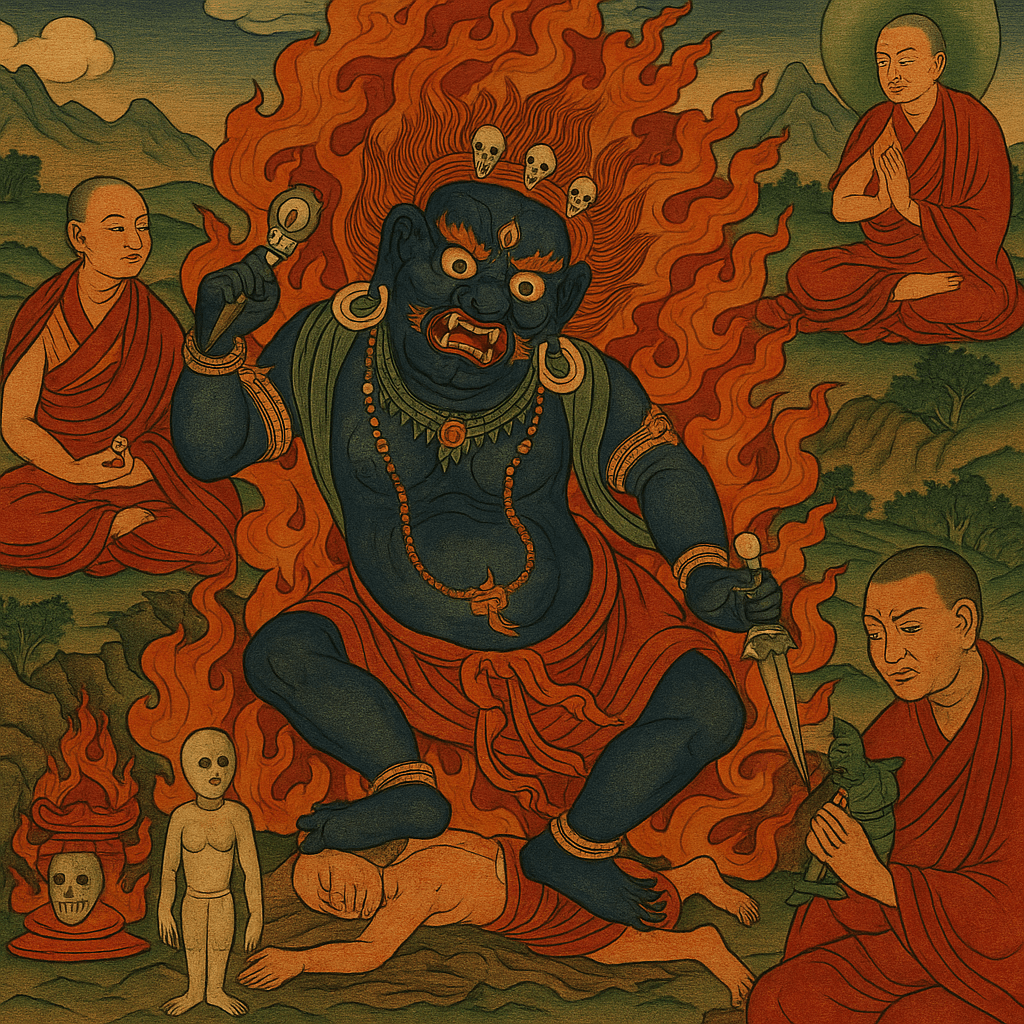
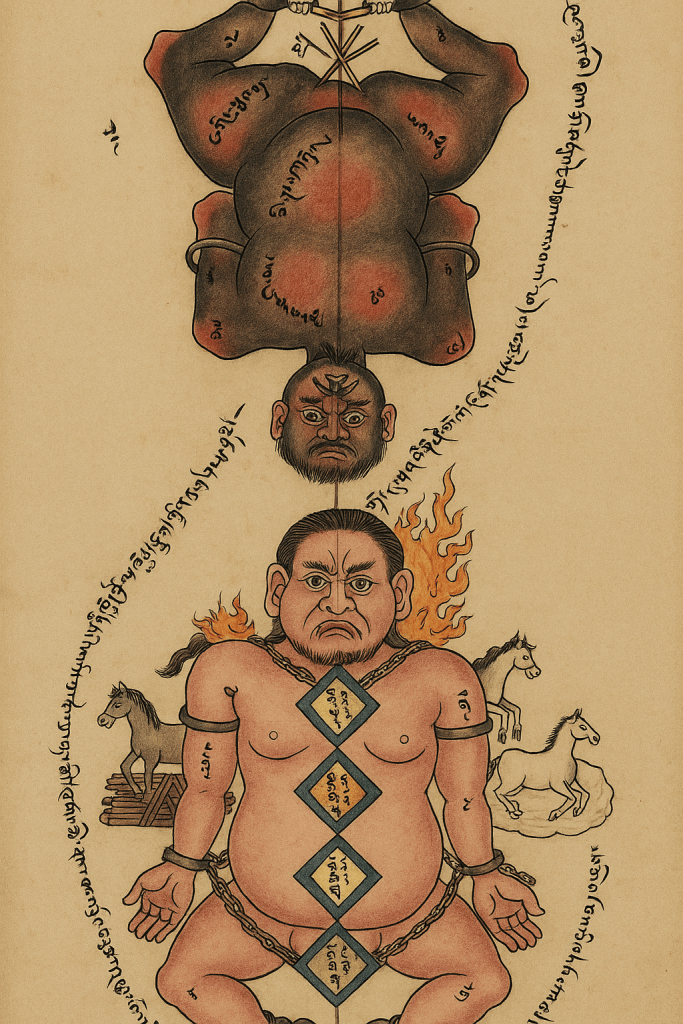
This type of linga resembles one depicted in the Secret Visions of the Fifth Dalai Lama, a visionary autobiography. It shows two figures to be ritually ‘liberated’ or killed, typical of effigies used in Tibetan Buddhist rites against so-called ‘enemies of the dharma.’ Such effigy sacrifices remain part of Tibetan Buddhist ritual practice today.


Footnotes

¹ Lin Kai, Meanings of Violence in Tibetan Buddhism, Substack, 2025.
² Elliot Sperling, Orientalism and Aspects of Violence in the Tibetan Tradition, Info-Buddhism, 2004.

Truth Behind the Myth: Violence in Tibetan Buddhism


In his article Orientalism and Aspects of Violence in the Tibetan Tradition, Elliot Sperling uses the term Orientalism in the sense made famous by Edward Said. It describes how Western scholars, writers, and media have often portrayed Asian and Middle Eastern societies in ways that are exotic, stereotypical, and distorted (Sperling 2001, p. 317). [1]

In this context, Elliot Sperling is pointing out that Tibet, especially Tibetan Buddhism, has been framed in the West not as a complex, politically active society but as a mystical and pacifist Shangri-la (Sperling 2001, p. 318). That romanticized portrayal fits the Orientalist mold because it projects Western fantasies and agendas onto a culture instead of showing it in its full, often messy, historical reality.

Here, Orientalism is not just about misunderstanding or stereotyping. It is about how those misconceptions feed into selective histories, in this case downplaying or erasing the tradition’s capacity for political maneuvering, power struggles, and violence.

It is important to cut through the sugar-coated narratives about Tibetan Buddhism as an always peaceful, otherworldly faith. Historian Elliot Sperling, a top authority on Tibet and China history, attempts to do this in his essay. He shreds the romanticized “compassionate lama” image and reintroduces the messy, political, and yes, violent realities of Tibetan history (Sperling 2001, p. 320).

  • Tibetan Buddhism was not pacifism incarnate. Sperling points out that the Fifth Dalai Lama did not shy away from military force when Gelugpa interests were on the line in the 17th century. In the early 20th century, the Thirteenth Dalai Lama actively sanctioned armed resistance against Qing forces in Lhasa (Sperling 2001, pp. 323–324).
  • Modern Western portrayals have softened the truth. The prevailing global image of Tibetan Buddhism, as inherently gentle, infallibly peaceful, and untouched by politics, is largely a product of Western assimilation and the Tibetan exile community’s framing of their own image (Sperling 2001, pp. 317–318).

Why It Matters

If you are buying into the “peace only” ideal, Sperling’s essay demands reconsideration. He forces you to recognize Tibetan Buddhism as a tradition entwined in power and violence when necessary (Sperling 2001, p. 317). The strident idealism selling Tibet as a spiritual Shangri-la does not hold up under scrutiny. In 1660, the Fifth Dalai Lama faced a rebellion in Tsang. Declaring he acted for the good of the people in the region, he issued uncompromising orders for the complete destruction of his enemies, men, women, children, servants, and property, leaving no trace of them. This directive, written in his own hand, reveals a leader willing to use extreme military force to secure his government’s power, a stark contrast to the modern image of the Dalai Lama as an unshakable symbol of peace.

[Of those in] the band of enemies who have despoiled the duties entrusted to them:
Make the male lines like trees that have had their roots cut;
Make the female lines like brooks that have dried up in winter;
Make the children and grandchildren like eggs smashed against rocks;
Make the servants and followers like heaps of grass consumed by fire;
Make their dominion like a lamp whose oil has been exhausted;
In short, annihilate any traces of them, even their names (Sperling 2001, p. 325).

This brutal passage, is a powerful and chilling indictment. It underscores the darker potential within any ideology. When power, anger, or fear take hold, even so-called peaceful spiritual traditions can sanction annihilation. Sperling’s work reminds us to stop buying into the marketing of Tibetan Buddhism as a compassionate, peaceful idyll. His historical analysis and the many examples of tantric annihilation rituals used against human targets says otherwise. It is time to drop the myth and acknowledge the tradition for what it truly is: a living, political, and sometimes violent force (Sperling 2001, p. 329).

  1. Elliot Sperling, “Orientalism and Aspects of Violence in the Tibetan Tradition” (2001), info-buddhism.com, originally published in Imagining Tibet: Perceptions, Projections, & Fantasies, ed. Thierry Dodin and Heinz Räther, Wisdom Publications. Available at: https://info-buddhism.com/Orientalism_Violence_Tibetan_Buddhism_Elliot_Sperling.html

Yamantaka and the Truth About Violent Rituals in Tibetan Buddhism


The following is based on Aleksandra Wenta’s article “Tantric Ritual and Conflict in Tibetan Buddhist Society: The Cult of Yamāntaka” (2022).

Public perception paints Buddhism as the ultimate religion of compassion. The Dalai Lama’s cheerful smile and monks chanting in maroon robes conjure images of peace in the Western imagination. But the historical record tells quite another story, one most Buddhist institutions would prefer to bury. Violent ritual has always had a place in Tibetan Buddhist practice, and the cult of the wrathful deity Yamantaka is one of the clearest examples.

The Deity of Destruction

Yamantaka, whose name means “Ender of Death,” is no serene Buddha. In tantric lore he is a ferocious, multi-headed, weapon-wielding deity invoked to annihilate enemies. These enemies might be inner demons in metaphor, but in many cases they were very real human targets. As Wenta’s research shows, Tibetan Buddhist ritual specialists used Yamantaka rites as deliberate acts of destruction, both spiritual and physical.

Politics and Ritual Warfare

The historical examples are difficult to dismiss. In the ninth century, the Buddhist master Gnubs chen Sangs rgyas yeshes allegedly used Yamantaka magic against King Lang Darma, a ruler seen as hostile to the Dharma. Centuries later, during the political struggles of the seventeenth century, the Fifth Dalai Lama employed Yamantaka rituals to consolidate power over rival factions. These were not fringe experiments, but state-linked religious acts intended to remove opponents.

The reach of these rites went beyond Tibet. The Manchu Qianlong emperor adopted Yamantaka worship to project legitimacy over his subjects, while Mongolian and Japanese traditions incorporated similar ritual violence into their own religious-political frameworks.

Violent Compassion as Justification

Practitioners did not see these rites as morally corrupt. They justified them through the doctrine of “violent compassion,” the belief that killing or harming could liberate an enemy from a worse rebirth. Wenta notes that tantric philosophy, particularly the doctrine of emptiness, was used to argue that concepts like killer or victim do not ultimately exist. In this logic, an enlightened being could commit an act of violence without accruing negative karma.

Ritualized Destruction

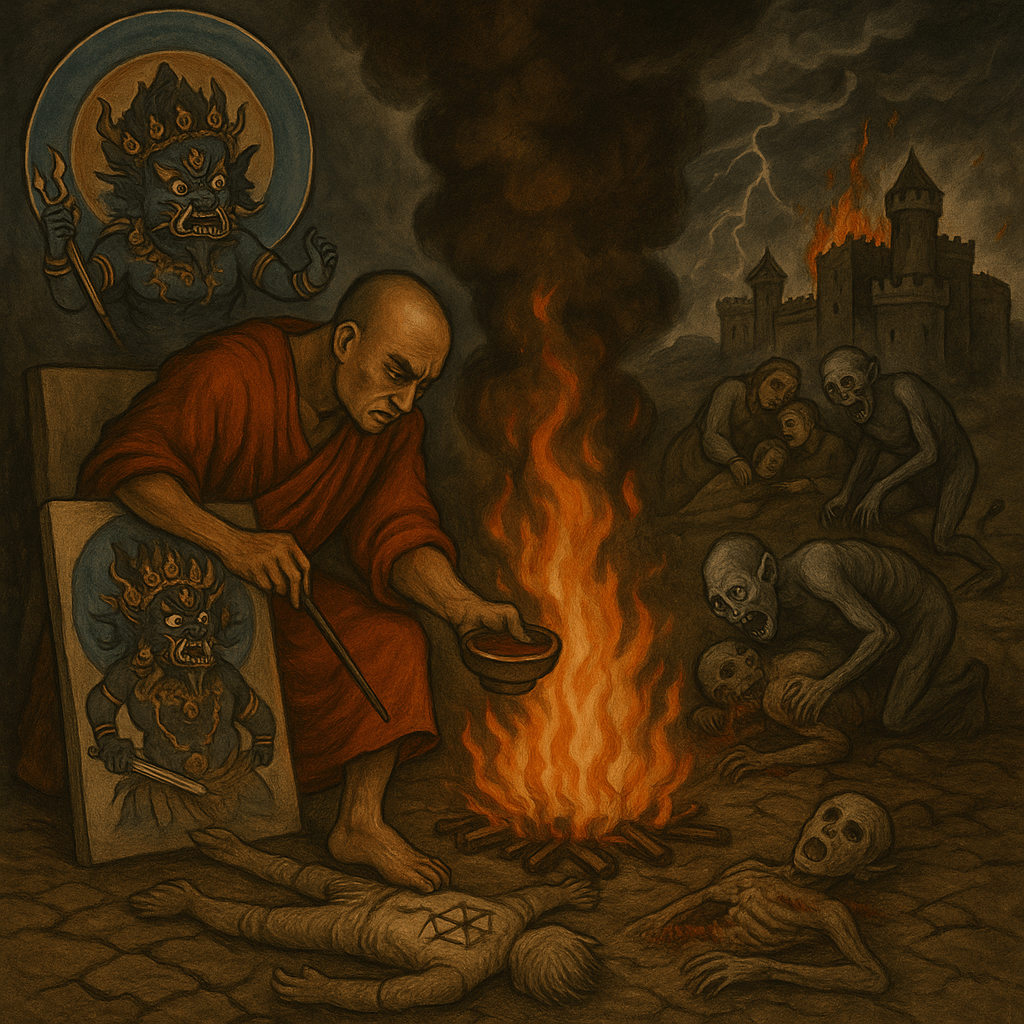
From the Mañjuśriyamūlakalpa’s “Ritual Against the Wicked Kings” comes one of the most explicit and brutal examples. The text instructs the practitioner to paint Yamantaka in terrifying form, then perform fire offerings of human blood, flesh, and powdered bone mixed with poisons and toxic plants to unleash plague, famine, storms, and demonic infestations upon the target. The king’s family is to die in sequence: son on the first day, wife and ministers on the second, the king himself on the third, while his court is overrun by flesh-eating spirits and his land struck by drought, fire from the sky, rockfall, and invasion. A human effigy bearing the victim’s birth star in cremation-ground charcoal is trampled during mantric recitation so the enemy dies, goes mad, or is devoured by demons. This is ritualized destruction in its most literal, calculated form.

One section of the same text reads like a manual for calculated devastation. The practitioner is instructed to heap human blood, flesh, powdered bone, poisons, and the roots of deadly plants onto a ritual fire in front of the painted deity. After 1008 offerings, not only is the enemy destroyed, but their family, ministers, and allies are swept away as well. The text promises droughts, plagues, famine, and storms, even fire and rocks falling from the sky, while demonic forces overrun the victim’s court. In some variations, a single datura root is enough to drive the target insane, or a few spoonfuls of spiced offerings can induce fatal fevers within days.

The text also states, “If he wants to kill someone, then having made a puppet (kṛtiṃ) he should write a name: the deity name or a nakṣatra (‘asterism under which the target was born’) using a charcoal of the cremation ground, which should be placed on the ground in front of the paṭa. Standing on [the puppet’s] head with his foot, he should be in a wrathful state, and do the recitation. He (the king) will become overpowered by a major disease, or he will die on the spot. That lord of men will be seized by piercing pains for no apparent reason, or he will be killed by an animal, or he will become crippled. He will be eaten by fierce rākṣasas, and various impure beings that have arisen from non-human birth (kravyādin), pūtanas, piśācas, pretas and the mothers, or he will be killed immediately by his own attendants.” 1

Conflict Inside the Tradition

Even within Tibetan Buddhism, the legitimacy of destructive rituals such as these was contested. Some figures, such as Rwa lo tsā ba, became famous for their wrathful practices but were denounced by peers as frauds or heretics. Reformers like Yeshes ’od tried to curtail the most extreme acts, replacing “live liberation” killings with symbolic substitutes like effigy destruction. But these reforms did not erase the underlying acceptance of ritual violence; they only tamed it for public consumption.

Another Piece of the Puzzle

Wenta’s work adds yet another piece of hard evidence to the growing pile that Tibetan Buddhism has long included practices designed to harm or destroy. These rituals were not simply metaphorical, and they were not limited to obscure sects. They were woven into the political and religious fabric of Tibet and beyond.

For those willing to look past Tibetan Buddhism’s carefully crafted PR image, the cult of Yamantaka exposes a reality in which the language of compassion hid a persistent undercurrent of deliberate harm.

Footnotes

1) Aleksandra Wenta, Tantric Ritual and Conflict in Tibetan Buddhist Society: The Cult of Yamāntaka, in Esimoncini, 19 Wenta CHIUSO, available at https://tibetanbuddhistencyclopedia.com/en/images/0/0b/Esimoncini%2C%2B19_Wenta_CHIUSO.pdf.

The Mirror and the Light: Spiritual Execution in Tibetan Feudalism


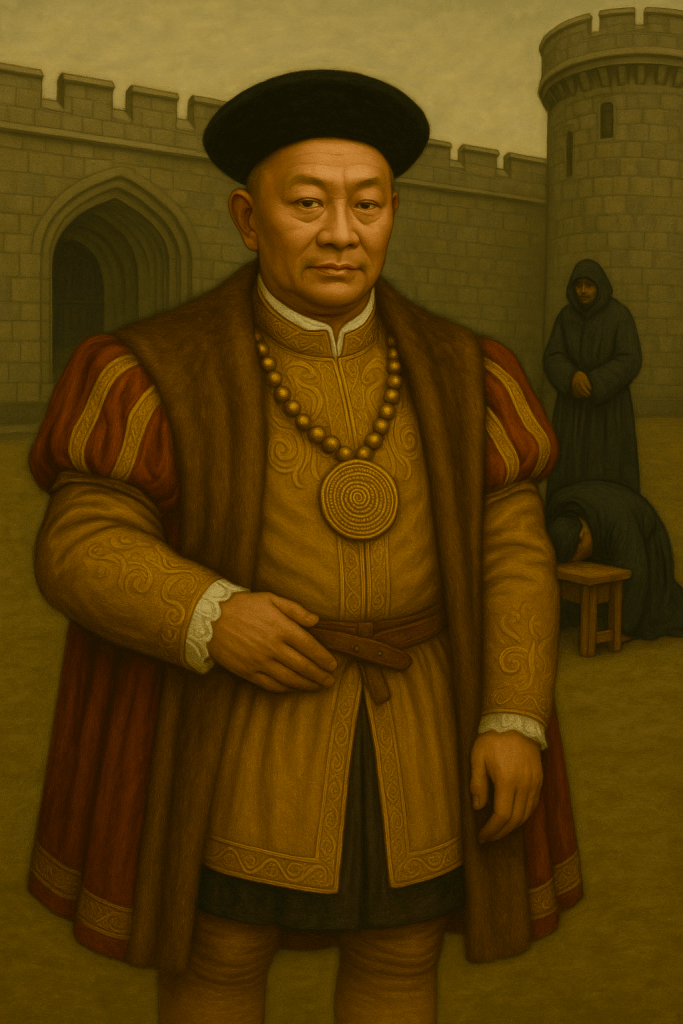
In Hilary Mantel’s The Mirror and the Light, Thomas Cromwell rises from blacksmith’s son to the right hand of King Henry VIII. He becomes the monarch’s “mirror and light,” reflecting and executing his will. But the same proximity that elevates him also destroys him. When Cromwell fails to deliver a pleasing queen, he is arrested, disgraced, and executed, his closeness to power proving fatal.

Tibetan tantric Buddhism operates on a hauntingly similar logic. In this tradition, the guru is king, and the disciple, like a courtier, is raised or destroyed at the guru’s whim. Far from being egalitarian or purely spiritual, Tibetan Buddhism, especially in its institutional forms, retains a deeply feudal structure, complete with titles, inheritance, land ownership, and enforced hierarchy.¹

Tibetan Buddhism as a Feudal System

For centuries, Tibetan Buddhism was not just a religion but the ruling system of the nation. The Dalai Lama was both spiritual sovereign and temporal king. Monasteries controlled vast tracts of land, collected taxes, and held legal authority over villages.² Senior lamas, often reincarnated tulkus, inherited wealth and power from their predecessors, a system akin to aristocracy by divine right. Large institutions like Drepung, Sera, and Tashi Lhunpo amassed political influence and wealth, with monasteries owning up to two-thirds of arable land in pre-1950s Tibet.³

The tulku system (identifying reincarnated masters) consolidated this feudalism. Wealth and authority passed to a chosen child, often from a high-status family, and the child was installed into a network of patronage, where senior monks managed the estate until the tulku matured. Ordinary monks and villagers remained economically dependent on these institutions, often working the land in exchange for spiritual services and blessings.⁴ According to historian Melvyn Goldstein, Tibetan society was “essentially a form of monastic feudalism.”⁵

The Guru as King: Absolute Power

In the Vajrayāna path, the guru is not merely a teacher: he is treated as the Buddha himself. Vajrayāna texts warn against questioning the guru, no matter how erratic or abusive his behavior.⁶ Students are bound by samaya (tantric vows), which demand total obedience, silence, and loyalty. In this relationship, the disciple becomes like Cromwell: a mirror for the guru’s will, performing rituals, making offerings, and receiving favor or punishment.

This closeness creates the illusion of intimacy, even love. Many disciples report feeling spiritually chosen or singled out by the guru. But this intimacy masks a darker truth: it is conditional and instrumental. When the disciple fails to satisfy the guru, by asking questions, expressing trauma, or failing to uphold impossible vows, they are cast out. Not just socially, but cosmically.⁷

Falling Out of Favor: Spiritual Annihilation

When a disciple displeases a guru in these feudal tantric systems, the consequences are severe. Historically, punishments ranged from beatings and public shaming to exile from the monastic estate.⁸ In modern times, exile takes subtler forms: ostracism, reputation assassination, spiritual gaslighting, and the threat of karmic damnation. Survivors of abuse report being told they were “possessed by demons,” “breaking their samaya,” or “falling into the lower realms” simply for speaking out.⁹

Just like Henry VIII’s wives or ministers, the disciple who falls out of favor is ritually erased. Their years of devotion are forgotten; their insights mocked. The same master who called them “special” now identifies them as a threat to the dharma. The disciple’s proximity to power becomes their undoing.

When the Light Burns

The title The Mirror and the Light is tragically fitting for both Thomas Cromwell and the countless disciples who believed that closeness to the guru meant safety. In Tibetan tantric Buddhism’s feudal framework, it often means the opposite. Disciples serve as tools of the guru’s charisma, devotion, and control. When they no longer reflect his will, they are discarded and spiritually “executed” without ceremony.

Just as Cromwell’s brilliance could not save him, neither can sincerity or devotion save a disciple in a rigged, feudal system.


Footnotes

  1. Geoffrey Samuel, Civilized Shamans: Buddhism in Tibetan Societies (Smithsonian Institution Press, 1993), pp. 22–29.
  2. Melvyn C. Goldstein, A History of Modern Tibet, Volume 1: The Demise of the Lamaist State (University of California Press, 1989), pp. 80–95.
  3. Matthew T. Kapstein, The Tibetans (Wiley-Blackwell, 2006), pp. 142–148.
  4. Toni Huber and Stuart Blackburn, Origins of the Tulku System in The Social History of Tibetan Institutions (Brill, 2002).
  5. Goldstein, History of Modern Tibet, p. 90.
  6. Alex Wayman, The Role of the Guru in Vajrayana, in Tibetan Buddhism: Reason and Revelation, ed. S. Lopez (SUNY Press, 1997).
  7. Miranda Adams, Samaya and Silence: Enforcing Obedience in Vajrayana Communities, unpublished thesis, 2020.
  8. Janet Gyatso, Being Human in a Buddhist World (Columbia University Press, 2015), ch. 3.
  9. Annabella Pitkin, “Broken Samaya and the Threat of Hell: Devotion, Dissent, and Control in Contemporary Tibetan Buddhism,” Journal of Global Buddhism, Vol. 22 (2021).

Mahāsiddhas, Mantras, and Murder: Tibetan Buddhist Ritual Violence Reexamined

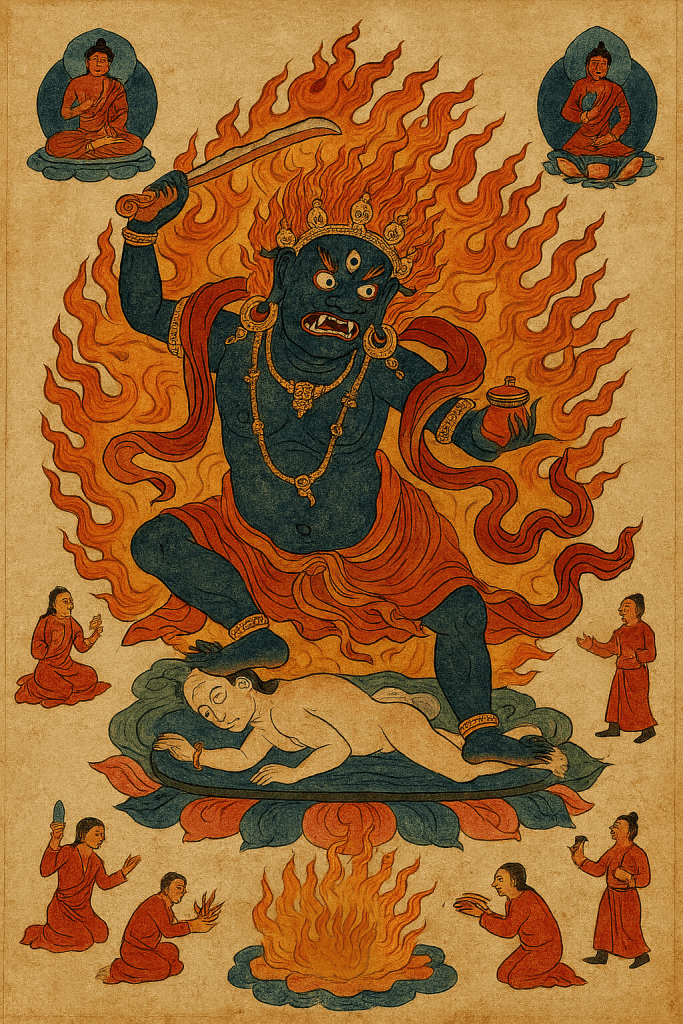
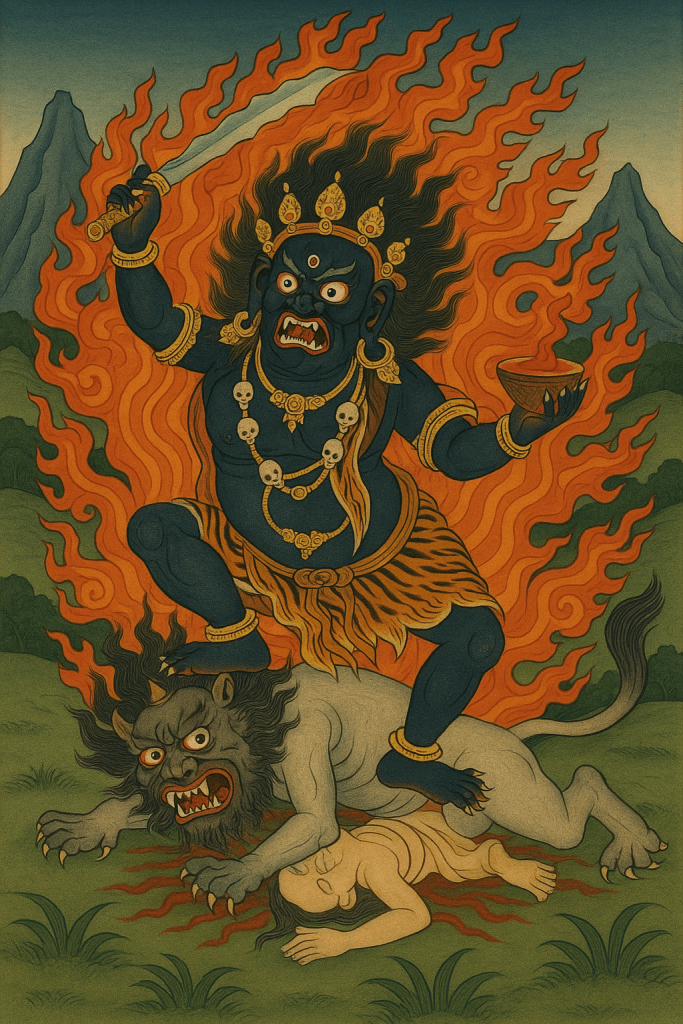
In this thangka-style painting, a wrathful tantric deity, likely Mahākāla, stands triumphant, engulfed in flames of spiritual power. He tramples a beast-like demon beneath his feet, which in turn crushes a human figure below. Far from mere symbolism, this hierarchy reveals a grim reality embedded in Tibetan tantric worldview: a cosmology where demons are organized in ranks, with wrathful deities occupying the highest tiers. These so-called “protector” spirits are themselves demonic in nature. They are powerful but subjugated through ritual, and are commanded by the guru to unleash violence against enemies of the dharma. The animal-like demon represents a lower-order spirit, weaponized by the deity. The crushed human symbolizes an actual person, someone the practitioner or lama has deemed a threat. The image is not just metaphor: it is a magical contract of domination.

Buddhists sometimes invoke ferocious protector deities like Mahākāla or Vajrakīlaya in rituals charged with violent imagery. In Tibetan history, such wrathful practices were often presented as spiritual rites to subdue obstacles, but evidence shows they could target actual enemies. For example, medieval Tibetan lamas served in warfare and politics: Lama Zhang (12th C. Kagyu) “engaged in political and military affairs” and even sent students into battle (War Magic: Tibetan Sorcery | Rubin Museum), using tantric rituals and deities (like Vajravārāhī and Mahākāla) to subjugate foes. Under the Mongol Yuan, Tibetan Buddhist “magical warfare” became statecraft: Tsami Lotsāwa, a Tangut court chaplain, authored texts like “The Usurpation of Government,” a how-to on overthrowing rulers invoking Mahākāla against armies. When Genghis Khan’s siege faltered in 1210, Tibetan sources credit Mahākāla summoned by Tsami (War Magic: Tibetan Sorcery | Rubin Museum) with bursting the Mongol siege dams and routing the attackers. The Mongols then adopted Mahākāla as their state protector. Likewise, Tibetan figures like the 8th Karmapa Karma Pakshi reportedly requested Mahākāla to exact revenge on his Chinese captors; lore even says Mahākāla “struck” the imperial palace (calling upon Mahakala…. | Ganachakra). Even the Nyingma saint Rwa Lotsāwa Dorje Drag (11th–12th C.) is celebrated in tradition for having “killed/murdered thirteen lamas” allegedly via Vajrabhairava rituals (Teacher: Rwa Lotsawa Dorje Drag). These and other incidents show tantric masters of Nyingma and Kagyu lineages historically appealed to protectors and demons in worldly struggles, not just inner battles.

Historical examples of tantric “war magic” include:

  • Imperial warfare: Tibetan Buddhist shamans at the Tangut and Yuan courts summoned Mahākāla to combat invading armies (War Magic: Tibetan Sorcery | Rubin Museum). Mongol ruler Qubilai Khan’s ritualist (the Sakya lama Dampa) was famed for invoking Mahākāla to turn back enemies; Mahākāla’s visage was later flown on Mongol battle banners (Himalayan Art: News) (War Magic: Tibetan Sorcery | Rubin Museum).
  • Sectarian conflicts: Rival Buddhist factions sometimes accused each other of violent tantra. (For example, later Gelugpa–Nyingma disputes mention rituals aimed at sectarian “enemies.”) In legend, a Kagyu master used Mahākāla to punish “impure” Gelugpas, and Dorje Shugden cult lore alleges victims of protector curses. (Such sectarian claims persist, though here we focus on pre-modern precedents.)
  • Regional skirmishes: Kagyu and Nyingma yogins were known as healers and sorcerers. One Kagyu lama reportedly used protective rites to strike fear into rebels. Vajrabhairava, a wrathful Nyingma deity, was famously employed by Rwa Lotsāwa in ritual assassinations (one story credits him with killing Marpa Lotsāwa’s son, Dharma Dode) (Himalayan Art: News).

These accounts contradict the comforting piety that “the only enemies are our defilements.” Instead, Tibetan sources show tantric deities being literally invoked against human foes and armies. Even art and prayers reinforce this: Palden Lhamo, the Dalai Lamas’ protector, is often depicted brandishing a sword and holding a skull bowl “brimming with the blood of vanquished enemies” (Palden Lhamo: Supreme Guardian Goddess of the Dalai Lamas – Tibetan Buddhist Encyclopedia). Such imagery underscores that the deity’s “compassion” is militarized.

Violent Imagery in Ritual Texts

The ritual texts themselves are unapologetically graphic. For example, a common Vajrakīlaya (Krodha Phurba) sādhanā (prayer) reads like a battle spell. One verse proclaims that Vajrakīlaya wields weapons “with which even the whole great mountain Sumeru is crushed to dust,” and that he “grinds to atoms the nine Gong-po brothers of phenomenal existence” (Cult of the Deity Vajrakila). In context, the “Gong-po brothers” symbolize fundamental enemies or obstacles (often conceptualized as Mara’s forces or the mind’s afflictions), but the language is literal and violent.

Texts on Mahākāla and Vajrabhairava likewise list long menus of violent exploits, trampling demons, cannibalizing spirits, or annihilating armies. In many kīlaya and bairaṇa (wrathful) rituals, the practitioner is explicitly instructed to cast forms or effigies of enemies into a bonfire or entangle them with magical ropes (Cult of the Deity Vajrakila) (The Rhetoric of Violence in the Buddhist Tantras). These are not purely abstract symbols but are described as actively destroying whoever or whatever they represent.

Indeed, scholar David Gray notes that Buddhist tantras use two kinds of violent rhetoric: grandiose, hyperbolic imagery to glorify the deity and impress the initiate, and actual ritual prescriptions for “violent ritual practices” (The Rhetoric of Violence in the Buddhist Tantras). While the former may seem merely figurative, Gray observes that even “symbolic” rituals often aim to harm the person symbolized (for example, burning an effigy of an enemy) (The Rhetoric of Violence in the Buddhist Tantras). Many tantra texts then justify these acts as transcending ordinary ethics: invoking a state of “non-dual gnosis” to excuse what would otherwise be murder (The Rhetoric of Violence in the Buddhist Tantras). In short, tantric sādhanās straddle symbolism and reality: they metaphorically crush delusions, but describe that metaphor in ultra-realistic, brutal terms accompanied by magical spells intended to harm human beings.

Empowered Lamas and “Transgressive” Rituals

Why this double talk? Tibetan lineages insist that only the most accomplished yogins (mahasiddhas) may perform such rites, precisely because they are “transgressive” and dangerous. The idea is that a realized master, having already tamed anger within, can safely wield wrath outside. As one modern analysis notes, advanced tantric practitioners are allowed “to invert Buddhist moral injunctions,” because rites aimed at killing are taught only to those senior enough to hold them (Buddhist Pacifists at War – JSTOR Daily). In practice, this meant kings, high lamas or court chaplains, not ordinary monks, performed these rituals.

Yet even senior masters often downplay the literal meaning today. Contemporary teachers frequently claim that prayers to “destroy enemies” really target the five poisons or ego-clinging, not people. (For instance, some explain Palden Lhamo’s blood bowl as symbolic of afflictions conquered.) Such interpretations align with inner-journey aspects of Vajrayāna. But history and ritual texts offer a different picture: these deities were invoked as warrior gods. Indeed, modern scholars argue that Buddhist tantra developed war-magic precisely because societies faced real threats. As Iain Sinclair puts it, defensive magic in early tantras was “pacifist in nature” but “destructive war magic also developed.” (Buddhist Pacifists at War – JSTOR Daily) Tantric manuals taught spells to freeze enemy armies with blizzards, sicken them with disease, or even consume them invisibly (Buddhist Pacifists at War – JSTOR Daily) ((PDF) War Magic: Religion, Sorcery, and Performance). One text in the Kālacakra cycle even provides a just-war framework, allowing only defensive conflict, infused with inner virtue, but this too presumes actual armed struggle (Buddhist Pacifists at War – JSTOR Daily).

This tension has sparked scholarly debate. Bryan Cuevas notes tantra’s fusion of “the internal and external worlds,” with protectors serving both spiritual and mundane power (War Magic: Tibetan Sorcery | Rubin Museum). Gray emphasizes that, despite rhetoric, tantrics did prescribe lethal rituals, legitimized by claims to higher awareness (The Rhetoric of Violence in the Buddhist Tantras).

Critical Perspective and Conclusions

In light of this evidence, the standard assurance that wrathful protector practices are only symbolic ring hollow. Certainly, Vajrayāna doctrine can spiritualize violence, positing that a bodhisattva’s anger is “pure compassion.” But when lamas claim “I’m just crushing my own ego,” the historical record shows they were also legitimizing political or personal power plays. At the very least, the literalist language of the liturgies warrants skepticism. A practitioner chanting “grind my enemies into dust” is arguably invoking cosmic butchery, not just inner peace.

For modern readers, this does not necessarily indict all Vajrayāna practice for many make upstanding vows and use wrathful deities for healing or psychological aid. However, it does mean we should be wary of uncritical glosses. As Gray warns, tantra’s “ethical double standard,” appealing to transcendent insight to excuse violence, has been used to justify harmful actions even in contemporary settings (The Rhetoric of Violence in the Buddhist Tantras).

For those intrigued or unsettled by these findings, scholars continue to examine how Tibetan Buddhism navigates the gulf between its nonviolent ideals and its martial heritage. Controversies within the tradition and in academic circles reflect this struggle. What is certain is that any romantic notion of pacifist Buddhism must contend with the very real phenomenon of tantric war magic and the subjugation rituals conducted against human beings.

Further Reading: For critical scholarship on these issues, see Iain Sinclair’s “War Magic and Just War in Indian Tantric Buddhism” (Buddhist Pacifists at War – JSTOR Daily) (Buddhist Pacifists at War – JSTOR Daily) and Bryan Cuevas, “The Wizarding World of Tibetan Sorcery” (in Faith and Empire, esp. ch.5) (War Magic: Tibetan Sorcery | Rubin Museum) (War Magic: Tibetan Sorcery | Rubin Museum). David B. Gray’s article “The Rhetoric of Violence in the Buddhist Tantras” (2018) explicitly examines tantric prescriptions of violence (The Rhetoric of Violence in the Buddhist Tantras). Solomon FitzHerbert’s study of 17th-c. Tibetan “ritual propaganda” is also enlightening. (Online references: Rubin Museum’s “War Magic” exhibition, Himalayan Art archives, and academic discussions by Sinclair and Gray are excellent starting points.)