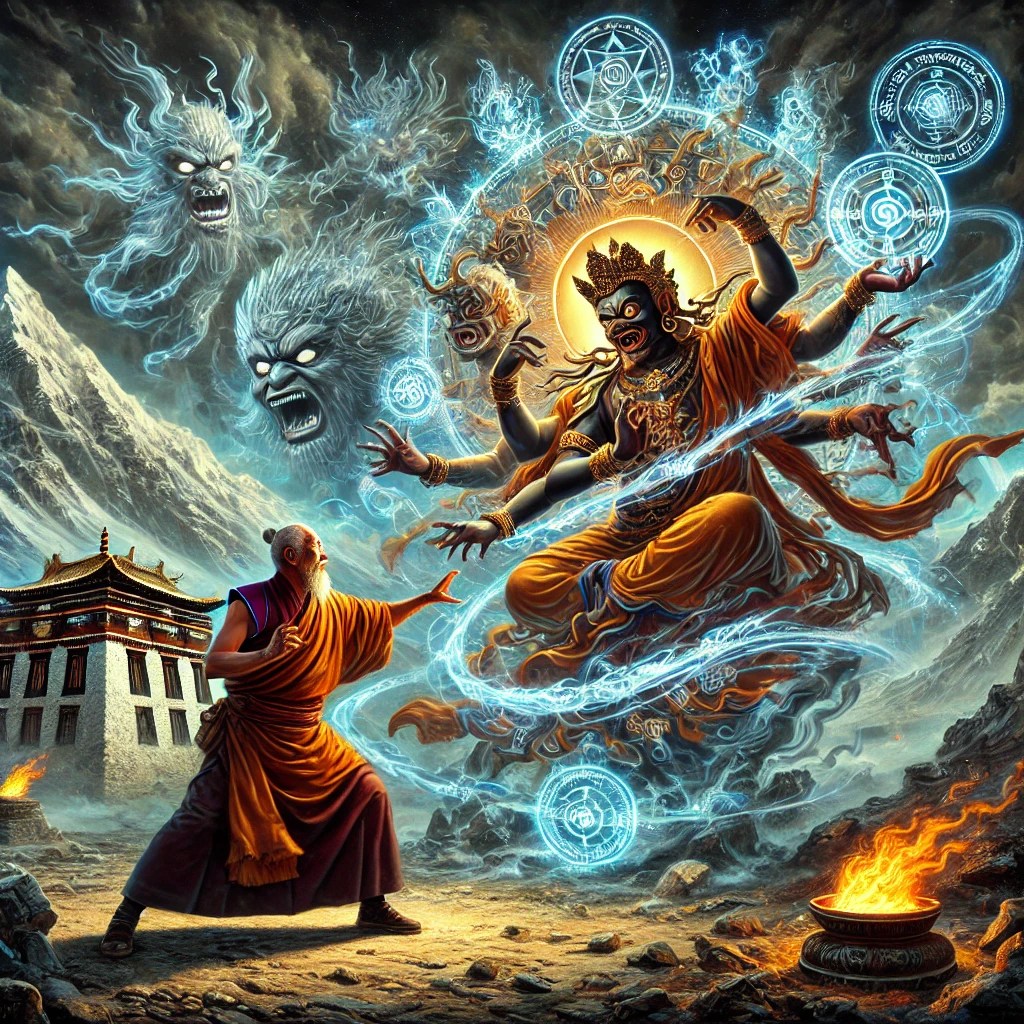
Throughout Tibetan history, occult warfare has been an enduring element of religious and political life. The case of Jamgon Kongtrul the Great, one of Tibet’s most revered scholars and visionaries, illustrates this reality. The texts documenting Kongtrul’s life recount a dramatic confrontation with an adversary named Kuntrul, who sought to harm him through violent and magical means. Kongtrul, deeply engaged in esoteric practices, responded with his own ritual countermeasures, emerging victorious in a struggle that was as much metaphysical as it was physical. Notably, some accounts suggest that Kongtrul’s rituals were not merely protective but also offensive, raising questions about whether his actions aligned with the pacifist image of Tibetan Buddhism.
Given the ubiquity of such accounts in Tibetan history, it is striking that contemporary adherents of Tibetan Buddhism often dismiss similar experiences when they occur today, particularly when they involve those who challenge the power structures of the tradition.
The Occult Battles of Jamgon Kongtrul
Jamgon Kongtrul’s conflict with Kuntrul was a high-stakes struggle marked by sorcery and supernatural intervention. Historical sources describe how Kuntrul employed a mix of mundane and esoteric strategies, including bribing local leaders to attack Kongtrul’s camp. Faced with this threat, Kongtrul and his party resorted to protective rituals, invoking powerful deities such as Tārā and performing rites designed to repel harmful influences. Despite being outnumbered and targeted, Kongtrul survived unscathed, a testament, in the view of his followers, to the efficacy of his spiritual defenses.
His ritual responses played a role in neutralizing Kuntrul as a threat. “As Gardener surmises, it does not just appear that Kongtrul protected his companions and himself with various rituals and so on, but that they positively ‘vanquished their enemies’ like the victor in a ‘deadly black magic contest.’” [1] What is evident is that Tibetan Buddhist magic was not just about shielding oneself from harm but also about eliminating threats in a direct and forceful manner. This calls into question the modern perception of Tibetan Buddhism as purely compassionate and pacifist, when in reality, its historical figures wielded spiritual power as a weapon.
Kongtrul’s deep knowledge of tantric practices, including wrathful deity invocations, can be better understood through his own writings in The Treasury of Knowledge. In this monumental work, Kongtrul systematically outlines the structure of Buddhist tantra, including the use of rituals for both protection and destruction. [2] His mastery of these teachings suggests that his confrontation with Kuntrul was not an isolated event but part of a broader understanding of how spiritual power could be wielded in Tibetan Buddhism.
The 5th Dalai Lama and Ritual Warfare
One of the most well-documented cases of tantric warfare in Tibetan history is the political ascent of the 5th Dalai Lama (1617–1682). The Great Fifth, as he is known, engaged in elaborate tantric rituals to subdue his enemies, particularly those who opposed the Gelugpa school’s dominance. His autobiography describes how he invoked wrathful deities to ensure the downfall of his opponents, including the destruction of the Jonang and the suppression of rival sects. The Dalai Lama’s spiritual and political strategies were deeply interwoven, demonstrating how ritual power was a critical tool in Tibetan statecraft. [3]
The Silence Around Modern Black Magic Warfare
Given the historical reality of occult battles in Tibetan Buddhism, why is it so difficult for contemporary practitioners, especially those invested in maintaining the tradition’s public image, to acknowledge that similar tactics might still be used today?
This question is especially pertinent to my own experiences after participating in the public exposure of my first teacher as a sexual predator. Tibetan Buddhism has a long history of protecting its elite figures through both institutional suppression and supernatural means. If even luminaries such as Kongtrul were subjected to ritual attacks and responded with powerful countermeasures, why should it be inconceivable that similar tactics would be employed against those who disrupt the modern power structures of Tibetan Buddhism?
The cognitive dissonance here is profound. Those who deeply believe in the efficacy of Tibetan magic when it serves the tradition’s interests refuse to acknowledge its potential use against those who challenge the status quo. This selective skepticism allows abuse and corruption to persist while shielding the tradition from scrutiny.
Conclusion
Tibetan Buddhism has never been a purely pacifist tradition; it has always wielded spiritual power in service of political and institutional control. The case of Jamgon Kongtrul the Great, as well as the 5th Dalai Lama’s strategic use of tantric rituals, reveals that black magic battles were historically a real and recognized aspect of Tibetan life.
To dismiss similar experiences today, particularly when they involve whistleblowers or those who expose misconduct, is not only inconsistent but a deliberate act of denial.
If the Tibetan Buddhist establishment was willing to deploy supernatural means to protect its authority in the past, why would it not do so in the present?
Kongtrul, Jamgon. The Treasury of Knowledge: Book Six, Part Four: Systems of Buddhist Tantra. Translated by Elio Guarisco and Ingrid McLeod. Ithaca, NY: Snow Lion Publications, 2008.
Ngawang Lobsang Gyatso, Fifth Dalai Lama. The Autobiography of the Fifth Dalai Lama. Translated by Zahiruddin Ahmad. Bloomington: Indiana University Press, 1998.
Smith, Gene. Among Tibetan Texts: History and Literature of the Himalayan Plateau. Boston: Wisdom Publications, 2001.
Gardner, Alexander. The Life of Jamgon Kongtrul the Great. Boston: Shambhala Publications, 2019.
As a young practitioner, I was taught that the Buddhist tantras were revealed after the Buddha’s parinirvana (death). According to this myth, the Buddha appeared in a divine form to gods and advanced beings, delivering esoteric teachings that remained hidden during his lifetime. These secret instructions were entrusted to celestial beings, nāgas (serpentine spirits), and bodhisattvas, who later transmitted them when conditions were ripe. This framed the tantras as mystical extensions of the Buddha’s wisdom, distinct from his public teachings in the sutras.
However, modern scholarship, like Jacob Dalton’s work, suggests a different history. Instead of divine revelation, tantric rituals and methodologies likely evolved through independent ritual manuals rather than canonical scripture.
The Karma Kagyu Perspective
The Karma Kagyu tradition holds that tantras were revealed by Vajradhara, the Dharmakaya Buddha, through visionary transmission to highly realized beings like Tilopa. Some teachings were safeguarded by dakinis and nāgas, while others were hidden as terma (treasures) to be revealed later. These traditional narratives emphasize a mystical origin; however, Dalton’s research suggests that tantric Buddhism developed more organically, emerging from evolving ritual manuals.
If one takes the traditional Buddhist stance that tantra was revealed by the Buddha (or Vajradhara), then Dalton’s research presents a major challenge. It suggests that these teachings were likely developed and refined within Buddhist circles long after the Buddha’s time rather than being his direct transmission.
Sutras vs. Tantras
Sutras are foundational Buddhist texts attributed to the historical Buddha, emphasizing ethical conduct, meditation, and wisdom. These canonical scriptures are preserved in the Pali, Chinese, and Tibetan canons. In contrast, tantras focus on esoteric rituals, deity yoga, mantra recitation, and secret initiations aimed at accelerating enlightenment. Unlike sutras, tantras use symbolic, coded language and require initiation from a qualified teacher.
The Dunhuang Manuscripts and Ritual Manuals
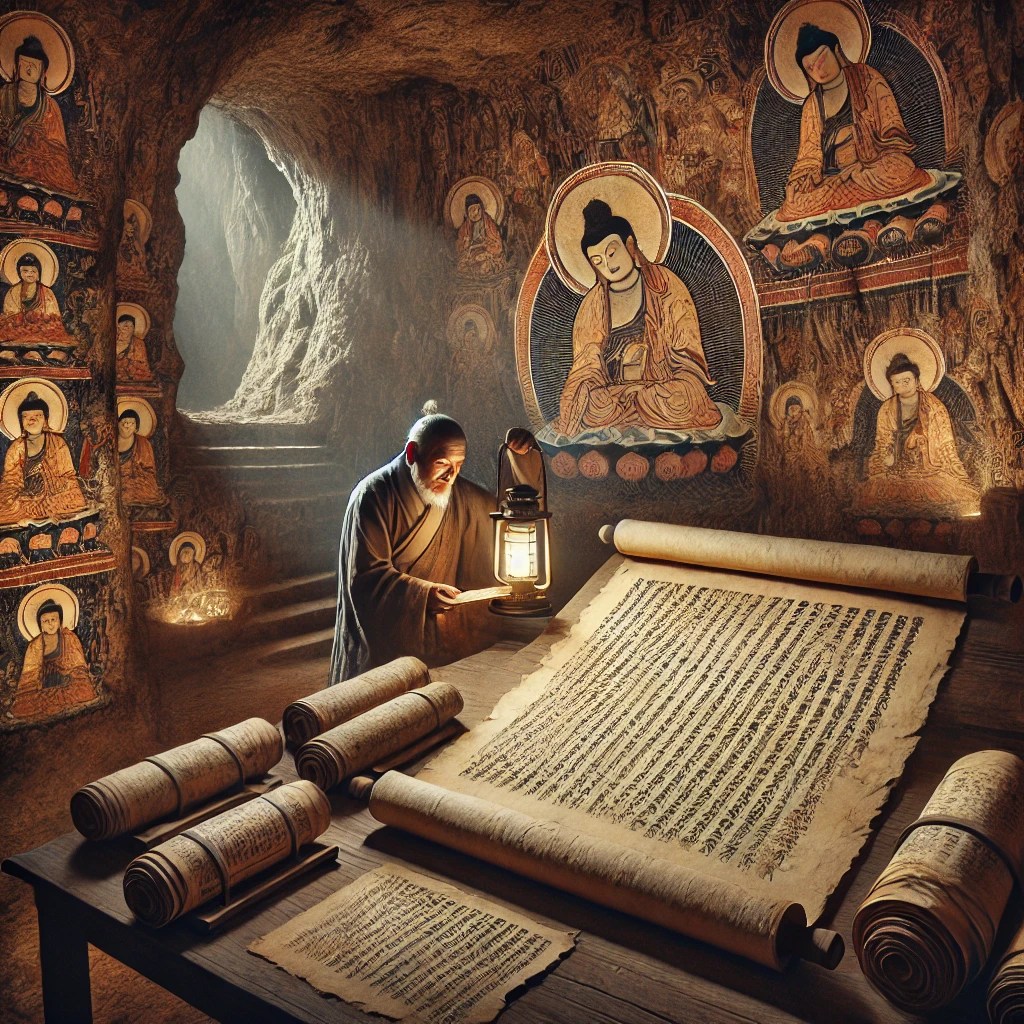
The Dunhuang manuscripts, discovered along the Silk Road, offer insight into early tantric Buddhism. Dalton’s work with these texts suggests that tantric Buddhism initially developed through practical ritual manuals (Vidhis, Kalpas, and Sadhanas) rather than formalized scriptures. These guides were adapted and often discarded, making their historical traceability difficult.
Dalton found that these manuals were frequently appended to or inserted into Dharani sutras, but also existed independently.[1] This suggests that Buddhist rituals did not originate from sutras but were already in practice before being formally recorded in scripture.
The Evolution of Tantric Practices
By the fifth century, ritual manuals became prominent alongside Dharani sutras, marking a shift toward applied spirituality. The rise of altar diagrams, temple worship, and visualization techniques in Buddhist rituals coincided with Hindu esoteric traditions, reflecting a cross-pollination of practices.
Conjuring the Buddha: A Reversal of Scriptural Authority
Jacob Dalton’s book Conjuring the Buddha: Ritual Manuals in Early Tantric Buddhism, explores how tantric Buddhism is deeply ritualistic and magical, emphasizing that practitioners sought to conjure the Buddha rather than merely study doctrine.
A key argument in his work is that ritual practices predated and shaped canonical texts, rather than the traditional assumption that textual sources dictated practice. This challenges the linear evolutionary model that sees tantric Buddhism as a straightforward development from Mahayana sutras. Instead, Dalton suggests that lived ritual traditions influenced the formation of canonical texts, making tantric Buddhism a dynamic and experiential tradition rather than a purely doctrinal one.
Rethinking Tantric Buddhism’s Origins
Dalton’s research does not outright prove that tantra did not come from the Buddha, but it strongly challenges the traditional Buddhist claim that tantras were directly revealed by him (whether in his historical form or as Vajradhara). Instead, it suggests that tantric Buddhism developed as an evolving ritual tradition rather than being a fully formed teaching originating from the Buddha himself.
Here’s why:
Ritual Practices Evolved Separately from Canonical Teachings Dalton’s findings indicate that tantric practices were initially recorded in independent ritual manuals that were later appended to or integrated into Dharani sutras. This suggests that these practices were not originally part of the Buddha’s recorded teachings but emerged over time within Buddhist communities.
No Direct Scriptural Evidence from Early Buddhist Texts The earliest Buddhist texts, the Pali Canon and Mahayana sutras, do not contain fully developed tantric doctrines. Tantra, as it appears in Vajrayana Buddhism, became prominent centuries later, and its early development seems to be more of a gradual accumulation of esoteric ritual practices rather than a singular revelation by the Buddha.
Cross-Pollination with Other Esoteric Traditions Many tantric elements such as mantras, deity yoga, mandalas, and ritual visualization, resemble practices found in Indian Shaiva and Shakta traditions. This suggests that tantric Buddhism developed through cultural and religious exchange rather than being an entirely unique transmission from the Buddha.
A Shift in Scriptural Authority The fact that tantric practices existed before being formally written into Buddhist scriptures implies that tantric Buddhism may have been practitioner-driven rather than stemming from a singular enlightened source (such as the Buddha). The codification of these rituals into texts might have been an attempt to legitimize or systematize existing practices rather than recording an original revelation.
What This Means for the Traditional View
If one takes the traditional Buddhist stance that tantra was revealed by the Buddha (or Vajradhara), then Dalton’s research presents a major challenge. It suggests that these teachings were likely developed and refined within Buddhist circles long after the Buddha’s time rather than being his direct transmission. Whether this undermines the legitimacy of tantra as a Buddhist tradition depends on one’s perspective: traditionalists may argue that the Buddha foresaw and seeded tantric teachings in hidden ways, while scholars would argue that tantra is a later development influenced by various religious and ritual traditions.
[1] In Tibetan Buddhism, a Dharani Sutra is a type of scripture or sacred text that contains dharanis—extended formulas or phrases composed of Sanskrit syllables believed to carry spiritual power. These are similar to mantras but often longer and more elaborate.
The full transcript of the lecture cited in the article can be read here:
Speaker: Jacob Dalton, Ph.D. | Distinguished Professor in Tibetan Buddhism, UC Berkeley
Thank you, Sanjot, for inviting me. It’s a strange experience to speak to a home crowd.
I’ve given a couple of talks on this book before, and those were more formal, in-depth lectures on specific elements of the book. But since those are all available online, I decided to take a different approach today—something a bit more personal and informal. I want to talk about the process I went through in writing this book.
Since many of you, particularly those in my seminars, have probably heard me discuss these ideas countless times—ideas I’ve been working with for nearly 20 years—I hope this will be the last time you have to listen to me talk about them.
This book began taking shape after I finished my Ph.D. and moved to London to work at the British Library. I was hired by the International Dunhuang Project, which had received a three-year grant to digitize the Tibetan tantric manuscripts in the Stein Collection.
A brief word on the Dunhuang manuscripts: they were discovered over a century ago in a cave along the Silk Road, near the city of Dunhuang. They are a treasure trove for scholars of Chinese and Tibetan religious studies, containing some of the earliest materials we have in Tibetan.
As part of this project, I worked alongside Sam van Schaik to catalog the tantric manuscripts. It was an incredibly fortunate three years, as my interests aligned perfectly with the project’s goals, allowing me to read through the collection extensively.
As I began working through these manuscripts, I noticed that previous scholarship had largely relied on the existing catalog of Tibetan manuscripts in London. Rather than being constrained by that framework, I decided to read through the manuscripts one by one, which led to the discovery of many new treasures.
At the start, I was so excited by my findings that I rushed to publish a few articles. Looking back, I wish I could retract them—they were filled with errors. I simply wasn’t yet qualified to fully understand the collection. Realizing this, I paused my publishing efforts to re-educate myself on the early history of tantric Buddhism in India, which ultimately delayed the completion of this book for nearly two decades.
The book does several things at once. It uses the Tibetan tantric manuscripts from Dunhuang as a window into the development of tantric Buddhism in India. My previous book, Taming of the Demons, used the same manuscripts to explore early Tibetan history, but this time I wanted to contextualize them in relation to Indian developments. While I am not a Sanskritist, I undertook the challenge of examining this material from an Indian perspective.
Despite what Sanjot may have said, much of the book is quite technical, dealing with the evolution of tantric ritual and how it functioned as a system. However, two larger arguments underpin the book.
First, I emphasize the importance of ritual manuals. The book is, in many ways, a study of early tantric ritual manuals as a distinct genre, particularly those preserved in Dunhuang.
Second, influenced by my time at UC Berkeley and conversations with colleagues like Paula and Allan, I began approaching these texts through a more literary lens.
The Discovery of Ritual Manuals as a Distinct Genre
In 2004, while working on an exhibition at the British Library, I was asked to write catalog entries for several manuscripts, including a Chinese diagram of an altar for the worship of Uṣṇīṣa Vijaya. Not knowing Chinese, I sought help in translating it, and I soon realized that nothing in the Uṣṇīṣa Vijaya Dhāraṇī Sūtra itself corresponded to the ritual practices depicted in the manuscript.
This led me to investigate further, and I discovered multiple versions of the text—some with separate ritual sections, others with independently circulating ritual manuals (vīdhis). The Chinese canon preserved some of these, as did the Tibetan canon, while the Dunhuang manuscript represented yet another variant.
This realization led to a major breakthrough: I began to see that ritual manuals had a life of their own, distinct from the canonical scriptures. Using the Taishō Tripiṭaka, I traced the emergence of ritual manuals, finding that they first appeared alongside dhāraṇī sūtras in the second half of the fifth century and proliferated in the sixth and seventh centuries.
Surprisingly, I found no evidence of Buddhist ritual manuals before this period. This was a revolutionary moment for me—I realized that an entire genre, central to contemporary Buddhist practice, had emerged relatively late in Buddhist history.
Ritual Manuals and the Proto-Tantric Debate
This finding intersected with a longstanding scholarly debate about whether dhāraṇī sūtras were proto-tantric. Scholars like Michel Strickmann argued that they were, while others, such as Robert Sharf, disagreed.
I concluded that dhāraṇī sūtras themselves were not tantric but rather Mahāyāna texts. However, the ritual manuals associated with them were proto-tantric. These manuals became a kind of “literary Petri dish,” fostering experimentation, localization, and innovation in Buddhist ritual practice.
What made these ritual manuals so flexible was their non-canonical status. Unlike scriptures deemed the word of the Buddha, these were human-authored texts that practitioners personalized with notes, additions, and modifications. Today, we can still see this practice in Tibetan Buddhism, where individuals compile personalized collections of prayers and instructions.
Yet, because they were seen as unimportant, these manuscripts were rarely preserved—except in rare cases like the Dunhuang collection, which offers a unique glimpse into this otherwise ephemeral tradition.
The Literary Qualities of Ritual Manuals
A turning point in my thinking came when Paula, a literature scholar, asked me what defined ritual manuals as a genre. Until then, I had approached them purely as practical guides. But her question forced me to consider their literary qualities.
Unlike Mahāyāna sūtras, which recount the Buddha’s teachings in a narrative framework, ritual manuals speak directly to the reader, instructing them in the imperative tense: “Place the offering here. Hold the beads in your right hand. Recite the mantra 21 times.” This direct address collapses the distance between text and practitioner, drawing the reader into the ritual itself.
With the rise of tantra, another shift occurred. The imagined world of the Buddha, once distant in Mahāyāna sūtras, merged with the practitioner’s experience. Instead of merely praying to a Buddha, practitioners imagined themselves as the Buddha at the center of the mandala.
This change is vividly illustrated in an eighth-century Tibetan commentary, which states that before drawing a physical mandala, the practitioner must first visualize the true mandala hovering above it. Here, the imagined world takes precedence over the physical.
The Evolution of Tantric Ritual and Poetic Language
A key feature of tantric ritual manuals is their use of poetry at crucial ritual moments. While early manuals were mostly prose, later tantric texts incorporated poetic passages, particularly during initiations and moments of transformation.
For example, in an initiation ritual, the master bestows symbolic objects upon the initiate while reciting poetic verses. This poetic register heightens the ritual’s significance, marking it as a moment of spiritual transformation.
By the ninth and tenth centuries, entire tantric ritual manuals were composed in verse, blurring the lines between human and Buddha-authored texts. These poetic passages, rich in metaphor and imagery, were designed to induce visionary experiences in the practitioner.
Conclusion
The developments I have traced in ritual manuals culminated in the late eighth and ninth centuries with the rise of esoteric initiations, the fourth empowerment, and the direct transmission of awakening through poetic or symbolic gestures—hallmarks of later tantric Buddhism.
While I have limited my argument to the evolution of ritual manuals, it is tempting to see a connection between these literary developments and the emergence of direct transmission methods in traditions like Dzogchen and Zen. By the end of the eighth century, the transmission of awakening was no longer solely a doctrinal process but an experiential one, facilitated through poetic, symbolic, and ritual means.
As a young person, I was assured by a respected Tibetan Buddhist rinpoche that one could be both Christian and Buddhist. [1] He acknowledged that many had faith in Jesus Christ and claimed there was no contradiction between the two traditions. Yet, this assertion directly contradicts biblical Christianity. Whether well-intentioned or deceptive, he was wrong.
Tibetan Buddhism is often presented in the West as a tradition of wisdom and compassion, sometimes compared to Christianity. However, its fundamental tenets conflict with Christian doctrine, not only in rejecting a Creator God but also in its deep commitment to tantric practices that diverge from biblical teachings. Tibetan Buddhism’s fusion of Indian Buddhist philosophy, tantric practices, and Tibetan shamanism has resulted in a system where esoteric tantric laws supersede even the historical Buddha’s teachings, let alone Christian principles.
Tantric Roots: Beyond the Buddha’s Teachings
It is important to note that Tibetan Buddhism is not solely derived from the historical Buddha’s teachings but incorporates various esoteric influences, including elements from broader South Asian tantric traditions. Scholar Jacob Dalton notes that early Buddhist tantra developed ritualized practices such as mantra recitation and yogic breath-control techniques. Over centuries, Tibetan Buddhist tantra evolved beyond the Buddha’s original teachings, shaped by ongoing ritual innovations and textual developments rather than direct continuity with the Buddha’s doctrine (Dalton, “On the Early Development of Sexual Union in Buddhist Tantric Practice”) [2]
The Buddha’s original teachings emphasized ethics, meditation, and wisdom, not esoteric rituals, deity invocations, or secret empowerments, which later became central to Tibetan Buddhist practice. The introduction of tantric elements centuries after his death fundamentally altered Buddhism, aligning it more closely with Hindu tantra than with its original foundations.
The Fusion of Buddhism, Tantra, and Tibetan Shamanism
Tibetan Buddhism is not a pure continuation of the Buddha’s teachings but a blend of:
Mahayana Buddhism: Contributed philosophical concepts like emptiness (shunyata) and the bodhisattva ideal.
Kashmir Shaivism & Indian Tantra: Introduced deity yoga, secret initiations, and esoteric sexual rituals.
Tibetan Bon Shamanism: Integrated animistic practices, spirit invocations, and sorcery.
This synthesis was fraught with contradictions. The Buddha’s ethical teachings often clashed with tantra’s disregard for conventional morality, which, according to tantric texts, must be transcended for enlightenment. Tantric laws ultimately took precedence over traditional Buddhist ethics, justifying actions that the Buddha explicitly condemned, such as ritual intoxication, sexual practices, and deceptive methods of control.
Dalton’s book, The Taming of the Demons: Violence and Liberation in Tibetan Buddhism, highlights how tantric law overshadowed Buddhist nonviolence, allowing for ritual violence against perceived enemies of the dharma (Dalton, The Taming of the Demons). [3] This unresolved tension continues in Tibetan Buddhist circles, where lamas justify behaviors the Buddha would have rejected.
Idol Worship and the Biblical Condemnation of Tibetan Buddhism
Christianity explicitly condemns the core practices of Tibetan Buddhism, particularly idol worship, sorcery, and reliance on spiritual intermediaries outside of God. Scripture warns against such practices:
Isaiah 42:8 “I am the Lord; that is my name! I will not yield my glory to another or my praise to idols.”
Galatians 1:8 “Even if we or an angel from heaven should preach a gospel other than the one we preached to you, let them be under God’s curse!”
Deuteronomy 18:10-12 “There shall not be found among you anyone who… practices divination, tells fortunes, or interprets omens… For whoever does these things is an abomination to the Lord.”
1 Corinthians 10:20-21 “The sacrifices of pagans are offered to demons, not to God, and I do not want you to be participants with demons.”
Tibetan Buddhism actively promotes deity worship, ritual magic, and tantric initiations that invoke spiritual forces, aligning it with practices the Bible condemns as deceptive and demonic.
Two Paths That Cannot Be Reconciled
Despite modern claims of compatibility, Christianity and Tibetan Buddhism are fundamentally irreconcilable. Tibetan Buddhism is rooted in tantric laws that contradict the teachings of both the Buddha and Christ. It is not merely a philosophy but an esoteric system steeped in idol worship, occult rituals, and doctrines opposed to biblical truth.
An honorific title used to refer to highly respected teachers.
Jacob Dalton, On the Early Development of Sexual Union in Buddhist Tantric Practice, Journal of the International Association of Buddhist Studies, vol. 32, no. 1–2, 2009.
Jacob Dalton, The Taming of the Demons: Violence and Liberation in Tibetan Buddhism (New Haven: Yale University Press, 2011).
Hidden in the depths of Tibetan esoteric traditions, certain wrathful rituals exist that are rarely spoken of outside the inner sanctums of designated tantric practitioners. These rituals, designed for the destruction of a consciousness, are meant to dissolve its influence, perceived obstructive intent, or spiritual presence. While these practices claim to protect against malevolent spirits, they have, at times, been weaponized against living humans, including those who threaten to expose misconduct within Buddhist institutions.
The Ritual of Consciousness Annihilation
A specific type of tantric ritual involves an esoteric diagram, similar to the one depicted in the image above, where a human form is inscribed with powerful mantras, seed syllables, and esoteric symbols. There is a six-pointed blade weapon surrounding the victim. The six points of the blade correspond to the double triangle (hexagram-shaped) mandala of the chief deity in this lineage. If the deity and guru/s decide that the practitioner has broken the samayas (tantric laws), according to their system, the deity’s mandala turns into a horrific weapon that destroys the mind/consciousness of the victim. But this ritual doesn’t just affect the mind/consciousness, it also has a profound effect on the physical body. The victim’s body will be tortured extensively through a type of voodoo and the very shape of the person’s body will morph to resemble the figure in the diagram. This ritual serves to bind, neutralize, and dissolve a targeted consciousness, whether it be an external spirit, a human, or a “perceived” karmic obstruction. The ritual process follows a structured framework
Creation of the Diagram
The targeted consciousness is symbolically bound within a mandala-like formation.
Protective and wrathful mantras seal off escape routes.
Crosses and sigils mark the finality of the destruction process.
Invocation of Wrathful Deities
Mantras and visualizations call forth powerful, wrathful deities.
The deities are instructed to subdue, bind, and annihilate the “perceived” enemy.
The practitioner performing the ritual sees themselves as a manifestation of the deity, wielding its power.
Execution of the Consciousness
The bound entity is pierced, burned, or dissolved into emptiness.
Ritual implements, such as a phurba (ritual dagger), are used to cut through the energy ties of the target.
The ritual often ends with the destruction of the paper or material that carried the sigils.
The Four Wrathful Deities that Could be Used in Consciousness Destruction Rituals
1. Mahākāla (The Black-Cloaked Guardian)
Mahākāla is the supreme protector of the Dharma, known for his fierce nature. In the context of destructive rituals, Mahākāla is invoked to crush obstacles and eliminate spiritual threats. His iconography often features a black body, fiery aura, and skull garland, symbolizing the destruction of ignorance and negative forces.
Origins: Derived from Hinduism’s Shiva, Mahākāla was integrated into Buddhism as a Dharma protector.
Role in Rituals: Practitioners visualize Mahākāla’s fire consuming the obstructive consciousness, reducing it to emptiness.
2. Vajrakīlaya (Dorje Phurba, The Slayer of Demonic Forces)
Vajrakīlaya is one of the most feared wrathful deities in Vajrayana Buddhism. He is depicted holding a three-bladed phurba dagger, which symbolizes his power to penetrate and destroy negative karmic influences and malicious forces.
Origins: Introduced into Tibetan Buddhism through the great master Padmasambhava.
Role in Rituals: Vajrakīlaya’s phurba is symbolically plunged into the obstructive consciousness, shattering its energy and dispersing it into the void.
3. Dorje Legpa (The Enforcer of Vows)
Dorje Legpa is a lesser-known but highly effective Dharma protector, often depicted riding a snow lion. His primary role is to punish those who violate spiritual oaths and disrupt the Dharma.
Origins: A native Tibetan deity later assimilated into Buddhist protector pantheon.
Role in Rituals: He is invoked to hunt down malevolent forces, bind them in the diagram, and neutralize their influence.
4. Ekajati (The One-Eyed Protector)
Ekajati is a wrathful female deity, feared for her ability to cut off the life force of negative beings and obstructive forces. She is depicted with one eye, one tooth, and one breast, symbolizing her singular focus on eradicating spiritual threats.
Origins: A key protector in the Nyingma and Kagyu traditions, linked to Padmasambhava.
Role in Rituals: Practitioners visualize Ekajati severing the energy threads of the targeted consciousness, ensuring complete destruction.
Historically, these rituals were supposed to be used to eliminate spiritual and karmic obstacles, not to harm innocent people. However, in some cases, they have been repurposed as tools of suppression within Buddhist institutions. When fear, secrecy, and power dynamics come into play, these ancient magical practices can be wielded as weapons.
There are instances where individuals who were never a true threat to the Dharma were nonetheless targeted. Some have been subjected to these rituals simply because they possessed knowledge that could expose wrongdoing, particularly cases of sexual misconduct and abuse within monastic settings. Instead of facing accountability, certain powerful tantric figures within these circles have used their esoteric knowledge to attack those they feared might reveal the truth.
Karmic Consequences of Weaponized Tantra
From a Buddhist perspective, the intentional use of spiritual power to harm others, especially for self-serving reasons, carries immense karmic consequences. Perhaps this can explain why certain prominent lineages in Tibetan Buddhism face overwhelming obstacles, such as vicious infighting and shocking treachery.
If such a ritual is performed with malicious intent, the negative karma generated will eventually return to the practitioner.
Those who use these practices risk invoking their own downfall.
Consciousness destruction rituals are horrific tools of suppression and spiritual manipulation. The existence of these rituals, the fact that they abide within the sacred confines of the so-called Buddha Dharma, raises an important ethical question: Who decides what constitutes an “enemy of the Dharma” and how does this practice line up with the teachings of the historical Buddha that emphasize ahimsa or non-violence? And why aren’t spiritual seekers told the truth about these destructive practices before they sign their names on the proverbial dotted line. Even the most beatific seeming Rinpoche must know this sort of thing goes on behind the scenes. Withholding the truth about the dark side of Tibetan Buddhism is very wrong as it puts innocent people in harm’s way.
Moreover, for those who have been targeted, these rituals represent not just an abuse of spiritual power but a deep betrayal of the very teachings they were meant to uphold. Ultimately, any attempt to silence or destroy others through dark esoteric means will eventually meet its own hellish reckoning.
For many seekers, Tibetan Buddhism presents itself as a path of compassion, wisdom, and enlightenment. The colorful rituals, profound teachings, and the promise of an awakened state draw thousands into its fold. Yet, I found that beneath this altruistic exterior lies a deeply disturbing reality that has left many devoted practitioners feeling shattered and betrayed.
The Ignored Epidemic: Sexual Abuse and Victim Blaming
Sexual abuse within Tibetan Buddhist communities is not an isolated phenomenon, it is a systemic issue that has been ignored, dismissed, and, at worst, facilitated. Victims who come forward are met with disbelief and outright hostility. Rather than holding perpetrators accountable, institutions protect the accused, often elevating them to near-divine status, making any accusation seem like an attack on Buddhism itself. Survivors who speak out are gaslit into questioning their own experiences and sanity.
Many have spent years of their lives in service to Buddhist centers and teachers, sacrificing their time, finances, and personal aspirations in the belief that they were contributing to something greater than themselves. But when they are exploited or harmed, they are left with nothing to show for their time and effort.
Devotion Without Reward: The Disillusionment of Lifelong Service
Many who enter Tibetan Buddhist communities do so with sincere intentions, offering years, sometimes decades, of unpaid or underpaid labor to their teachers and centers. They are told that serving a lama is a privilege, a form of spiritual merit that will bring them closer to enlightenment.
But the stark reality is that this so-called merit often leaves people impoverished, physically exhausted, and emotionally drained. The promised rewards of spiritual progress and personal transformation rarely materialize in any meaningful way. Instead, the real benefits accrue to the teachers, who gain wealth, power, and unchallenged authority while their followers struggle to sustain themselves. Those who finally wake up to this exploitation often find themselves discarded, ostracized, and in some cases, actively harmed.
The Dark Side of Tibetan Tantra: Black Magic and Suppression
Tibetan Buddhism is often presented to the world as a practice rooted in loving-kindness and compassion. However, what is rarely discussed is the hidden world of tantric practices that extend into the realm of manipulation and harm.
There exist rituals and practices, known only to initiated insiders, that can be used to attack, suppress, or even destroy those who pose a threat to an abusive teacher. These methods are supernatural and are employed with impunity, while the broader community remains willfully unaware. Advanced practitioners in the know choose to look the other way, refusing to intervene even when witnessing outright harm. Worse, they glorify the abusers, reinforcing their power through public displays of devotion and praise.
The Complicity of the Buddhist Community
The silence and complicity of Tibetan Buddhist institutions and practitioners enables abuse to persist, both mundane and supernatural. In dharma communities where a lama is acting harmfully, those who know the truth either fear retaliation or believe that questioning a lama is a sign of spiritual failure. This culture of submission and blind faith creates a vacuum where predators thrive, shielded by the very people they exploit.
For those who leave, the road to healing is long and painful. The betrayal cuts deeply, not just from the teachers themselves but from the entire community that was supposed to uphold compassion and integrity. The disillusionment is profound, and the scars left behind serve as a haunting reminder of the dangers hidden behind the serene facade of Tibetan Buddhism.
Breaking the Silence
The only way to dismantle this system of abuse is to expose it. Survivors must be heard, their stories believed, and perpetrators held accountable. Blind devotion must give way to critical thinking. The world must recognize that behind the elaborate ceremonies and teachings, a toxic power structure thrives, one that has left too many people in ruins.
Tibetan Buddhism, as it is practiced today in many corners of the world, is not what it claims to be. Until it confronts its dark underbelly, it will continue to betray those who place their trust in its teachings. The truth must be spoken, no matter how uncomfortable it makes those still deceived by the illusion.
The hexagram symbol on the right depicts the mandala of an important Tibetan Buddhist female deity.
I was having a discussion with a former tantric Buddhist practitioner, and it got me thinking about the popular notion that all roads lead to God and that it doesn’t matter whether or not one has practiced in occult traditions as long as they are trying to live virtuous lives. This idea is comforting to many, but from a theological standpoint, it is deeply flawed. Not all spiritual paths lead to God, and certain practices, no matter how well-intentioned, can take people further away from Him rather than closer.
The Illusion of “Enlightenment”
Many believe that high-level Buddhist teachers or gurus have a special ability to perceive the karma of others. This belief leads followers to trust their guidance blindly, assuming they possess supernatural wisdom. But from a theological perspective, what these figures claim to see and know is not divine insight but a form of spiritual deception. The power they wield does not come from God but from spiritual forces that oppose Him.
The very concept of enlightenment in Tibetan Buddhism is fundamentally at odds with Biblical teachings. In this system, enlightenment is not about growing closer to God, but about achieving a state of being that makes one a vessel for spiritual forces that are hostile to Him. The gurus who have attained the so-called spiritual height of “enlightenment” have not reached divine truth but have instead become “perfectly possessed” by the spirits that fuel the tantric path.
The Reality of Spiritual Pacts
Participation in tantric initiations is not merely symbolic. The promises made in these rituals have serious spiritual consequences. When one makes commitments during empowerments, even unknowingly, they are entering into agreements that give authority over their soul to forces that do not serve God.
This is not a matter of personal interpretation. The laws governing these spiritual transactions are real, and those who understand the theology behind them recognize that they operate within a strict legalistic framework. The idea that someone can engage with these practices while remaining spiritually “safe” is misguided. The demons involved do not care whether a person understands what they have agreed to; once the ritual is completed, the spiritual consequences are set in motion.
The False Hope of Virtue Alone
A common misconception in modern spiritual thought is that simply being a good or virtuous person is enough to secure salvation. But righteousness apart from God does not lead to eternal life. If someone is actively engaging in spiritual practices that align with forces opposed to God, no amount of virtue can undo that.
As written in Deuteronomy 18:10-12, “There shall not be found among you anyone who burns his son or his daughter as an offering, anyone who practices divination or tells fortunes or interprets omens, or a sorcerer or a charmer or a medium or a necromancer or one who inquires of the dead, for whoever does these things is an abomination to the Lord.” Tibetan Buddhism’s reliance on occult rituals, divination, and spirit invocations falls into this category.
This is why it is crucial to educate people about these realities. Many well-intentioned individuals are being led into spiritual traps without realizing it. They are promised wisdom, peace, or power, but in reality, they are binding themselves to forces that seek to separate them from God permanently.
The good news is that no one is beyond redemption. Those who have unknowingly or knowingly engaged in these practices can still turn back to Jesus Christ, who alone has the power to break these spiritual bonds. The key is to recognize the deception, reject it, and seek salvation in Christ alone.
Our responsibility is to share this knowledge with others, so they, too, can be set free. It is not enough to hope that people will figure it out on their own. We must share the truth and help guide others away from deception and into the light of God’s salvation.
For some years, I lived in a small retreat house at a Tibetan Buddhist center, nestled in a quiet, wooded landscape. It was a new, meticulously clean space with no rotting food or garbage. There was nothing that should have attracted swarms of flies. Yet, there they were: clinging to the screens on the front of the house, a dark, buzzing mass that never seemed to disappear. It didn’t matter the season, the weather, or my efforts to get rid of them.
At the time, I was undergoing what many in the spiritual world would call a Kundalini awakening, an intense, often overwhelming process where powerful spiritual energy rises through the spine, the chakras, and the channels of the subtle body. But there was nothing peaceful or transcendent about what I was experiencing. Instead of clarity and enlightenment, I suffered intensely. My body burned, my mind was tormented, and I felt under siege.
During that time, I was receiving visits, both physically and astrally, from various gurus and deities associated with Tibetan Buddhism. They would appear in dreams and visions, and in ways that were difficult to explain in rational terms. Despite these encounters, my suffering deepened. My body felt like it was being torn apart, my mind filled with fear, and my energy drained to the point of collapse.
As I struggled, I began to suspect that the flies weren’t just a coincidence. In spiritual traditions across the world, flies have long been associated with decay, demonic forces, and sorcery. In Christianity, Beelzebub, one of the chief demons, is known as the “Lord of the Flies.” In some indigenous shamanic practices, swarms of flies indicate spiritual corruption or an entity feeding off suffering.
Tibetan Buddhism, for all its outward beauty and mystical allure, is deeply entwined with tantric and shamanic practices that most Westerners don’t fully understand. Tantric rituals involve elaborate visualizations, empowerments, and the summoning of deities. But these deities are not mere symbols but are powerful spiritual forces. When a practitioner takes part in these rituals, they are essentially opening doors to these entities, inviting them into their lives, their minds, and their bodies.
I came to realize that I was not simply experiencing the effects of Kundalini awakening, nor was I being guided by compassionate, enlightened beings. Instead, I was being attacked, manipulated, and drained by forces I had unknowingly allowed in. The gurus I had once trusted, who claimed to be working for my spiritual liberation, were not what they seemed. Whether knowingly or unknowingly, they had unleashed something dark into my life.
The flies at my retreat house were more than just a physical nuisance. They were an omen, a manifestation of the unseen forces at play. They clung to my house as the spiritual attacks intensified, seeming to feed off the energy of my suffering. Eventually after two or three years, the flies dropped off, but my troubles had only begun.
For those drawn to the mystical allure of Tantra and Tibetan Buddhism, I offer a warning: things are not always what they seem. Beneath the beautiful rituals, the elaborate thangkas, and the poetic teachings lies a world that can be deeply dangerous. The spiritual forces summoned in these traditions are real and they do not always have your best interests in mind.
If you find yourself suffering inexplicably, if you are experiencing intense spiritual distress, and if strange phenomena, like the endless buzzing of flies, begin to manifest around you, pay attention. Sometimes, it’s a warning that demons have been summoned to destroy your life.
This was one of the first things I read when I began studying Tantric Buddhism. It was a shocking statement, yet it carried the weight of an esoteric truth known to practitioners of the Vajrayana path. In the most advanced forms of Tantra, the guru is not merely a teacher; he is the gateway to “enlightenment” or the architect of one’s destruction. Through astral projection, a guru can enter the mind of a disciple, influence their thoughts, and direct their spiritual trajectory.
Avesa: The Guru’s Entry Into the Disciple
The Sanskrit concept of avesa (आवेश) refers to divine or spiritual possession, when a being, such as a deity, spirit, or guru, enters and takes hold of another person’s body or consciousness. In Tantric Buddhism, avesa can occur through astral projection, where an adept guru, having mastered yogic siddhis (supernatural abilities), can merge his subtle body with that of the disciple. This ability allows the guru to read the disciple’s thoughts, observe their karmic imprints, and even modify their spiritual path.
A compassionate guru may use this power to guide a disciple toward enlightenment, removing obstacles and transmitting realization directly into their mindstream.* However, a wrathful or corrupt guru may do the opposite, inflict suffering, confusion, and even damn the disciple to lower realms through curses or negative empowerment.
The Snake in the Bamboo Tube: Ascending or Falling into Hell
Tantric lore often compares the disciple’s spiritual journey to a snake trapped in a hollow bamboo tube. The snake has only two directions it can go: upwards, toward enlightenment, or down into the depths of hell. This metaphor illustrates the danger and intensity of the Tantric path: there is no middle ground or safe plateau where one can pause or exit the path.
If the guru possesses mastery over astral projection and avesa, he can act as the force that propels the disciple upward or, conversely, drags them downward. This is why the relationship with a guru is considered the most critical aspect of Vajrayana practice. It is said that an enlightened master can lead one to Buddhahood in a single lifetime, while a false or wrathful teacher can bring utter ruin.
The Power and Danger of Guru Astral Projection
Stories abound in Tantric Buddhist and Hindu traditions of gurus using subtle forms of possession to test, guide, or manipulate their disciples. Some accounts tell of masters who enter their students’ dreams or consciousness to impart wisdom. Others describe darker encounters where a guru, angered by disobedience or perceived betrayal, sends nightmares, sickness, or madness to a disciple through subtle-body manipulation.
It is said that once a disciple has given their trust to a guru, their mind becomes an open book. The enlightened guru, through avesa, can see their past actions, hidden thoughts, and future circumstances. A corrupt teacher may use it for personal gain or control.
The Razor’s Edge of Tantra
Tantric Buddhism is often called a “razor’s edge” path because it offers both the quickest path to enlightenment and the greatest risk of spiritual downfall. The concept of avesa, coupled with astral projection, reveals just how profound and perilous the guru-disciple relationship can be. Whether the snake in the bamboo tube ascends to liberation or falls into hell depends on the guru’s intent and the disciple’s discernment.
*From a Christian point of view, “enlightenment” is little more than “perfect possession.” This means total at-one-ment with the meditational deity (yidam) and the guru. This is similar to intentional Satanic possession.
For years, I was ensnared in the world of Tantric Buddhism, believing its practices held the key to enlightenment. But instead of finding peace and liberation, I encountered spiritual torment on and off for years, first with sexual abuse by a lama and then when the kundalini energy went completely awry. My guru, whom I had trusted, placed a curse on me, and the so-called enlightened deities of Tibetan Buddhism revealed themselves as tormenting demons. The suffering I endured was beyond anything I could have imagined.
After the linga annihilation ritual, I thought there was no hope. I had been completely immersed in their tantric system for most of my adult life. Thanks to a suggestion from a young man I met who was going through a devastating kundalini awakening, I had the idea to contact a Catholic exorcist. I read his book called Diary of an American Exorcist that came out in 2021 , and for the first time in my life, I started to think I might actually be possessed by the tantric deities I had practiced for years. I had been taught they were perfectly enlightened buddhas, so why had they turned against me, manifesting as demonic forces bent on my total destruction? How could I overcome these forces that seemed so powerful, so intransigent? The answer was something higher, greater, and infinitely more powerful than the tantric magical system. In order for it to work, it had to be completely outside of their deceptive system. That answer was the Biblical God and his son Jesus Christ.
The Power of Christ Over Dark Forces
Tibetan Buddhism presents itself as a perfect path to enlightenment, but what I experienced was a system built on deception and control. The practices I had been taught that used rituals, empowerments, and deity visualizations, brought many experiences, both blissful and horrible. When I started to have grave doubts and investigated the origins of tantra, to question and examine, it became obvious that was not allowed. Then came punishment and the bloody realization that these forces would never let me go.
But ever since I turned to Jesus Christ, slowly, gradually, things have changed. His power is greater than any so-called tantric magic or divine blessing from a guru. The name of Jesus brings healing and casts out demons. He has authority over all the small “g” gods.
Tibetan Buddhism teaches that its deities are compassionate buddhas and bodhisattvas, but in the end, I found them to be nothing but oppressive spirits masquerading as wisdom beings. They were powerless against Christ. The moment I surrendered to Jesus, they started to lose their grip on me. This was not psychological; it was spiritual warfare. I am not unique; many others have experienced the same freedom from demons and darkness.
Evidence in My Own Life: Healing, Hope, and Peace
If Tibetan Buddhism had been the true path, I would have found healing through it. Instead, it nearly destroyed me. The fact that I am now very much recovered, that I am healing and have hope, happiness, and peace, is proof that Christ is real and that He reigns above all. No Buddhist deity, no tantric ritual, no guru’s power is more powerful.
As Psalm 91:13 declares, “You will tread on the lion and the cobra; you will trample the great lion and the serpent.” This scripture became real in my life as Jesus granted me victory over the kundalini spirit and the guru. Although I am not completely free, they still have some control over my dreams and my body, I am so much more healed. I finally see the light at the end of the tunnel.
Why Christianity is the True Religion
Christ’s Power Over Darkness: No tantric deity or Buddhist practice could free me. Only Jesus could break the chains that bound me spiritually.
A Relationship, Not Rituals: Christianity is about knowing a living God, not engaging in endless rituals to appease deities that ultimately bring suffering.
True Healing and Transformation: The peace, hope, and healing I have now are real and lasting. No Buddhist practice ever gave me that.
The Dominion of Christ: The fact that Jesus Christ is triumphing over all the forces that tormented me proves His supremacy over all spiritual powers.
Tantric effigies, often referred to as linga, play a significant role in Vajrayana Buddhism, especially when used as instruments of spiritual protection or tools for overcoming various obstacles and enemies. These symbolic figures, primarily drawn or carved, are part of an extensive arsenal designed to affect not just the environment, but also entities and humans.
What is a Linga?
The term linga (or lingam) refers to a symbolic representation of divine power, often associated with Shiva in Hinduism, but in the context of Vajrayana Buddhism, it has taken on broader meanings. In Buddhist Tantra, linga effigies are intricately designed symbols or blockprints that serve as consecrated figures infused with spiritual potency. These are often drawn with profound intention and purpose, and they may be used in ritual contexts aimed at safeguarding the practitioner, overcoming internal or external obstacles, or exerting influence over other individuals.
The Role of Yantra and Linga
The creation of these effigies falls under the broader category of yantra, a Sanskrit term that means a mystical diagram, generally consisting of geometric patterns, sacred geometry, and other spiritual symbols. Yantras are central to Tantric practices across various traditions, including those found in Vajrayana Buddhism.
While the primary purpose of these yantras is to facilitate communication with higher spiritual realms, their scope extends further. They are also utilized to overcome real-world challenges and enemies. The designs, which often incorporate powerful symbols and mantras, carry potent energies capable of affecting the lives of living beings. Their geometric formations have a unique power to influence reality in profound ways.
The Darker Use of Yantra: Targeting Living Humans
While many tantric practices appear to be centered on positive transformation, some yantras, especially the one depicted in the image above, are created with a more malicious intent. These may be used as a means to control, manipulate, or incapacitate a living person. Often, these designs are invoked when a practitioner feels threatened, when they believe someone is working against them, or when they wish to remove or neutralize an opponent.
In the darker aspects of Tantric Buddhism, these images become tools of spiritual warfare. The effigies, with their precise, intricate diagrams, are said to unleash energies capable of affecting the target at a very deep level, interfering with their mental state, their health, or their circumstances. In this sense, the use of such yantras can be likened to a form of spiritual attack, though it is often viewed through the lens of the practitioner’s need for protection or redress.
The image above is an example of such designs. Similar images may be viewed here. They range from those that depict complex, concentric patterns to those that show figures bound by chains, limbs twisted into unnatural positions, and surrounded by ominous symbols. The repetitive nature of the patterns, often arranged in a triangular, circular, or star-shaped structure, is indicative of their purpose to concentrate and focus spiritual energy. Whether drawn on paper or inscribed on talismans, these figures are sometimes used in rituals specifically designed to target a human being.
Why Use Linga and Yantra Against Living Humans?
The reasons for using these powerful symbols against another human are varied. In Tantric Buddhism, as in other forms of esoteric spiritual practice, the belief exists that the power of the mind can utilize demonic forces to directly affect the material world. When someone faces extreme opposition or malefic influence, or for other reasons, they may turn to these symbols for relief or to change their reality.
These rituals, however, are not without ethical consequences. While some view the use of yantras as a form of spiritual justice, others consider it malicious, especially when the symbols are used to manipulate or harm people for personal reasons. It is important to note that such practices fall outside the bounds of mainstream Buddhist teachings but are definitely used in Tibetan Buddhist tantra. This poses the question: how “Buddhist” are the practices in tantric Tibetan Buddhism, really?
The Power and Potential of Yantras
Whether used in defense or as an act of aggression, the power of linga and yantra comes from their ability to channel spiritual energy and demonic entities. They are meticulously created and charged with specific intentions. The geometric precision and intricate design are not merely aesthetic but are believed to carry profound spiritual repercussions.
Conclusion
It is important to understand that the effigies and yantras used in Vajrayana Buddhism represent more than just spiritual protection. These powerful drawings, blockprints, and talismans are active spiritual forces that, when used effectively, can bring about profound harm. As these ancient Tantric practices continue to spread throughout the world, it is essential to understand their darker uses. Only through knowledge and wisdom can these traditions be fully comprehended. Aspirants should take care and not stumble blindly into spiritual esotericism, even if it is cloaked in an appearance of compassion and light.








 Tantric Deception