

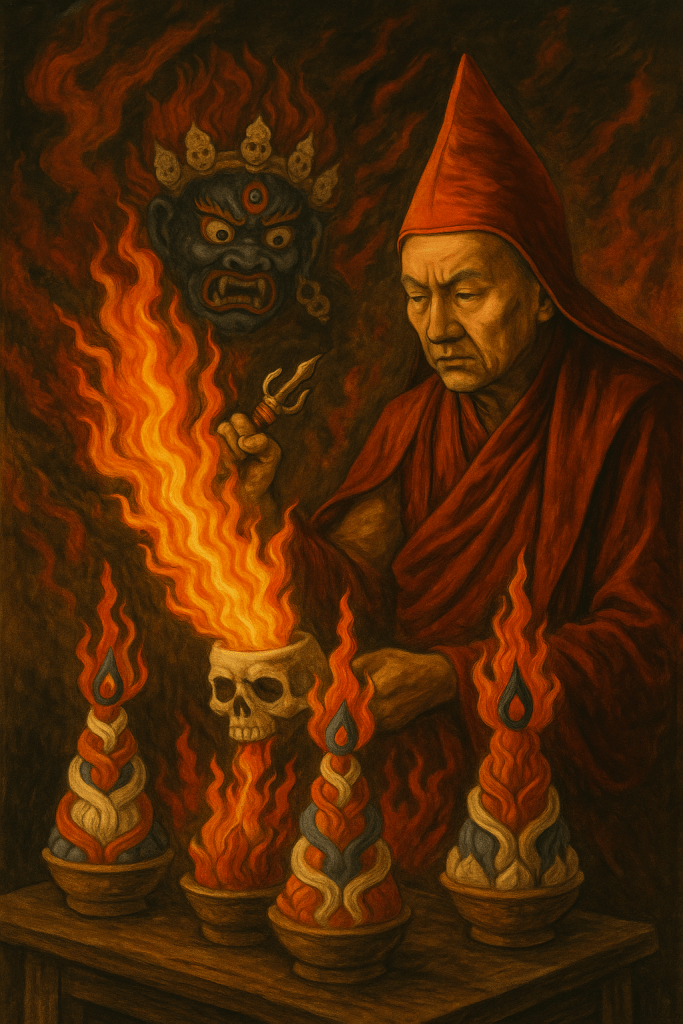
Tormas, those colorful, often conical sculptures made of barley flour, butter, and symbolic color, are widely recognized in Tibetan Buddhism as ritual offerings to deities. They are often seen as objects of devotion, used to accumulate merit and cultivate compassion. But there is another seldom discussed dimension of torma practice: their use in rituals of subjugation. These are aimed at destroying enemies, silencing dissenters, and even killing.
This article isn’t written for shock value or out of cultural disrespect. It comes from a deep need for transparency. I practiced within Tibetan Buddhism for decades, and what I discovered about the weaponization of these ritual objects came not from hearsay or internet rumors, but from firsthand experience, insider teachings, and years of quiet observation that finally crystallized into understanding.
What Are Tormas?
Tormas are empowered physical representations of deities as well as their palaces and mandalas. They also serve as offerings to the deities. Some types of tormas are used for offerings to spirits, and as weapons against obstructive spirits or humans. Other types of tormas known as “effigies” serve as targets. They are not merely symbolic. In Vajrayana practice, the effigies serve as “substitute bodies” for the consciousness of beings, meaning that a torma can become the ritual stand-in for an actual person. When a torma is offered, burned, stabbed, buried, or fed to spirits, it is not just a prop. It is, ritually speaking, a direct vessel for action.
In general, use of tormas can be for peaceful or wrathful purposes.
Categories of Harmful Tormas
While Western practitioners are often taught the “peaceful” or “blissful” uses of tormas (such as offering to bodhisattvas or for pacifying illnesses), most Tibetan tantric lineages include the “four activities” of pacifying, enriching, magnetizing, and subjugating. These last two, magnetizing and subjugating, can lead to dangerous territory.
Here are some of the more occult, wrathful uses of tormas:
1. Subjugation of Enemies
Tormas are used to summon wrathful deities, who are then directed to “crush” or “bind” an enemy’s consciousness. This includes ritual domination of the enemy’s will, health, and spiritual power.
2. “Black Torma” Killings
Some lineages include advanced practices where a torma is empowered as the life force of a person. The torma is ritually destroyed: stabbed, burned, or fed to spirits. The goal is to destroy the target’s body, mind, or soul. In some cases, the practitioner prays explicitly for the target’s death.
3. “Torma of Speech Destruction”
These are used to silence critics or opposing religious figures. The practitioner invokes wrathful deities to sever the “enemy’s” speech, discredit them, or even cause them to go mad.
4. Sending Spirits via Tormas
Tormas can serve as carriers or offerings to nefarious spirits, binding the target’s consciousness to entities tasked with tormenting them. This can result in psychic invasion, night terrors, loss of mental clarity, or obsession.
Why This Needs to Be Talked About
These rituals are rarely, if ever, disclosed to outsiders. In fact, many lamas downplay them entirely until a student is “ripe” for higher teachings. But many practitioners have felt the effects of these rituals without knowing what they are. Unexplained breakdowns, spiritual confusion, sudden illness, and relational collapse often follow a break with the guru or a breach of samaya. We are told it is just our karma, but sometimes, it’s a ritual backlash.
If this sounds unbelievable, I understand. It sounded unbelievable to me, too, until I experienced it firsthand.
These practices are not just theoretical. They are happening now, in retreat centers and monasteries in India, Nepal and the West, in ritual rooms, behind closed doors. And their effects are very real.
Who Is Most at Risk?
- Former students who break samaya or speak out
- Critics of the guru or institution
- Those perceived as spiritual “competitors”
- Women who reject inappropriate advances
- Outsiders who get too close to the truth
Reclaiming Truth
This article is not an indictment of all Tibetan teachers or practitioners. There are sincere people within the tradition who reject the use of harmful rites. But silence around these rituals has enabled a culture of fear, manipulation, and unchecked spiritual abuse.
It’s time to talk about it. The torma is not always what it seems. What looks like a simple offering on the altar may, in some cases, be a vessel of vengeance. We must not look away. If we really care deeply about the benefit of “all sentient beings” we must expose the truth about the dark side of tormas and their harmful uses in tantric Tibetan Buddhism.
 Tantric Deception