

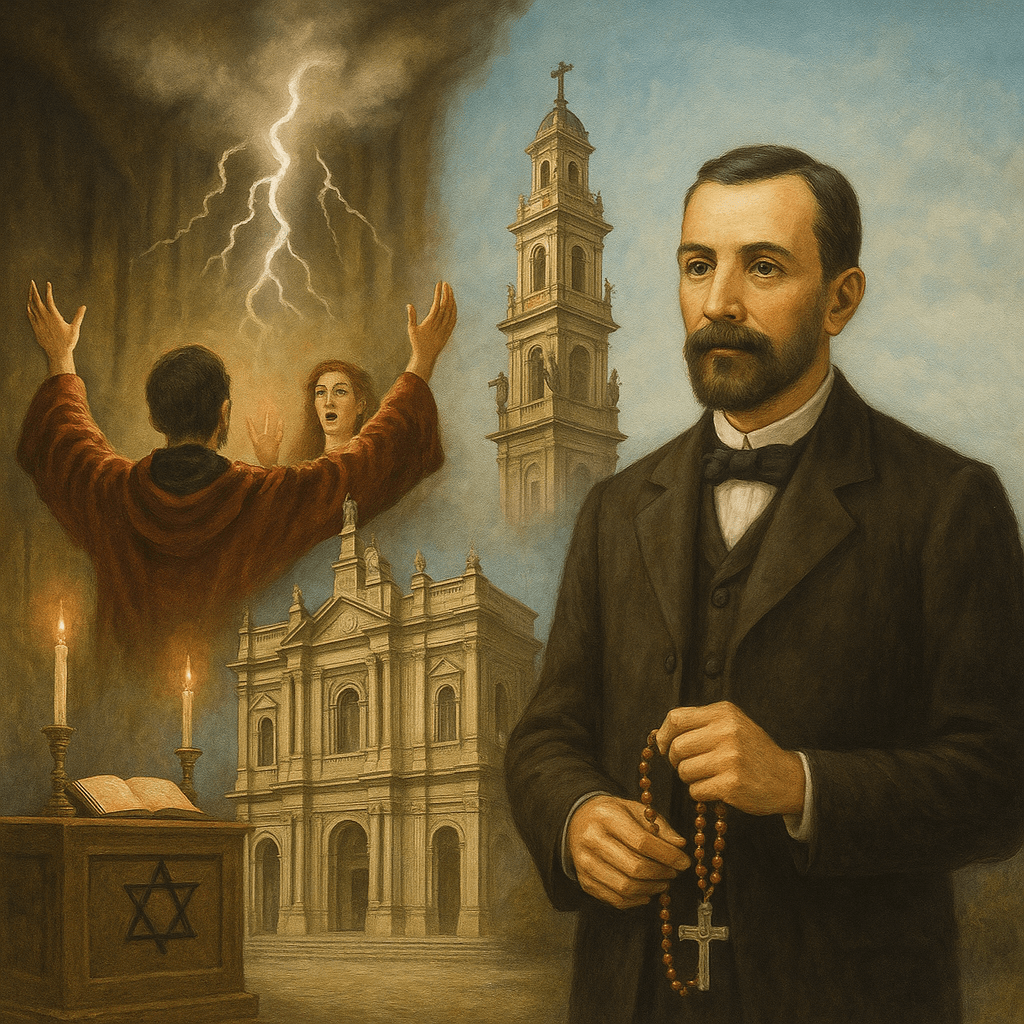
Saint Bartolo Longo was canonized by Pope Leo XIV on October 19, 2025, during a solemn Mass in St. Peter’s Square that elevated seven new saints to the altars of the Catholic Church. The Vatican’s announcement confirmed what many had long anticipated: that the once wayward lawyer who fell into occultism but found redemption would at last be formally recognized among the saints.
Before his story begins, it is worth repeating the Church’s timeless warning about the dangers of all occult practices and the spiritual counterfeits that appear holy but lead astray. The New Age fascination with séances, channeling, tarot, reiki, and yoga is not new. It is a repetition of the same deceit that misled Bartolo himself. Likewise Tibetan Buddhism, which hides black magic and sorcery behind the peaceful facade of Buddhism, should be closely examined. Bartolo Longo’s life shows something deeply consoling: no matter how far one strays into darkness, there is always a way back through repentance, confession, and devotion to Christ and His Mother.
Bartolo Longo was born in Latiano, a small southern Italian village, on February 10, 1841. His family were respected townspeople and lived comfortably with servants. Bartolo had an older sister and a younger brother, and his father worked as a physician. As a boy, Bartolo was lively and mischievous; he was quick-witted, theatrical, and often irreverent. His mother, however, formed him in devotion to the Virgin Mary and the Rosary.
When he was six, Bartolo was sent to a priest-run boarding school. He thrived there, making friends, studying hard, and developing a gift for music and fireworks. His temper, though, remained fiery. At ten, his father died, and his mother later remarried a lawyer. That stepfather’s profession drew Bartolo’s interest, and he resolved to study law.
By the 1860s, while the anti-Catholic movement was reshaping Italy, Bartolo and his brother moved to Naples for their studies. The intellectual climate was hostile to the Church. Professors openly mocked the Pope and religious orders. The young student’s faith eroded in that atmosphere. He became fascinated by the new philosophies of reason and freedom that dismissed religion as superstition.
In this environment, spiritualism was fashionable among students, and Bartolo, hungry for meaning, began attending séances. These gatherings promised secret knowledge and communion with spirits. For a time, he believed he had found truth in these occult practices. But the spirits he invoked deceived him. Gradually, curiosity gave way to obsession. He became involved with a group of spiritualists and, eventually, a full satanic sect that ordained him a “priest.” During his initiation, thunder roared, and blasphemous cries filled the air. Bartolo later recalled the terror of that night, when he felt the presence of something utterly dark take hold of him.
In the months that followed, Bartolo lived in dread. He sensed an invisible companion, an “angel of darkness,” whispering to him. He felt trapped between delusion and madness. Yet even in that state, he completed his law degree and continued public attacks against the Church. His family, horrified, prayed constantly for his conversion.
Among the few faithful Catholics left at the university was Professor Vincenzo Pepe. When Bartolo confessed that he believed he had heard his dead father’s voice, Pepe warned him that the spirits were lying and that his practices would destroy both his mind and his soul. The professor begged him to repent and return to the Church. Remarkably, Bartolo agreed. Pepe gathered others to pray for him, including Caterina Volpicelli, a devout woman who led a Rosary group dedicated to the Sacred Heart of Jesus.
Through their prayers, Bartolo met Father Alberto Radente, a Dominican friar. For a full month, Father Radente counseled and exorcised him daily. Finally, on June 23, 1865, the Feast of the Sacred Heart, Bartolo made his confession and received absolution. He was reconciled to the Church and freed from the darkness that had enslaved him.
Overwhelmed with gratitude, Bartolo vowed to save others from the same deception. He attended one last séance, not to participate, but to renounce it. In the midst of the meeting, he stood up, raised a medal of the Virgin, and publicly proclaimed that spiritualism was a web of falsehood. From that moment, he dedicated his life to Christ and to Mary.
With the guidance of his spiritual directors, Bartolo discerned that his vocation was not to marry or become a priest but to serve God as a lay Dominican. On October 7, 1871 on the Feast of Our Lady of the Rosary, he entered the Third Order of St. Dominic, taking the name Brother Rosario. He studied diligently, prayed the Rosary daily, and worked among the sick and poor.
When he traveled to Pompeii to manage property for a widow, the Countess Marianna de Fusco, Bartolo found the people living in ignorance and superstition. The local church was in ruins. Remembering his own past, he resolved to restore both the building and the people’s faith. During a time of despair, haunted by thoughts of damnation, he heard an interior voice say: “If you seek salvation, propagate the Rosary. Whoever spreads the Rosary will be saved.” At that instant, peace filled his soul, and he understood his mission.
Bartolo restored the church, began teaching the Rosary, and organized an annual Feast of the Rosary in 1873. He brought to Pompeii a worn painting of Our Lady of the Rosary, later associated with miracles that drew pilgrims from across Italy. Encouraged by the Bishop of Nola, he began building a grander church, whose cornerstone was laid on May 8, 1876. Fifteen years later, it was consecrated by Cardinal Raffaele Monaco La Valletta, representing Pope Leo XIII. Today, the Pontifical Shrine of the Blessed Virgin of the Rosary of Pompeii welcomes tens of thousands of pilgrims daily.
His mission expanded beyond the basilica. Bartolo founded schools, orphanages, and homes for the children of prisoners. He started a magazine and wrote extensively about the Rosary, the saints, and Christian life. To avoid scandal from his close collaboration with Countess de Fusco, Pope Leo XIII advised them to marry. They wed on April 7, 1885, living chastely as brother and sister while continuing their charitable work.
Bartolo died peacefully on October 5, 1926, after receiving Holy Communion and praying the Rosary surrounded by orphans. His last words were, “My only desire is to see Mary, who has saved me and who will save me from the clutches of Satan.” Pope John Paul II beatified him on October 26, 1980, calling him “a man of the Rosary.” On October 19, 2025, Pope Leo XIV canonized him as Saint Bartolo Longo, Apostle of the Rosary.
Bartolo’s life remains a witness for every age: no matter how lost or deceived, a soul that turns back to God can be saved. His feast day is October 5.
Credit:
Summary inspired by Bartolo Longo by Mary’s Dowry Productions (2017), available on YouTube: https://www.youtube.com/watch?v=3OQLRndbHIM. Used under fair use for educational and religious commentary.
 Tantric Deception