How So-Called “Buddhist” Dhāraṇīs, Images and Mandalas Were Developed Post Buddha


I spent years as a Tibetan tantric Buddhist practitioner. I once assumed the mantra, ritual, and mandala machinery I practiced was simply the Buddha’s own teaching passed down intact. We were taught that although the historical Buddha did not teach tantra in person, he taught it after his passing, on Mount Malaya, to gods and men. Koichi Shinohara’s work forces a different view and poses the question: Did Sakyamuni really teach the long formulaic dhāraṇīs, image worship, and mandala visualization as later practitioners used them? Or did later communities invent those ritual technologies and then cloak them in the Buddha’s authority so people would better accept them?

In Spells, Images, and Maṇḍalas: Tracing the Evolution of Esoteric Buddhist Rituals, Shinohara gives us a working hypothesis that can be pressed hard for answers.[1] The rituals in question are most plausibly later innovations that used the Buddha’s prestige to become authoritative. They were not the Buddha’s core teachings in any strictly historical sense. That does not make them illegitimate as religious forms for people who practice them today. It does mean historians and critics should stop pretending these rituals are reflections of Sakyamuni’s own instructions. The burden of proof rests on anyone who wants to show unbroken doctrinal transmission from the Buddha to the later esoteric ritual machinery.

Shinohara offers a testable, evidence-driven reconstruction. He traces a plausible sequence from simple spoken spells through image ritual to organized visualization. Crucially, he foregrounds early, datable Chinese dhāraṇī collections and ritual manuals. Those Chinese witnesses often predate the surviving Sanskrit and Tibetan corpora scholars have relied on. That chronological fact is the hinge of the whole argument. (Columbia University Press)

What Shinohara’s working hypothesis means

A working hypothesis is provisional and falsifiable. Shinohara is not issuing an ideological verdict. He is proposing a historical explanation that organizes the evidence and makes concrete predictions that could be falsified by earlier, securely dated Indian or canonical texts showing the full ritual machinery already present in the Buddha’s time. To press the hypothesis hard, scholars should look for those disconfirming witnesses. So far the datable documentary and manuscript evidence he emphasizes points toward post-Buddha innovation that relied on attribution to the Buddha for legitimacy.

The core empirical point

Early Buddhism included ritual speech. The Pali paritta corpus shows that communal protective chants and recitations were an early feature of Buddhist practice. Importantly, these early chants are directed primarily to the historical Buddha and the Triple Gem, the Buddha, the Dhamma, and the Saṅgha, rather than to the later, expanded pantheon of cosmic buddhas and bodhisattvas that appear in Mahāyāna and tantric literature. By contrast, the long, formulaic dhāraṇīs with non-lexical syllables, their ritual manuals, and the tightly scripted mandala visualizations appear in the surviving record mainly in later sources, often first in Chinese translations and compilations dated to the fourth through eighth centuries. That pattern strongly suggests the later technical dhāraṇī and mandala apparatus developed after the historical Buddha and used his name as an authority seal rather than being his literal, unbroken teaching (see Ratana Sutta and the paritta collections; Access to Insight).

Pali paritta versus three representative dhāraṇīs

Below is one short Pali paritta example and three representative dhāraṇī excerpts that have early Chinese witnesses. For each dhāraṇī there is a short literal transliteration excerpt, the earliest datable Chinese witness, and why this matters for Shinohara’s thesis.

A note about transliteration and length. Full dhāraṇī texts can be very long and use non-lexical syllables. I quote short, clearly identifiable openings or kernel sequences and give citations to the editions or translations where you can read the full texts.

A. Pali paritta exemplar (short protective chant from the Buddha’s time)

  • Text (Pali, introductory formula used in paritta recitation):
    Namo tassa bhagavato arahato sammāsambuddhassa.
    Translation: “Homage to the Blessed One, the Worthy One, the Fully and Exactly Awakened One.”
    Dating and context: part of the Ratana Sutta and the paritta repertoire attested in the earliest Pali strata and used continuously in Theravada protective ritual. These are short, lexically meaningful formulas employed in communal contexts. (Access to Insight)

This matters because paritta recitation shows early Buddhists used spoken protective formulas directed to the Buddha and the Triple Gem. That continuity leaves an opening for later mantra culture to develop, but continuity alone does not prove that the later technical dhāraṇīs were the Buddha’s teaching.


B. Uṣṇīṣavijayā dhāraṇī: short transliteration excerpt and dating

  • Transliteration excerpt (IAST style, short kernel):
    oṃ aḥ hūṃ uṣṇīṣa vijaya svāh. Translation: “Om. Ah. Hum. Victory to the Ushnisha. Svāhā.” Note: full versions are much longer and include complex Siddhaṃ syllables. The line above is a short recognizable kernel rather than the entire dhāraṇī.
  • Earliest datable witness: multiple Tang dynasty Chinese translations; primary translations appear in the late seventh century and the text circulated widely in Tang China thereafter. Several ritual manuals for this dhāraṇī were also translated into Chinese. (84000)

This is important because Uṣṇīṣavijayā is a canonical example of a dhāraṇī that crystallized as a ritual unit in China by the seventh century. Its early and repeated Chinese attestations show how the formulaic dhāraṇī corpus became standardized in East Asia, a datum that supports Shinohara’s emphasis on Chinese witnesses. (84000)


C. Nīlakaṇṭha / Great Compassion dhāraṇī: short transliteration excerpt and dating

  • Transliteration excerpt (short recognizable opening):
    Namo ratna trayāya … oṃ namaḥ parāya svāhā. Translation: “Homage to the Three Jewels… Om. I bow to the Supreme. Svāhā.”
    Again, the dhāraṇī in practice is very long; this is a short illustrative kernel.
  • Earliest datable witness: Bhagavaddharma’s Chinese transliteration of the Thousand-armed Avalokiteśvara dhāraṇī is commonly dated to ca. 650–661 CE at Khotan, and Dunhuang manuscript copies are attested from the eighth century onward. The standard East Asian version is listed in Taishō as T.1060. (Wikipedia)

This matters because the Great Compassion dhāraṇī’s early Chinese and Central Asian circulation shows the mobility of formulaic spells across cultural borders and their crystallization in Chinese textual layers before the later Tibetan tantra apparatus matured. That pattern again undercuts a simple claim of unbroken oral descent from the historical Buddha.


D. The Dhāraṇī of the Six Gates: transliteration indicator and dating

  • Short indicator: the sutra opens with formulaic addresses and contains six gate dhāraṇī sequences; full transliteration is available in modern critical editions. The Chinese translation by Xuanzang is dated to 645 CE (Taishō 1360). (84000)

This matters because Xuanzang’s mid-seventh century translation gives a secure terminus ante quem for certain dhāraṇī forms in East Asia. The existence of such dated translations is exactly the kind of evidence Shinohara places in the foreground when reconstructing the genealogy of ritual techniques. (84000)

Short methodological point about dates and what they prove

When a long formulaic dhāraṇī and a ritual manual appear in a secure, dated Chinese translation in the seventh century but not in any securely dated Indian source from the centuries immediately after the Buddha, the safest historical inference is that the particular ritual form crystallized later and that Chinese transmission played a major role in its textual preservation and standardization. That does not prove the practice first originated in China. It does show that the textual and ritual machinery as preserved and circulated in East Asia is early and often predates surviving Sanskrit witnesses. Shinohara uses exactly this dating logic to show how spells, images, and visualization interrelate historically. (Columbia University Press)

Did the Buddha forbid images or deification of himself?

Canonical passages caution against attachment to the person of the teacher. A well known example is the Vakkali Sutta where the Buddha tells the sick Vakkali that seeing the Dhamma is what matters, not seeing his physical body: “One who sees the Dhamma sees me; one who sees me sees the Dhamma.” That admonition has been read as discouraging hero cult and literal deification. (SuttaCentral)

The archaeological and textual record complicates the claim that the Buddha formally forbade images. However, here is a settled scholarly debate about early “aniconism” in Buddhist art. Most scholars agree that standardized, large anthropomorphic Buddha images do not appear widely until several centuries after the historical Buddha’s death. Some specialists argue that early absence of the anthropomorphic image reflects doctrinally driven aniconism. Other specialists argue the evidence is better explained by devotional practice, material culture, and local circumstances rather than by a simple canonical ban. In short, canonical caution about attachment to persons exists, but practice evolved in ways that embraced images for devotional, pedagogical, and institutional reasons. (Wikipedia)

For the former practitioner who wants a practical takeaway

If you were taught that tantric rituals are from Sakyamuni’s own instructions, the historical picture is more complicated and poses big questions to that narrative. The very technical dhāraṇī machinery, image cults, and visualization systems that define much of later tantric practice have a historical biography. They emerge, consolidate, and professionalize in the centuries after the Buddha lived, and much of the documentary evidence that preserves them comes from dated Chinese compilations and Dunhuang manuscripts. That history changes how they should be presented when someone claims they were directly taught by the Buddha himself.

History cannot prove the metaphysical provenance of a ritual. Textual and manuscript research can show whether a practice dates to Sakyamuni’s lifetime or to later cultural development, but it cannot by itself settle whether a given visionary or ritual impulse is benign or malign. If you take the language of spiritual warfare seriously, that uncertainty argues for caution. Here are four practical questions to ask before you embrace a practice: Where does its chain of transmission point? Does it coherently line up with the ethical core of the Buddha’s teaching, such as nonharm, compassion, and right conduct? What fruits does it produce in practitioners’ lives, emotionally and morally? And how transparent are its teachers about origins and effects? If a practice fails those tests, step back and favor practices that visibly cultivate ethical integrity and mental clarity. For someone who has been inside the tantric world, this is not an abstract exercise. It is a matter of spiritual survival. Let historical honesty inform your discernment, and let the lived, ethical results of practice be the final arbiter.

Sources and Bibliography

[1] Koichi Shinohara. Spells, Images, and Maṇḍalas: Tracing the Evolution of Esoteric Buddhist Rituals. New York: Columbia University Press, 2014. xxii, 324 pp. ISBN 9780231166140. See especially Chapter 1, “The Three Ritual Scenarios” (pp. 1–28), the material on the Collected Dhāraṇī Sūtras and the All-Gathering ceremony (pp. 28–89), and the chapters on the introduction of visualization practice (pp. 89–160). Recommended exact pages to quote when discussing the three scenarios and Chinese-dated evidence: consult pp. 1–4, pp. 28–64, and pp. 89–118 for Shinohara’s core arguments and manuscript citations. (Columbia University Press)

Primary dhāraṇī witnesses and editions (quick references)

  • Dhāraṇīsaṃgraha, Taishō no. 901, translated by Atikūṭa in the Tang; contains collected dhāraṇī sūtras and an early mandala initiation ritual. See Taishō T.901 and catalog entry. (NTI Reader)
  • Uṣṇīṣavijayā Dhāraṇī. Multiple Tang Chinese translations; widely circulated from the late seventh century. See 84000 Reading Room entries explaining translation history. (84000)
  • Nīlakaṇṭha / Great Compassion Dhāraṇī. Bhagavaddharma’s Khotan transliteration dated ca. 650–661 CE; standard Taishō entry T.1060 and Dunhuang manuscripts attest its early East Asian circulation. (Wikipedia)
  • Dhāraṇī of the Six Gates. Chinese translation by Xuanzang dated 645 CE (Taishō 1360). See Xuanzang colophon and modern critical editions. (84000)

Pali and early canonical material (for paritta comparison)

  • Ratana Sutta, Sutta Nipāta 2.1. Standard Pali editions and translations; see SuttaCentral and Access to Insight translations for text and context. (Wikipedia)

Secondary literature and resources on dating, aniconism, and early ritual evidence

  • Scholarly debate on Buddhist aniconism and the delayed appearance of anthropomorphic Buddha images. See Susan L. Huntington, “Early Buddhist Art and the Theory of Aniconism” and subsequent debates summarized in surveys of early Buddhist art. (Buddhism Library)
  • Columbia University Press page for Shinohara’s book with contents and excerpt. (Columbia University Press)
The Slow Dawning: Rethinking Tibetan Tantric Buddhism


It has taken me decades to admit something that began as a faint suspicion, then settled into unease, and now has crystallized into a sober conclusion: Tibetan tantric Buddhism is not what I thought it was. Nor is it what I believed when I first encountered it many years ago, a bit before the time His Holiness the Dalai Lama received the Nobel Peace Prize in 1989.

Back then, the first wave of Tibetan lamas and rinpoches were arriving in the West. To many of us, they seemed like emissaries from a lost Shangrila. Coming out of the disillusionment of the Vietnam War years, with trust in government and organized religion badly shaken, we were primed to seek something transcendent and pure. And here were these men, holy men trained in the monasteries of old Tibet, carrying with them an aura of mystery and profound wisdom. Meeting them felt like an unimaginable stroke of good fortune.

The historical Buddha’s teachings struck us as luminous and deeply humane. The philosophical treatises were subtle, the meditation techniques precise and effective. And then there was tantra. We were told, almost in passing, that tantra too came directly from the Buddha. No mention was made of its roots in Shaivism, or its overlaps with the worship of Shiva, Kali, and the other tantric currents in Indian religion. Yes, there were references to the 84 Siddhas, some of whom practiced in Hindu traditions, but it was presented as a kind of colorful backdrop rather than something that demanded careful inquiry. The task, we were told, was to study the dharma, not to ask too many uncomfortable questions.

And yet, the Buddha himself had urged his students to test his words as one tests gold: cutting, burning, hammering to see if it is true. I carried that instruction into Tibetan Buddhism. But the environment I found myself in didn’t encourage such testing. Quite the opposite.

Very quickly, I was drawn into the highest yoga tantras. After a series of initiations that were performed in Tibetan, a language I didn’t understand, I was informed by a lama I scarcely knew that from now on, I had to do whatever he told me. Cognitive dissonance set in immediately. Around me, others spoke of him as a fully enlightened buddha. Terms like samaya and vajra hell were introduced without context, wrapped in a swirl of historical Buddha teachings and cryptic tantric concepts. Critical thought was not just discouraged; it was quietly undermined. The lama was king, and the student’s role was obedience.

For Westerners raised with democratic ideals and an education that stressed inquiry, this was a bewildering fit. Many of us unconsciously overlaid our early religious conditioning onto what was, in fact, a foreign and feudal religious structure with a pantheon of strange and colorful deities. The result of treating the lama as an omniscient god created confusion, sometimes tragedy. I have heard of suicides, psychotic breaks, and lives unmoored. At the same time, I know people who genuinely believe they have benefited from Tibetan Buddhism. For years, I counted myself among them, until my own turn came.

I was privately attacked by my gurus during a tantric ritual for what I considered minor offenses related to situations outside of my control. What followed was worse: a series of what can only be described as black magical assaults. I now look back at those suicides I had once heard about and wonder: had they endured similar attacks, subtle or overt, after questioning or disappointing their teachers? Perhaps. I cannot know for sure. But I do know this: the mask of compassion many lamas wear often drops when they feel challenged or exposed. Not all, certainly. But enough to form a pattern.

That slow dawning that Tibetan tantric Buddhism was not what it was presented to be has been deeply painful. The disillusionment runs far beyond personal disappointment; it speaks to a betrayal of trust, the suppression of critical thought, and the dangers that arise when power is handed to unaccountable gurus who claim authority over hidden magical practices and wield them at will. Brought into a Western culture of sincere but searching seekers, this has created a toxic mix that leaves people vulnerable at the very moment they are most open.

The Shadow Side of Tantra: Magic and Violence Lurk Behind the Mask of Compassion

A ritual battle scene: Kschetrapala rising from a burning sacrificial torma outside Lhasa, facing the monstrous nine-headed Chinese demon in a clash of spirit armies.


This article contains excerpts from The Shadow of the Dalai Lama: Sexuality, Magic and Politics in Tibetan Buddhism by Victor and Victoria Trimondi

Who were the Trimondis?

Victor and Victoria Trimondi are the pen names of German cultural historians Herbert and Mariana Röttgen. In the 1980s and early 1990s, they were active supporters of the Dalai Lama, translating and publishing his works into German and helping to organize international events in support of Tibet. Initially, they saw Tibetan Buddhism as a beacon of compassion and ethical renewal.

But their perspective changed. Over years of study, they became disillusioned by what they regarded as the darker, concealed aspects of Tibetan tantric Buddhism: ritual magic, sexual practices, secrecy, and the fusion of religion with political power. Their critical work The Shadow of the Dalai Lama: Sexuality, Magic and Politics in Tibetan Buddhism (2003) full text here seeks to expose these elements, drawing heavily on Tibetan source texts and the earlier ethnographic research of figures like René de Nebesky-Wojkowitz (Oracles and Demons of Tibet, 1956) and Matthias Hermanns.

Because of this trajectory, from enthusiastic supporters of Tibetan Buddhism to outspoken critics, the Trimondis occupy a controversial position. Admirers of Tibetan Buddhism accuse them of exaggeration and hostility, but their book nonetheless catalogs texts, rituals, and historical examples that complicate the popular image of Tibetan Buddhism as peaceful and compassionate.


Excerpts from The Shadow of the Dalai Lama

Part II, Chapter 8: Magic as a Political Instrument

The following excerpts illustrate how the Trimondis argue that ritual magic was systematically integrated into Tibetan politics and warfare:

Invocation of demons
Since time immemorial ritual magic and politics have been one in Tibet. A large proportion of these magic practices are devoted to the annihilation of enemies, and especially to the neutralizing of political opponents. The help of demons was necessary for such ends. And they could be found everywhere — the Land of Snows all but overflowed with terror gods, fateful spirits, vampires, ghouls, vengeful goddesses, devils, messengers of death and similar entities, who, in the words of Matthias Hermanns, “completely overgrow the mild and goodly elements [of Buddhism] and hardly let them reveal their advantages” (Hermanns, 1965, p. 401).

For this reason, invocations of demons were not at all rare occurrences nor were they restricted to the spheres of personal and family life. They were in general among the most preferred functions of the lamas. Hence, “demonology” was a high science taught at the monastic universities, and ritual dealings with malevolent spirits were — as we shall see in a moment — an important function of the lamaist state.


The war demon Kschetrapala
Once the gods had accepted the sacrifice they stood at the ritual master’s disposal. The four-armed protective deity, Mahakala, was considered a particularly active assistant when it came to the destruction of enemies. In national matters his bloodthirsty emanation, the six-handed Kschetrapala, was called upon. The magician in charge wrote the war god’s mantra on a piece of paper in gold ink or blood from the blade of a sword together with the wishes he hoped to have granted, and began the invocation.

Towards the end of the forties the Gelugpa lamas sent Kschetrapala into battle against the Chinese. He was cast into a roughly three-yard high sacrificial cake (or torma). This was then set alight outside Lhasa, and whilst the priests lowered their victory banner the demon freed himself and flew in the direction of the threatened border with his army. A real battle of the spirits took place here, as a “nine-headed Chinese demon”, who was assumed to have assisted the Communists in all matters concerning Tibet, appeared on the battlefield. Both spirit princes (the Tibetan and the Chinese) have been mortal enemies for centuries. Obviously the nine-headed emerged from this final battle of the demons as the victor.


“Voodoo magic” in Tibetan Buddhism
The practice widely known from the Haitian voodoo religion of making a likeness of an enemy or a doll and torturing or destroying this in their place is also widespread in Tibetan Buddhism. Usually, some substance belonging to the opponent, be it a hair or a swatch from their clothing, has to be incorporated into the substitute. It is, however, sufficient to note their name on a piece of paper…

Such “voodoo practices” were no rare and unhealthy products of the Nyingmapa sect or the despised pre-Buddhist Bonpos. Under the Fifth Dalai Lama they became part of the elevated politics of state. The “Great Fifth” had a terrible “recipe book” (the Golden Manuscript) recorded on black thangkas which was exclusively concerned with magical techniques for destroying an enemy.


Why all this matters

These passages highlight a side of Tibetan Buddhism that is largely hidden from public view: the integration of destructive magic and spirit warfare into the machinery of the lamaist state. Nebesky-Wojkowitz’s research on ritual manuals, Hermanns’ cultural observations, and the Trimondis’ synthesis all converge on the same conclusion: alongside compassion and wisdom, Tibetan Buddhism preserved and continues to use technologies of coercion and violence.

For modern practitioners and students in the West, this raises unavoidable questions:

  • Are newcomers told that tantric ritual includes not only deities of compassion but also demon invocations and rites of subjugation? What risks do these violent magical technologies pose for the unsuspecting student?
  • What does “consent” mean if disciples are invited to take refuge in Tibetan Buddhism and receive empowerments without knowledge of these dimensions?
  • How much of this is framed as symbolic or metaphorical today, and is that distinction clearly explained? Evidence suggests that such practices continue much as they did in the past, which makes a thorough and honest examination all the more urgent.

Conclusion

The Trimondis’ work is controversial, but it is also important because it insists on remembering what is usually forgotten or denied. If the compassionate face of Tibetan Buddhism is to be embraced honestly, then its shadow side, the reality of political magic, demon invocations, and coercive ritual, must also be acknowledged. Only then can students and practitioners engage with full awareness, rather than be fooled by the illusion of partial truths.


References and Further Reading

  • Victor & Victoria Trimondi, The Shadow of the Dalai Lama: Sexuality, Magic and Politics in Tibetan Buddhism (2003).
  • René de Nebesky-Wojkowitz, Oracles and Demons of Tibet (1956).
  • Matthias Hermanns, The Indo-Tibetan Religion of the Great Goddess of the Land (1965).
  • Melvyn C. Goldstein & A. Grunfeld, The Making of Modern Tibet (1996).
  • Samten Karmay, The Secret Visions of the Fifth Dalai Lama (1988).

The Illusion of Consent

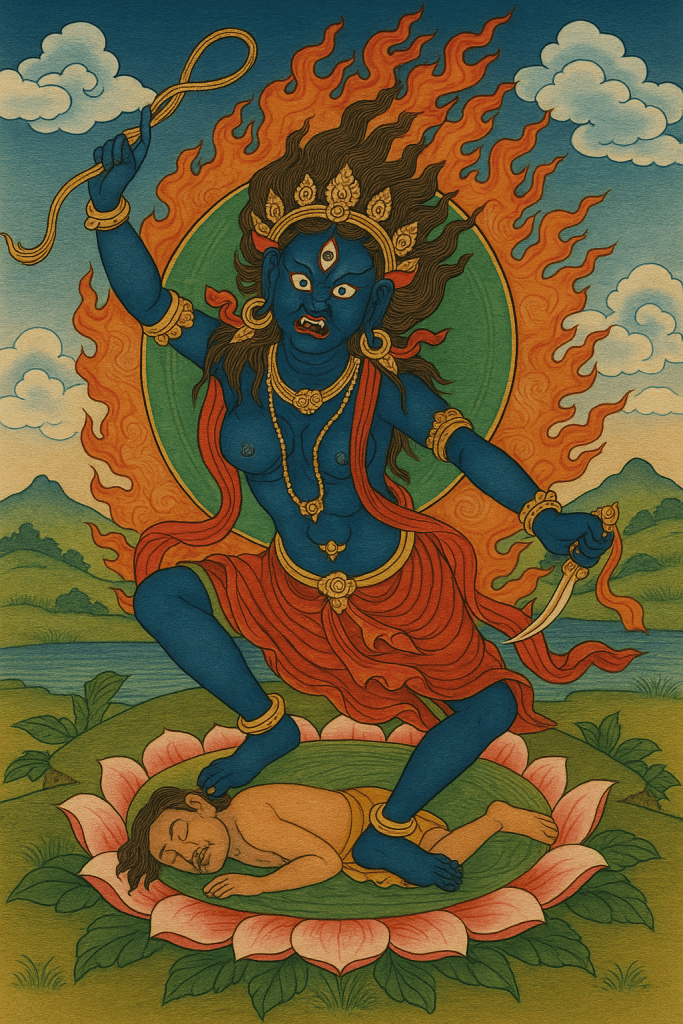
Kurukullā, the red goddess of magnetizing, depicted in a traditional Tibetan thangka style, embodying the tantric power to attract and bind.

Western seekers approaching Tibetan Buddhism are usually drawn to its most humane face. Chenrezig practice promises the cultivation of boundless compassion through visualizing Avalokiteśvara and reciting his mantra Om Mani Peme Hung. Tonglen “taking and sending” practice trains the mind to breathe in the suffering of others and breathe out relief. These sincere aspirations are the public face of Tibetan Buddhism. Yet this religion also preserves a hidden curriculum. Alongside compassionate practices sit the four activities that structure tantric ritual: pacifying, enriching, magnetizing, and subjugating. This fuller picture is rarely presented to beginners, and yet it has consequences for any claim to informed consent.[1]

The four activities: not just compassion

The four activities, known in Sanskrit as caturkarman, classify tantric rites by their intended effect:

  • Pacifying (śāntika) calms illness and obstacles.
  • Enriching (puṣṭika) augments longevity, merit, charisma, retinues, and wealth.
  • Magnetizing (vaśīkaraṇa) draws people and circumstances into a chosen orbit.
  • Subjugating (abhicāra) forces or destroys enemies.

These are not modern inventions but standard categories across tantric manuals and commentaries.[2]

While Western students are typically introduced to the activities of pacifying and enriching, the other two, magnetizing and subjugating, remain obscure, despite being prominent in tantric ritual literature. Historian Jacob Dalton has shown that violent tantric rites were not marginal but integral, even harnessed by Tibetan states to consolidate power in the medieval period.[3]

Kurukullā: the red goddess of attraction

Kurukullā, a red goddess associated with Amitābha and Tara, epitomizes magnetizing. In traditional texts she is praised as the deity of attraction, and in Tibetan sources she is sometimes known as the “Magnetizing Tara.” She is depicted holding a arrow, bow, flower and hook, all instruments of enchantment. [4]

Contemporary dharma centers sometimes describe her as a deity of love and influence, a kind of esoteric Cupid. But Tibetan ritual manuals, as catalogued by Stephan Beyer and translated in part by modern scholars, show that Kurukullā rites include binding the loyalty or desire of others.[5]

The omission of this material in introductory teachings is significant. Students often hear of compassion, not of enchantment and coercion.

Subjugation and tantric violence

Subjugating rituals, by contrast, can be overtly violent. Dunhuang manuscripts detail effigy rites and “liberation” practices, in which enemies are ritually slain to protect practitioners and their patrons. Dalton notes that these methods scaled from local shamanic forms into state-sanctioned tantric technologies by the 13th century.[6]

Even today, wrathful practices remain part of Tibetan public culture. Cham dances of Mahākāla, staged annually in monasteries, dramatically enact the destruction of obstacles. While these are often seen as symbolic, their presence keeps alive a framework where wrathful force is ritually mobilized against perceived threats.[7]

Samaya: the binding vow

In Highest Yoga Tantra empowerments, disciples take vows of refuge, bodhisattva vows, and tantric samaya commitments. Samaya is described as a “sacred bond” with the guru and the deity. Root downfalls include disrespecting the master or revealing tantric secrets. Breach is said to bring spiritual ruin.[8]

This means that students who take empowerments without understanding the full scope of tantric practices, including magnetizing, subjugating, and punishment rites, are effectively giving consent under partial information. Despite not understanding fully what they are entering into, the bond of samaya can become a blanket mechanism of control.

As the 17th Karmapa indicated in teachings earlier this year, samaya breakers are spoken of in language that implies wrathful retribution, both spiritual and physical. The retribution he described is not symbolic but actual. See my essay, “Read Between the Lines,” for more on this.[9]

Survivors’ voices

Accounts from survivors and critical practitioners suggest that magnetizing and wrathful practices are not just metaphors. Women have described experiences of sexual energy being manipulated at a distance, sometimes calling it a form of “astral rape.” Whether one interprets this as energetic manipulation or psychological intrusion, the perception of violation is real.

Lion’s Roar published testimonies arguing that samaya has been used as a principal mechanism of coercion in abuse cases. Independent investigations of groups like Shambhala document patterns where devotion and secrecy prevented victims from speaking out.[10]

Buddhist communities are now grappling with these realities. Some organizations are introducing explicit consent policies, recognizing that the charisma of a guru, altered states of consciousness induced during a ritual, and the binding reality of vows can impair a student’s capacity to freely choose.[11]

Historical context does not erase ethical duty

Scholars such as Ronald Davidson have contextualized tantric violence as a product of medieval frontier politics and kingship.[12] This explains how such rites developed. But historical context does not remove the ethical obligation to disclose them to modern students.

Without disclosure, the vows taken in empowerments are not truly informed. The student consents to Buddhist compassion, but is bound to a system that also contains sexual enchantment, psychological manipulation, and deadly punishments.

Conclusion

The compassionate practices of Chenrezig and Tonglen have a genuine power to transform, yet Tibetan Buddhism’s esoteric side contains hidden technologies that are not peaceful but harmful: the rites of magnetizing, subjugation, and punishment. These are attested in texts, preserved in ritual, and acknowledged by scholars and survivors alike. Until these dimensions are more fully disclosed, the vows taken in tantric empowerments remain shadowy. Consent given without knowledge of the whole spectrum of practice is not true consent. It is, as this essay argues, an illusion.

Source Notes

1. Rigpa Wiki, “Four activities,” accessed 2025.
Rigpa Wiki is a practitioner-maintained encyclopedia that summarizes key Vajrayana concepts. Its entry on the “four activities” clearly lays out pacifying, enriching, magnetizing, and subjugating as the classical categories of tantric ritual. It is not a critical academic source, but it reflects how contemporary Tibetan Buddhist institutions themselves present the material.

2. Study Buddhism, “What is Samaya?” and “Empowerment.”
Study Buddhism is a project led by Alexander Berzin and colleagues, offering accessible introductions to Buddhist theory and practice. These entries explain samaya as a binding relationship with a guru and empowerment as the ritual granting of authority to practice tantra. They are useful for showing how Tibetan teachers explain vows and empowerments to Western audiences.

3. Jacob P. Dalton, The Taming of the Demons: Violence and Liberation in Tibetan Buddhism (Yale University Press, 2011).
Dalton’s book is a landmark study of ritual violence in Tibetan Buddhism. Drawing on Dunhuang manuscripts, he shows that wrathful rites, including violent subjugation and “liberation” rituals, were integral to tantric practice. Dalton’s work challenges romantic views of Buddhism as purely peaceful.

4. Wikipedia, “Kurukullā”
The Wikipedia entry gives a concise overview of Kurukullā as a magnetizing deity across Buddhist cultures.

Tomlin, Adele. “MAGNETISING RED QUEEN, KURUKULLĀ: ‘Outshining the perceptions of others and bringing afflictive emotions under control’ teaching of 8th Garchen Rinpoche,” Dakini Translations, 8 June 2021. Available at: https://dakinitranslations.com/2021/06/08/magnetising-dancing-queen-kurukulla-outshining-the-perceptions-of-others-and-bringing-afflictive-emotions-under-control-teaching-of-8th-garchen-rinpoche/

5. Stephan Beyer, The Cult of Tārā: Magic and Ritual in Tibet (University of California Press, 1973).
Beyer’s study remains a foundational ethnography of tantric ritual in Tibet. His translations of ritual manuals include examples of both compassionate and wrathful practices, including rites of attraction and subjugation. It is particularly valuable for showing how deity practices were embedded in everyday Tibetan religious life.

6. Dalton, Taming of the Demons; see also Jacob P. Dalton, “A Crisis of Doxography,” in Journal of the International Association of Buddhist Studies 28, no. 1 (2005).
In addition to his book, Dalton’s article “A Crisis of Doxography” analyzes how violent rites were classified in Tibetan scholastic traditions. He shows that even systematizing scholars struggled to reconcile wrathful tantric methods with Buddhist ideals, which underscores their presence and their tension.

7. Associated Press, “Wrathful deities in Tibetan Cham dance,” 2024.
This news report covers annual cham dances in Tibet and in exile communities, where wrathful deities like Mahākāla are invoked to repel obstacles. It illustrates that wrathful practices are still a living part of Tibetan Buddhist culture, even if framed from the public as symbolic or theatrical.

8. Study Buddhism, “Samaya”; Rigpa Wiki, “Empowerment.”
Both entries describe the vows and commitments made during empowerment rituals. They confirm that samaya includes strict obligations to the guru and to secrecy. Their language highlights how the bonding process is explained to new students, and how much is left unspoken.

9 “Read Between the Lines: A Glimpse Into the Dark Heart of Guru Devotion,” Tantric Deception, April 4, 2025.
This essay analyzes a teaching by the 17th Karmapa, where he discussed samaya and hinted at punitive consequences for breaking devotion. It shows how even contemporary high lamas continue to invoke the discourse of samaya enforcement, reinforcing the concerns about consent.

10. Lion’s Roar, “When Samaya is Used as a Weapon,” 2018; Buddhist Project Sunshine Reports, 2018–2019.
Lion’s Roar published reflections by teachers and survivors on how samaya language has been used to silence or coerce students in abuse cases. Buddhist Project Sunshine was a grassroots effort to document sexual misconduct in Shambhala and other Tibetan Buddhist organizations. These sources provide survivor-centered evidence of how samaya functions in practice.

11. Buddhist Ethics Working Group, “Consent in Vajrayana,” 2021.
This collective statement from Buddhist practitioners and ethicists proposes new standards for sexual and spiritual consent in Vajrayana contexts. It emphasizes enthusiastic, ongoing consent and rejects the misuse of tantric language to excuse coercion. It is an attempt at reform efforts from within the tradition.

12. Ronald M. Davidson, Indian Esoteric Buddhism: A Social History of the Tantric Movement (Columbia University Press, 2002).
Davidson’s historical study situates tantric Buddhism in the political and social context of medieval India. He shows how esoteric practices were bound up with kingship, warfare, and elite patronage. His work helps explain how violent and manipulative rites could become integral to the tradition, even if they clash with Buddhist ethics.

“Books of Spells” in Tibetan Buddhism: Magnetizing and Subjugation Rites, and the Problem of Sexual and Spiritual Abuse


To view Tibetan Buddhism as purely meditative and philosophical is to miss a large and still under-mapped terrain of ritual manuals and spell collections. A 9th to 10th-century Tibetan “book of spells” from the Dunhuang cave library (British Library IOL Tib J 401) shows that Tibetan monks compiled practical ritual instructions covering healing, protection, exorcism, and subjugation. It is the earliest surviving compendium of Tibetan Buddhist magical ritual and looks exactly like what we’d call a grimoire: a working handbook of spellcraft.¹

Moving forward in time, the 18th-century polymath Slelung Zhadepa Dorje (Sle lung Bzhad pa’i rdo rje) assembled a large tantric cycle centered on the Jñānaḍākinī. Within that cycle, scholars have identified several distinct grimoires of spells that are, again, practical instruction sets embedded in a broader tantric collection. As one study notes: “This paper seeks to examine such techniques in several grimoires of spells found in the tantric cycle of Gsang ba ye shes mkha’ ’gro… compiled and edited… by Sle lung Bzhad pa’i rdo rje (1697–1740) in the 1730s.”²

“Magical practices in Buddhism are still one of the least studied aspects of the religion.”³

Despite strong indications that there are many such grimoires, from Dunhuang through later ritual cycles, there is no comprehensive catalog. Scholars themselves admit the field’s patchy mapping. Sam van Schaik emphasizes the neglect, and others underline that studies too often treat magic as a literary trope rather than as practical ritual.³ ⁴

Personal experience

I do not come to this subject as a detached scholar. I was targeted by two different lamas at different times, one of whom used coercion to draw me into a sexual relationship and then employed what I can only describe as black magic when I resisted, questioned, and tried to break free. Living through those experiences is what drove me to investigate Tibetan spell craft.

“From the inside, the grimoires of Tibetan Buddhism do not feel very different from the grimoires of Western occultism.”

Although I practiced intensely for years in long retreats, I was never taught these darker rituals, yet I witnessed unsettling rites performed by my lamas. After rebuffing the advances of the first guru, I experienced what felt like severe magical attacks that reverberated for years. The cognitive dissonance was crushing: I believed these teachers were fully enlightened buddhas, yet I suffered severe trauma and PTSD.

“Fear of vajra hell kept me clinging to the practices, even as abuse intensified.”

My second guru was later exposed publicly for sexual and psychological abuse. Being caught in his orbit, I became the target of annihilation rituals. Surviving and recovering has been extraordinarily difficult. I now see that while some teachers avoid such practices, others weaponize spells of magnetism and subjugation to manipulate students, especially women, for sex and energetic vampirization. This gray area of practical magic within Tibetan Buddhism is vast and dangerous.

What the rites actually claim to do: magnetizing and subjugation

Classical Vajrayāna sorts ritual aims into four “activities”: pacifying, enriching, magnetizing, and subjugating. These are not marginal ideas; they are a standard frame for tantric ritual. Magnetizing (Tib. dbang du sdud pa) is explicitly defined as bringing others “under one’s control,” while subjugation names violent rites directed at overcoming obstacles and destroying opponents.⁵ ⁶

Texts and prayers for magnetizing circulate broadly, for instance, the “Wang Dü” prayer attributed to Mipham, described as “magnetizing or bringing under one’s control.” None of this is esoteric in the sense of being unknown; it is central to tantric categories and practice rhetoric.⁶ ⁷

From ritual claims to real-world power: how coercion maps onto communities and individuals

A ritual manual promising to attract, influence, or subdue doesn’t automatically produce abuse. Still, the rhetoric of magnetizing and subjugation sits within a social system that grants absolute authority to gurus and expects strong devotion from students. When high-status teachers have access to rites whose very names project attraction and control, the risk of translating ritual language into interpersonal domination is real.

Recent history demonstrates the danger. In 2018 Rigpa, the international organization founded by Sogyal Rinpoche, published the results of an independent investigation by the law firm Lewis Silkin that validated numerous allegations of physical and sexual abuse and identified serious safeguarding failures.⁸

The published report recounts patterns of violence and coercion including “slapping,” “punching,” “hitting with a backscratcher, phones, cups and hangers,” and documents testimonies of sexual abuse, concluding that the community had failed to protect students.⁹

This is not to claim that tantric ritual texts instruct teachers to abuse students. It is to note a combustible mix: magical mechanisms of control, asymmetries of authority, sacralized obedience, and the frequent absence of external accountability.

Bringing the strands together

  • Books of spells are the norm: Tibetan Buddhist literature contains actual “books of spells” and multiple grimoires embedded in tantric cycles. These are not aberrations but part of the tradition.¹ ²
  • An under-researched domain: Leading scholars explicitly acknowledge that this area of Buddhist practice is still understudied.³ ⁴
  • Control as a ritual aim: The four tantric activities include “magnetizing” and “subjugating,” both routinely glossed as bringing beings or circumstances under one’s control.⁵ ⁶
  • Abuse linked to ritual rhetoric: Documented cases in Tibetan Buddhist communities show how claims to ritual power combined with intense guru-devotion can provide cover for coercion and severe abuse.⁸ ⁹

Where the research gap still matters

A fuller picture of “how many” grimoires are in Tibetan tantric collections requires systematic cataloging across canons and private libraries. Right now we have case studies and local inventories rather than a master list. These texts need to be thoroughly studied in their historical and contemporary contexts and exposed to the world for what they really are–recipes for white and black magic–not sugarcoated as quaint and innocuous artifacts.³ ⁴

Without naming and analyzing how these are taught and performed, it is hard for communities and individuals to protect themselves from magical attacks.

What better safeguards look like

  • Name the risk: community materials should explain what “magnetizing” and “subjugation” denote in practice and how these can and will be used against students at the guru’s discretion.
  • Independent oversight: adopt and publish external safeguarding standards and reporting channels. The Rigpa case shows why self-policing fails.⁸
  • Informed consent and boundaries: spell out that teacher/student sex, even where allowed by law, requires adult consent free of spiritual pressure, and that the bar for “free of pressure” is very high in asymmetric relationships.
  • Don’t assume that all Tibetan Buddhist lamas have pure intention and integrity.

The safest course is to avoid Tibetan Buddhism altogether, since in practice the guru’s needs and moods often override the Buddha’s teaching of non-harm.

A closing note on method

This article is a call for transparency and insistence on precision. Tibetan Buddhist archives contain grimoires. The tradition attracts students to its supposedly compassionate practices while concealing that darker “magnetizing” and “subjugation” practices are core ritual elements. Scholars say this area is understudied. And history shows that these techniques of control, in the hands of unaccountable authorities, can easily become abusive, even deadly.

Footnotes

  1. Sam van Schaik, “The Early Tibetan Book of Spells.” Analysis of British Library manuscript IOL Tib J 401 from Dunhuang (9th–10th century). This manuscript is recognized as the earliest surviving Tibetan compendium of spells and rituals, containing instructions for healing, protection, and exorcism. See: Sam van Schaik, Early Tibet blog (2008), and also referenced in his book Tibetan Zen: Discovering a Lost Tradition (Snow Lion, 2015).
  2. Sle lung Bzhad pa’i rdo rje’s Jñānaḍākinī cycle study (Academia.edu). Scholarly paper examining several grimoires embedded in the tantric cycle of Gsang ba ye shes mkha’ ’gro, compiled and edited in the 1730s by Sle lung Bzhad pa’i rdo rje (1697–1740). The paper highlights ritual techniques, their organization, and their status as practical spell collections within a broader cycle. Available on Academia.edu.
  3. Sam van Schaik on magical practices in Buddhism. Statement that “magical practices in Buddhism are still one of the least studied aspects of the religion.” Quoted in his writings on Buddhist magic, including his blog Early Tibet and in Tibetan Zen (Snow Lion, 2015).
  4. Cameron Bailey, “The Magic of Secret Gnosis: A Theoretical Analysis of a Tibetan Buddhist ‘Grimoire’.” Journal of the Korean Association of Buddhist Studies 84 (2020): 145–176. Available via Academia.edu. Bailey notes that “magic power in Buddhism has been studied more from the perspective of a literary trope than as practical and exactingly specific ritual techniques,” and examines grimoires embedded within the Gsang ba ye shes mkha’ ’gro (Secret Gnosis Dakini) cycle compiled by Sle lung Bzhad pa’i rdo rje in the 1730s.
  5. Vajrayāna framework of four activities. Standard tantric taxonomy of ritual aims: pacifying (zhi ba), enriching (rgyas pa), magnetizing (dbang sdud), and subjugating (dbang ’joms). Discussed in multiple Vajrayāna handbooks and summaries, including descriptions in online resources such as Rigpa Wiki and introductory texts on Vajrayāna Buddhism.
  6. Definitions of magnetizing. Magnetizing (dbang du sdud pa) is routinely glossed as “bringing others under one’s control.” See standard glosses in Vajrayāna dictionaries, sadhana commentaries, and contemporary teaching materials (e.g. Rigpa Wiki, “Four activities”).
  7. “Wang Dü” prayer attributed to Mipham. A widely recited prayer describing magnetizing activities, attributed to the 19th-century scholar Mipham Rinpoche (1846–1912). Circulates in Tibetan and English translation as a practice of magnetizing or bringing beings under one’s control.
  8. Rigpa Independent Investigation, Lewis Silkin LLP (2018). Commissioned by Rigpa International following widespread allegations against founder Sogyal Lakar (Sogyal Rinpoche). The final report documented physical assaults, psychological abuse, and sexual exploitation, and called out systemic safeguarding failures. Full report available through Rigpa’s website and media coverage (2018).
  9. Findings on abuse in Rigpa/Sogyal Rinpoche’s communities. The Lewis Silkin report and subsequent coverage summarized multiple testimonies: repeated slapping, punching, use of objects to hit students, as well as sexual coercion and exploitation of women. Findings were corroborated by survivor accounts and reinforced calls for reform in Tibetan Buddhist organizations.

The Grimoire of Secret Gnosis


A Hidden Side of Tantric Buddhism

Buddhism is usually presented in the West as a religion of mindfulness and compassion. But hidden in its tantric wing is something darker. In the eighteenth century, Sélung Shepa Dorjé (Sle lung Bzhad pa’i rdo rje) compiled a sixteen-volume cycle called Secret Gnosis Dakini (Gsang ba ye shes mkha’ ’gro, or GYCK). This was not just a collection of esoteric philosophy, but also a grimoire filled with magical spells.

According to Cameron Bailey in The Magic of Secret Gnosis: A Theoretical Analysis of a Tibetan Buddhist “Grimoire,” grimoires of spell instructions are common in Tibetan Buddhism. They often appear inside larger tantric cycles like the GYCK or in the collected works of great lamas. As the scholar Berounsky, cited by Bailey, put it, the operations in such texts are “an amalgam of tantric interventions combined with popular magic.” [1]

Volumes four and twelve of the GYCK preserve dozens of rituals for worldly power. The twelfth volume in particular reads like a magician’s handbook. It does not hide its intent; it offers ninety-two spells to heal, protect, enrich, and subjugate.

Rituals of Control

Among these spells are some dedicated to domination. Far from the common image of Buddhism as a purely gentle path of liberation, the Secret Gnosis spells allowed practitioners to bind and control others. One entire text, The Magic Lasso, instructs adepts on capturing their targets through visualization and mantra. Other spells direct them to create talismans and effigies, ritually charged to influence or destroy enemies.

Bailey emphasizes that these rituals work by merging tantric deity yoga with ritual techniques: the practitioner visualizes themselves as a wrathful god, projects light rays at the target, and seals the action with mantra. Your meditation becomes, in effect, a weapon.

The Spellbook as Technology

The grimoire aspect of the Secret Gnosis cycle cannot be overlooked. It contains practical instructions for bending reality to one’s desire. Substances like herbs, turquoise, and even urine or flesh are prescribed as tools of ritual practice.

Bailey notes that these spells are framed within a bodhisattva ethic. They are said to protect the Dharma or defend communities. Yet to modern eyes, they read unmistakably as instructions for control. This is where interpretation diverges. Bailey highlights the philosophical and ritual integration, while a critical lens reveals the coercive logic beneath the compassionate rhetoric.

A Tradition of Ambivalence

Figures like Milarepa warned against sorcery, even though his story is entangled with it. The Buddhist tradition as a whole often drew a line between miracle powers that “arise naturally” from meditation and deliberate ritual magic. But that line was blurred from the beginning. The Secret Gnosis makes clear how deeply magical domination was preserved within the canon.

Conclusion

The Secret Gnosis Dakini cycle exposes a side of tantric Buddhism rarely acknowledged publicly. Bailey shows that its grimoire-like sections are integral to tantric practice, not just marginal curiosities. What I emphasize here is that these spells—especially those of subjugation—show a system where manipulation was not an aberration but an option built into the tradition. What is presented today as a path of compassion was also, sometimes, a path of great harm.


[1] Cameron Bailey, “The Magic of Secret Gnosis: A Theoretical Analysis of a Tibetan Buddhist ‘Grimoire,’” Journal of the Korean Association for Buddhist Studies 93 (2020): 535–570.

Kundalini Possession vs. Classic Demonic Possession: A Comparative Study


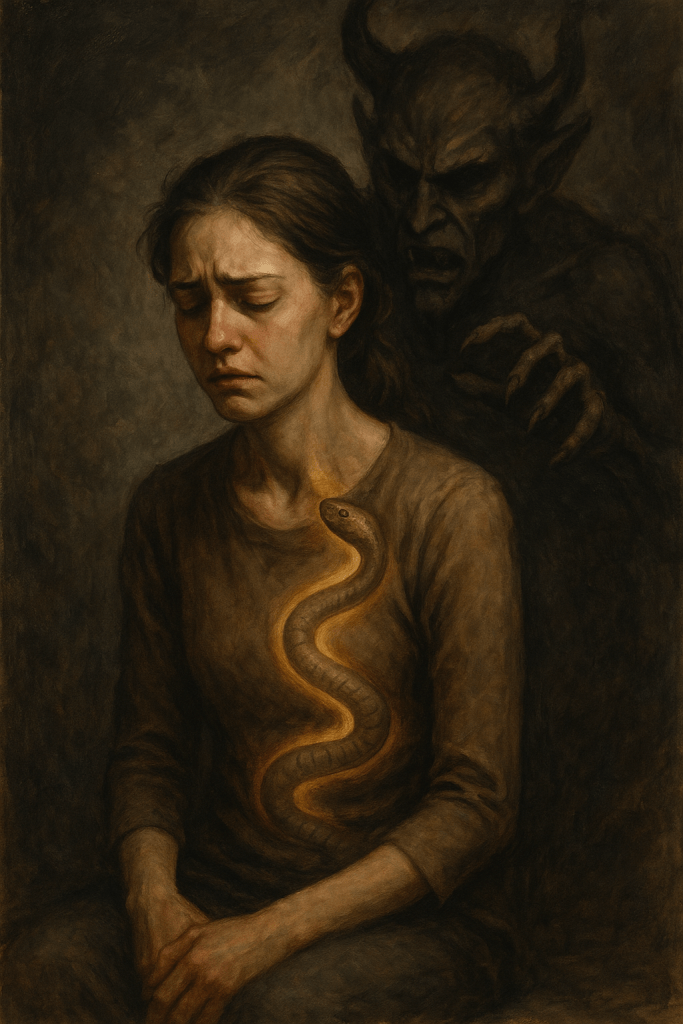
Kundalini is often described in modern yoga and New Age spirituality as a universal spiritual energy coiled at the base of the spine, waiting to rise and bring enlightenment. This portrayal is misleading. In reality, what is called a “kundalini awakening” is better understood as a form of possession. Rather than a benign inner energy, kundalini is a demonic force that enters the human mind-body continuum, hijacks the nervous system, and rewires perception, behavior, and physiology. This explains why the symptoms of kundalini often overlap with those of classic demonic possession.

Symptoms: Kundalini Possession vs. Demonic Possession

Kundalini possession symptoms

  • Involuntary bodily spasms or kriyas, often violent or exhausting.
  • A sensation of a serpent or current moving through the spine, causing heat, pressure, or pain.
  • Rapid swings between bliss and terror, often accompanied by visions or auditory phenomena.
  • Disassociation and feelings of being controlled by something non-human.
  • Progressive neurological deterioration: insomnia, paranoia, and psychosis.
  • Identification with Hindu deities or serpentine archetypes, which parallels demonic manifestations described in other cultures.

Demonic possession symptoms (more broadly recognized)

  • Aversion to the sacred, where holy names, prayers, or symbols provoke rage.
  • Manifestations of supernatural strength or the sudden ability to speak foreign languages.
  • Violent outbursts, self-harm, or aggression against others.
  • Distorted voice, grotesque facial expressions, or animal-like behavior.
  • Physical disturbances such as objects moving, foul odors, or sudden temperature drops.
  • A clear sense of hostile external control.

Both states are marked by loss of sovereignty and the intrusion of an alien intelligence. What makes kundalini more deceptive is that it cloaks itself in the language of spiritual progress.

The Entities Behind the Possessions

Kundalini-related beings

  • Kundalini is personified as Shakti, the serpent goddess. While Hindu texts portray her as divine, serpent symbolism universally points to deception and danger, as the serpent has long been associated with Satan in Christianity.
  • Many afflicted report contact with or identification as Kali, Durga, or other fierce Hindu and tantric Buddhist deities whose attributes of blood, violence, and intoxication align closely with demonic qualities.

Entities in wider demonic possession

  • Christianity: fallen angels under Satan’s authority.
  • Islam: malicious jinn, created from smokeless fire.
  • Judaism: dybbuks, wandering spirits of the dead seeking to inhabit bodies.
  • Indigenous traditions: hungry ghosts, nature demons, or restless ancestral spirits.

The same destructive force that is worshiped in India as divine feminine energy is interpreted in other traditions as demonic intrusion.

Why Kundalini Possession Often Appears Different

There are many anecdotal accounts of people afflicted by kundalini who do not display the same dramatic symptoms seen in major exorcisms performed by the Catholic Church. They may not display superhuman strength, speak unknown languages, or react violently to holy objects. Instead, their suffering appears as neurological collapse or uncontrollable kriyas.

Why does this happen? One possibility is what some exorcists call “perfect possession.” By willingly engaging in yoga, Eastern meditation, or tantric practices, the person effectively invites the spirit in. Once invited, the demon does not always need to manifest with violence or open hostility. It is already enthroned, so to speak, in the person’s consciousness and nervous system. It burrows in and embeds itself. The possession is often quieter but no less real.

Another possibility is that kundalini spirits simply manifest differently than other categories of demons. The absence of classic symptoms described by the Catholic Church may not mean the person is not possessed. It may mean they are afflicted by a different type of spirit, or by a demon whose preferred mode of influence is more insidious and long-term. Rather than breaking furniture or speaking in foreign tongues, it works by corrupting the nervous system, trapping the victim in cycles of ecstatic highs and devastating lows, and slowly eroding the mind and spirit.

Implications for the Catholic Church

Because many of these cases do not fit the criteria traditionally used to diagnose possession, individuals suffering from kundalini affliction are sometimes turned away by exorcists. Yet the sheer number of Westerners who have turned to yoga, meditation, and tantric practices since the 1960s suggests that the Church may need to reevaluate how possession presents in modern contexts. Kundalini demons may not manifest with the same overt signs as other kinds of possession, but their effects are no less destructive.

To dismiss these cases as mere psychological breakdowns risks ignoring an entire category of demonic assault that has proliferated under the guise of spirituality. The deceptive packaging of kundalini as “spiritual energy” makes it one of the most dangerous forms of possession today.