

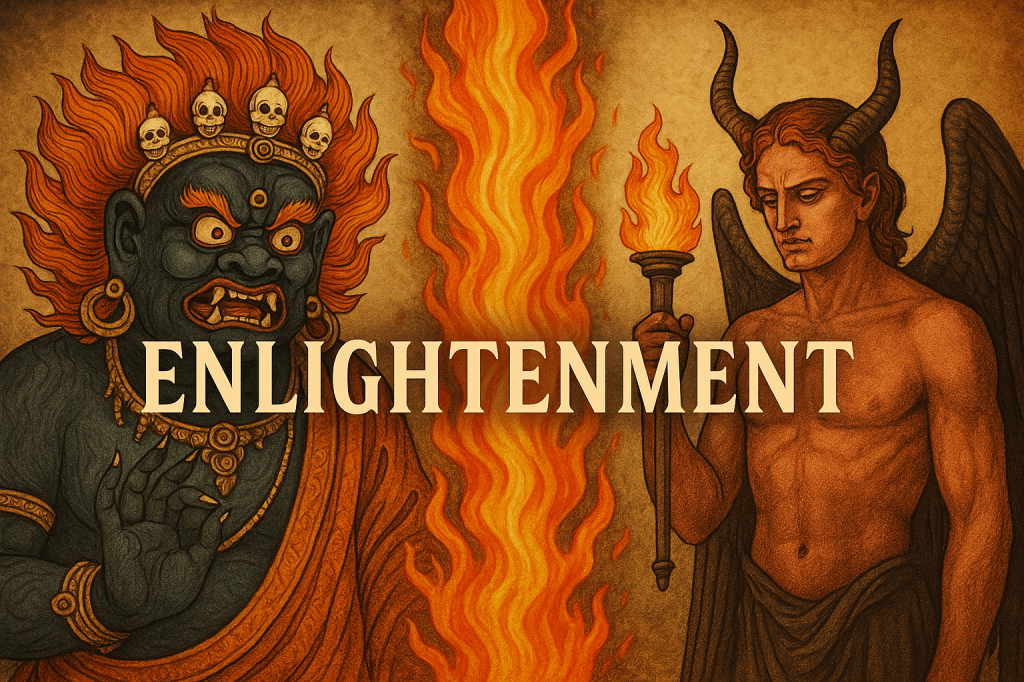
When I was a devoted Tibetan Buddhist, the word enlightenment held sacred weight. It meant the complete awakening of compassion and wisdom, the state of a Buddha who sees through illusion and dedicates themselves to freeing all sentient beings from the sufferings of samsara. I trusted in that vision, because I believed I was following a noble tradition.
But even then, something always felt a little off. I had a quiet discomfort I kept pushing aside.
The problem was this: the term enlightenment wasn’t exclusive to Buddhism. I saw the same word used in the occult, in Theosophy, Freemasonry, and even Luciferianism, often in ways that glorified rebellion and the pursuit of hidden knowledge. Why were systems as wildly different as Tibetan Buddhism and Luciferian occultism both invoking “enlightenment” and “awakening” as their ultimate goal? Why did the same term span both the sacred and the profane?
Tibetan Buddhism: Enlightenment as Compassionate Wisdom
In Tibetan Buddhism, enlightenment is the realization of emptiness, the transcendence of ego, and the birth of boundless compassion. The ideal of the bodhisattva is someone who delays their own final nirvana in order to help all other beings reach liberation. This enlightenment isn’t just something a guru gifts you; it’s a hard-won transformation of your own mind.
Vajrayana Buddhism, the tantric branch of Tibetan Buddhism, adds layers of secrecy and initiation. There are empowerments, mantras, visualizations, and guru devotion practices. It uses powerful symbols such as vajras, weapons, fire, and wrathful deities that on the surface could resemble occult ritual. This made me uneasy. Was this actually an Eastern form of the same hidden path to power that Western esoteric groups followed?
I reassured myself that Vajrayana was different. It used “occult” methods, maybe, but only to realize true compassion and emptiness. Still, the similarity in tone and terminology between tantric rituals and occult rites always bothered me.
Now, after 35 years of hard work, study, devotion, and ultimately betrayal at the hands of tantric Buddhist gurus and deities, I’ve come to a grim realization: the enlightenment I was seeking wasn’t what I thought it was. It is merely an occult system dressed in Buddhist robes. The deeper I went, the clearer it became that Tibetan Buddhism and Luciferianism are two sides of the same coin. They may use different language, imagery, and rituals, but they are architecturally and spiritually similar and they both serve darkness, not light.
The word that they share, enlightenment, is the bait they use to ensnare seekers.
Luciferianism and Tibetan Buddhism: Two Faces of the Same Enlightenment Agenda
In Luciferianism, enlightenment is about becoming your own god. Lucifer is framed not as evil, but as the “light-bringer,” the one who defies divine authority to bestow forbidden knowledge. Enlightenment here is rebellion, self-deification, and esoteric power.
Helena Blavatsky, the founder of Theosophy, which heavily influenced modern occultism, named her journal Lucifer and described the figure as a misunderstood bringer of divine wisdom¹. In The Secret Doctrine, she refers to Lucifer as the “spirit of intellectual enlightenment”² and equates him with the higher mind of humanity. Freemasonry, Theosophy, and modern occultism all share the core motif: moving from darkness to light, and from ignorance to gnosis, through secret initiation.³
This kind of “light” is occult and exclusive. The “enlightened ones” in these systems are initiates who’ve been brought into deeper mysteries. The light is not for everyone; it’s reserved for those chosen by the system who are able to serve its agenda.
What shocked me, and what I ignored for years, is that tantric Buddhism functions much the same way. It promises special teachings, revealed only to the initiated. It trains students to see their guru as a living Buddha, above criticism or doubt, and presents his questionable actions as “skillful means,” while bypassing basic moral accountability. There is a similar secretive, hierarchical structure although this one is surrounded by colorful thangkas and Sanskrit mantras.
The deeper I went, the more I saw that my devotion was being weaponized against me. Tantric gurus used “crazy wisdom” to justify harm, and “samaya vows” to silence dissent. It wasn’t really compassion, but a spiritual aristocracy, no different from the occult orders I once thought Buddhism stood apart from. The beatific vision of enlightenment for the benefit of all sentient beings was merely the bait. The hook was the hidden power of dark forces.
Now I see clearly that the word enlightenment, both in Tibetan Buddhism and Luciferianism, functions as a kind of smokescreen. It sounds noble, luminous, and superior. But in both systems, it serves those in power and creates a class of “enlightened ones” who are above reproach, who serve gods and buddhas from unseen realms that are not what they appear to be.
“Enlightened Ones” as Agents of the Lie
It’s not just that the term enlightenment is misused. It’s that those who claim it, whether in Tibetan Buddhism or Luciferianism, are agents of a system that serves a being or beings pretending to be of the light.
These “enlightened ones” often behave the same way, regardless of tradition: they demand loyalty, obedience, and silence. They wield charisma and secrecy as tools. And when challenged, they invoke mystical authority and retaliation.
In both systems, the “light” is a mask and those who follow it are bound to something posing as divine. Whether it’s called Buddha, a Bodhisattva, an Ascended Master, or Lucifer, the same current runs underneath: it is a demonic force clothed in the language of transcendence.
Christianity and the True Nature of Light
Unlike Tibetan Buddhism and occultism, Christianity doesn’t use enlightenment as a central goal. It speaks instead of salvation, grace, and being born again through the Holy Spirit. The light of Christ is not esoteric knowledge reserved for an initiated elite but is open, relational, and grounded in love and repentance. Christ’s light is not something attained through ritual or secrecy; it is something revealed publicly and offered to all.
As Jesus says in the Gospel of John: *“I have spoken openly to the world. I have always taught in synagogues and in the temple, where all Jews come together. I have said nothing in secret.”⁵ This sharply contrasts with occult traditions, including tantric Buddhism, where knowledge is concealed, layered in initiations, and distributed only to those deemed “ready.” In my own experience, this secrecy became a mask for control. I was told not to question or doubt. I had to sacrifice my own inner wisdom and clarity.
But the light of Christ does not require silence or blind devotion. The Holy Spirit is not a power to be manipulated, but a divine presence who convicts, comforts, and guides with truth. In my experience, that is the only light that does not deceive.
Every other version I followed, no matter how radiant it appeared, eventually demanded that I suppress my discernment, abandon my conscience, and serve a system of secrecy cloaked in mystical language.
A Word to the Seekers
To anyone still in these systems, or brushing up against them through yoga, New Age teachings, or tantric practices: be careful with “light” that demands you stop using discernment. Be cautious of teachers who ask for your silence or your soul. Be wary of the spiritual forces behind the promised enlightenment.
I say this not as an outsider, but as someone who gave my life to this path. I practiced the rituals, prostrated to the gurus, and offered my heart in devotion. And when the mask came off, I saw what was truly being served, and it wasn’t holy. It was something else entirely.
Footnotes and Sources
- Blavatsky, H. P., Lucifer, Vol. 1. Theosophical Society, 1887.
- Blavatsky, H. P., The Secret Doctrine, Vol. 2. Theosophical Publishing House, 1888.
- Pike, Albert. Morals and Dogma of the Ancient and Accepted Scottish Rite of Freemasonry. Southern Jurisdiction, 1871.
- Mackey, Albert G. The Symbolism of Freemasonry. Masonic Publishing, 1882.
- The Holy Bible, English Standard Version, John 18:20.
- Crowley, Aleister. The Book of the Law. 1904.
- Bailey, Alice A. Initiation, Human and Solar. Lucis Publishing Company, 1922.
- Dapsance, Marion. “Behind the Smiling Façade: Abuse in Tibetan Buddhism.” Le Nouvel Observateur, 2018. Translated and discussed in Tricycle: The Buddhist Review.
- Sawerthal, Anna. “Sogyal Rinpoche’s Abuse and the Breakdown of Secrecy in Buddhism.” Tricycle, 2018.
- Peljor, Tenzin. “Tibetan Buddhism and Abuse: Why Critical Thinking is Essential.” Interview in Spiegel Online, 2019.
 Tantric Deception