

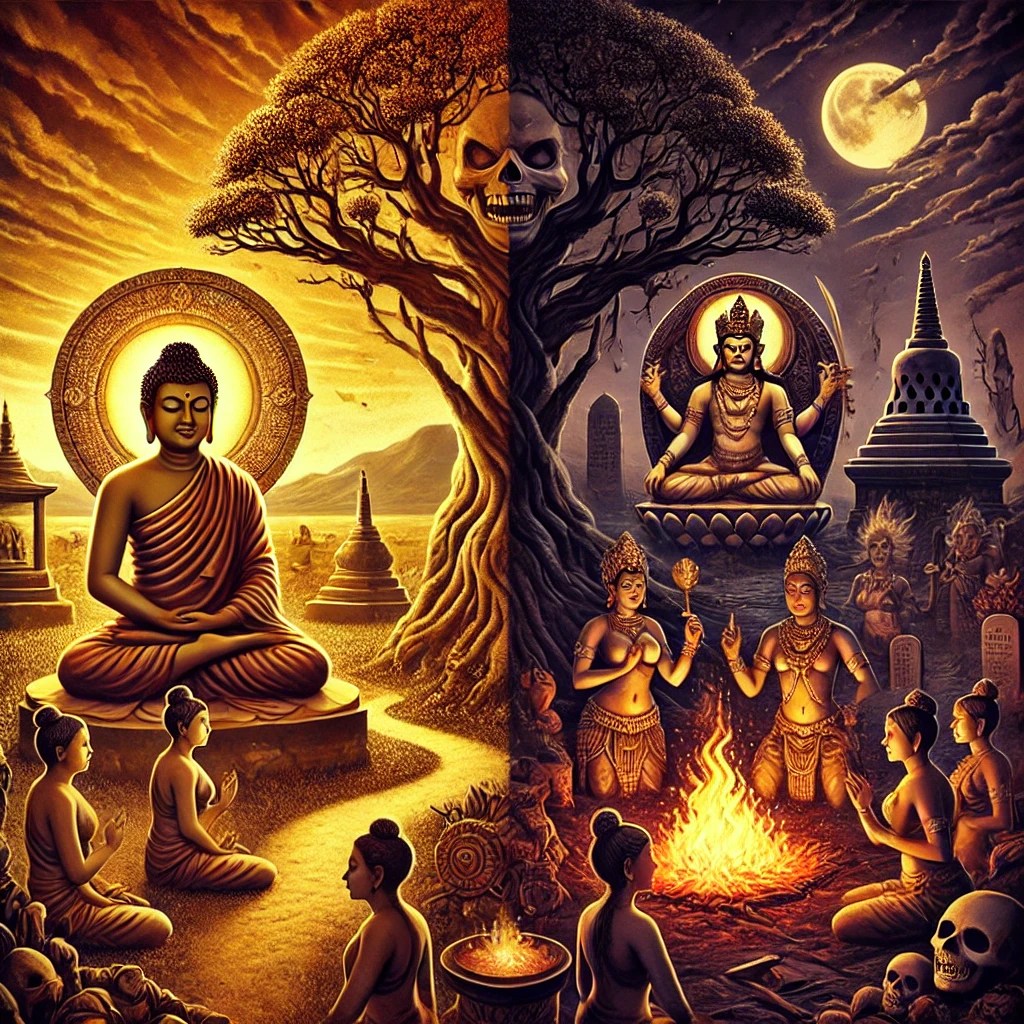
The Buddhist Tantras present themselves as the so-called ‘fast track’ to enlightenment, yet their historical origins, practices, and content diverge so significantly from the Buddha’s original teachings that one must ask: has something hijacked Buddhism under the guise of esoteric wisdom? Given that the Buddha never endorsed magical practices, sexual rituals, or deity worship, why would these suddenly emerge in the later tantric texts? Did an alien or even malevolent force infiltrate and co-opt Buddhism?
The Evolution of Tantra: A Radical Departure
David B. Gray’s study of the Cakrasamvara Tantra and Francesco Sferra’s analysis of the Hindu-Buddhist tantric relationship both expose an inconvenient truth: Tantric Buddhism did not originate organically from the Buddha’s teachings. Instead, it emerged centuries later, largely influenced by non-Buddhist elements, specifically, Hindu Śaiva traditions and indigenous occult practices.
The Buddha’s original teachings in the Pali Canon and early Mahayana texts emphasized ethical living, meditation, and wisdom as the path to liberation. Nowhere in the sutras do we find instructions for transgressive sexual rites, violence, or summoning spirits, yet these are prominent features in Tantric Buddhism.
Gray’s study of Cakrasamvara Tantra makes it clear that these texts were not composed within monastic Buddhist institutions but rather in liminal, non-traditional spaces. The practitioners of these tantras, the siddhas, were often depicted as wandering ascetics engaging in bizarre and shocking rituals. This movement incorporated elements of Hindu Kapalika practices, which involved cremation ground rituals, consumption of taboo substances, and the worship of wrathful deities. Such imagery is wholly alien to the serene and ethical path laid out by the Buddha.
Magical Powers and Occult Influences
One of the most glaring discrepancies between Tantra and early Buddhism is the obsession with supernatural powers (siddhis). In the Cakrasamvara Tantra, entire chapters are dedicated to spell-casting, invisibility techniques, and the control of spirits. Gray describes a ritual where an adept pulverizes the skin of a corpse’s foot, mixes it with blood, and recites mantras to gain the power of invisibility. This is not the noble Eightfold Path.
Similarly, Sferra highlights the deep infiltration of Hindu esoteric ideas into Buddhist Tantra. The very concept of mantra as a mechanism for altering reality aligns more closely with Vedic sacrificial traditions than with the Buddha’s core doctrine of impermanence and dependent origination. If enlightenment is beyond form, why is so much emphasis placed on elaborate rituals, deity worship, and secret initiations?
The “Demonic” Question: An Ancient Deception?
Given the radical departure from Buddhist teachings, one must ask: what is really behind the Tantras? If Tantra promises enlightenment but is steeped in dark rituals and transgressive practices, could it be a deception? The Bible describes Satan as a deceiver who masquerades as an angel of light (2 Corinthians 11:14). Could Tantra be a system where malevolent entities disguise themselves as enlightened deities?
Tantric deities such as Heruka and Vajravārāhī are described as trampling on Hindu gods, signifying the subjugation of earlier traditions. However, they themselves bear striking similarities to wrathful Hindu deities like Bhairava and Kali. Gray notes that these deities were often worshipped in charnel grounds, places of death and decay: locations that, across cultures, have been associated with spirits and demonic activity.
Furthermore, the Yoginītantras introduce figures such as dakinis, who were once seen as flesh-eating spirits but were later reinterpreted as enlightened beings. Why would the Buddha, who taught the renunciation of desire, suddenly endorse interactions with terrifying, sexualized female spirits? Could it be that these entities were never enlightened at all, but rather opportunistic spirits hijacking Buddhism for their own ends?
Why Would the Buddha Suddenly Promote Magic?
Sferra’s work highlights that even within Buddhist circles, there was resistance to the Tantras. The Yoginītantras, which emphasize sexuality and violent rituals, were seen as particularly controversial. The historical Buddha spent his life teaching śīla (morality), samadhi (concentration), and prajñā (wisdom). The introduction of abhiseka (initiation rites), visualization of deities, and sexual yoga represents an alien system grafted onto Buddhism rather than an authentic development of his teachings.
Even within later Buddhist traditions, there were attempts to downplay the more disturbing aspects of Tantra. Gray notes that later Tibetan commentators, such as Tsongkhapa, reinterpreted or omitted elements that were too transgressive. If Tantra were truly the highest Buddhist path, why would it require such extensive revision?
Conclusion: A Counterfeit Path?
Tantric Buddhism presents itself as a shortcut to enlightenment, but historical scrutiny reveals it to be a hybrid system, borrowing heavily from non-Buddhist traditions while contradicting the very essence of the Buddha’s teachings. The emphasis on occult powers, erotic mysticism, and deity worship starkly contrasts with the original Buddhist path.
If the Buddha himself never taught Tantra, why should we accept it as a legitimate form of Buddhism? More disturbingly, given its fixation on spirit invocation, possession, and ritual magic, is it possible that Tantra is not just an aberration but an infiltration? Is it a deception designed to mislead practitioners?
The questions remain open, but one thing is clear: Tantra is not Buddhism as the Buddha taught it. Those seeking truth must discern whether they are walking the Buddha’s path or following an elaborate illusion that masquerades as enlightenment.
REFERENCES:
- Gray, David B. The Cakrasamvara Tantra: Its History, Interpretation, and Practice in India and Tibet. Religion Compass 1, no. 6 (2007): 695–710. https://doi.org/10.1111/j.1749-8171.2007.00046.x.
- Sferra, Francesco. “Some Considerations on the Relationship Between Hindu and Buddhist Tantras.” Journal of the International Association of Buddhist Studies 27, no. 1 (2004): 263–307.
 Tantric Deception