

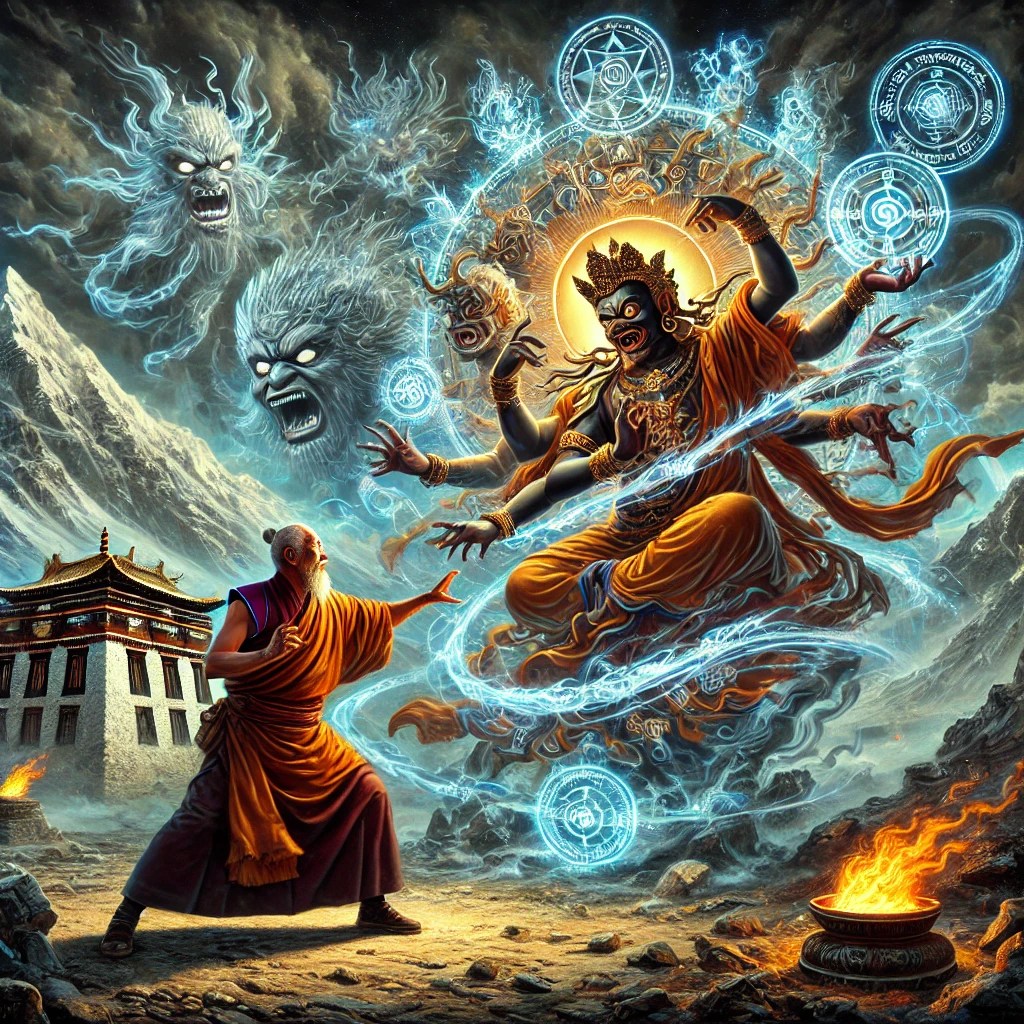
Throughout Tibetan history, occult warfare has been an enduring element of religious and political life. The case of Jamgon Kongtrul the Great, one of Tibet’s most revered scholars and visionaries, illustrates this reality. The texts documenting Kongtrul’s life recount a dramatic confrontation with an adversary named Kuntrul, who sought to harm him through violent and magical means. Kongtrul, deeply engaged in esoteric practices, responded with his own ritual countermeasures, emerging victorious in a struggle that was as much metaphysical as it was physical. Notably, some accounts suggest that Kongtrul’s rituals were not merely protective but also offensive, raising questions about whether his actions aligned with the pacifist image of Tibetan Buddhism.
Given the ubiquity of such accounts in Tibetan history, it is striking that contemporary adherents of Tibetan Buddhism often dismiss similar experiences when they occur today, particularly when they involve those who challenge the power structures of the tradition.
The Occult Battles of Jamgon Kongtrul
Jamgon Kongtrul’s conflict with Kuntrul was a high-stakes struggle marked by sorcery and supernatural intervention. Historical sources describe how Kuntrul employed a mix of mundane and esoteric strategies, including bribing local leaders to attack Kongtrul’s camp. Faced with this threat, Kongtrul and his party resorted to protective rituals, invoking powerful deities such as Tārā and performing rites designed to repel harmful influences. Despite being outnumbered and targeted, Kongtrul survived unscathed, a testament, in the view of his followers, to the efficacy of his spiritual defenses.
His ritual responses played a role in neutralizing Kuntrul as a threat. “As Gardener surmises, it does not just appear that Kongtrul protected his companions and himself with various rituals and so on, but that they positively ‘vanquished their enemies’ like the victor in a ‘deadly black magic contest.’” [1] What is evident is that Tibetan Buddhist magic was not just about shielding oneself from harm but also about eliminating threats in a direct and forceful manner. This calls into question the modern perception of Tibetan Buddhism as purely compassionate and pacifist, when in reality, its historical figures wielded spiritual power as a weapon.
Kongtrul’s deep knowledge of tantric practices, including wrathful deity invocations, can be better understood through his own writings in The Treasury of Knowledge. In this monumental work, Kongtrul systematically outlines the structure of Buddhist tantra, including the use of rituals for both protection and destruction. [2] His mastery of these teachings suggests that his confrontation with Kuntrul was not an isolated event but part of a broader understanding of how spiritual power could be wielded in Tibetan Buddhism.
The 5th Dalai Lama and Ritual Warfare
One of the most well-documented cases of tantric warfare in Tibetan history is the political ascent of the 5th Dalai Lama (1617–1682). The Great Fifth, as he is known, engaged in elaborate tantric rituals to subdue his enemies, particularly those who opposed the Gelugpa school’s dominance. His autobiography describes how he invoked wrathful deities to ensure the downfall of his opponents, including the destruction of the Jonang and the suppression of rival sects. The Dalai Lama’s spiritual and political strategies were deeply interwoven, demonstrating how ritual power was a critical tool in Tibetan statecraft. [3]
The Silence Around Modern Black Magic Warfare
Given the historical reality of occult battles in Tibetan Buddhism, why is it so difficult for contemporary practitioners, especially those invested in maintaining the tradition’s public image, to acknowledge that similar tactics might still be used today?
This question is especially pertinent to my own experiences after participating in the public exposure of my first teacher as a sexual predator. Tibetan Buddhism has a long history of protecting its elite figures through both institutional suppression and supernatural means. If even luminaries such as Kongtrul were subjected to ritual attacks and responded with powerful countermeasures, why should it be inconceivable that similar tactics would be employed against those who disrupt the modern power structures of Tibetan Buddhism?
The cognitive dissonance here is profound. Those who deeply believe in the efficacy of Tibetan magic when it serves the tradition’s interests refuse to acknowledge its potential use against those who challenge the status quo. This selective skepticism allows abuse and corruption to persist while shielding the tradition from scrutiny.
Conclusion
Tibetan Buddhism has never been a purely pacifist tradition; it has always wielded spiritual power in service of political and institutional control. The case of Jamgon Kongtrul the Great, as well as the 5th Dalai Lama’s strategic use of tantric rituals, reveals that black magic battles were historically a real and recognized aspect of Tibetan life.
To dismiss similar experiences today, particularly when they involve whistleblowers or those who expose misconduct, is not only inconsistent but a deliberate act of denial.
If the Tibetan Buddhist establishment was willing to deploy supernatural means to protect its authority in the past, why would it not do so in the present?
Sources:
- Dakini Translations. Murder Plots, Omens, Black Magic, and Kalacakra: Tantric Hero Jamgon Kongtrul’s Dangerous First Trip to Jonang Monastery. September 20, 2019. https://dakinitranslations.com/2019/09/20/murder-plots-omens-black-magic-and-kalacakra-tantric-hero-jamgon-kongtruls-dangerous-first-trip-to-jonang-monastery/.
- Kongtrul, Jamgon. The Treasury of Knowledge: Book Six, Part Four: Systems of Buddhist Tantra. Translated by Elio Guarisco and Ingrid McLeod. Ithaca, NY: Snow Lion Publications, 2008.
- Ngawang Lobsang Gyatso, Fifth Dalai Lama. The Autobiography of the Fifth Dalai Lama. Translated by Zahiruddin Ahmad. Bloomington: Indiana University Press, 1998.
- Smith, Gene. Among Tibetan Texts: History and Literature of the Himalayan Plateau. Boston: Wisdom Publications, 2001.
- Gardner, Alexander. The Life of Jamgon Kongtrul the Great. Boston: Shambhala Publications, 2019.
 Tantric Deception