

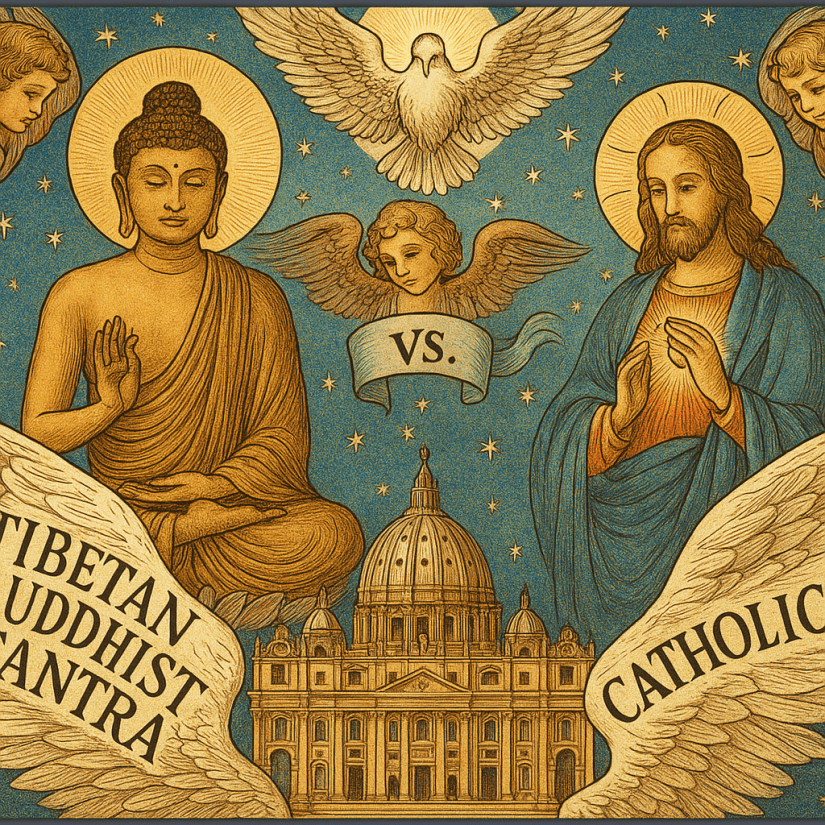
As a young person, I was assured by a respected Tibetan Buddhist rinpoche that one could be both Christian and Buddhist. [1] He acknowledged that many had faith in Jesus Christ and claimed there was no contradiction between the two traditions. Yet, this assertion directly contradicts biblical Christianity. Whether well-intentioned or deceptive, he was wrong.
Tibetan Buddhism is often presented in the West as a tradition of wisdom and compassion, sometimes compared to Christianity. However, its fundamental tenets conflict with Christian doctrine, not only in rejecting a Creator God but also in its deep commitment to tantric practices that diverge from biblical teachings. Tibetan Buddhism’s fusion of Indian Buddhist philosophy, tantric practices, and Tibetan shamanism has resulted in a system where esoteric tantric laws supersede even the historical Buddha’s teachings, let alone Christian principles.
Tantric Roots: Beyond the Buddha’s Teachings
It is important to note that Tibetan Buddhism is not solely derived from the historical Buddha’s teachings but incorporates various esoteric influences, including elements from broader South Asian tantric traditions. Scholar Jacob Dalton notes that early Buddhist tantra developed ritualized practices such as mantra recitation and yogic breath-control techniques. Over centuries, Tibetan Buddhist tantra evolved beyond the Buddha’s original teachings, shaped by ongoing ritual innovations and textual developments rather than direct continuity with the Buddha’s doctrine (Dalton, “On the Early Development of Sexual Union in Buddhist Tantric Practice”) [2]
The Buddha’s original teachings emphasized ethics, meditation, and wisdom, not esoteric rituals, deity invocations, or secret empowerments, which later became central to Tibetan Buddhist practice. The introduction of tantric elements centuries after his death fundamentally altered Buddhism, aligning it more closely with Hindu tantra than with its original foundations.
The Fusion of Buddhism, Tantra, and Tibetan Shamanism
Tibetan Buddhism is not a pure continuation of the Buddha’s teachings but a blend of:
- Mahayana Buddhism: Contributed philosophical concepts like emptiness (shunyata) and the bodhisattva ideal.
- Kashmir Shaivism & Indian Tantra: Introduced deity yoga, secret initiations, and esoteric sexual rituals.
- Tibetan Bon Shamanism: Integrated animistic practices, spirit invocations, and sorcery.
This synthesis was fraught with contradictions. The Buddha’s ethical teachings often clashed with tantra’s disregard for conventional morality, which, according to tantric texts, must be transcended for enlightenment. Tantric laws ultimately took precedence over traditional Buddhist ethics, justifying actions that the Buddha explicitly condemned, such as ritual intoxication, sexual practices, and deceptive methods of control.
Dalton’s book, The Taming of the Demons: Violence and Liberation in Tibetan Buddhism, highlights how tantric law overshadowed Buddhist nonviolence, allowing for ritual violence against perceived enemies of the dharma (Dalton, The Taming of the Demons). [3] This unresolved tension continues in Tibetan Buddhist circles, where lamas justify behaviors the Buddha would have rejected.
Idol Worship and the Biblical Condemnation of Tibetan Buddhism
Christianity explicitly condemns the core practices of Tibetan Buddhism, particularly idol worship, sorcery, and reliance on spiritual intermediaries outside of God. Scripture warns against such practices:
- Isaiah 42:8 “I am the Lord; that is my name! I will not yield my glory to another or my praise to idols.”
- Galatians 1:8 “Even if we or an angel from heaven should preach a gospel other than the one we preached to you, let them be under God’s curse!”
- Deuteronomy 18:10-12 “There shall not be found among you anyone who… practices divination, tells fortunes, or interprets omens… For whoever does these things is an abomination to the Lord.”
- 1 Corinthians 10:20-21 “The sacrifices of pagans are offered to demons, not to God, and I do not want you to be participants with demons.”
Tibetan Buddhism actively promotes deity worship, ritual magic, and tantric initiations that invoke spiritual forces, aligning it with practices the Bible condemns as deceptive and demonic.
Two Paths That Cannot Be Reconciled
Despite modern claims of compatibility, Christianity and Tibetan Buddhism are fundamentally irreconcilable. Tibetan Buddhism is rooted in tantric laws that contradict the teachings of both the Buddha and Christ. It is not merely a philosophy but an esoteric system steeped in idol worship, occult rituals, and doctrines opposed to biblical truth.
- An honorific title used to refer to highly respected teachers.
- Jacob Dalton, On the Early Development of Sexual Union in Buddhist Tantric Practice, Journal of the International Association of Buddhist Studies, vol. 32, no. 1–2, 2009.
- Jacob Dalton, The Taming of the Demons: Violence and Liberation in Tibetan Buddhism (New Haven: Yale University Press, 2011).
 Tantric Deception